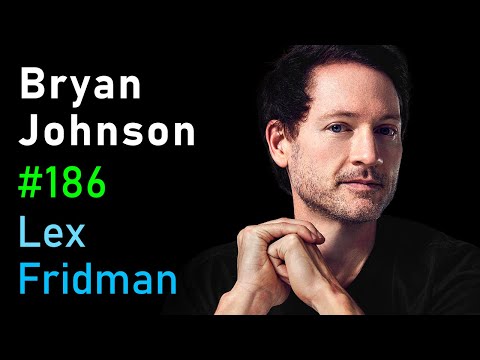
Bryan Johnson: Kernel Brain-Computer Interfaces | Lex Fridman Podcast #186
What this covers
Bryan Johnson is the founder and CEO of Kernel, OS Fund, and previously Braintree. Please support this podcast by checking out our sponsors: - Four Sigmatic: https://foursigmatic.com/lex and use code LexPod to get up to 60% off - NetSuite: http://netsuite.com/lex to get free product tour - Grammarly: https://grammarly.com/lex to get 20% off premium - ExpressVPN: https://expressvpn.com/lexpod and use code LexPod to get 3 months free
EPISODE LINKS: Bryan's Twitter: https://twitter.com/bryan_johnson Bryan's Website: https://www.bryanjohnson.co/ Kernel's Twitter: https://twitter.com/KernelCo Kernel's Website: https://www.kernel.com/
PODCAST INFO: Podcast website: https://lexfridman.com/podcast Apple Podcasts: https://apple.co/2lwqZIr Spotify: https://spoti.fi/2nEwCF8 RSS: https://lexfridman.com/feed/podcast/ Full episodes playlist: https://www.youtube.com/playlist?list=PLrAXtmErZgOdP_8GztsuKi9nrraNbKKp4 Clips playlist: https://www.youtube.com/playlist?list=PLrAXtmErZgOeciFP3CBCIEElOJeitOr41
OUTLINE: 0:00 - Introduction 1:13 - Kernel Flow demo 10:25 - The future of brain-computer interfaces 43:54 - Existential risk 49:33 - Overcoming depression 1:04:52 - Zeroth principles thinking 1:13:05 - Engineering consciousness 1:19:19 - Privacy 1:23:48 - Neuralink 1:33:27 - Braintree and Venmo 1:49:10 - Eating one meal a day 1:55:22 - Sleep 2:15:04 - Climbing Mount Kilimanjaro 2:22:02 - Advice for young people 2:26:38 - Meaning of life
SOCIAL: - Twitter: https://twitter.com/lexfridman - LinkedIn: https://www.linkedin.com/in/lexfridman - Facebook: https://www.facebook.com/lexfridman - Instagram: https://www.instagram.com/lexfridman - Medium: https://medium.com/@lexfridman - Reddit: https://reddit.com/r/lexfridman - Support on Patreon: https://www.patreon.com/lexfridman
Source description (no synthesized summary yet).
Brian Johnson argues that non-invasive brain measurement devices like Kernel Flow will unlock high-bandwidth brain data at scale, enabling an engineering discipline of cognition that fundamentally restructures how we understand health, consciousness, and human optimization—and that this represents humanity's chance to scaffold an evolution toward forms of consciousness we cannot yet imagine.
- Brain data is the last major unmeasured domain; quantifying it at population scale will enable systematic cognition engineering like we've done for other systems
- Non-invasive technologies can achieve sufficient bandwidth and accessibility to drive mainstream adoption and ecosystem development, similar to how the internet's utility grew with dial-up bandwidth improvements
- The trajectory of intelligence costs going to zero—both through evolution and AI—means the central challenge becomes goal alignment, which brain measurement data enables
This asset isn't compiled yet
You're seeing its claims, ranked. Compile it to build the argument threads, weight them, and check each claim against your library — the full view.
Kernel Flow uses near-infrared spectroscopy with 52 photon modules (each containing one laser and six sensors firing in ~100 picoseconds) to measure blood oxygenation changes in the cortex, with approximately 1,000+ channels sampling brain activity in real-time without requiring laboratory settings or surgical implants.
“there's 52 modules and each module has one laser and six sensors and they're the sensors fire uh in about 100 picoseconds and then the photons scatter and absorb in your brain and then a few go in if you come back out they a bunch go in that a fuel come back out and we sense those photons and then we do the reconstruction for the activity overall there's about a thousand plus channels that are sampling your activity”
Deep thinking requires sensitivity and ability to work with fragile, fleeting ideas that disappear if attention wavers; this sensitivity is destroyed by divided attention (phone, social media, work context-switching), poor sleep, or poor diet, making these foundational optimizations valuable for cognitive work.
“if i concede to a world where i'm on my phone texting i'm also on social media i'm also doing 15 things at the same time... my mind would not be on what matters in 100 years or 200 or 300 years i would be irritable i would be in a different state”
PayPal's dominant profitability in the payments industry was due to having zero payment costs (people funded PayPal accounts with checking accounts rather than credit cards), giving them 3% margins versus typical payment processors earning a nickel, dime, or penny per transaction; PayPal's model was therefore the 'killer app' Johnson sought to replicate with Braintree.
“what i was really going after for though was it was paypal they were the only company in payments making money because they because they had the relationship with ebay early on people created a paypal account they'd fund their account with their checking account versus their credit cards and then when they'd use paypal to pay a merchant paypal had a cost of payment of zero versus if you have coming from a credit card you have to pay the bank the fees so paypal's margins were three percent on a transaction versus a typical payments company which may be a nickel or a penny or a dime or something like that”
Current approach to tech company data collection is a 'wild wild west' where companies acquire as much information on users as possible without approval and sell it without transparency; the correction requires three principles: (1) the individual always has control over their data, (2) transparency about what's collected and how it's used, and (3) clear rules of play that prevent individuals from being taken advantage of without awareness.
“if you're a company you can go out and get as much information on a person as you can find without their approval and you can also do things to induce them to give you as much information and you don't need to tell them what you're doing with it you can do anything on the back side you can make money on it but the game is who can acquire the most information and devise the most clever schemes to do it that was a bad starting place and so we are in this period where we need to wreck we need to correct for that and we need to say first of all the individual always has control over their data”
Many companies attempted to replicate PayPal's two-sided marketplace model (getting consumers to fund accounts and merchants to accept), but all failed because building two-sided marketplaces is very difficult, requiring simultaneous adoption from both sides.
“a bunch of companies had tried to do that they tried to come in and build a two-sided marketplace so get consumers to fund the checking account and merchants to accept it but they'd all failed because building a two-sided marketplace is very hard at the same time”
Social proof through identifying satisfied customers accelerated Brian's sales success, creating a virtuous cycle where satisfied customers' willingness to share their experience became the primary sales mechanism.
“and so i built a social proof structure and i became the number one salesperson out of 400 people nationwide doing this and i worked you know half time still doing another startup”
Wearing a wearable device measuring heart rate variability, respiration rate, metabolic approximations, and sleep patterns provided the first-time access to information about how eating close to bedtime affects deep sleep and all the downstream consequences of poor sleep, opening a window of self-understanding that self-introspection alone cannot provide.
“when i started wearing a wearable in my wrist that would give me data about my heart rate heart rate variability respiration rate metabolic approximations etc for the first time in my life i had access to information uh sleep patterns that were highly impactful they they told me for example if i eat close to bedtime i'm not going to get deep sleep and not getting deep sleep means you have all these follow-on consequences in life”
Most technologies enabling mainstream adoption languish in academia for long periods before reaching market, and the difficulty of bringing transformative brain technologies to market is why most brain interface efforts remain academic rather than commercial, which Kernel hopes to overcome in coming years.
“this is the difficulty of bringing bringing you know technology like this to market it's why most of the time it just ling it languishes in academia academia for quite some time but we hope that we will over you know cross over and make this mainstream in the coming years”
Johnson rejected human intuition in favor of machine learning approaches for discovering brain data insights, exemplified by a neuroscientist who explicitly did not want human theory-of-mind frameworks and instead requested raw data streams to train ML models, reflecting a broader trend of devaluing human intuition in scientific discovery.
“i was speaking just one young associate professor and i approached a conversation and said hey we have these five data streams that we're pulling off when you hear that what weighted value do you add to each data source like which one do you think is going to be valuable for your objectives and which one's not and he said i don't care just give me the data all i care about is my machine learning model but importantly he did not have a theory of mind he did not come to the table and say i think the brain operates you know in this way and these regions that have these these functions he didn't care he just wanted the data and we're seeing that more and more that certain people are devaluing human intuitions for good reasons as we've seen in machine learning over over the past couple years”
Nutrition science is highly flawed because humans are too variable and the mind has too much impact on physical outcomes to conduct strong studies, making individual self-experimentation and observation of personal effects more reliable than published nutritional science for determining what works for any specific person.
“nutrition science is a very difficult uh field of study because humans are so different and the mind has so much impact on the way your body behaves and it's so difficult from a scientific perspective to conduct really strong studies that you have to be almost like a scientist of an of one you have to do these studies on yourself that's the best way to understand what works for you or not”
Johnson believes consciousness is not a fundamental property that humans 'possess' but rather something that is created through social interaction and communication; he rejects what philosophers call 'the hard problem of consciousness' and instead suggests consciousness is constructed through communication, similar to how emotion and language are constructed through their use.
“consciousness is created socially that like much of the power of consciousness is in the social interaction i create your consciousness no i create my consciousness by having interaction with you and that that's the display of consciousness it's the same as like the display of emotion emotion is created through communication language is created through its use and then we somehow humans kind of especially philosophers you know the heart problem of consciousness really want to believe that we possess this thing that's like there's a there's a bot there's a there's an elf sitting there with the with the hat that's or like name tag says consciousness”
Braintree's strategy was to first become the preferred payment processor for the fastest-growing tech companies (Uber, Airbnb, Github, Basecamp), then in year 5 acquire a consumer payments company (Venmo) to bring together merchant and consumer sides, replicating PayPal's model.
“my plan was i'm going to build a company and get the best merchants in the whole world to use our service then in year five i'm going to have i'm going to acquire a consumer payments company and i'm going to bring the two together wow and so focus on the merchant side exactly and then get the payments company does the the customer the whatever the the other side yeah this is the planet presented uh when i was at the university of chicago and weirdly it happened exactly like that so for four years in our customer base included uber airbnb github 37 signals now base camp we had a fantastic collection of companies”
Brain measurement and quantification should be formalized as an engineering discipline—called the 'formal engineering of cognition'—that integrates with broader societal scaffolding (news consumption, relationships, politics, economics, education), analogous to how engineering standards already enable appliance interoperability and manufacturing.
“we don't have engineering standards around cognition it's not a for it has not entered as a formal engineering discipline that enables us to scaffold in society with everything else we're doing including consuming news our relationships politics economics education all the above and so to me that the most significant contribution that kernel technology has to offer would be the formal sca the introduction of the formal engineering of cognition as it relates to everything else in society”
Johnson's core investment thesis is that the design, manufacturing, and distribution cost of artificial intelligence is heading toward zero; simultaneously, evolution produced human intelligence and humans are now designing artificial intelligence systems; therefore, the central problem of existence becomes 'goal alignment'—negotiation between conscious and unconscious existence across all entities (human, AI, biological systems).
“one is the design manufacturing and distribution of intelligence is heading towards zero con a cost curve over over a certain design over a certain time frame but our ability to you know evolution produced us an intelligent form of intelligence we are now designing our own intelligence systems and the design manufacturing distribution of that intelligence over a certain uh time frame is going to go to a cost of zero...and then now in parallel to that then you say okay what what then happens if when that cost curve is heading to zero our existence becomes a goal alignment problem”
Zeroth principle thinking is the practice of identifying foundational ideas that are so revolutionary that they become building blocks for entire civilizations (like the discovery of zero in mathematics), and should be a staple of human cognitive infrastructure because computational intelligence will increasingly generate zeroth-level insights requiring humans to expand beyond first-principles frameworks.
“zeroth principles are building blocks first principles are understanding of system laws... zero is of course the representation of zeroth principle thinking which is it's the caliber and consequential nature of an idea”
The human race has quantified nearly everything in the known universe—from distant stars to calories and steps to the human genome—except for the human mind, which remains largely unquantified at population scale, representing the single largest raw input material into society that is unmeasured.
“most we've done a pretty good job like we the human race has done a pretty good job figuring out how to quantify the things around us from distance stars to calories and steps and our genome so we can measure and quantify pretty much everything in the known universe except for our minds and we can do these one-offs if we're going to get an fmri scan or do something with the low-res eeg system but we haven't done this at population scale”
Brain interface adoption and value creation will follow a discovery model analogous to early internet development (Drake Equation model): populate an ecosystem with devices, encourage experiments from experts and non-experts, harvest mistakes and serendipitous discoveries, and the algorithms and applications will emerge from human exploration rather than pre-specified use cases.
“the analogy is like brain interfaces are like early 90s of the internet is you you want to populate an ecosystem with a certain number of devices you want a certain number of people who play around with them who do experiments of certain data collection parameters you want to encourage certain mistakes from experts to non-experts these are all critical elements that ignite discovery and so we believe we've accomplished the first objective building technology that reaches those thresholds and now it's the drake equation component of how do we try to generate 20 years of value discovery in a two or three year time period”
Johnson designed and marketed Braintree's payment processing software to be 'beautiful' and 'magical' specifically to appeal to software engineers, contrasting with stagnant competitors (PayPal under eBay, Authorize.net); his entry strategy was to win the best merchants first rather than attempting to build a two-sided consumer marketplace (which had consistently failed for others).
“with braintree i thought the entry point is to build software that engineers will love and if we can find the entry point via software make it easy and beautiful and just a magical experience and then provide customer service on top of that...my plan was i'm going to build a company and get the best merchants in the whole world to use our service then in year five i'm going to have i'm going to acquire a consumer payments company”
Brain interfaces could engineer richer consciousness by increasing the bandwidth of human-to-human communication: currently, text and email reduce information transfer compared to face-to-face communication; brain interfaces could add dimensions of data (e.g., 50-dimensional vector space representing the exact quality of one person's emotional state) that increase mutual understanding and empathy between individuals.
“you and i text back and forth and we're sending each other emojis that has a certain amount of information transfer rate as we're communicating with each other and so in our communication with people via email and text and whatnot we've taken the bandwidth of human interaction the information transfer rate and we've reduced it we have less social cues we have less information to work with there's a lot more opportunity for misunderstanding so that is altering the conscious experience between two individuals and if we add brain interfaces to the equation let's imagine now we amplify the dimensionality of our communications”
Understanding the low and high points of neurochemistry helps understand broader societal phenomena: individual brain states aggregate into collective psychology that likely distorts reality, compounds problems, and obscures opportunities society could pursue.
“you wonder when you look at society what how does that contribute to all the other compounded problems that we're experiencing how does that blind us to the the opportunities we could be looking at and so it really it has this potential distortion effect on reality that just makes everything worse”
Johnson does not worry significantly about AGI or paperclip-maximizer-style risks because: (1) humans naturally have a fear response to novel foreign things (amygdala firing), but (2) this is the first generation of intelligent beings who can look over their lifetime and see the possibility of 'entirely novel forms of consciousness' that are 'totally unrecognizable to us today,' which should be the 'defining aspiration of all intelligent life on earth' rather than a source of fear.
“it's unsurprising that a new thing comes into the sphere of human consciousness humans identify the foreign object in this case artificial intelligence our amygdala fires up and says scary foreign we should be apprehensive about this and so it makes sense from a biological perspective that humans for the the knee-jerk reaction is fear what i don't think has been properly weighted with that is that we are the first generation of intelligent beings on this earth that has been able to look out over their expected lifetime and see there is a real possibility of evolving into entirely novel forms of consciousness yeah so different that it would be totally unrecognizable to us today”
The collective intelligence enabled by the internet has fundamentally changed humanity: individuals are no longer isolated intelligences but part of a collective intelligence where ideas travel virally across populations; thoughts are now 'had by many people...thousands or millions of people' simultaneously, and this shift has changed everything in ways that would have been impossible to predict before the internet existed.
“predicting collective intelligence which i don't think we're understanding that we're living through that now is that there's now we've we've in some sense stopped being individual intelligences and become much more like collective intelligences because ideas travel much much faster now and they can in a viral way like sweep across the populations and so it's almost i mean it almost feels like a thought is had by many people now thousands or millions of people as opposed to an individual person and that's changed everything”
Consciousness might be dissolved through brain-digital integration, people might exist in virtual worlds rather than physical ones, and these transformations might involve ego death and dissolution of individual consciousness, yet simultaneously could be richly fulfilling in ways entirely unlike current human experience.
“it might involve dissolution of ego and consciousness and so on you're no longer one individual it might be more you know that might be a certain kind of death and ego death but the experience might be really exciting and enriching maybe we'll live in a virtual like it's like it's it's funny to think about a bunch of sort of hypothetical questions of would it be more fulfilling to live in a virtual world”
Johnson became the #1 salesman out of 400 nationwide for credit card processing sales by using a counter-intuitive strategy: offering potential customers $100 to listen, then explaining the entire credit card industry (including how companies deceive customers), positioning himself as 'no different than anyone else,' and building social proof by referencing previous adopters—after 9 months of half-time work, his customer base was generating ~$62,504 monthly in revenues.
“i'd walk into a business and say look i would give you 100 i'd pull out a hundred dollar bill and say i'll give you a hundred dollars for three minutes of your time if you don't say yes to what i'm saying i'll give you a hundred dollars and then you usually crack a smile and say okay what do you got for me son and so i'd sit down i just open my book and i'd say here's the credit card industry here's how it works here are the players here's what they do here's how they deceive you here's what i am...i became the number one salesperson out of 400 people nationwide doing this and i worked you know half time...my customer base was making was generating around i think a sick if i remember correctly sixty two thousand five hundred four dollars a month”
The meaning of life for Johnson is twofold: (1) building a future state of existence that is 'more fantastic than anything we could ever imagine' that 'defies expectations,' and (2) playing infinite games—continuing to play the game itself rather than trying to 'win' a finite game; this frames existence as an ongoing negotiation of goal alignment rather than a destination to reach.
“the meaning of life is that we can build a future state of existence that is more fantastic than anything we could ever imagine the striving for something more amazing and that defies expectations...there's a moment here where we can contemplate playing infinite games therefore it may make sense to err on the side of making sure one is in a situation to be plain infinite games if that opportunity arises”
Future of human conscious existence 20-50 years ahead cannot be predicted using first-principles thinking alone because we cannot anchor our imagination in what doesn't yet exist; therefore, the future is likely to include one or more zeroth-principle transformations that first-principles analysis is incompetent to foresee.
“we cannot predict the future with first principles thinking we can't that cannot be our imagination set it can't be uh our sole anchor in this situation that basically the future of our conscious existence 20 30 40 50 years is probably a zero”
Lex experiences sadness about the fact that he will die one day and his brain data will go offline, representing the termination of a unique perspective and experience that cannot be preserved.
“for you individually though does it make you sad that your brain ends that you die one day very soon that the whole thing that that uh that data source just goes offline sooner than you would like”
Psychedelic research and brain data could be coupled to enable quantification of baseline brain state, during-experience state, and post-experience state longitudinally, allowing determination of optimal molecule, dosage, frequency, contextual environment, and diet—transforming psychedelic therapy from art to systematic science with improved outcomes and safety.
“to have again to be able to measure the brain and get a baseline state and then to measure during a psychedelic experience and post a psychedelic experience then do it longitudinally you now have a quantification of what's going on and so you could then pose questions what molecule is appropriate at what dosages at what frequency in what contextual environment”
Johnson initially planned to make enough money by age 30 to 'never have to work again' and dedicate the rest of his life to helping others, motivated by his experience of extreme poverty during a 2-year stay in Ecuador that made him realize the vast resource disparity of the United States.
“i discovered payments by accident as i was when i was 21 i i just returned from ecuador living the money extreme poverty for two years and i came back to the u.s and i was shocked by the opulence and yeah of the united states and i just thought this is i couldn't believe it and i decided i wanted to try to spend my life helping others that was a life objective that i thought was worthwhile to pursue versus making money and whatever the case may be for its own right and so i decided in that moment that i was going to try to make enough money by the age of 30 to never have to work again and then with some abundance of money i could then choose to do things that might be beneficial to others”
When severely depressed, Johnson approached treatment by systematically trying 'literally everything' but nothing would fix his depression; he now sees brain interfaces as potentially offering quantified data on brain states that could enable doctors to move beyond crude self-report scales (e.g., 'on a scale of 10, how bad is your suicidality?') and toward precise, measurable interventions.
“when i was trying to solve my depression i tried literally ev you name it i tried it systematically and nothing would fix it and so this is what gives me hope with brain interfaces for example like could i have numbers on my brain can i see what's going on because i go to the doctor and it's like how do you feel i don't know terrible like on a scale of 10 how bad you want to commit suicide 10. okay at this moment here's here's his bottle how much i take well i don't know like just yeah it's very very crude”
Kernel was initially built with invasive brain interface technology; approximately one year after a meeting with Elon Musk (in which they discussed both pursuing brain interfaces), Johnson was presented with a neuroscientist who suggested that 'every 15 years or so a new technology comes along that changes everything...it's probably already here, you just can't see it yet'; this prompted Johnson to pivot Kernel's entire technology from invasive to non-invasive.
“i was building invasive technology at the time that's ultimately where he's gone a little less than a year after elon and i were engaged i shifted kernel to do non-invasive and we had this neuroscientist come to colonel we were talking about he had been doing neurosurgery for 30 years one of the most respected neuroscientists in the us and we brought him to colonel to figure out the ins and outs of his profession and at the very end of our three hour conversation he said you know every 15 or so years a new technology comes along that changes everything he said it's probably already here you just can't see it yet and my jaw dropped”
Kernel's approach to brain data privacy is based on individual consent, control, and transparent permissioning; users should be able to grant access to specific data streams for limited durations and revoke access, similar to app permissions on smartphones (e.g., 'you can have access to this vector space model but only for this duration of time and then you've got to delete it').
“individual consent it's individual control and then you can build up on top of that but it has to be based upon some clear rules of play if everyone knows what's being collected they know what's being done with it and the person has control over it so transparency and control...you can say you can have access to this vector space model but only for this duration of time and uh and then you've got to delete it”
Johnson advises people to seek advice from others but use it as a 'mirror' to understand the assumptions and knowledge stack of the advisor rather than to blindly follow their recommendations; true value comes from understanding the full journey and reasoning that led the advisor to their conclusions, not from the conclusions themselves.
“i would say listen to advice and see it for what it is a mirror of that person and then map and know that your future is going to be in a zeroth principle land and so what you're hearing today is a representation of what may have been the right principles to build upon previously but they're likely depreciating very fast...the value is not doing that the value is understanding the assumption stack they built the assumption and knowledge stack they built around that that body of knowledge”
Zero: A Biography of a Dangerous Idea is Johnson's favorite book; the book explores how the number zero (as a concept) had to be discovered and caused a revolution in philosophy and mathematics, building modern society but 'wrecking everything in its way'; this inspired Johnson's concept of 'zeroth principle thinking' as distinct from 'first principles thinking'—representing ideas that are civilization-transforming rather than merely systematic.
“i read the book zero a biography of a dangerous idea and i i have a really good book by the way it's i think it's my favorite book i've ever read...zero...i i wasn't aware that the number zero had to be discovered i didn't realize that it caused a revolution in philosophy and it just tore up math and it tore up i mean it builds modern society but it it wrecked everything in its way it was an unbelievable disrupter”
Johnson believes Kernel's competitors and collaborators (like Neuralink) are fellow travelers in pursuing the brain interface opportunity, not enemies; the space is large enough that multiple companies pursuing different technological approaches increases the chance that at least one succeeds, which is beneficial for the entire field.
“it's a fellow traveler it's like at the beginning of the internet is how many companies are going to be invited to this new ecosystem like an endless number because if you think that the hardware just starts the process”
Consciousness engineering is entering a stage of becoming methodical and quantitative through brain interfaces, which creates better guardrails for ethical systems compared to current 'wild wild west' of how interactions happen without measurement or understanding.
“we're entering into it in a stage where it will be much more methodical and quantitative based and computational in how we go about doing it which to me i find encouraging because i think it creates better guardrails for to create uh ethical systems on versus right now i feel like it's really wild wild west on how these interactions are happening”
After Braintree exit, Brian surveyed everything in existence to identify the single thing that could have the highest value potential for humanity, ultimately arriving at brain interfaces after extensive research and deliberation.
“and so that what paypal offered was sufficient for me to get that amount of money to basically have a go and that's when i set off to survey everything i could identify in existence to say of anything in the entire world i could do what one thing could i do that would actually have the highest value potential for the species and so it took me a little while to arrive at brain interfaces”
The early door-to-door credit card sales work Brian did taught him the credit card industry was built on deceit and customer distrust, and he succeeded by being radically honest about how the industry worked and treating customers as intelligent adults.
“i figured out that the industry really was built on people on deceit basically people promising things that that were not reality and so i'd walk into a business and say look i would give you 100 i'd pull out a hundred dollar bill and say i'll give you a hundred dollars for three minutes of your time if you don't say yes to what i'm saying i'll give you a hundred dollars and then you usually crack a smile and say okay what do you got for me son and so i'd sit down i just open my book and i'd say here's the credit card industry here's how it works here are the players here's what they do here's how they deceive you here's what i am i'm no different than anyone else”
Johnson climbed Mount Kilimanjaro during the darkest period of his life (ending a 13-year marriage, leaving his religion, selling Braintree, battling depression); he became severely ill on day 3 (stomach flu + altitude sickness at 15,000 feet) but chose to attempt the summit; during the midnight summit push, he listened to Eminem, felt 'so ferocious' physical pain that it became 'everything he was struggling with,' and his guide said 'you've got it in you...look up, take a step, take a breath'; he reached the summit with blood oxygen at ~50% (danger zone) and later had to be carried down on a stretcher; he describes this as a transformational demarcation point where he 'locked in with reality' and decided to rebuild his life.
“we were summiting on day five i came into the camp base camp at fifteen thousand feet uh just you know going to the bathroom on myself and like falling all over it was just i was just a disaster...i had three young children and so i was trying to reconcile like this is not a whether whether i live or not is not my decision by itself...i had to decide whether i was going to summit the next day...midnight came and our guide came in and he said where you at and i said i think i'm okay...from midnight to i made it to the summit at 5 a.m it was one of the most transformational moments of my existence...and it was uh...he said look brian i i know where you're at...i can tell you you've got it in you...look up take a step take a breath...we pulled out the the pulse oximeter and measured my blood oxygen levels and it's like it was like 50 something percent”
Brian aspires to have empathy and deep listening skills to be that person for others who need meaningful guidance, rather than a retailer of advice tricks, creating truly impactful one-on-one connections.
“the wisdom i would aspire to is to have the awareness and the empathy to be that for other people and not a a retail advertiser of advice of tricks and for life but deeply meaningful and empathetic with a one-on-one context with people that it really could make a difference”
Johnson experienced chronic depression for 10 years and was born into a religious system with an afterlife theology that promised punishment or reward; during this period he desperately wanted death but felt trapped by the belief that suicide would result in eternal punishment, creating a state he describes as 'indescribable hopelessness' of both wanting to die and being forced to exist.
“i had chronic depression for 10 years and so in that 10-year time period i desperately wanted lights to be off and the thing that made it even worse is i was in a religious i was born into a religion it was the only reality i ever understood and it's difficult to articulate to people when you're born into that kind of reality and it's the only reality you're exposed to you're literally blinded to the existence of other realities because it's so much the in-group out group thing and so in that situation it was not only that i desperately wanted lights out forever it was that i couldn't have lights out forever it was there was an afterlife and this afterlife had this system that would either penalize or or reward you for your behaviors and so it's almost like this is indescribable hopelessness of not only being in hopeless despair of not wanting to exist but then also being forced to be to exist”
Brain data could improve design of meditation apps, deep work tools, and other cognitive products by expanding the number of known variables by '10x or 20x or 30x'; product designers who built meditation apps with certain assumptions about what meditation does could reconstruct their products if they had access to high-resolution brain data from actual users.
“and in all of your examples it's interesting that everyone who's designed an experience for you so whether it be the meditation app or the deep work or with all the things you mentioned they constructed this product with a certain number of knowns yeah now what if we expanded the number of knowns by 10x or 20x or 30x they would reconstruct their product cool incorporate those known”
Lex experiences a tension between optimization and chaos: he values both the structured health practices (sleep, diet, exercise) that enable clear thinking and the freedom to act on passion and intuition, including moments of 'sleeping under the desk' or eating things he knows aren't optimal in pursuit of focused work; he is concerned about over-optimization leading to excessive caution and lost moments of lived experience.
“there's a lot of things that you can reasonably say that this is the smart thing to do that can prevent you that becomes conservative that can prevent you from fully embracing life i think ultimately you can be very intelligent and data driven and also embrace life but i er on the side of embracing life”
Most ideas in society have been conservative and risk-averse due to resource constraints, incentives for social status, and desire for accomplishment, minimizing zeroth principle thinking even though historically it appears that zeroth principle insights occur at accelerating rates.
“life constraints favor first principle thinking because it it enables faster action with higher probability of success pursuing zero with principal optionality is expensive and uncertain and so in a society constrained by resources time and money and a desire for social status accomplishment etc it minimizes zero principle thinking”
Johnson funds the majority of Kernel's operation ($53 million) himself in the early stages because investors uniformly ask 'what is the killer app?' and there was 'no known path to even build a technology that could potentially become mainstream'; this lack of venture capital interest validated his bet-the-company pivot to non-invasive technology—once he demonstrated technological viability, he was able to raise a first funding round, but it required self-funding to prove possibility.
“this has been one of the most significant challenges of building kernel and colonel wouldn't exist if i wasn't able to fund it initially by myself because when i engage in conversations with investors the immediate thought is what is the killer app...in the case with brain interfaces when i started the company there was no known path to even build a technology that could potentially become mainstream yes and then once we figured out the technology we could even we could commence having conversations with investors...i've funded the first 53 million dollars of the company”
Living in the Soviet Union created a deeply-rooted psychological orientation toward valuing freedom and resisting centralized control and authority, which manifests as Lex's preference for Texas over MIT despite intellectual alignment with MIT's culture.
“that's my neurochemistry whatever the hell that is whatever whatever maybe probably is rooted to the fact that i grew up in the soviet union it was so such a constrained system that you'd really deeply value freedom and you've you always want to escape the demand and the control of centralized systems”
Internally at Kernel, when discussions veer toward intuitions about what applications should be pursued, the team flags it as a 'human intuition alert' and stops the discussion, believing that organic discovery through users playing with devices in expected and unexpected ways is superior to exercising informed intuitions.
“when we have these discussions and we begin circling around this concept of does anybody have an idea does anyone have intuitions and if we see the conversation starting to to veer in that direction we flag it and say human intuition alert stop it and so we really want to focus on the algorithm of there's a natural process of human discovery”
Lex reported experiencing deep joy from looking at ordinary objects (e.g., a coffee cup) in a way he describes as biochemical, not rational, happening multiple times daily; he attributes this to his neurochemistry rather than conscious reason and suspects it is the opposite of the depression state Johnson experienced.
“i go many times throughout the day i'll i'll look at like this cup and i'll be overcome with joy how amazing it is to be alive like i actually think i'm my biochemistry is such that it's not as common like i've talked to people and i don't think that's that common like it's a and it's not a rational thing at all it's like i feel like i'm on drugs and i'll just be like whoa”
Johnson's core motivational framework is to care more about what people in the year 2500 will think of him than what people think of him today; this orientation drives his choices about sleep, diet, work focus, and which problems to pursue.
“i maintain the schedule i do is i've chosen a game to say i would like to live a life where i care more about what intelligent what people who live in 2000 the year 2500 think of me than i do today that's the game i'm trying to play”
Braintree was Kernel's intellectual predecessor: both represented attempts to build technologies with underlying principles of transparency, removing friction, and enabling better outcomes than existing flawed systems, scaling from technical users to mainstream adoption.
“i think payments in themselves are revolutionary technologies that can change the world like let's not let's not uh sort of um let's not forget that too easily”
Johnson received an attractive offer from PayPal to acquire Braintree; his goal was not to become the world's largest payments company or to climb the Forbes billionaire list, but to earn sufficient money to pursue something he believed could have 'the highest value potential for the species' from the vantage point of the years 2050, 2100, and 2500.
“my goal was not to build the biggest payments company in the world it wasn't to try to climb the forbes billionaire list it was the objective was i want to earn enough money so that i can basically dedicate my attention to doing something that could potentially be useful on a society-wide skill and uh more importantly that could be considered to be valuable from the vantage point of 2050 2100 and 2500”
Johnson conducted an internal study at Kernel where he wore a prototype device and performed cognitive tasks across 13 sessions (measuring reaction time, impulse control, short-term memory, and resting state) and found that his impulse control was independently correlated with his sleep quality, independent of behavioral measures—confirming his lived experience that deep sleep determines resistance to temptation.
“we did this internal study at kernel where i wore a prototype device and we were measuring the cognitive effects of sleep so i had a device measuring my sleep i performed with 13 of my my co-workers we performed four cognitive tasks over 13 sessions and we focused on reaction time impulse control short-term memory and then a resting state task and we with mine we found for example that my impulse control was independently correlated with my sleep outside of behavioral measures of my ability to play the game”
Johnson practices extreme dietary optimization, tracking over 200 biomarkers every 90 days (including cholesterol, blood glucose, DNA methylation) and generates his shopping list and daily meals from biomarker data rather than from conscious preference, a strategy he calls 'goal alignment within Brian' designed to sidestep the flawed decision-making of his conscious mind.
“i started doing a program where i now track over 200 biomarkers every 90 days and it captures of course the things you would expect like cholesterol but also dna methylation and all kinds of things that about my body all the processes that make up me and then i let that data generate the shopping list and so i never actually ask my mind what it wants it's entirely what my body is reporting that it wants”
Kernel has assembled 'just under 100 people' including 'something like 36 or 37 PhDs' in specialized fields where there are only 'a few people in the world' with the needed expertise, necessary to build full-stack brain interface technology from photon physics through machine learning.
“kernel we are from the photon and the atom through the machine learning we have just under 100 people i think it's something like 36 37 phds in these specialties these areas that there's only a few people in the world who have these abilities”
The future of human health optimization will not require going to stores, making daily choices, or reading nutritional science; instead, closed-loop devices measuring real-time biomarkers will autonomously determine what the body needs and provide it, removing decision-making burden while improving outcomes.
“my objective on this is i want an algorithm for perfect health that i never have to think about and then i want that system to be scalable to anybody so that they don't have to think about it...the future of being human is not going to the grocery store and deciding what to eat...devices on the outside and inside your body assessing real time what your body needs and then creating closed systems for that to happen”
Johnson is bullish on cryptocurrency and blockchain technology not just for payments but as foundational infrastructure that embodies methodical, structured, transparent, and accountable systems; he sees the principles underlying cryptocurrency (decentralization, transparency, immutability) as applicable to brain interfaces and goal alignment systems for society.
“and it becomes what is a killer app and so what has been so i've funded the first 53 million dollars of the company and to raise the round of funding the first one we did i spoke to 228 investors one said yes it was remarkable and it was mostly around this concept around what is a killer app...it's the it's the same way i think about my diet where previously it was conscious brian looking at foods in certain biochemical states...what i like about the building blocks of cryptocurrency is it's methodical it's structured it is uh accountable it's transparent and so it introduces this scaffolding which i think again is the right starting point for how we think about building next generation institutions for society and that's why i think it's much broader much broader than money”
News consumption, social media use, and how individuals allocate attention online are compelling domains for brain interface application because the coupling of brain data with digital behavior patterns could reveal the effects of digital world behaviors on physical body effects.
“it seems like to be um a compelling time and place to do it is when you're behind a desk behind a computer because you could probably wear it for prolonged periods of time as you're as you're taking in content and there could a lot of because some of our so much of our lives happens in the digital world now that kind of coupling the information about the human mind with the consumption and the behaviors in the digital world might give us a lot of information about the effects of the way we behave and navigate the digital world to the actual physical meat space uh effects on our body”
Future scenarios might involve individuals creating more reliable predictors of themselves through Kernel devices than big tech companies can, enabling those individuals to negotiate with companies from positions of data ownership rather than data subjects.
“it's not unimaginable that you will create with like kernel device for example a more reliable predictor of you than they could and that they're asking you for permission to complete their objectives and you're the one that gets to negotiate that with them and say sure but it's not un unimaginable that might be the case”
Johnson believes Kernel hardware will represent only 5-10% of the ultimate value of the ecosystem; the majority of value will come from software, applications, and data products built on top by others—similar to how Apple's ecosystem value comes from developers building on the platform, not from the hardware alone.
“if you look for example at apple and the device they sell you have value in the device that someone buys but also you have everyone who's building on top of it you have this additional ecosystem value and then you have additional data streams that come in which increase the value of the product and so if you say if you look at the the hardware as the instigator of value creation you know over time it what we've built may constitute five or ten percent of the value of the overall ecosystem”
Johnson believes that organ replacement and regeneration technologies (xenotransplantation, regenerative medicine) will eventually allow replacement of most organs except the brain, making brain health the ultimate health frontier; therefore, trade-offs that risk brain function (like sleep deprivation for work) become increasingly unjustifiable.
“the progress in biology over the past say decade has been stunning yes and it now appears as if we will be able to replace are organs xenocs transplantation and so we probably have a path to replace and regenerate every organ of your body except for your brain you can you can lose your hand and your arm and leg you can have an artificial heart you can't operate without your brain and so when you make that trade-off decision of whether you're going to sleep under the desk or not...there's a cost-benefit trade-off of what's going on what's happening to your brain”
Brian has had magical moments with certain people where they saw his soul or inner state and provided deeply meaningful support, though he acknowledges he may not be good at recognizing or naming these moments with appropriate gratitude.
“there's magical people in my life that have done things like that and i suspect they probably don't know i i probably should be better at identifying those things and but yeah hopefully them”
Johnson advises treating depressive thoughts as 'false realities' and reminding oneself 'thank you, you're not real'—a cognitive strategy to distance oneself from the emotional content of depressive ideation while acknowledging that the neurochemical state causing them is real and alterable.
“but the key is when you're in that situation those thoughts are landing to be able to say thank you you're not real i know you're not real yeah and so i'm in a situation where for whatever reason i'm having this this uh neurochemical state but that state can be altered”
Kernel Flow provides 'a full screen on the picture of information but the image is going to be blurred and the audio is going to be muffled' (lower resolution coverage) compared to Neuralink which provides 'a circle on the screen of 4k' (high resolution but narrow coverage); both have pros and cons, and Johnson believes the next 7 years will see innovation in hardware that improves non-invasive approaches.
“if you say what kernel flow uh is going to give you a full screen on the picture of information but as you're going to be watching a movie but the image is going to be blurred and the audio is going to be muffled so it has a lower resolution of coverage kernel flux our amyg technology is going to give you the full movie in 1080p okay and neuralink is going to give you a circle on the screen of 4k okay and so each one has their pros and cons”
Kernel team members joined not because of certainty of success but because they find it to be the most exhilarating opportunity they could pursue in this time to be alive, indicating alignment with transformational potential rather than commercial certainty.
“the people at colonel have joined not because we have certainty of success but because we find it to be the most exhilarating opportunity we could ever pursue in this time uh to be alive”
Lex has been following a dietary approach of eating one meal per day and is considering Johnson's suggestion to eat that meal in the morning rather than in the evening, as a potential optimization based on data insights about how sleep quality impacts willpower and daytime energy.
“i eat one meal a day and uh like i have been this this week actually especially when i travel and it's it's funny that uh it never occurred to me to just basically look at the fact that i'm able to be much smarter about my eating decisions in the morning in the afternoon than i am at night so if i eat one meal a day why not eat that one meal a day in the morning”
Brain data could provide gentle nudges that encourage self-investigation without imposing interpretation, helping individuals discover which behaviors and activities make them feel good or bad through concrete data rather than relying on fallible memory and emotional state.
“in some sense the data would help encourage you to be more self-aware not just because you trust everything the data is saying but is it'll give you a prod to start investigating like i would love to get like a a rating like a ranking of all the things i do and what are the things this is probably important to do without the data but the data will certainly help”
Cal Newport advocates deep work (focus without distraction) as essential to meaningful work, and Lex structures his life to enable multi-hour deep work sessions, finding this practice central to his productivity and satisfaction.
“in terms of both like for work i i'm a big fan of uh cal newport his ideas of deep work that uh i spend uh with few exceptions i try to spend the first two hours of every day usually if i'm like at home and have nothing on my schedule is going to be up to eight hours of deep work or focus zero distraction”
Brian's daily diet consists of a 'super veggie' pudding made of 250g broccoli, 150g cauliflower and other vegetables, a 'nutty pudding' providing fat, and a rotating third dish with variations like kale, spinach, and sweet potato, plus approximately 20 supplements formulated to achieve perfect nutritional profile.
“i eat what i call super veggie which is it's a pudding of 250 grams of broccoli 150 grams of cauliflower and a whole bunch of other vegetables... and then a bowl in the form of nuts... and then i have vegan vegan yes vegan and so that's fat and that's like... and then i have a third dish which is it changes every day uh today was kale and spinach and sweet potato and then i take about 20 supplements”
Lex started practicing meditation using the Waking Up app after talking to Sam Harris and finds it interesting to measure brain data during meditation to understand the active noise-cancellation process happening in the mind.
“i just talked to sam harris a few days ago and been uh building up to that i started using started meditating using his app waking up but very much uh recommend it it'd be interesting to get data on that because it's you're very it's like you're removing all the noise from your head and you're very much it's an active process of active noise removal”