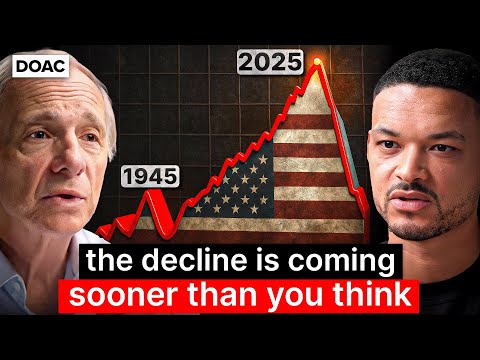
Ray Dalio: We’re Heading Into Very, Very Dark Times! America & The UK’s Decline Is Coming!
What this covers
Ray Dalio, founder of Bridgewater Associates, sits down with Steven Bartlett to discuss his framework for understanding historical cycles and their implications for current geopolitical decline. The conversation spans roughly 90 minutes and moves between macroeconomic analysis and personal philosophy. Dalio presents his theory that empires and economies follow predictable patterns driven by five interacting forces—money and debt cycles, internal political conflict, geopolitical competition, natural disasters, and technological innovation—which together generate a recurring cycle of roughly 80 years. He argues that both the United States and the United Kingdom currently exhibit late-stage symptoms of this cycle: mounting debt, widening wealth gaps, internal polarization, and relative loss of geopolitical standing. The bulk of the interview situates these large-scale historical patterns against questions about how individuals should position themselves financially and geographically in response.
The second half shifts toward personal decision-making and character. Dalio discusses the psychological and practical foundations of effective leadership: radical open-mindedness born from his own catastrophic miscall in 1982, the importance of hiring people of high character and capability, and the principle that pain plus reflection produces progress. He touches on artificial intelligence, warning that technological displacement of human labor will create a redistribution problem societies may lack the coherence to solve. On the question of individual resilience, he emphasizes what he calls "three holes"—geographic and financial mobility—as protection against national decline, and argues that beyond a basic threshold, money correlates poorly with well-being; community and meaningful relationships matter far more. The conversation includes practical framing about how to approach different life stages, the hazards of strong opinions held without genuine openness to challenge, and whether human nature will rise to meet the collective problems posed by AI and geopolitical competition.
Ray Dalio argues that understanding historical cycles driven by five forces (money-debt dynamics, internal conflict, geopolitical competition, acts of nature, and technological innovation) is essential for navigating personal and societal futures, and that individual success depends on radical open-mindedness, meaningful work and relationships, and principles-based decision-making.
- The same 80-year cycles repeat across history, making past patterns predictive of future crises in debt, political polarization, and great power conflict
- Personal wealth and happiness correlate weakly with money but strongly with meaningful work, community, and how one handles inevitable pain through reflection and meditation
- AI and automation will concentrate power and create winners and losers unless societies develop shared principles around redistribution, productivity, and collective well-being
This asset isn't compiled yet
You're seeing its claims, ranked. Compile it to build the argument threads, weight them, and check each claim against your library — the full view.
Radical open-mindedness is one of the two transformations that made Ray Dalio successful, requiring you to be stress-tested, want your thinking challenged, and treat intellectual disagreement as curiosity (not a fight), with the principle that when someone disagrees with you, it should prompt a 50-50 'I don't know if I'm wrong or they're wrong' stance rather than ego-defensive sticking to your opinion.
“I watch people becoming so tied to their own opinions. Like this is the greatest tragedy of mankind. The greatest tragedy of mankind cuz it's so easily can be fixed is holding a strong opinion that is wrong that you could have made right better if you were open to learning more... I want to be stress tested. I want my thinking to be stress tested.”
The Serenity Prayer ('God give me the serenity to accept that which I can't control and give me the power to control that which I can and the wisdom to tell the difference') is essential to good reflection and decision-making because it focuses effort on controllable variables while accepting uncontrollable ones.
“there's you know, there's uh I I would say there's a Serenity Prayer. The Serenity Prayer is God give me the serenity to accept that which I can't control and give me the power to control that which I can and the wisdom to tell the difference. Okay? And so to how you approach these things, we're talking about reflection. You asked me reflection, okay? If you can reflect in that quality way, then you deal with anything.”
People are attracted to places that are better and leave places that are worse—this is fundamental incentive logic that nations ignore at their peril; the UK is losing 16,000 millionaires annually and this capital flight is a symptom of underlying problems.
“People will go to the places that are better than them than stay in the places that worse for them. This is fundamental, right? Incentives. Okay. So you have to make the place better.”
Within the United States, approximately 3 million people (about 1% of the 330 million population) are doing exceptionally well, while the top 10% are doing really well, but the bottom 60% of Americans have below a sixth-grade reading level, creating a fragmented society where broad-based productivity and prosperity—necessary for a successful society—is absent.
“About 3 million people in a country of 330 million people are really unbelievably doing great... And then there's the top 10%, let's say, which is the people around them and they're really really doing great... At the same time, the bottom 60% of Americans have below a sixth grade reading level.”
The mechanism for personal wealth and well-being is that beyond a basic level of money ($X threshold), there is no correlation between additional money and happiness or well-being across societies and studies; the highest correlation with happiness and well-being is community—whether you have a sense of community around you.
“it doesn't have much correlation past a certain level of money uh it doesn't have much correlation with um that well-being with the amount of money you have. And if you see studies across societies and you'll see that past that certain basic level, there's no correlation between the amount of money they have and how much happiness they have or well-being, okay? That the highest level of correlation across societies and studies of happiness and well-being is community.”
Humans are one of 10,000 species, only about 200,000 years old (short in history), with similar evolutionary structures (two eyes, brains with cerebrum, cerebellum, prefrontal cortex) showing that all species evolve; understanding evolution as a universal force is essential to understanding how reality works.
“Everything is evolving. Okay, all species. Man is one of 10,000 species. I mean and they're and they're all structured similarly... mankind's only about 200,000 years old. That's in history, that's short, okay? And and the species and all species evolve, okay?”
There's an organizational reality that at 75-100 people, a group stops knowing each other and loses cohesion, so you must shift to a 'villages in a city' structure with sub-teams maintaining relationships, while keeping the larger organization together through common mission, departmental events, and intentional cross-group mingling.
“I found it to be true and it's well established fact that if you get a group of people past a certain size, which is 75 to 100 people, um they don't know each other. Okay, they they they start to become different and then you lose those relationships, you lose a lot and so on.”
Building financial strength requires understanding how you earn, spend, and save (which determines the amount), then investing that amount well; flexibility and the ability to move capital matters historically, so nailing yourself to a house as primary asset limits flexibility compared to alternatives.
“building your financial strength is important, which has to do with how you earn, spend, and save. That will determine the amount. And then, what you do with that amount is invest... The ability to move capital matters. And if you look at history this has been an important consideration.”
The highest form of leverage is not working harder but working through others by picking capable, trustworthy people with good character, orchestrating them well, and providing them the context and resources to make decisions; Ray managed 30 direct reports with monthly one-hour meetings each, creating more output than he could alone.
“It's knowing how to do it through others... Get the best players... good character and good capabilities and orchestrate them well... I um when I was doing the most, I had 30 direct reports... I would deal with them on this 30 reports. I'd have maybe um an hour meeting with them once every 2 weeks.”
Ray Dalio believes understanding multiple domains (history, evolution, biology, business) is more important than being a specialist; the world is interrelated and you can't understand one domain in isolation, so being broadly curious and eclectic is necessary to understand reality and be successful.
“I I yeah, I just see I I don't is that to me maybe too much of a specialist that kind of mentality, but the world is being interrelated to these things. If you want to understand how reality works, um you can't say I'm going to be just a specialist. I mean these are all affected by each other.”
It is more than conceivable that within 50 to 100 years the United States could no longer be the dominant global power, because historical evolution and challenge-response patterns are inevitable; the US faces the same symptomatic challenges that preceded the fall of previous empires, visible in the last 500 years of history.
“Do you think it's conceivable that in the next 50 to 100 years the US could no longer be the dominant power globally? Yeah. Yeah, more than conceivable. More than conceivable... these evolutions always take place. And they take place in a certain way. And that if you look at the probabilities and the paths and the symptoms, there is a challenge the United States is facing a number of those challenges.”
History shows an evolution from the Dark Ages/Agricultural Age (where most people were like oxen and nobles/royalty ruled) through the Printing Press invention (more knowledge and intelligence), to Age of Exploration and Industrial Revolution (machines replaced physical labor), to current era where intelligence matters more than anything because it attracts investment and drives power.
“through um evolution, we have gone from a period of time which was called the Dark Ages or the Agricultural Age in which basically there was land, it's agricultural and so on, and people were treated and they were essentially like oxen, most people. And then there were the landowners who were nobles, and then there were the royalty who were the families that control most things and so on. And then in history, with the invention of the printing press, there became more knowledge um and more intelligence, and we see an evolution in which you start to see new ages emerge...”
With AI and robotics converging, we will not need many current jobs (lawyers, accountants, medical professionals) if we have humanoid robots smarter than humans with PhDs in everything; the question is what society does, and Ray worries that societies are too fragmented to figure out redistribution policies because most people need to be productive and prosperous for a healthy society.
“We will not need a lot of those jobs for the reasons that you're saying. Okay... And then the question is what our society does... I think we fight over about what we do, unfortunately... I don't think we have escaped a world where most people to have a healthy society, most people have to be productive and prosperous.”
Ray Dalio's brain has a logical conscious part (reasonable, tries to reason things through) and a subconscious mind (subliminal, really driving behavior), and reflection allows you to recognize how emotions enter into decisions and align these two parts, which is very powerful.
“the basically the brain's got two parts to it, right? It has the logical part of your brain, reasonable, tries to reason things through, and that which is conscious. And then it has the subconscious mind, which is the subliminal that is really driving you. And so when you can reflect, okay, how are my emotions entering into it? What do you know, and so on, and you can think and you can align that. That's very powerful.”
Transcendental meditation works by repeating a mantra (meaningless sound like 'om') in your mind with your breath, which prevents other thoughts; as you stabilize on the mantra, it eventually disappears and you transcend into a subconscious state (not unconscious/sleeping but a different state of consciousness) where you're relaxed and in slow-motion-like clarity, which brings conscious and subconscious into alignment.
“you sit quietly and you repeat in your mind what is called a mantra, which is a sound that it's a word that has no meaning. Let me say the most classic example of that would be om. Okay, so you quietly there and you go with your breath you go you know, om. Om, like that... When you are uh in the mantra a a lot, then it disappears. The sound disappears and you go into your subconscious mind. That's what they call transcending. Transcendental meditation is the type of meditation I do.”
An idea meritocracy means the best idea wins regardless of who presents it or their rank, which sounds simple but isn't how most businesses operate; bigger companies with more intellectual horsepower sometimes get less innovative because they become more bureaucratic, fragmented, and less willing to challenge leadership ideas.
“I want what do I want? I want the best idea to win. This sounds simple but but again, it's it's not how businesses operate... when businesses get bigger and they have more intellectual horsepower by I mean, if you just added up how many brains they had, they sometimes get less innovative... Well, because they become more more bureaucratic and more fragmented.”
The winners of wars determine how the new world order works by drawing borders and making rules; when a rising power challenges an existing power in a deteriorating world order, international conflict results; this pattern repeats and all prior orders break down.
“the way that works is that the winners of the war determine how the world order works. They draw borders. They say, 'Here's how it's going to work.' And that's the new order, okay? And that continues until there's a rising power challenging an existing power in the existing world order, which typically is deteriorating at that time. And then you have international conflict, okay?”
The US-China technology competition is the war that will determine all other wars because technology determines economic and geopolitical power; this is not new—nuclear technology won World War II, and throughout history the technology leader has determined the world order.
“the question is going to be who wins the technology war because the winner of the technology war is going to win all wars, okay? In other words, they'll win the economic war. They'll win the geopolitical war because technology. And I'm not saying anything that hasn't repeated through history. Give me that historical context if you can just for for The technology, for example, nuclear Yeah. Nuclear won World War II.”
Two things turned Dalio's career around after a catastrophic wrong bet in 1982 (predicting a debt crisis would crash the market at what turned out to be the exact bottom): learning radical open-mindedness/humility (seeking the smartest people to stress-test his opinions because he could be wrong), and learning to diversify his bets to dramatically reduce risk without reducing returns.
“I lost money for the clients... that was the exact bottom in the stock market, August 1982. So, I couldn't have been more wrong.”
Bridgewater managed $150 billion at its peak, operated with 1,500 people, and became the largest hedge fund in the world through systematic application of principles-based decision-making, diversified bets to reduce risk without reducing returns, and radical open-mindedness culture.
“Managing how much at 150 billion dollars. 1,500 people 150 billion dollars... my company Bridgewater became the largest hedge fund in the world... extremely successful.”
The United States is facing significant risks including high debt, internal conflict between left and right due to wealth and values gaps, leading role in geopolitical great power conflict with China, climate effects, and technology competition where the winner determines all other wars, creating conditions where democracy itself is at risk if people lose faith the system will work for them.
“If I go down my list, it definitely has this debt money economy problem... It definitely has the internal conflict power in which there is a fight between the left... due to wealth and values gaps and people not believing that the system will work for them. And so, democracy is at risk because they don't believe the they're not going to follow the rules.”
The benefits these technologies bring (e.g., extended life expectancy) are less important than human nature: across history, societies may have had greater well-being in some past eras despite worse technology, so the real question of the AI age is whether people can rise above self-interest to think of the collective good and operate by karma and win-win relationships—and Dalio worries human nature will prevent this, especially amid geopolitical tensions.
“these technologies and so on bring us, while very important, extends life expectancy and all of that, is not important as important as human nature.”
Being an entrepreneur is better advised in the United States than the UK because the US has a culture of entrepreneurship and inventiveness where age, appearance, and status matter less—a 25-year-old with a blue streak in their hair can get resources if they have talent—while Europe and UK have establishment cultures that constrain such mobility.
“I think you should be in the US. Why? The US has a culture of um entrepreneurship, inventiveness. There's a whole different culture like in Europe, generally speaking, and in and and in the UK. There's an establishment culture, right? And it here um you could be 25, have a blue streak in your hair, and have the talent, but if you got the talent to pull it off, you can get the resources and you can be an entrepreneur.”
There are first-order consequences and second-order consequences to most actions, and most of the time the first-order consequences are opposite to the second-order consequences; for example, eating food you like has good first-order consequence (pleasure) but bad second-order consequence (health), while working hard has bad first-order consequence (discomfort) but good second-order consequence (strength and power).
“Some people some people, you know, I'm not saying they want to choose it, but the iron- the irony of things is there are first order consequences and there are second order consequences. This is like a rule of life, okay? And most of the time the first order consequences, whether they're likable or not, has the opposite second quarter second order consequences.”
Pain plus reflection equals progress; this principle has been foundational to Ray Dalio's success because learning from pain requires attention to reality, understanding how reality works, developing principles for dealing with it differently, which led to Bridgewater becoming the world's largest hedge fund.
“Pain plus reflection equals progress. And from that principle, my company became the largest hedge fund in the world.”
The greatest tragedy of mankind is holding strong wrong opinions that could have been made right if one were open to learning more, viewing intellectual challenge as a fight rather than as an opportunity to test thinking—this is egotistical and prevents correction.
“The greatest tragedy of mankind. The greatest tragedy of mankind cuz it's so easily can be fixed is holding a strong opinion that is wrong that you could have made right better if you were open to learning more.”
Understanding your own nature (personality, preferences, innate tendencies) is more important than willpower or discipline—choose a path aligned with your actual nature rather than fighting it.
“You said what's your nature. What do you mean by nature? People are born with and then also their environment creates their different nature, you know? We have our preferences, our inclinations. We think in a certain way. You chose to be entrepreneurial, okay? You're living out your nature, okay? This isn't for somebody else. You know, some people have a different nature, okay? They would like to have the stability of a job and clarity and so on. So, when you have your nature, you want to know that and then find the path that is going to be good for your nature.”
Transcendental meditation has been enormously significant to Ray Dalio's success because it calms the mind, brings conscious and subconscious states into alignment, provides a state like the 'ninja in ninja movies' fighting in slow motion, and is invaluable for dealing with extreme pain (he used it to process losing a son).
“to go through that with meditation, with reflection, and so on, uh was invaluable... I urge your audience, I urge you, to uh to learn that. That's very helpful.”
There are five big forces that create a repeating cycle lasting about 80 years: (1) money-debt forces that create wealth and opportunity gaps, (2) internal conflict between left and right due to those gaps, (3) geopolitical/international conflict, (4) acts of nature like droughts and pandemics, and (5) man's inventiveness in new technologies, and understanding these is essential for predicting financial crashes and future outcomes.
“there's five big forces that create a big cycle that's repeated through history, which lasts about 80 years. The first is the money debt force that creates wealth and opportunities gaps. And it's connected to the second force, the internal conflict where you don't trust the system, causing wars between the left and the right... the third is geopolitical force... Then there's acts of nature. And then number five is man's inventiveness, particularly of new technologies.”
In the 1930s, four major democracies (Italy, Germany, Spain, Japan) chose to become autocracies, and there's pressure toward autocratic leaders during system stress because people want a strong leader to get control of things and make it work; this could happen again in the UK and US if people lose faith in democratic institutions.
“And then the 30s four major democracies chose to be autocracies. Okay. That happened in Italy, Germany, Spain and Japan... And the UK could become an autocracy as could the US I guess. Um you're going to see a lot of pressure for that strong leader who will get control of things and make it work well.”
Spirituality (distinct from religion) means seeing yourself as part of a greater whole, loving that greater whole, and believing that all life evolves; religion often mixes superstitions with spiritual principles (like karma or 'do unto others'), but the core truth applies universally—that helping others helps society which helps you.
“I'm not religious, but I'm spiritual... Religions are typically um a mix between superstitions and spirituality... the way people should deal with each other. There is karma. Okay? All religions there's a part of them that says do unto others as you would have them do unto you, or what goes around comes around.”
The two-step decision-making process is: first take in (gather evidence and be open-minded), then decide; most harmful decisions are made when people skip step one and make emotional/ego-driven choices without evidence gathering, and this principle applies across business and personal life.
“Learn Learn radical open-mindedness. In other words, unlike there's a principle in the book, you have to take in before you put out. Or that um decision-making is a two-step process. First, take in, then decide. Okay?”
Building a great team requires binding capable, high-character people with a culture of meaningful work and meaningful relationships plus radical truthfulness and transparency, because most people hide what others are bad at to avoid hurting feelings, and that dishonesty is the barrier to having an A-team.
“it's meaningful work and meaningful relationships through radical truthfulness and radical transparency.”
Beyond a certain basic level of money there is no correlation across societies between the amount of money people have and their happiness or well-being; the highest correlation with well-being across studies is community, and having a sense of community makes you live longer and have a more joyous life.
“past that certain basic level, there's no correlation between the amount of money they have and how much happiness they have or well-being... the highest level of correlation across societies and studies of happiness and well-being is community.”
In your early life cycle you should be around the best people—those of good character and good capabilities who can teach and mentor you—rather than the job that pays the most.
“you should be around the the people who are the best people to teach you... you should be around the best, not the job that pays you the most.”
You should orient your career around making your work and your passion the same thing (while not forgetting the financial implications), because meaningful work plus meaningful relationships brings happiness and probably also greater career success; vast amounts of money should not be equated with success.
“Make your work and your passion the same thing and don't forget about the money part.”
Becoming a better decision-maker at scale requires leveraging yourself through others rather than working harder—picking trustworthy, capable people of good character and orchestrating them well (like running a symphony)—because your brain and time have hard capacity limits and others may be far better at specific tasks.
“It's knowing how to do it through others... It's like uh running a symphony... the process is how to get more out of a minute or a day. Not how to work harder.”
First-order consequences and second-order consequences are usually opposite: the immediately likable choice (eating the foods you like, not exercising) tends to have bad second-order consequences, while hard work—though not immediately likable—gives you strength and power that makes things easier and better later.
“most of the time the first order consequences, whether they're likable or not, has the opposite second quarter second order consequences.”
History of things that never happened in your own lifetime is important to understand in order to predict the future, because events like currency devaluations recur in ways you won't anticipate from recent experience alone.
“I learned that history of things that never happened in my lifetime before were important things to understand.”
The most important decision Ray Dalio made in his early life was getting hooked on playing the investment game at age 12 after buying a penny stock that tripled, which gave him a lifelong passion for markets; combined with studying history to understand devaluations (1971 Nixon shock paralleled 1933 Roosevelt), this led to being hired as commodities director, getting fired for being rowdy, but then being paid by clients for advice, which became Bridgewater.
“when I was 12, a kid I earned money with odd jobs... I put some money in the stock market... I picked um the stock. It was the only stock I ever heard of that was selling for less than $5 a share... another company acquired it and it tripled in price. And I said, I like this game. So, I got I got hooked on the game. I'm still hooked on the game, right?”
There are five big forces that create a recurring big cycle lasting about 80 years (give or take): a money/debt economy force, an internal political/social conflict force driven by wealth and opportunity gaps, a geopolitical (international conflict) force, acts of nature, and human inventiveness in new technologies; these forces interact and together determine the rise and fall of orders.
“there are five big forces that create a big cycle that lasts about 80 years, give or take 50, let's say.”
There is a historical precedent for AI: evolution has moved from the Agricultural/Dark Ages (most people treated like oxen) through the printing press, Age of Exploration, and Industrial Revolutions, in which machines replaced people first physically (body up) and now mentally; intelligence now matters more than money or anything else because it attracts capital, and the open question is whether humans run out of capacity to shift or are totally replaced.
“machines replaced people. And it's almost like they first replaced them physically... it's almost like from the body up in terms of the mind.”
The most important strategic decision in early career is not to maximize salary but to surround yourself with the best people—those of good character and good capabilities—because learning from and operating alongside exceptional people is the highest-return investment you can make in your early life cycle.
“the answer is um that you should be around the the people who are the best people to teach you, to operate by them, the mentors, and the learnings, and so on. You should be around the best people. And when I say best people, I mean people of good character and good capabilities, okay? And uh so, you should be around the best, not the job that pays you the most.”
Ray Dalio systematized hiring by: defining what personality types and backgrounds predict success in specific jobs through data on existing successful employees, creating job specifications based on those attributes, and then continuing to evaluate people after hire by asking 'would I hire them again?' on an ongoing basis, treating evaluation as a continuous process not a one-time decision.
“I would think what are the personalities, what are the backgrounds of the people that I'm hiring, what are the choices, how do I specify it? And I've and I got it by also maintaining a lot of data with people... If you know what people are like, you know what you can expect of them. And then I would then say uh in a very data way, those people who are successful in these jobs have the following attributes that would create a job spec, specifications for that type of job.”
A 'smart rabbit has three holes,' a Chinese saying meaning you should have the ability and flexibility to move to better places and away from worse places when circumstances change, which is an important principle in navigating uncertain futures.
“there's a saying in Hong Kong um a Chinese saying which is a smart rabbit has three holes. And what that means is you can see is it the UK or the US and uh and I can then move to the better place and get out of the place that's a terrible place. So, can I successfully be an immigrant or whatever and change my location? Throughout history, that's been important.”
The real question in an age of AI/robotics is whether human nature can rise above greed, power-hunger, and short-term thinking to embrace collective good and karma; technology alone doesn't determine outcome—human values do; Dalio finds past societies happier in some ways despite lower technology because human relationships and community mattered more.
“I think it all comes down to human nature...I've also watched the evolution of species...You can use these things, intelligence, to your detriment...the things that these technologies...extends life expectancy...is not important as important as human nature...do you have happier societies?...So, you can go 50 years ago, and you might say the well-being is greater 50 years ago...you may have had a better life...because it's human nature of how people are going to deal with each other...the real question is can people rise above this?...can people then rise above it so that they think of the collective good...karma, you know, in other words, the realization that if I help you...we have win-win relationships, it'll be good”
The last geopolitical world order began in 1945 after World War II, lasted about 80 years (like the typical cycle), and now at 80 years from 1945 (around 2025), the symptoms of the next transition are clear and visible in the charts in Ray's books.
“The last war ended in 1945, '44, and we began a new order in 1945... What 80 years from World War II. 80 years from World War II, yeah. And you're seeing the symptoms. Yeah. Symptoms are clear. They're all in that book.”
Making your work and your passion the same thing is more important than money because if work and passion align, you'll have an enjoyable and satisfactory life, you'll probably be better at your career, and you'll probably advance; most happiness comes from meaningful work and meaningful relationships, and this doesn't much correlate with the absolute amount of money.
“I have a principle. Make your work and your passion the same thing and don't forget about the money part. Okay, if you make your work and your passion the same thing so that you're really enjoying your work you'll have an enjoyable, satisfactory life and you'll probably be better at your career.”
Life follows an arc of rises and falls; if you reflect well and learn how reality works, you'll pass setbacks and move forward; this is 'just what it is, that's just the way life is,' and doing it well means living your best possible life.
“meaning you make advances. You will have setbacks. Okay? If you reflect well and you learn how reality works and how you will deal with it, you will get past that and go on. And that's just what it is. That's just the way life is. And if you do that well, then that's your best possible life.”
Hard work is valuable because it provides power and strength, which in turn makes things easier and better—working hard is not about suffering but about building capacity, similar to how exercise is uncomfortable but produces strength.
“Working hard, which gives you strength. Where does strength come from? I mean strength comes from working hard. So, working hard will will give you power. Power will make things easier and make things better. That's just the way it is.”
Dalio is not focused on being optimistic or pessimistic about the future but rather on being realistic and accurate in assessing risks and opportunities—his disposition is practical pragmatism rather than faith-based optimism.
“You were slightly um as if you've kind of given up on the UK a little bit... No, I'm I'm just a I'm just a I'm a practical guy. I'm a realistic guy. I made my money. I'm in the business and it's my nature to try to be realistic. And to bet on how things will transpire. And that's not healthy. The situation in the UK is not healthy.”
The life cycle follows a consistent arc: exploration and learning in youth (where breadth of learning is critical over earning), transition into peak productivity in middle age, and culmination in old age focused on transitioning wealth, knowledge, and legacy. Different games must be played in each season.
“in the early part of your life cycle, what you're going to do is I mean, the more learning and experiencing is the most important thing that you can do in the learning in the early part of your life cycle... once you're at the end of your life cycle, you're pretty much relieved from all of that. You're not going to be working to earn, okay? You're going to be free of all of that. You're going to have um and you have freedom of choices and so on. And you're going to be thinking about transitioning.”
Historical discovery: In August 1971, President Nixon ended the gold standard (allowing conversion of paper money to gold), which Dalio didn't initially understand, but upon studying history, he found that Franklin Roosevelt made the identical announcement in March 1933 when devaluing currency, revealing that understanding historical precedent for unprecedented events is critical for prediction.
“on August 15th, 1971, Richard Nixon gets on the television and says that you know the promise that that you were going to be able to take your paper money and go get gold, you can't do that... I walked on the floor of the New York Stock Exchange that summer and I thought the market was going to go down a lot and the market went up a lot. And I didn't understand why cuz I never went through a devaluation before and I studied history and I found that in March of 1933, Roosevelt got on the radio and made the exact same announcement”
Acts of nature—droughts, floods, and pandemics—have throughout history killed more people than wars and have a large effect on the course of civilizations.
“Droughts, floods, and pandemics, for example, have killed more people than wars.”
Decision-making is a two-step process—first take in (learn), then decide—and the biggest threat to good decisions is harmful emotions; being open-minded does not reduce your freedom to decide, so failing to be open-minded is irrational.
“decision-making is a two-step process. First, take in, then decide.”
An individual can protect themselves from national decline through mobility—'a smart rabbit has three holes'—meaning the ability to move oneself and one's capital to better places and away from bad ones, which has historically been important; this implies that buying a house can be a liability if it anchors you and nails down your primary capital, reducing flexibility.
“a smart rabbit has three holes... I can then move to the better place and get out of the place that's a terrible place.”
It is a well-established fact that once a group exceeds about 75 to 100 people they no longer know each other, relationships break down, and the organization becomes more bureaucratic and fragmented and often less innovative; the solution is to keep cohesive sub-groups ('villages in a city') and create cross-group cohesiveness and common mission.
“if you get a group of people past a certain size, which is 75 to 100 people, um they don't know each other... then you lose those relationships”
When a government prints a lot of money (as in 1971 and 1933 when the US severed the dollar-gold link), asset markets go up rather than down, contrary to what an inexperienced investor might expect.
“when you print a lot of money, you have that... I walked on the floor of the New York Stock Exchange that summer and I thought the market was going to go down a lot and the market went up a lot.”
Pain plus reflection equals progress: your best learnings come from pain, which is a message to pay attention; by reflecting on how reality works and what to do when something happens, you develop principles for dealing with reality better.
“Pain plus reflection equals progress. Okay. Your best learnings come from the pain. It's a message. Pay attention.”
The greatest tragedy of mankind is holding a strong opinion that is wrong when it could have been made better by being open to learning more; a differing opinion should prompt curiosity (a 50% chance you are wrong) rather than a fight, but subliminal, egotistical instincts make people treat intellectual challenge as a fight.
“this is the greatest tragedy of mankind... holding a strong opinion that is wrong that you could have made right better if you were open to learning more.”
As humanoid robots and AI converge, society will not need many jobs (lawyers, accountants, much of medicine), and the key question becomes what society does; redistribution will be necessary but not merely of money, because 'uselessness and money may not be a great combination'—most people still need to be productive and prosperous for a healthy society, and the risk is that we are too fragmented to agree on a solution.
“we will not need a lot of those jobs for the reasons that you're saying... I don't think that's just a redistribution of money policy because uselessness and money may not be a great combination.”
To understand how reality works you cannot be just a specialist, because domains like nature, biology, business, and investing are all interrelated and affect each other; drawing principles across domains is necessary to understand reality.
“If you want to understand how reality works, um you can't say I'm going to be just a specialist. I mean these are all affected by each other.”
At Bridgewater, the culture of radical transparency and radical truthfulness was enforced by a policy: talk critically about another person behind their back three times and you're fired; this was made acceptable emotionally by explaining to people that honest feedback (from intellectual mind) is better for the team and for individual evolution than dishonesty (from emotional fear).
“I had a policy, talk behind another person's back um critically. That happens three times, you're out. And then I would have radical transparency so everybody could see everything.”
Building meaningful relationships is not something you force but something you create a culture around; Ray created clubs at Bridgewater where if 20+ people wanted to form a group, he'd pay half the costs (up to $500/person) for sports, chess, social activities, which created organic community and made people comfortable with radical honesty because they knew each other beyond work.
“I created uh clubs. I said any club that you want to create that has more than 20 people, um whatever it is up to $500 per person, I'll pay for half. So, so I don't care what it is. If it's play softball or play chess or whatever it is that you're enjoying each other's company... I to nobody has obligations to or something. But if I have that kind of meaningful relationships, so you can talk honestly with each other.”
In 1979-1980, Ray Dalio calculated that American banks had lent more money to foreign countries than they would be able to pay back, predicting a debt crisis; however, at the exact moment Mexico defaulted in August 1982 (which triggered the crisis he predicted), the stock market bottomed and reversed, so his analysis was correct but his timing was wrong, causing him to lose money for himself and clients until he borrowed $4,000 from his father.
“I had calculated that American banks had lent more money to foreign countries that they were going to be able to pay back and that we were going to have a debt crisis. Very controversial point of view. In August of 1982, Mexico defaulted on its debts. And over the next decade, many other countries did... However, at that time, I thought things were going to get bad and that was the exact bottom in the stock market, August 1982. So, I couldn't have been more wrong.”
A strong political middle is the most important requirement for fixing countries with debt, inequality, and internal conflict; this middle must be analytically strong enough to understand problems AND politically strong enough to get people to do what is necessary even if they don't want to do it; without this, policies cannot be implemented.
“First of all, if you go back to the basic problem which is there's too much debt there are deficits there's differences in education and opportunity levels and so on. The most important thing that you can have is a strong middle. Political middle? Political middle. To be analytically strong and also strong enough to get the people to do what needs to be done even if they don't want to do it to get to be productive.”
The world order breaks down in three dimensions simultaneously: monetary order, internal political order, and geopolitical order, and all three interact together, creating feedback loops where instability in one dimension exacerbates instability in others.
“These orders, there's a monetary order, they all break down. There's an in- internal political order, they all break down. And and there's a geopolitical order. They all have this conflict and they work together.”
When credit is extended, it gives spending power but also produces debt that must be repaid; if there isn't enough income to repay it, debt rises relative to income, which squeezes out spending and makes people unwilling to hold debt assets, producing financial decline.
“when you give somebody credit, they can spend. And then but it also produces debt. And debt has to be paid back. And so, what happens is if there's not enough income to pay back the debt, then you have um debt rising relative to income. It squeezes out spending. People don't want to hold the debt assets”
You should play the life game differently at different stages of the life cycle: in the early part, learning and experiencing is most important because you are making directional choices; at the end, you are relieved from earning and focus on transitioning your well-being and wealth.
“in the early part of your life cycle, what you're going to do is... the more learning and experiencing is the most important thing... once you're at the end of your life cycle... You're going to be thinking about transitioning.”
The Serenity Prayer—serenity to accept what you can't control, the power to control what you can, and the wisdom to tell the difference—captures how to approach reflection and dealing with difficult situations.
“The Serenity Prayer is God give me the serenity to accept that which I can't control and give me the power to control that which I can and the wisdom to tell the difference.”
When wealth and opportunity gaps grow large and people stop believing the system works for them or trusting it, internal conflict erupts between left and right, and democracy itself is at risk because people stop following the rules; this typically leads toward pressure for a strong autocratic leader, as happened in the 1930s when Italy, Germany, Spain, and Japan chose autocracy.
“when you get to the situation where you don't believe the system is working for you and you don't trust the system, then there are wars. There are internal conflicts”
Whoever wins the technology war (currently between the US and China) will win all wars—the economic war and the geopolitical war—because technological superiority is decisive, just as nuclear technology decided World War II.
“who wins the technology war because the winner of the technology war is going to win all wars... they'll win the economic war. They'll win the geopolitical war because technology.”
Religions are typically a mix of superstition and spirituality; the spiritual, practical core common to nearly all religions is the golden rule and karma ('what goes around comes around'), and small acts of mutual help create win-win relationships and better societies—this is what Dalio means by spirituality, seeing oneself as part of a greater whole.
“religions are typically um a mix between superstitions and spirituality.”
The United Kingdom is not an optimistic case because it has high debt, internal social conflict, is affected by geopolitical factors, and lacks the entrepreneurial culture and capital markets infrastructure that the United States has to support innovation at scale, causing millionaire exodus and decline since World War II.
“The UK has a financial problem... the government has a debt problem. It doesn't have enough money for what it wants to do... And the UK has been in decline since the war. Even the development of the capital markets, can you raise capital there? All of these things are much worse than they are in the United States.”
It takes approximately 18 months to figure out whether a person can adapt to an organizational culture and participate in honest disagreement, and another 18 months to 2 years to fully learn their strengths and weaknesses; only then can you make a solid decision about their fit.
“I found out that for me, the big question mostly, there were two big questions, but um the big question is how do you adapt to my culture? And that would take about 18 months to find out. Like, can you speak honestly about what can we have thoughtful disagreement?... learning about the people, their strengths and weaknesses, would take 18 months to 2 years, maybe something along those lines.”
The US looks innovative in aggregate but generalizations are misleading: roughly 3 million people out of 330 million are doing unbelievably well and the top 10% are thriving, while the bottom 60% of Americans read below a sixth-grade level; a successful society requires broad-based productivity and prosperity, which this bifurcation undermines.
“About 3 million people in a country of 330 million people are really unbelievably doing great... At the same time, the bottom 60% 60% of Americans have below a sixth grade reading level.”
Neither the US nor China is likely to be the clearly dominant power for a very long time; the quickest path to dominance would be a dangerous war, but the hope is the relationship evolves under mutually assured destruction (as with the Soviet Union) so that one system eventually outcompetes the other through an evolutionary process.
“I don't think either side is going to be the clearly dominant power for for a very long time... maybe it evolves hopefully the way the Soviet Union of evolved that the the worry of mutually assured destruction keeps everybody not having that kind of war”
It is more than conceivable that within the next 50-100 years the US could lose its position as the dominant global power, because such evolutions always take place and the US is facing many of the symptomatic challenges; whether it can avoid a damaging outcome depends on whether its people and system can get control without fighting to the point of damaging each other.
“More than conceivable... these evolutions always take place. And they take place in a certain way.”
Big cycles average about 80 years (like a life cycle) but are not predetermined—just as a person who takes care of themselves lives longer, a society's path can be lengthened or shortened by its actions; you can read where a society is in its cycle by observing its symptoms, like taking a physical.
“they are about a life cycle about 80 years. But it's not predetermined just like your life cycle is not predetermined.”
The most important thing for fixing a country like the UK is a strong political middle that is analytically strong and powerful enough to get people to do what needs to be done—even what they don't want to do—to be productive; alongside this you need to strive for equal education and equal opportunity, because historically people move to places that are better for them than where they are.
“The most important thing that you can have is a strong middle... To be analytically strong and also strong enough to get the people to do what needs to be done even if they don't want to do it to get to be productive.”
Geopolitical orders follow a cycle from one big war to the next: the winners of a war set the new world order and draw borders, and that order persists until a rising power challenges an existing, deteriorating power, producing international conflict; the last order was established in 1945 and we are now ~80 years into it.
“the winners of the war determine how the world order works. They draw borders. They say, Here's how it's going to work. And that's the new order... until there's a rising power challenging an existing power in the existing world order, which typically is deteriorating at that time.”
The most important force in a society's success is not money but the ability to find talented people, identify those worth betting on, and enable them; capital markets matter precisely because they channel money to enable talented people, which is how companies like Nvidia arise.
“what works is finding great people, talented people, and identifying those who you want to bet on. And enabling them. And that works that's the most important force, much more important than money.”
Building your financial strength—governed by how you earn, spend, and save (which determines your amount) and then how you invest that amount—is an essential individual response to navigating risky times, alongside mobility and knowledge.
“building your financial strength is important, which has to do with how you earn, spend, and save. That will determine the amount. And then, what you do with that amount is invest.”
People are born with a nature (preferences, inclinations, ways of thinking) that is also shaped by environment, and the key to a good life is knowing your nature and finding the path suited to it, rather than following a path meant for someone else.
“when you have your nature, you want to know that and then find the path that is going to be good for your nature.”
AI will be very valuable for management and decision-making (leveraging people enormously), but in terms of broader economic change it will create a limited number of winners and many losers, producing much greater polarity that concentrates benefits in the top 1-10% and acts as a dividing force in society.
“there will be a limited number of winners and a bunch of losers, and I think it's going to create much greater polarity”
People always think the future will be a slightly modified version of the present and fail to see how an empire could fall, because watching over decades is like watching a person grow—you don't see the life arc even though the life arc is irrefutable.
“People always think that the future would be a slightly modified version of the present. And it's not... you don't see the life arc... but the life arc is irrefutable.”
Dalio is not optimistic about the future of the UK because it has high debt, social/internal conflict, exposure to geopolitical factors, and lacks the inventive culture and deep capital markets (at the needed scale) that countries like the US have.
“No. Because it has high debt, it has the social internal conflict, it has it's affected by the geopolitical factors. And in terms of inventiveness, it doesn't have the culture that other countries have like like the US.”
Hiring can be systematized using data: by maintaining data on what people are like, you can identify the attributes and backgrounds of those who succeed in a given job and turn that into a job spec; the evaluation process doesn't stop at hire but continues, repeatedly asking 'would I still have hired them?', and it takes about 18 months to learn cultural fit and 18 months to 2 years to learn strengths and weaknesses.
“those people who are successful in these jobs have the following attributes that would create a job spec”
Developing principles—pausing to reflect on what you should do if a situation recurs and writing it down—lets you treat new events as instances of recognizable 'species' (e.g., 'this is a duck, how do I deal with a duck?') rather than a blizzard of novel inputs, dramatically improving decision quality; these decision rules can even be computerized and back-tested.
“I see everything as another one of those... that's what kind of species is it and how do I deal with that species?”
Honesty in an organization can be engineered: Dalio enforced a policy that criticizing a person behind their back three times got you fired, instituted radical transparency so everyone could see his decision-making, and built meaningful relationships (subsidizing clubs up to $500/person for groups over 20) so people could speak honestly with each other.
“I had a policy, talk behind another person's back um critically. That happens three times, you're out.”
The three books Ray Dalio recommends most are: Richard Dawkins' 'River from Eden' (about evolution as a universal force), Will and Ariel Durant's 'Lessons from History' (104 pages distilling 5,000 years of history), and Joseph Campbell's 'The Hero with a Thousand Faces' (about human nature and the life journey).
“There are three books. There's a book on evolution but written by Richard Dawkins. Uh River from Eden, I think it's called. Then a book by um Will and Ariel Durant, which are the maybe the greatest historians in time, and it's called Lessons from History. It's a very short book. I think it's 104 pages... And then um Joseph Campbell's The Hero's Journey. Is it the the hero with a thousand faces? Yes, that's it.”
The brain has a conscious, logical/reasoning part and a subconscious (subliminal) part that is really driving you; reflecting on how emotions enter your decisions and aligning the conscious and subconscious is very powerful, and transcendental meditation naturally produces this alignment by letting you transcend into the subconscious in a calm, conscious-yet-subconscious state.
“the brain's got two parts to it... the logical part of your brain... And then it has the subconscious mind, which is the subliminal that is really driving you.”
Trump sees the debt problem and the internal conflict/disorder problem and represents the 'red states' united behind him, while those losing programs (like food stamps) feel unrepresented; the upcoming New York mayoral election exemplifies the two sides, and the open question is whether the system will have enough support to work.
“I think he sees the debt problem. I think he sees the internal conflict disorder problem. And I think he represents the red let's call it the red states.”
When facing an unresolvable meta-uncertainty (like whether human nature will doom the AI future), the practical move is to accept you may never be confident of the meta-prediction and just get on with using the technology in the best way that works for you.
“some problems you just just accept the fact that you may not be able to be confident of the meta prediction in the future... and just get on with the fact of using it for yourself in the best way that works for you.”
Transcendental meditation was enormously significant to Dalio's success because it changed the way he sees things, putting him in a calm, slow-motion state (like a ninja in slow motion) for dealing with what comes at him, and it was invaluable in coping with the worst pain—the loss of his son.
“How influential was transcendental meditation in your success? Oh, enormously successful... Ver- very very significant.”
Bridgewater became the largest hedge fund in the world (managing roughly $150 billion with about 1,500 people), which Dalio attributes to applying the pain-plus-reflection process and his principles.
“my company Bridgewater became the largest hedge fund in the world... Managing how much at 150 billion dollars. 1,500 people 150 billion dollars.”
The UK is not equally exposed as other countries because countries differ: some have more debt, some have populations more willing to hold their debt, some have more resources, are bigger or more powerful, or are running surpluses—so the cycle does not hit all nations equally, and the UK is particularly exposed due to high debt, internal conflict, geopolitical exposure, and lack of an inventive culture and deep capital markets.
“they're not all equal. Okay, some are more in debt than others... Some countries have surpluses, some countries, you know, are not in the middle of where they're just having a war.”
Donald Trump represents the red states and the red side of internal political conflict; he sees the debt problem and internal conflict disorder problem, and views himself as needing to take charge to do certain things, uniting his side behind him, though others in that population would say programs he might cut (food stamps, etc.) represent them, creating devotion on both red and blue sides rather than unified system.
“he represents the red let's call it the red states... he represents that and they're united behind him in terms of doing some things... he represents let's call it the red side... he views himself as somebody who needs to take charge and to do certain things. Others in that population would say those who let's say are not getting or having the food stamp program cut off or having other programs cut off that they're dependent on would say well a second that's not representing me.”
For an entrepreneur building a technology company, the US is a better environment than the UK because the US has a culture of entrepreneurship and inventiveness where a 25-year-old with talent can attract resources, whereas Europe and the UK have an 'establishment culture'; this cultural difference shows up in the relative performance of their economies.
“The US has a culture of um entrepreneurship, inventiveness. There's a whole different culture like in Europe... There's an establishment culture”
Pay attention. Pain plus reflection equals progress.
“Pay attention. Pain plus reflection equals progress.”
Subscribing to the channel is a simple, free thing viewers can do to help the show keep going.
“if you could do me a favor and double-check if you're a subscriber to this channel, that would be tremendously appreciated.”