What this covers
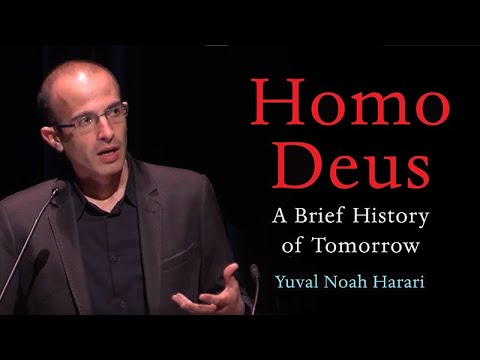
Historian Yuval Noah Harari has taken the world on a tour through the span of humanity, from apes to rulers of the world. Harari became an international sensation when he argued in his best-selling book Sapiens that humans conquered the world through our ability to believe in collective myths about gods, money and freedom. In the highly-anticipated sequel Homo Deus, Harari looks to the future, exploring how godlike technologies such as artificial intelligence and genetic engineering will define what we become. Recorded on 02/27/2017. [6/2017] [Show ID: 32146]
Donate to UCTV to support informative & inspiring programming: https://www.uctv.tv/donate
More videos from: SAGE Center for the Study of the Mind (https://www.uctv.tv/SAGE)
Explore More Humanities on UCTV (https://www.uctv.tv/humanities) The humanities encourage us to think creatively and explore questions about our world. UCTV explores human culture through literature, history, ethics, philosophy, cinema and religion so we can better understand the human experience.
UCTV is the broadcast and online media platform of the University of California, featuring programming from its ten campuses, three national labs and affiliated research institutions. UCTV explores a broad spectrum of subjects for a general audience, including science, health and medicine, public affairs, humanities, arts and music, business, education, and agriculture. Launched in January 2000, UCTV embraces the core missions of the University of California -- teaching, research, and public service – by providing quality, in-depth television far beyond the campus borders to inquisitive viewers around the world. (https://www.uctv.tv)
Source description (no synthesized summary yet).
Harari argues that human authority is shifting from individual feelings (humanism) to algorithmic systems (dataism) because algorithms will soon understand human biology and emotions better than humans themselves, fundamentally restructuring how decisions are made across all domains of life.
- Organisms including humans are biochemical algorithms; feelings are probability-calculating processes shaped by evolution, not metaphysical truths
- Technology companies now have access to data, biological knowledge, and computing power to understand human psychology better than individuals can understand themselves
- This shift from humanistic to dataist authority is already happening in medicine and will expand to all life decisions as people prove algorithms make better recommendations than human intuition
This asset isn't compiled yet
You're seeing its claims, ranked. Compile it to build the argument threads, weight them, and check each claim against your library — the full view.
Technology is not deterministic—the same technology can be used to create very different kinds of societies, from communist dictatorships to fascist regimes to liberal democracies, so the particular outcomes of dataism depend on policy choices, not technological inevitability.
“technology is never deterministic. You can use the same technology in order to create very different kinds of societies. This is one of the chief lessons of the 20th century. You could use the technology of the 20th century, of the Industrial Revolution, trains and electricity and radio and cars and so forth. You could use that to create a communist dictatorship or a fascist regime or a liberal democracy. The trains did not tell you what to do with them.”
These two previously separate developments (biotech and infotech) are now converging; the wall separating biotech from infotech is collapsing, visible in corporations like Apple, Amazon, Google, and Facebook that began as infotech companies but are increasingly becoming biotech companies
“Until today, these two were kind of separate developments, but now they are coming together. I think the crucial thing that is happening right now in the second decade of the 21st century, is the merging of these two tidal waves. The wall separating biotech from infotech is collapsing, which you can also see in the market, that corporations like Apple or Amazon or Google or Facebook, that began as strictly infotech corporations, are increasingly becoming biotech.”
Humans' unique capacity for large-scale cooperation is enabled by their ability to collectively believe in and act upon fictions—shared imaginary constructs like nations, corporations, money, laws, and religions—that have no basis in objective biological reality but are tremendously powerful in coordinating behavior.
“our capacity to believe in such things is actually part of what makes us so special. That ultimately, it's humankind's imagination and our ability to believe in fictions, to hold collectively a belief in fictions, which is what gives us our remarkable capacity.”
Humans have the capacity for flexible cooperation in large numbers that other animals lack—chimpanzees can cooperate in groups of 15-30 but not hundreds of thousands, and while bees operate in large scale, they cannot do so flexibly the way humans can.
“other animals can cooperate, chimpanzees can cooperate, but not in large scales though, groups of maybe 15, 20, 30, but certainly not in the hundreds thousands that humans are. Bees can operate in large scale, but not flexibly.”
Humanism as an ideology shifted the source of authority from external divine sources (God, the Bible, the Church) to human beings, and specifically to the feelings and free choices of individual humans, making this the supreme source of authority across politics, economics, ethics, and education.
“Then in the last two, three centuries, we saw the humanist revolution, a tremendous political and religious and ethical revolution, which said basically, which brought down authority from the heavens down to earth, down to humans, and said that the most important source of authority, the supreme source of authority, in all fields of life is human beings, and in particular, it is the feelings and the free choices of human individuals.”
In humanist aesthetics, beauty and artistic value are determined entirely by individual human perception and feeling—there is no objective standard for what constitutes art or beauty, and any assertion of personal aesthetic preference constitutes legitimate authority.
“Beauty is in the eyes of the beholder. In 1917, exactly a century ago, Marcel Duchamp took an ordinary mass-produced urinal declared it a work of art, named it Fountain, and ever since then... the lecture shows the image and asks the students, 'Well, what do you think?'. And all hell breaks loose. 'Hey, it's art, it's not art, it is, it isn't'. And at least if this is a humanist university or humanist college, the lecture will steer the discussion to the conclusion that there is no objective definition or yardstick for art, or for beauty.”
GPS and navigation applications (Google Maps, Waze) are already an example of this process: people use them, find they work better than intuition, gradually stop trusting their spatial awareness and sense of direction, and become dependent on devices they would be helpless without if they failed.
“Like if you think about finding your way around town. So more and more people delegate this responsibility to Google Maps or to Waze... You reach an intersection, your gut instinct tells you turn right, Google Maps tells you, 'No, no, no, turn me left... you trust your intuition, and you turn right and you're late. Next time, you say, 'Okay, I'll try Google Maps', and you follow Google's recommendation and you arrive on time, you learn not to trust your intuition, it's better to trust Google. And very soon, people reach a point, when they have no idea where they are, they lose their spatial ability to know where they are and find their way around space. They just follow blindly whatever the application is telling them.”
Satellite images of East Asia at night show a contrast between the lights of South Korea and China versus the darkness of North Korea, illustrating that technology choices (whether to electrify and develop) are not determined by access to technology but by policy and political systems.
“This is a very famous image. This is East Asia. An image of East Asia at night taken from outer space from a satellite. And what you see the bottom right corner is South Korea, a sea of light. And in the top corner you see China, another sea of light. And in between the dark part, it's not the sea, this is North Korea. Now why is North Korea so dark, while South Korea is so full of light? It's not because North Koreans haven't heard about electricity or light bulbs. It's because they chose to do very different things with electricity than the people in South Korea or in China.”
In humanist economics, the customer is positioned as always right, with the assumption that customer preferences (expressed through purchasing decisions) represent the highest economic authority that cannot be overridden by experts or authorities
“What is humanist economics? It's an economic view that says that the highest authority is the feelings, the wishes, the whims of individual customers. The customer is always right.”
There are deep aspects of the brain and mind that we still don't understand, so it's possible that the entire vision of algorithmic human hacking is a fantasy despite appearing plausible based on current science
“There are some very deep things we still don't understand about the brain and the mind, and all this dream will turn out to be a fantasy. So this is the first thing we need to take into account, we still, we are not yet there yet, really understanding the human brain and the human mind.”
In the age of dataism, when you ask an algorithm like Amazon or Google for a recommendation (what book to read), it will tell you that it has been following you, monitoring your preferences, analyzing statistics from millions of other users, and can recommend what you should read based on data and statistics about human behavior.
“we go to the Amazon virtual bookshop, and the moment I enter the Amazon Bookshop, an algorithm pops up and tells me, 'I know you. I've been following you, I've been following your likes and dislikes, and based on what I know about you, and statistics about millions of other readers and books, I recommend these three books to you'.”
Human feelings and emotions are not metaphysical phenomena or supernatural gifts from God, but are biochemical algorithms—processes of calculating probabilities shaped by millions of years of natural selection to enable good decision-making regarding survival and reproduction.
“as for feelings, they are definitely real, they are not a fiction of our imagination, but feelings are really just biochemical algorithms, and there is nothing metaphysical or supernatural about them.”
The concept that 'organisms are algorithms' can summarize more than a century of life sciences and evolutionary biology research and represents the increasingly dominant view in both life sciences and computer science, explaining why biotech and infotech are merging.
“in a way it's possible to summarize more than a century of research in the life sciences and especially in biology and in evolution, in just three words, organisms are algorithms. This is now more and more the dominant view, not only in the life sciences, but also in computer science, which is why the two are merging.”
A baboon making a survival decision (whether to risk getting bananas despite a nearby lion) is actually performing rapid probabilistic calculation by taking in sensory data, internally computing probabilities very quickly, and expressing the result as an emotion (courage or fear) that determines behavior.
“Let's say you're a baboon somewhere in the African savanna, and you face a typical problem of survival... I need to calculate the probability that I would starve to death if I don't eat the bananas, versus the probability that the lion will eat me if I try to reach for these bananas... Then I need to take all these pieces of data and somehow calculate them very, very fast, the probabilities... the entire body of the baboon is the calculator. It takes in the data with what we call our senses... and then the nervous system and the brain, they're the calculator that within a split second, calculates the probabilities, and the answer will appear not as a number, the answer will appear as a feeling or an emotion.”
Angelina Jolie underwent a double mastectomy based on a big data algorithm's statistical prediction (87% chance of breast cancer from BRCA1 mutation) rather than on her current health or feelings, choosing algorithmic authority over her own felt experience
“Two, three years ago, there was this very famous story about Angelina Jolie. She did a genetic test, a DNA test that revealed she had a mutation, I think it was in the BRCA1 gene. And according to big data statistics, women who have this particular mutation in this particular gene, they have an 87% chance of getting breast cancer. Now, at the time, Angelina Jolie did not have breast cancer...She felt also perfectly healthy. Her feelings were telling her, 'You're perfectly okay. You don't need to do anything'. But the big data algorithms, they were telling her a very different story...Angelina Jolie very courageously and sensibly preferred to listen to the algorithm, and not to her own feelings. She underwent a double mastectomy.”
The humanist worldview, which has dominated the past 2-3 centuries, is now facing a serious threat—not from religious fundamentalists or dictators, but from scientific research in universities and tech companies revealing that the basis of humanism (free will and human feelings as supreme authority) rests on outdated understanding of human biology.
“all of this is now under the cloud now facing a huge threat a deadly threat. This entire humanist worldview is facing a threat, not so much from religious fundamentalists, or from dictators in North Korea or Russia or elsewhere. The really big threat to the humanist worldview is now emerging from the laboratories, from the universities, from the research departments in places like Silicon Valley, because what more and more scientists are telling us, is that this entire story of humanism is really based on outdated science or an outdated understanding of the world.”
Kindle collects data about which pages readers read quickly and which slowly, and when readers stop reading a book entirely, allowing Amazon to build a profile of reader preferences without explicit questioning
“You go back to ancient times or you go back to the early modern print revolution, so Gutenberg brought print to Europe and they started printing books, but all these books printed by Gutenberg and his successors, they never read people...Kindle is following me. Kindle knows which pages I read fast, which pages I read slow, it's very easy for Kindle to know that. And Kindle also notices when I stop reading the book, and perhaps never coming back to it.”
Within the current decade, technology companies like Facebook and Google will possess the data, biological knowledge, and computing power to understand human feelings and decision-making better than individuals understand themselves, unlike historical authorities like the KGB or Catholic Church which lacked this capability.
“we're very close to the point when unlike the KGB, and unlike the Catholic Church, Facebook or Google will be able to understand you better than you understand yourself. Because they will have the data, they will have the biological knowledge, and they will have the computing power necessary to understand exactly how you feel, and why you feel the way that you feel.”
Modern science has determined that free will does not exist—nature contains only deterministic and random processes (and combinations thereof producing probabilistic outcomes), meaning freedom has no validity from a physical or biological perspective and is merely another myth like God or heaven and hell.
“there is no such thing as free will. Science is familiar with just two kinds of processes in nature. You have deterministic processes, and you have random processes, and of course, you have combinations of randomness and determinism, which result in a probabilistic outcome, but none of that is freedom. Freedom has absolutely no meaning from a physical or biological perspective.”
In a totalitarian state like North Korea, if someone's biometric sensors indicate anger when viewing an image of the leader, the person would face execution, showing how dataism enables complete behavioral control through emotional surveillance.
“If you live, let's say in North Korea, so everybody will have to wear this biometric bracelet, and if you enter a room and you see a picture of Kim Jong-un, and your blood pressure and brain activity indicates anger, then that's the end of you.”
Until the early 21st century, the understanding that organisms are algorithms had little practical impact because no entity had sufficient data, biological knowledge, and computing power to hack human beings and understand what occurs within human minds and bodies.
“until today, until the early 21st century, this idea, this understanding that organisms are algorithms, that emotions and feelings are really just a biochemical process of calculating probabilities, this didn't have much of a practical impact, because nobody had the capacity to collect enough data, and nobody had the computing power necessary to analyze that data, and really understand what's happening within me.”
Authority has already begun to shift from humans to algorithms in medicine—the most important health decisions during a person's lifetime will be made by algorithms based on what they know about the person, not by the person based on their own feelings.
“This is already happening in one very important field which is the field of medicine. In the field of medicine, it's already happened basically. Authority has already began to shift dramatically from humans to algorithms... I think it's a very fair estimate or prediction, that the most important decisions about your health, about your body, during your lifetime will not be taken by you on the basis of your feelings, they will be taken by algorithms on the basis of what they know about you and you don't know about yourself.”
If an algorithm like Google has analyzed billions of relationships and trillions of data points about you and your potential partner, it could claim—with 87% probability based on data—that you should marry this person, but also understand that you won't like this recommendation because your evolved preferences overweight physical attractiveness at 30%, while the true impact is only 11%.
“Google will say... 'I recommend to you with a probability of 87%, that it's a good idea to get married. That's the best thing for you, to get married... I even know you don't like the advice I now gave you... your biochemical algorithm that was shaped in the African savanna 100,000 years ago, it gives far too much importance to external looks... But my algorithm is much, much better. I know that the true impact of looks on the long term success of a relationship is just 11%.'”
The process of algorithmic authority expansion is not being imposed by governments or corporations—it results from voluntary daily decisions by individuals choosing tools that work better than their own judgment, without any coercion required.
“And it's not because some government forced us to do it, it's decisions we are all taking on a daily basis.”
Algorithms don't need to be perfect decision-makers; they only need to be better than the average human making important life decisions, and since humans frequently make terrible mistakes about education, marriage, and career, algorithms just have to exceed that low bar to become trusted authorities.
“In the end, it's an empirical question. Google doesn't have to be perfect, it just have to be better than the average human. It just have to make consistently better recommendations than the decisions people take for themselves. And people often make such terrible mistakes in the most important decisions of their life.”
Homo sapiens probably will not exist as a species within a century or two, as humans will be displaced by fundamentally different kinds of beings or entities that are more different from us than we are different from Neanderthals or chimpanzees
“I don't think that Homo sapiens has much of a future left. We are probably one of the last generations of Homo sapiens, in a century or two at most, I guess that humans like you and me will disappear, and earth will be dominated by very different kind of beings or entities. Beings that will be more different from us than we are different from Neanderthals or from chimpanzees.”
By the time you finish reading a complex text like Tolstoy's War and Peace, you will have forgotten most of it, but Amazon will never forget anything—it will possess a complete map of your personality, emotional vulnerabilities, and psychological buttons that can be pressed to manipulate your decisions and behavior.
“By the time I finish reading Tolstoy's 'War and Peace', I forgot most of it. But Amazon will never forget anything. By the time I finish 'War and Peace', Amazon knows exactly who I am, what is my personality type, and how to press my emotional buttons.”
Even religious fundamentalists have learned to conduct ethical debates in terms of human feelings rather than divine commandments, as this rhetorical strategy is more effective in modern public discourse
“It's interesting that today, even some religious fundamentalists have learned this trick. And they're using the language of human feelings and not the language of divine commandments.”
The next step in algorithmic understanding of humans will involve connecting Kindle to facial recognition software, allowing the system to detect when readers laugh, cry, become bored, or angry based on facial expression, giving Amazon superior insight into emotional responses to content.
“If you connect Kindle to face recognition software, which is already in existence, then Kindle could know, when I laugh, when I cry, when I'm bored, when I'm angry, based on my facial expression... We can now have Kindle reading the faces of readers. And based on that, Amazon will have a much better idea of what I like or don't like.”
The introducer framed Harari as someone who asks 'really, really big questions' and contextualizes them in a 'daunting manner,' distinguishing his approach from narrower historical scholarship that focuses on specific eras, battles, or individuals.
“Often times, when we think about historians, we imagine them focusing on some very narrow topic, some particular era, some 20 years, some particular author, some particular battle, something of that sort. My apologies to historians in the audience who I may have insulted, but this is sort of our stereotype. But Professor Harari is exactly the opposite of that sort of narrow perspective. He has demonstrated a remarkable capacity to ask really, really big questions and to contextualize them in a truly daunting manner.”