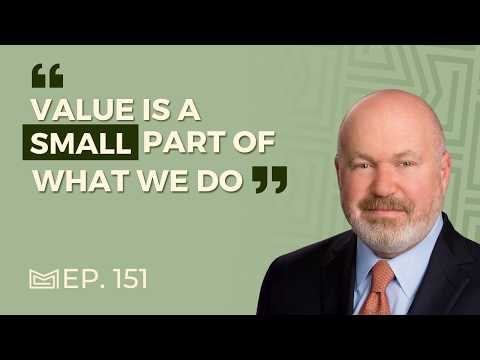
Volatility Laundering in PE, International Diversification, Value Vs Growth and Systematic Investing
What this covers
Simon introduces Cliff Asness, Co-Founder and CIO of AQR (Applied Quantitative Research), highlighting the firm's systematic approach to investing in a variety of assets.
Cliff Asness shared his background, mentioning that he was initially an underachiever in school but transitioned to a highly driven person during college at the University of Pennsylvania.
He explained that market efficiency is a spectrum, and even Fama admitted that markets are not perfectly efficient, despite what many might assume.
Discussing current markets, Asness emphasized the importance of global diversification and noted that the U.S.'s prolonged outperformance mostly stemmed from its increasing valuation premium over international markets.
He highlighted "volatility laundering" in private assets, where the infrequent marking of private investments creates an illusion of lower volatility, cautioning that this could lead to misinformed investment decisions.
Asness touched on philanthropy, saying he finds joy in charitable giving despite the difficulty in assessing the best use of funds and mentioned the importance of concentrating philanthropy for more impact.
Subscribe to stay up to date with our range of fascinating interviews, featuring some of the biggest names in global finance and business!
TOPICS: 00:00:00 - Introduction 00:05:30 - Choosing between Wharton, Chicago, and Stanford 00:15:49 - Discovering Momentum 00:20:53 - Joining Goldman Sachs Asset Management 00:31:34 - The Evolution of Investment Models and Strategies 00:36:45 - The Value of Small Bets and Diversification 00:42:10 - The Importance of International Diversification 00:52:23 - The Inevitability of Being Wrong 00:57:28 - The Definition of Risk 01:08:06 - Lessons from Dealing with Media 01:18:26 - Philanthropy 01:23:23 - General Information and Disclaimer
SPONSORS: - Schroders is a global investment and wealth manager, with a purpose to provide excellent investment performance to clients, through active investment management. Find out more: https://www.schroders.com/en/global/individual/
- IFM Investors are a global institutional asset manager whose purpose is to invest, protect and grow the long term retirement savings of working people. They manage investments across infrastructure, debt, listed equities and private equity assets. Find out more: https://ifminvestors.com/en-gb/
- The World Gold Council is membership organisation that champions the role gold plays as a strategic asset, shaping the future of a responsible and accessible gold supply chain. Our team of experts builds understanding of the use case and possibilities of gold through trusted research, analysis, commentary, and insights. Find out more: https://www.gold.org/
STAY UP TO DATE ✅ Newsletter: https://www.moneymazepodcast.com/subscribe ✅ LinkedIn: https://uk.linkedin.com/company/the-money-maze-podcast ✅ X/Twitter: https://twitter.com/podcast_maze
LISTEN: 🎧 Apple Podcasts: https://podcasts.apple.com/gb/podcast/the-money-maze-podcast/id1504477769 🎧 Spotify: https://open.spotify.com/show/0uT0iw8BkDIvFH12Z3GJKR
DISCLAIMER All content on the Money Maze Podcast is for your general information and use only and is not intended to address your particular requirements. In particular, the content does not constitute any form of advice, recommendation, representation, endorsement or arrangement and is not intended to be relied upon by users in making (or refraining from making) any specific investment or other decisions. Guests and presenters may have positions in any of the investments discussed. The Money Maze Podcast is funded by third party advertising, with all episodes editorial - and not commercial - in relation to all interview content discussed. Please note, Money Maze Curated Podcasts do not contain third party advertising, and are instead funded by the featured interviewee and/or their business (these episodes are commercial, as opposed to editorial features).
Source description (no synthesized summary yet).
Asness argues that systematic, diversified, quantitative investing based on historical data and behavioral finance principles can generate consistent alpha while markets are inefficient enough to exploit but unpredictable enough that timing catalysts is futile; long-term investors must resist concentrated bets and maintain disciplined processes across market cycles.
- Markets are 'almost assuredly not perfectly efficient' but finding profitable mispricings requires diversification and sticking to systematic rules, not trying to time when they'll correct
- US outperformance vs international stocks is 85% repricing (multiple expansion), not fundamentals, so future returns are unlikely to repeat despite 30-year track record
- Private assets use 'volatility laundering' by infrequent marking, hiding true risk; illiquidity was once compensated as a bug but is now treated as costless, threatening future returns
This asset isn't compiled yet
You're seeing its claims, ranked. Compile it to build the argument threads, weight them, and check each claim against your library — the full view.
Asness found from 1963-1990 that the last 12 months of total price return tend to predict the next month's price return, with far-from-perfect but trading-strategy-quality predictive power well above what would be expected under market efficiency.
“I found this result initially from 63 to the to 90 that the last 12 months of price return tend to predict the next month's price return it's far or Total return or Price return doesn't matter it's far from perfect it's a trading strategy with what we would call a decent risk adjusted return well above what it should have if there was no predictive power”
Once you open the door to questioning perfect market efficiency, the real debate becomes 'how efficient are they' and 'does that change through time,' with literally nobody in the world believing in perfect market efficiency, so all arguments are about where on the spectrum between the goalposts they fall.
“so I think it's that's how I understood the whole thing uh but it gets really interesting when you start drilling into it uh literally nobody in the world uh believes in perfect market efficiency um we all uh you know a gray area arguments are harder but we're all arguing about where amongst the goalposts they are”
Systematic investing is defined by: (1) rules-based, historical data analysis with theoretical foundation, (2) consistent adherence to the model output with few exceptions, and (3) diversification across many positions rather than concentrated bets, because quants typically have small edges applied across many situations.
“systematic is largely based on historical data hopefully with theory that you pursue it diversification and with perilously few exceptions that day you follow your model you're not sitting there saying how do I feel about this... systematic almost by definition means almost all the time there can be Exceptions there could be risk breaks there can be you can have you you can think maybe the data is bad and we have to go check it um but almost all the time you are following what your model says... quantitative systematic investing is almost always a small Edge that you want to apply in many many places”
International diversification's primary risk is crashes occurring simultaneously across major developed markets in short time horizons, but its core benefit is protection against decades-long country-specific underperformance like Japan's 1990s lost decade.
“when the world panics when you have a March of 2020 when you have an October of 87 and August of 98 when Russia defaulted some go down more than others but there aren't a lot of safe developed big Global Equity markets they crash together... if you look at worst cases for a global do portfolio they're fairly similar to individual country wor cases at the short end but if you take a longer lens and look at worst say decades the worst decade for the global portfolio has been considerably more mild than the worst decade for pretty much every individual country because there are decades that are country specific”
Finding the precise catalyst for when market mispricings will correct is nearly impossible for investment managers, even when they believe a valuation bubble is justified in contracting, so successful bubble-period investing requires maintaining conviction in the strategy despite extended periods of underperformance.
“we are really bad and I don't just mean aqr I mean the collective Financial Community certainly including aqr at finding the precise Catalyst for when rationality is reimposed on on markets”
An investor should maintain an open mind that their models might be wrong because even if claims that 'the world has changed' are wrong 99 out of 100 times, the 1 time they're right is important enough to warrant continuous skepticism
“you never want to say we've been running this model for 20 years and it works because even if the claim the world has changed and it's different this time is wrong 99 out of 100 times I would doubt it's wrong a 100 out of 100 times so if you don't have an open mind that you might be wrong you're doing it wrong”
US market outperformance versus International over approximately 30 years derives 85% from US valuation multiple expansion (repricing) and only 15% from genuine fundamental performance—better earnings growth, margins, and execution.
“don't quote me on the actual numbers but it's very close about 85% to the US's victory over the last 30 some odd years has come from the US getting more expensive relative to non- us markets... 15% has come from genuine fundamental performance growing earnings sales margins better the US has functioned somewhat better”
To distinguish random data mining results from real effects, researchers must verify: (1) a plausible theory explaining why the result should exist, and (2) out-of-sample tests showing the result holds in data the researcher had not previously examined.
“if some result isn't just random you find uh that that uh CEOs with first initials that begin with a vowel companies do better two things a do you have any Theory that's plausible... the other thing you look for are what are called add of sample tests those are is there data available to run essentially the same test that you have not looked at yet”
Momentum effects also passed international out-of-sample tests, which is important because if a behavioral pattern only works in the US due to specific psychological reasons, it strains credibility; if it works globally, it's more likely to be a fundamental market inefficiency.
“later on not initially in my dissertation we also tested all of that internationally which is another beautiful out of sample test um you I'm sure you've never found this but we in the US May occasionally think we're the entire world if something works in the US for psychological behavioral reasons that make markets not terrible but imperfect you got to really tell a very Twisted story why it's only in the US if it doesn't work anywhere else”
Asness wrote a piece titled 'The Long Run Is Lying to You' examining US versus international performance and other long-period comparisons (value versus growth), showing that 30-year periods can be highly misleading and that someone investing based on 30 years of underperformance (like never owning the US) would have been wrong for a long time before eventually being proven right.
“I wrote a piece on this called the long run is lying to you it wasn't just on US versus International it also looked at Value growth and a few other things um but the US's Victory and call it it's a little more call it 30 years”
The illiquidity and opacity 'bug' has become a 'feature' that investors now willingly close their eyes to because it makes their lives easier (steady reporting), transforming a compensated cost into an uncompensated benefit for the manager—the edge should be much smaller, gone, or even negative going forward.
“but I believe my story and it's you have to you don't have to believe me that this bug has become a feature that many willingly close their eyes to because it makes life easier for them well a feature is something you pay for not something you get paid for and it's not portending disaster for privates at all but it does say that edge might be much smaller gone or even the wrong sign going forward if this makes life easier you should be willing to accept a lower return than the true beta and risk entail”
Private equity and private debt are marked infrequently (often quarterly or less), which enables them to report artificially smooth returns and low measured volatility compared to daily-marked public equity portfolios, a practice Asness terms 'volatility laundering'—the appearance of low risk is created not by the investments being genuinely low-risk but by infrequent repricing.
“you can think of any investment as expected return over risk how to define risk is an open issue volatility is a simplistic way to do it and my phrase volatility laundering which is one of the few phrases attributed to me that I actually didn't steal um that I did come up with most of them I anything most of my quotes I am paraphrasing someone smarter than me um but return over risk any investor of any kind they may Define risk differently but that's that's how they should be thinking of the world”
The value spread (the dispersion between the cheapest and most expensive stocks on valuation metrics) is a useful measure of valuation extremity—when the spread is very wide (120th percentile as a mathematical joke), it indicates bubble-like conditions
“we built something called the value spread uh prior to that all the academic work at least had simply sorted stocks...but we...said okay but how big's the difference...Bubbles a good working definition of a bubble is a disparity so large you don't think it's possibly justified”
Eugene Fama, despite winning the Nobel Prize for the Efficient Market Hypothesis, has repeatedly stated in class that markets are 'almost assuredly not perfectly efficient,' and this statement generates audible shock from University of Chicago students but is met with indifference elsewhere in the financial world.
“the third week of class Jean and I took the class three times effectively... it's about the third week every year he looks at the class after introducing the market uh the efficient market hypothesis and says just to be clear markets are almost assuredly not perfectly efficient and I don't know if it's a literal gasp but you can feel the room go like wow I can't believe he said that anywhere else in the world you don't get a gasp University of Chicago and jeans class you get a gasp anywhere else in the financial World they go yeah we know markets aren't perfect”
When a systematic investor truly studies their strategy and determines they're right despite extended underperformance, success comes from 'sticking to what you do like grim death' rather than trying to predict the catalyst for reversion
“those few times are not about predicting the Catalyst they're about sticking to what you do like Grim death and defending it and being proven right”
The private asset advantage historically derived from accepting illiquidity and opacity as 'bugs' in exchange for higher returns; David Swenson at Yale pioneered this in endowments by buying at large discounts to public market valuations because of illiquidity premiums that compensated for the friction.
“go back to say the 1980s and famously David Swenson at Yale was was the major Pioneer of introducing these assets into endowment portfolios it is highly likely that he was a genius and realized you got a very large premium for being willing to accept this illiquidity and OPAC opacity that means that illiquidity and opacity was a bug and in a rational investing world and the world's not always rational but in a rational investing world you get paid extra if you're willing to be the one to take the bug”
The financial community, including AQR, is 'really bad' at finding precise catalysts for when markets revert to rationality; the dot-com bubble bursting in March 2000 lacks a clear single cause despite retrospective explanations.
“we are really bad and I don't just mean aqr I mean the collective Financial Community certainly including aqr at finding the precise Catalyst for when rationality is reimposed on on markets um in 99 2000... if you tell me why the dotcom bubble burst in March of 2000 looking back I don't think anyone has a super clear reason”
The belief that perfect market efficiency is true is irrational and extreme; the real intellectual debate in finance is about the degree of market efficiency, not its existence.
“literally nobody in the world uh believes in perfect market efficiency um we all uh you know a gray area arguments are harder but we're all arguing about where amongst the goalposts they are”
Data mining without theory (testing patterns in data without first establishing a mechanistic why) is a genuine risk in empirical finance, but finding patterns empirically and then reverse-engineering a plausible theory is better than having theory with no empirical support.
“there's a great danger to just testing everything and seeing what works because a lot of things just work randomly and will it work going forward...if some result isn't just random you find uh that that uh CEOs with first initials that begin with a vowel companies do better two things a do you have any Theory that's plausible”
Eugene Fama, despite being the founder of the efficient market hypothesis and a Nobel laureate for that work, explicitly tells his students that markets are 'almost assuredly not perfectly efficient' and that this statement causes gasps of surprise at the University of Chicago but not elsewhere in the financial world, revealing a philosophical shift even from the theory's originator.
“he looks at the class after introducing the market uh the efficient market hypothesis and says just to be clear markets are Mo almost assuredly not perfectly efficient and I don't know if it's a literal gasp but you can feel the room go like wow I can't believe he said that anywhere else in the world you don't get a gasp”
The efficient market hypothesis suggests prices reflect all available information with perfect rationality, though the dual hypothesis problem requires specifying a model for how information is rationally incorporated; testing market efficiency requires both a model of expected returns and data, which complicates clean rejection of the hypothesis.
“the efficient market hypothesis says prices reflect all information there is a technical problem I'll only spend a second on called the Dual hypothesis problem where you do have to think about how they're supposed to reflect that information you need a model for what is rational incorporation of information um and that that is actually still an issue in in studying Finance uh but just take idea the intuitive idea of efficient markets I think everyone gets that markets are pretty good at processing all out there and there aren't Giant mispricings”
Despite criticism of private assets generally, if you identify a private equity or private credit manager you genuinely believe is 5% better than the average (highly skilled), that belief should override concerns about the asset class, because finding truly superior managers is rare but can justify investment in otherwise sketchy categories.
“do you find a private Equity or private credit manager you think it's 5% better than the average always do that whatever I'm saying is trumped by if you find someone you think is incredibly skilled the cynic in me will say be really you know I I don't think you run into those managers every day uh but it's not about that uh but the general investment uh uh in these things I think is largely being sold on the ability to report what I think are fake numbers”
Asness ran momentum tests from 1926-1963 using historical price data and got essentially identical results to his 1963-1990 findings, providing strong out-of-sample evidence that momentum was a robust effect rather than a statistical artifact.
“I suddenly realized that at that point they didn't have the data to test value in particular prior to 63... and it just you know this was um made a kind of a simple Epiphany... I said wait what I'm studying is just price we do have that data back much more and then I ran the same test from 26 to 63 and got essentially the exact same results and that I had a little bit of a moment of oh wow that was that was cool”
No trees grow to the sun; the US relative valuation premium cannot expand infinitely, so one of two scenarios must occur: either the US premium is justified and future outperformance stops as multiples stabilize, or some of the premium will mean revert.
“there are basically two possibilities going forward and a third one that I dismiss the one I dismiss is the US continues to get relatively more expensive that Gap just grows to add infin item no trees grow to the sun and the US is already quite U more expensive so there are two possibilities the US expensiveness its relative expensiveness was wrong 30 years ago and is right now... the other is is some of this will mean revert”
Both private asset managers and public market quantitative managers can choose either to mark at market price or at perceived intrinsic value, but public market managers conventionally choose market price while private managers choose intrinsic value, creating inconsistent treatment of identical choices.
“private managers are absolutely capable of marking things at where they think it's worth or at where they think they could sell it today people make it sound like this is some oh we don't know where we could sell it these guys they know more about individual businesses that I can dream of they're brilliant they chose to buy these businesses based on a valuation model that is often based off the public markets and what discount they think they're getting they could absolutely tell you in an orderly sale what we think it would be down today... on the other hand we are completely capable of telling you what we think the portfolio is worth in March of 2020 when a 20 plus per Vol portfolio was down in the 30s”
A private equity or private credit manager who is 5% better than average is worth the fees, and such managers do exist, but they're not encountered every day and the bar for what constitutes 'better' is high
“if you find a private Equity or private credit manager you think it's 5% better than the average always do that whatever I'm saying is trumped by if you find someone you think is incredibly skilled the cynic in me will say be really you know I I don't think you run into those managers every day”
AQR's active portfolio makes only small directional bets on secular themes like the US versus international underperformance, rather than concentrated sector or regional bets, partly because of analysis showing value is a coarser classification than individual stock picking.
“we and it's not unique to us some other quants do this too take a very Diversified approach the Magnificent 7 are in there but at no special weight and we don't bet a lot on Industries or sectors U we wrote a paper in 95 saying value is pretty coarse way to do that and that has proven very good in the last few years as we've avoided that”
Academic finance and practical investing differ fundamentally: academic work must generate publishable findings with clear statistical results, while practical investing rewards small edges applied diversely over long periods, meaning academic insights don't always translate to investment success.
“I would say once you open the door now you argue now now the argument is how efficient are they and H and a subset of that is does that change through time um so I think it's that's how I understood the whole thing uh but it gets really interesting when you start drilling into it uh literally nobody in the world uh believes in perfect market efficiency um we all uh you know a gray area arguments are harder but we're all arguing about where amongst the goalposts they are”
Private equity benefits from a 30-40 year bull equity market with largely declining interest rates, creating ideal conditions for leveraged equity strategies; combined with infrequent marking creating perception of safety, it's unsurprising it became a gigantic business.
“they are the most long-term successful strategy you could imagine not only do they have this opacity but they had it during a 30 40y year bull Equity Market where in even counting the backup interest rates um interest rates have largely just done this so it was a pretty good 40 years to run a levered equity portfolio and then if you throw in we look much calmer and safer than we are it's not a wonder it is a gigantic business”
The primary psychological explanation for momentum is 'underreaction': when new news comes out, prices move but 'anchoring and adjustment' prevent them from moving all the way to their rational level, leaving 'juice' for momentum traders to profit from the continued adjustment.
“the main one people have the main one I think is going on is what's called underreaction when new news comes out the prices move but there's a psychological phenomenon called anchoring and adjustment don't move all the way um so there's still some juice left just by observing price moves”
AQR's flagship Global Alpha product at Goldman Sachs targeted volatility 50% higher than equity market volatility in a market-neutral structure, creating huge up and down days but theoretically unrelated to stock market direction, making the high volatility more tolerable despite being psychologically difficult during drawdowns.
“we were targeting volatility that was probably 50% more than the equity Market's volatility H and you know you may notice the equity Market tends to move around a bit um we were targeting that in a market neutral way though so we should move around a lot we should have huge up dayss huge down days but they should on average make money that's pretty important and be unrelated to the direction of the stock market”
International diversification fails to protect investors during short-term crashes (all developed markets crash together during March 2020, August 1998, October 1987 type events) but succeeds over longer time horizons because country-specific lost decades (like 1990s Japan) are diversified away when holding global portfolios.
“International diversification Works dot dot dot eventually and what we showed was that statement is absolutely true about short-term crashes or to be more tactical has been true always want to get my tenses right meaning when the world panics when you have a March of 2020 when you have an October of 87 and August of 98 when Russia defaulted some go down more than others but there aren't a lot of safe developed big Global Equity markets they crash together if you run the exercise so if you look at worst cases for a global do portfolio they're fairly similar to individual country wor cases at the short end but if you take a longer lens and look at worst say decades the worst decade for the global portfolio has been considerably more mild than the worst decade for pretty much every individual country because there are decades that are country specific”
Many private credit managers claim Sharpe ratios around 10.0, which is extraordinarily high and has never been achieved by even the best quant managers like Jim Simons' Medallion fund (estimated at 2–3 Sharpe ratio); the stock market has roughly a 0.4 Sharpe ratio, making a 10.0 claim implausible and suggesting systemic misrepresentation through volatility laundering.
“I got sent a private credit like a one-page tear sheet that had at the bottom sharp ratio realized sharp ratio over X you know pretty I forget five years whatever 10.0 we all have heard of unfortunately he's just passed on Jim Simons at Renaissance and The Medallion fund not everything Renaissance does a lot of the stuff they do is just good Quant stuff not better than what people like we do but The Medallion fund is Magic they have made an insane amount of money with very low risk in liquid Securities for a really long time and I bow before them Jim Simons never had a 10.0 sharp ratio I don't know the exact number uh but if I had a guess two three maybe um very amazing numbers the stock market's a 04 sharp ratio 10.0 even two or three might be an exaggeration 10.0 is insane”
Goldman Sachs wanted to start a Quant group largely because of the early success of Long-Term Capital Management, a group of academics on Wall Street making significant money; though Asness notes they did not do very similar things to Long-Term Capital and emphasizes the LTCM team were brilliant people who unfortunately had problems.
“Goldman was looking to start a Quant group there's an even funny subp part of the story you know why they were looking to start a Quant group largely because of the then success of long-term capital yes course a bunch of academics who were on Wall Street making a ton of money and Goldman was not alone other firms were saying we need some guys like that um I don't think what we do and I don't want to criticize the long-term capital guys they were brilliant guys thankfully for us CU it did have its problems we didn't do very similar things to them”
Systematic investing is defined by two essential components: (1) following what a rules-based model says almost all the time without daily discretionary overrides based on personal opinion, and (2) applying small edges across many diversified positions rather than concentrated bets, which is nearly definitional to quantitative investing.
“systematic is largely based on historical data hopefully with theory that you pursue it diversification and with perilously few exceptions that day you follow your model you're not sitting there saying how do I feel about this”
Gene Fama and Ken French called momentum 'the largest embarrassment to their three and later five Factor models' despite it being a real and reproducible phenomenon, revealing tension between empirical reality and theoretical model elegance
“he might not like that momentum Works he's called it the um he and Ken French have repeatedly called at the largest embarrassment to their three and later five Factor models um but he was very good about it and very supportive”
Private managers argue that when markets fall 20%, their marks shouldn't fall 20% because the underlying business is still worth more, which is a fair aggressive position that implies markets are 'totally wrong' but conflicts with objective risk assessment
“one of the great responses to me um from private managers are public markets are crazy that is volatility but our marks are more accurate what they're saying which I have a lot of sympathy for...is that they are right when markets fall 20% why should we Market down 20% the businesses are still worth more that's a fair aggressive position that says markets you know...they're totally wrong”
Private credit, while having a better return story than private equity (due to bank replacement), on average resembles 'some form of high-yield investing' and hasn't been tested through a credit crisis, so claiming extraordinary alpha risks being proven wrong when the real credit test comes.
“private Credit in particular private credit probably has a better story than private Equity right now because there is a replacement of banks who used to be the intermediaries here so the idea that there should be a large large new private credit industry I think is real but uh one of my colleagues Pete HEc uh and others have done this work if you actually look at the Returns on the average and it's hard to get the data but the best you can do average private credit manager it looks a lot like some form of high yield investing it doesn't look like magic and that whole industry has not been around through a credit crisis”
Asness discovered price momentum—the phenomenon that the last 12 months of price returns tend to predict the next month's returns—initially from 1963-1990, though colleagues Jegadeesh and Titman are credited as pioneers; he tested the strategy out of sample from 1926-1963 and found the same results, later testing internationally to confirm it wasn't a US-only artifact.
“we found I found this result initially from 63 to the to 90 that the last 12 months of price return tend to predict the next month's price return it's far or Total return or Price return doesn't matter it's far from perfect it's a trading strategy with what we would call a decent risk adjusted return”
US equity outperformance versus international stocks over the past 30 years has been approximately 85% due to multiple expansion (US stocks becoming relatively more expensive compared to international stocks) and only 15% due to genuine fundamental outperformance in earnings growth or margins.
“if you look at the US's Victory don't quote me on the actual numbers but it's very close about 85% to the US's victory over the last 30 some odd years has come from the US getting more expensive relative to non- us markets so pick your favorite multiple and we've looked at tons of them you can use Price to Book price to sales price to trailing earnings forecasted earnings free cash flow the us at the beginning of this period sold at a discount probably because people were depressed about it after a period of underperformance again it's hard to think about 1990 us but it was not an upbeat economic environment the US now sells at a substantial premium 85% of its victory in returns has been this repricing 15% has come from genuine fundamental performance growing earnings sales margins better the US has functioned somewhat better”
Finding the precise catalyst for when bubbles burst and mispricing corrects is nearly impossible, as demonstrated by the 2000 dotcom bubble which had multiple potential explanations (Y2K-related Fed liquidity withdrawal, Barron's burn rate story, cash depletion) but no single clear trigger, so the practical approach is to maintain diversified exposure while remaining open-minded about potential errors.
“catalysts are sometimes clear expost but even that if you tell me why that I'm I'm going back 25 years but if you tell me why the dotcom bubble burst in March of 2000 looking back I don't think anyone has a super clear reason the FED had injected a bunch of money worrying about Y2K another ancient issue that that probably a lot of people have never even heard of um and they were starting to withdraw that that might be part of it uh Baron's famously had a cover story about the burn rate Tech and particularly dot companies uh meaning they were burning through their cash and some people point to that as maybe you know they couldn't refinance but they burned through cash for a decade and they were always able to raise new cash at higher multiples so that's unsatisfying”
If a severe equity market drawdown occurs (like a truly bad decade), the volatility laundering of private assets would suddenly be exposed because even infrequent marking cannot hide major declines indefinitely, leading to a rude awakening for investors who assumed private assets had 4% volatility and 0.3 beta when they actually have 22% volatility and 1.3 beta.
“I I pray this doesn't happen because there's a lot of collateral damage in a devastating decade but if you have a really bad decade for equities You Can't Hide anymore even the privates will be there and if you assumed they were a 4% volatility portfolio and A3 beta when they're actually a 22% Vol 1.3 beta you were going to have a very rude awakening exactly when it matters most”
Private credit has a better structural story than private equity (due to bank disintermediation creating genuine supply-demand imbalance for alternative credit), but average private credit manager returns look like high-yield investing when properly analyzed, and the apparent superiority comes from volatility laundering rather than genuine outperformance.
“private Credit in particular private credit probably has a better story than private Equity right now because there is a replacement of banks who used to be the intermediaries here so the idea that there should be a large large new private credit industry I think is real but uh one of my colleagues Pete HEc uh and others have done this work if you actually look at the Returns on the average and it's hard to get the data but the best you can do average private credit manager it looks a lot like some form of high yield investing it doesn't look like magic it's the volatility laundering that looks like magic”
Value and momentum are negatively correlated over time—a good year for value investors is often a bad year for momentum investors and vice versa—but both work on average, making them ideal diversifying strategies that don't offset each other.
“they both on average work but they work at very different times and geek speak they're negatively correlated Simon if you're a value investor and I'm a price momentum investor a good year for you is often not a good year for me and vice versa but on average we both make money and that's one of the Holy Grails of investing be you a Quant or not a Quant finding things that on average work but don't work at the same time or even better work at different times”
Even after adjusting for industry effects (where the US dominates tech), US equity multiples remain larger than non-US markets on an industry-by-industry basis, suggesting the valuation premium is broad-based and not merely a sector composition effect.
“it's not as extreme obviously the US dominates in the tech industry but even if you look industry by industry the US multiples are larger”
Asness uses tools like Charity Navigator (checking overhead ratios and whether donations go to programs) as 'table stakes' for evaluating charities—avoiding those spending 80% on salaries—but even good overhead doesn't guarantee optimal use of funds.
“I use some of the very basic tools like famously charity Navigator is a tool everyone in the world that's largely Financial um is most of the money getting to the um you know there are Charities and and and I can't think of any off the top of my head thankfully where you realize the salaries being paid out or 80% of the donations coming in so that's kind of table Stakes that's M you know minimum is you want to avoid that”
The key to navigating bubbles is maintaining an open mind that you might be wrong while simultaneously studying the evidence and, if convinced of your analysis, sticking with it through periods of underperformance, defending your strategy until proven right—a few times in a career this discipline pays off dramatically.
“you never want to say we've been running this model for 20 years and it works because even if the claim the world has changed and it's different this time is wrong 99 out of 100 times I would doubt it's wrong a 100 out of 100 times so if you don't have an open mind that you might be wrong you're doing it wrong but if you really and truly study it and decide you're right those few times are not about predicting the Catalyst they're about sticking to what you do like Grim death and defending it and being proven right and that we've done that at least twice”
Long-term successful investment strategies inherently contain the seeds of their own decay as widespread adoption reduces the edge and changes the market structure that enabled their outperformance.
“any long-term successful strategy has a little bit of the root of its own problems going forward”
Investors should never say 'we've run this model for 20 years and it works, so it will keep working' because while claims of permanent model breakdown are usually wrong, they could be right 1-2% of the time, requiring open-mindedness to the possibility that the world has genuinely changed.
“you never want to say we've been running this model for 20 years and it works because even if the claim the world has changed and it's different this time is wrong 99 out of 100 times I would doubt it's wrong a 100 out of 100 times so if you don't have an open mind that you might be wrong you're doing it wrong but if you really and truly study it and decide you're right those few times are not about predicting the Catalyst they're about sticking to what you do like Grim death and defending it and being proven right”
If a major down decade occurs in equities, private assets marked at low volatility with assumed 0.3-0.5 beta that are actually 22% volatility 1.3 beta will create 'a very rude awakening exactly when it matters most,' as previously hidden risk becomes impossible to mask.
“I I pray this doesn't happen because there's a lot of collateral damage in a devastating decade but if you have a really bad decade for equities You Can't Hide anymore even the privates will be there and if you assumed they were a 4% volatility portfolio and A3 beta when they're actually a 22% Vol 1.3 beta you were going to have a very rude awakening exactly when it matters most”
Private credit as an industry has not yet been tested through a severe credit crisis, leaving uncertainty about whether current return characteristics and risk profiles will hold when extended credit cycles reverse and refinancing becomes difficult.
“and private Credit in particular private credit probably has a better story than private Equity right now because there is a replacement of banks who used to be the intermediaries here so the idea that there should be a large large new private credit industry I think is real but uh one of my colleagues Pete HEc uh and others have done this work if you actually look at the Returns on the average and it's hard to get the data but the best you can do average private credit manager it looks a lot like some form of high yield investing it doesn't look like magic it's the volatility laundering that looks like magic and that whole industry has not been around through a credit crisis”
The value-growth disparity in late 2020 was not justified by any reasonable valuation fundamentals that Asness examined, and AQR spent considerable time trying to find any defensible story for the extreme spread before deciding to defend the value position despite uncertainty about when it would work.
“I don't want to make that a sole excuse you know Co ate my Alpha is a poor is a poor excuse but it took Co to send it to extremes so by the by kind of the end of 2020 we saw record levels um and and and it was not justified by any fun fundamentals we looked at we spent a lot of time saying is there something we're missing and then the task is to stick with it”
At Goldman Sachs, Asness and colleagues ran multiple types of portfolios: traditional benchmarked portfolios (long-only, no shorting, no leverage) using their models to overweight and underweight stocks, and aggressive hedged market-neutral portfolios using long/short positions and derivatives with higher target volatility (50% more than equity market volatility).
“when we were at Goldman Sachs we ran all kinds of portfolios we ran very traditional um portfolios where you have a benchmark say of global equities um you can't do any of the hedge fund type stuff you can't short you can't lever um you can't use derivatives in many of them and you just use your models um again back then they were largely value in momentum and they've tremendously evolved since then but to buy things you think are better than the index and sell things you think are worse but in a very traditional format we also ran quite aggressive in some cases hedge fund versions these are less different than they sound they sound radically different but to be overs simplistic if in a traditional portfolio you overweight stock a and underweight Stock B based on your model in a market neutral hedge portfolio you long stock a and you short Stock B at some ratio you think is is very is very hedged um so it we were known for a bunch of things and we had a good run in in everything but the premier product back then was something called Global Alpha which was a very aggressive too aggressive I would I would look back now certainly career-wise too aggressive um we were we were targeting uh volatility volatility is not a perfect measure of risk it's just um one one gear one metric we were targeting volatility that was probably 50% more than the equity market's volatility H and you know you may notice the equity Market tends to move around a bit um we were targeting that in a market neutral way though so we should move around a lot we should have huge up dayss huge down days but they should on average make money that's pretty important and be unrelated to the direction of the stock market”
When Asness asked nine Wharton professors with PhDs in finance where they would recommend he go for a PhD, expecting them to say Wharton, nine of them said University of Chicago and one (Bob Litzenberger) said Stanford, reflecting that Chicago was known as more empirically-focused while Stanford was known as more theoretically-focused, though both were capable of excellence in either direction.
“I expected all these professors to go oh you stay at Wharton if you want a PhD and I was very comfortable with that I I I liked Philadelphia which sounds odd in retrospect nine of them said go to the University of Chicago one said go to Stanford guy named uh Bob litzenberger very famous uh wonderful academic uh and an ex Stanford Professor um the way it broke down back then a little bit was uh both both were good at both but Chicago was known as more the empirical school where you're going to really get your get into the data Stanford was known as more the theoretical school where it was more mathematical models um and that's an exaggeration you could be great at either at either but that was the split”
Despite concerns about private equity fees, the main issue Asness criticizes is not returns but risk measurement, particularly the gap between reported volatility and true underlying risk when marking practices hide volatility
“I do not have a particular bone to pick I have a few concerns going forward but I don't have a particular bone to pick with private investing about The Return part”
Momentum and value work together synergistically because they are negatively correlated—when value investing has good years, momentum tends to have poor years and vice versa—making them complementary rather than substitutes in a diversified portfolio, and this negative correlation was crucial to their academic and commercial success.
“they both on average work but they work at very different times and geek speak they're negatively correlated Simon if you're a value investor and I'm a price momentum investor a good year for you is often not a good year for me and vice versa but on average we both make money and that's one of the Holy Grails of investing be you a Quant or not a Quant finding things that on average work but don't work at the same time or even better work at different times”
Private equity investors could tell you exactly what their portfolio would be worth if forced to sell today in an orderly sale, but choose not to mark to that value, instead marking at intrinsic value where they think portfolios are worth.
“private managers are absolutely capable of marking things at where they think it's worth or at where they think they could sell it today people make it sound like this is some oh we don't know where we could sell it these guys they know more about individual businesses that I can dream of they're brilliant they chose to buy these businesses based on a valuation model that is often based off the public markets and what discount they think they're getting they could absolutely tell you in an orderly sale what we think it would be down today if the markets fell 20%”
Historically, the illiquidity and opacity of private assets were compensated by investors (treated as a 'bug' requiring higher returns), but over time as private asset allocation became common and increasingly elegant, these characteristics became features that investors accepted without demanding additional return, reducing the genuine premium available in the sector.
“you have to you don't have to believe me that this bug has become a feature that many willingly close their eyes because it makes life easier for them well a feature is something you pay for not something you get paid for and it's not portending disaster for privates at all but it does say that edge might be much smaller gone or even the wrong sign going forward if this makes life easier you should be willing to accept a lower return than the true beta and risk entail”
Volatility laundering is the practice of marking private assets at perceived intrinsic value rather than orderly sale price, creating artificially low volatility figures that misrepresent true risk; this allows private asset managers to appear to deliver riskless or low-risk returns.
“volatility laundering which is one of the few phrases attributed to me that I actually didn't steal um that I did come up with most of them I anything most of my quotes I am paraphrasing someone smarter than me um but return over risk any investor of any kind they may Define risk differently but that's that's how they should be thinking of the world”
Private equity and private debt have succeeded during a 30-40 year bull equity market with a long-term decline in interest rates, creating an artificial performance backdrop that inflated the apparent skill of private managers and their value-added, which may not persist going forward.
“they had it during a 30 40y year bull Equity Market where in even counting the backup interest rates um interest rates have largely just done this so it was a pretty good 40 years to run a levered equity portfolio and then if you throw in we look much calmer and safer than we are it's not a wonder it is a gigantic business but I think it is danger quite dangerous to assume that they're anywhere like some of the risk estimates people use”
Asness jokes that writers in the US ask 'why invest internationally' given US success, but one doesn't see papers in Japan asking 'why invest in US and avoid Japan,' revealing how arguments for home bias depend on looking backward at winners rather than forward with humility about future uncertainty.
“I and I somewhat joke um when you see papers in the US or or even strategy writeups that basically say why invest internationally look how well we've done are there papers being written in Japan saying why invest domestically you should only invest in the US no the diversification means let me give you my favorite quote about diversification”
A private credit tear sheet cited a 10.0 Sharpe ratio, which Asness found absurd—even Jim Simons' legendary Renaissance Medallion Fund probably achieved 2-3 Sharpe, and the stock market achieves 0.4, so claiming 10.0 is either deceptive or involves undisclosed caveats.
“I got sent a private credit like a one-page tear sheet that had at the bottom sharp ratio realized sharp ratio over X you know pretty I forget five years whatever 10.0 we all have heard of unfortunately he's just passed on Jim Simons at Renaissance and The Medallion fund not everything Renaissance does a lot of the stuff they do is just good Quant stuff not better than what people like we do but The Medallion fund is Magic they have made an insane amount of money with very low risk in liquid Securities for a really long time and I bow before them Jim Simons never had a 10.0 sharp ratio”
Every long-term successful investment strategy 'has a little bit of the root of its own problems going forward,' as its success becomes its weakness; private equity's opacity and low-volatility marking that created edge now make it harder to adjust expectations when risk actually manifests.
“and I think it is danger quite dangerous to assume that they're anywhere like some of the risk estimates people use... I think... every long-term successful strategy has a little bit of the root of its own problems going forward”
The multiples paid by private equity buyers have become much closer to public market multiples over time, suggesting that the illiquidity discount that once drove private asset alpha has largely disappeared, reducing the edge from significant premium to minimal.
“but if you get them a little tipsy they'll tell you and and that they what they buy the multiples are much closer to public markets than they were at at X early point in their career”
The primary theory explaining why momentum works is 'underreaction'—when new news arrives, prices move but anchor-and-adjust psychological phenomena prevent full adjustment, leaving exploitable juice in price movements.
“the main one people have the main one I think is going on is what's called underreaction when new news comes out the prices move but there's a psychological phenomenon called anchoring and adjustment don't move all the way um so there's still some juice left just by observing price moves”
Asness uses Charity Navigator and similar tools to screen out clearly wasteful organizations (those with very high overhead or salary ratios), treating this as a minimum standard rather than a sufficient condition for philanthropic value.
“I use some of the very basic tools like famously charity Navigator is a tool everyone in the world that's largely Financial um is most of the money getting to the um you know there are Charities and and and I can't think of any off the top of my head thankfully where you realize the salaries being paid out or 80% of the donations coming in so that's kind of table Stakes that's M you know minimum is you want to avoid that”
During the dot-com bubble period (late 1990s-early 2000s), value-oriented strategies were destroyed for 'only' about 18 months, but this felt like 10 years due to psychological pressure, illustrating the challenge of maintaining discipline during extended factor underperformance
“it took Co to really take us there uh but that was not all of it prior to covid we were getting close to.com bubble levels...there was only about a year and a half I say only um but it felt like 10 years of rational strategies”
Asness initially discovered price momentum through data mining and PhD desperation rather than theory-driven research, and admits his early work was 'probably just a PhD student hacking around the data' to find something publishable.
“I have to admit you've gotten this out of me Simon I I usually don't admit this one um I think my initial work was probably just a PhD student hacking around the data um and data mining um it turned out that when you find a result there are two things you really want to see if some result isn't just random”
When AQR launched, the traditional asset management industry required a multi-year track record while hedge fund investors would accept new managers, creating a paradox where Asness had to launch an aggressive hedge fund despite wanting to build a balanced firm, because traditional investors wouldn't invest in a new fund manager.
“we discovered pretty quickly at aqr that you couldn't launch a traditional business as a bunch of uh I think I was the old man at 30 um people would look and go well we want a five-year track record and we prefer managers who look like Cliff looks today at 57 not like I looked at 30 we prefer some Grizzle on our managers but ironically to start a super aggressive levered shorting derivatives based or derivatives using not based hedge fund you had to tell them we did really well at Goldman Sachs and we're closing and they lined up to invest so I always found a little ironic that the you had to be a mature adult to run the safe boring version but you had to be 30 years old in closing to run the super aggressive hedge fund”
Asness cites a Yogi Berra quote about attending other people's funerals so they attend yours, as an analogy for international diversification: you must 'be humble and go we don't know who the winner going to be' and diversify accordingly.
“he was supposed to have said was you have to go to other people's funerals otherwise they won't come to yours and Yogi missed the fact that you're dead already or vice vers but forgetting forgetting Yogi International diversification is kind of like that you have to be humble and go we don't know who the winner going to be”
Diversification is not the right principle for charitable giving; a 'good one versus a bad one don't offset each other,' so Asness is 'more willing to be concentrated' in charity than in investment portfolios, and aims to avoid building a 'highest sharpe ratio charity portfolio.'
“the value of diversification is not the same in charity a good one versus a bad one don't offset each other we're more willing to be concentrated we're not quants when it comes to charity we're not trying to build the highest sharp ratio charity portfolio”
Asness uses Yogi Berra's quote ('you have to go to other people's funerals otherwise they won't come to yours') as a metaphor for diversification: investors must be humble about not knowing which country will win and maintain international exposure to be prepared for any outcome.
“I'll defend it to my uh to my dying day absolutely I'm with you and any any non- us investor has benefited from it so so the iron is lost on one but but it's staying with that uh dispersion in valuation between the US and the non- US what do you think causes the pendulum to swing the other way first let me be brutally honest it might not uh if you look at like quality measures profitability margins the US is stronger um and some of this may be justified um prior to the last few years and and I don't want to get moreid but certainly prior to the last week I might have said people look at the US political and legal system as more stable and safe I I think that's probably a harder sell today um than it than it than it was sadly even a few days ago um but that has been part of the repricing um so some of it could be justified again even if some of it's Justified that just means you don't get it again um so it doesn't mean you want to overweight the US going forward um the second part is let's assume a big chunk of it is unjustified let me be brutally honest we are really bad and I don't just mean aqr I mean the collective Financial Community certainly including aqr at finding the precise Catalyst for when rationality is reimposed on on markets”
Asness admits that his choice of Goldman Sachs over Academia involved both luck and financial incentives—he told his professors honestly that he believed he could do the same academic work in industry while getting compensated financially for it, and he acknowledges that anyone in finance who claims money had nothing to do with their career choices is not being truthful.
“told my professors the honest truth I think I get to do and study the same academic stuff I'd be studying uh as a professor um I get to see if it works for real which is very exciting and to be brutally honest I get paid a Goldman Sachs salary um to do it with all the upside that that that can come with and uh anyone particularly someone educated in finance who tells you they chose Goldman Sachs over Academia but money had nothing to do with it is probably also not telling you the truth if luck had nothing to do with it they're not telling the truth and anyone who chooses a career as a quantitative money manager who says it it had nothing to do with it I you know I I really wanted to be a poet but I I found this even even more exciting also probably not telling the truth”
Asness started AQR after leaving Goldman Sachs, initially launching with only a hedged product equivalent to their Global Alpha strategy because traditional asset managers required a 5-year track record while aggressive hedge funds only required proof of past success and closure from the previous firm
“you couldn't launch a traditional business as a bunch of uh I think I was the old man at 30 um people would look and go well we want a five-year track record...but ironically to start a super aggressive levered shorting derivatives...you had to tell them we did really well at Goldman Sachs and we're closing and they lined up to invest”
Asness acknowledges that financial incentives (compensation) played a significant role in his choice to work on Wall Street rather than pursue academia, and anyone who claims career choices involving this size financial differential had nothing to do with money is not being honest.
“but to be brutally honest I get to do and study the same academic stuff I'd be studying uh as a professor um I get to see if it works for real which is very exciting and to be brutally honest I get paid a Goldman Sachs salary um to do it with all the upside that that that can come with and uh anyone particularly someone educated in finance who tells you they chose Goldman Sachs over Academia but money had nothing to do with it is probably also not telling you the truth if luck had nothing to do with it they're not telling the truth”
When Asness told Eugene Fama he wanted to write a dissertation on price momentum because it works really well, Fama responded with intellectual honesty by saying 'if it's in the data write the paper,' demonstrating his respect for empirical evidence over ideology.
“I remember telling Jean I want to write a dissertation that at least is partially actually wasn't all on this but at least partially is testing the price momentum strategy and then I'm pretty sure I mumbled the second part the second part was and it works really well and Jean was like what was that cliff and I'm like um it momentum works really well and I thought he might be very dismissive of it I I should have respected him more he was incredibly intellectually honest his exact words to me um because they felt like a religious statement were if it's in the data write the paper”
In Asness's two-year period after the 2000 dotcom bubble, value and momentum-based strategies were 'just destroyed' while generating theoretical returns in contrarian investments, forcing a choice between maintaining discipline and capitulating—maintaining discipline proved correct but was psychologically grueling.
“I wrote another piece called uh value is only a small part of what we do except occasionally when it's everything we do uh I kind of I paraphrase the title because I never remember my exact titles uh but I remember uh that was only about a year and a half I say only um but it felt like 10 years of rational strategies trying to buy cheap high quality things with low betas and um getting just destroyed and the question we got from everyone was when's it going to work and my answer would be it's going to work extremely big from here but I cannot tell you it's not going to get worse before it gets better”
Luck played a significant role in Asness's career success, including Lucky timing with Long-Term Capital's prominence creating demand for quant talent, Pimco reading his published paper and recruiting him, and multiple other chance factors, which he acknowledges openly rather than claiming pure skill or determination.
“I then I just think I got very lucky and anyone who who's happy where their life turns out particularly if you're an order statistic on some front if you don't admit you had a lot of luck along the way you're you're just not telling the truth you're you're you're an egomaniac and I may be an egomaniac but not on this front”
Paradoxically, when AQR started, investors wanted to invest in an aggressive levered hedge fund from ex-Goldman traders but not a traditional low-leverage portfolio, because investors preferred 'mature' managers for boring products but required youth and energy for aggressive strategies.
“ironically to start a super aggressive levered shorting derivatives based or derivatives using not based hedge fund you had to tell them we did really well at Goldman Sachs and we're closing and they lined up to invest so I always found a little ironic that the you had to be a mature adult to run the safe boring version but you had to be 30 years old in closing to run the super aggressive hedge fund”
AQR created a 'value spread' metric before 1999 that measured not just whether cheap beats expensive stocks but also how large that disparity was, enabling them to quantify when disparities were normal versus bubble-like, which was novel analytical work not done previously in academic research.
“prior to that all the academic work at least had simply sorted stocks on various measures of value and said on average the cheap beat the expensive but we I guess we got lucky because no one had looked at it yet we came along and said okay but how big's the difference you know you can sort all the stocks on your favorite valuation metric it can be a known it could be a proprietary one you can always find cheap and expensive on your own metric that's by definition but sometimes maybe they're all smush together”
Assessing whether charitable giving is successful is 'so hard' because it requires not just evaluating whether outcomes are good, but whether that was 'the best place for the money,' which is a difficult counterfactual to assess and requires constant re-evaluation.
“how do you judge a successful outcome oh that that hey that's so hard um it's so hard um because it's not just the outcome it's it's it's was this the best place for the money”
Asness and his wife employ someone to continuously re-evaluate their charitable giving, recognizing philanthropy as 'a responsibility that comes with getting lucky in life,' but admit they have 'no magic answer' beyond extensive research and 'sweat equity.'
“we have someone who works with us on it um who's constantly trying to re-evaluate um and I think we've done a pretty good job and it's one of my great Joys... it's one of my great Joys and also when you give to something that after the case you think that was really ineffective you feel really stupid and it's it's a great sadness so it's a responsibility that comes with getting lucky in life um I think we've embraced it uh but we sorry we have no magic answer a lot of Sweat Equity”
Asness and his wife don't use quantitative approaches (like optimizing charitable Sharpe ratios) when allocating to charities, instead being willing to make concentrated bets on specific causes they believe in, contrary to their professional diversification practices.
“the value of diversification is not the same in charity a good one versus a bad one don't offset each other we're more willing to be concentrated we're not quants when it comes to charity we're not trying to build the highest sharp ratio charity portfolio um we have someone who works with us on it um who's constantly trying to re-evaluate”
Evaluating successful philanthropic outcomes is difficult because it's not just the outcome but whether that outcome represented the best use of the money—measuring effectiveness across different charitable interventions is challenging and requires ongoing re-evaluation.
“oh that that hey that's so hard um it's so hard um because it's not just the outcome it's it's it's was this the best place for the money”
Asness was initially nervous about proposing a dissertation topic on momentum to Fama because buying what's going up and selling what's going down seems to contradict the efficient market hypothesis, but Fama's response was intellectually honest: 'if it's in the data write the paper,' demonstrating Fama's commitment to empirical evidence over theoretical purity.
“I had to go into Jee fama's office and this was act I was actually scared I'm embarrassed to tell you things I was scared about because it's like why would you be scared of this but you know you're early 20s and you're going to Jee F's office to tell him you want to write a dissertation on the fact that buying what's going up and selling what's going down seems to be a really good strategy that does not scream efficient markets again efficient markets are a subtler definition you can try to shoehorn it in but it's it's not um and I remember telling Jean I want to write a dissertation that at least is partially actually wasn't all on this but at least partially is testing the price momentum strategy and then I'm pretty sure I mumbled the second part the second part was and it works really well and Jean was like what was that cliff and I'm like um it momentum works really well and I thought he might be very dismissive of it I I should have respected him more he was incredibly intellectually honest his exact words to me um because they felt like a religious statement were if it's in the data write the paper”
The value spread (difference in valuation metrics between cheap and expensive stocks) can be measured by percentile, and by late 2020, the spread had reached what Asness calls the '120th percentile' (a mathematical joke meaning it exceeded the 100th percentile—the widest ever recorded), before mean-reverting to the mid-80s percentile.
“that disparity got to what I call this is a mathematical joke the 120th percentile the joke of course is there is no 120th percentile you were just the new 100th percentile but it got to decently wider bigger disparities than in the bubble”
The US's political and legal system stability, which was historically cited as justification for paying a premium valuation for US equities, has become a weaker argument in recent years, suggesting some of the valuation premium may not be justified.
“prior to the last few years and and I don't want to get moreid but certainly prior to the last week I might have said people look at the US political and legal system as more stable and safe I think that's probably a harder sell today um than it than it than it was sadly even a few days ago um but that has been part of the repricing”
AQR today manages slightly north of $100 billion, not a $100 billion hedge fund as sometimes reported, because the firm charges traditional asset management fees (20 basis points) not hedge fund fees (2 and 20%), making it a fundamentally different business model that generates less fee income despite similar asset scale.
“we are not a hundred billion doll hedge fund um I I always tell people that for various reasons one I I you know I'm not complaining I've done quite well but not as well as someone who runs a hundred billion doll hedge fund we do not charge for Mo the bulk of the assets hedge fund fees when you run beat The Benchmark by a few percent a year uh traditional portfolios you you got to charge 20 basis points not two and 20 um so they're very different businesses but today we run a little bit north of hundred billion”
Asness has backed away from supporting higher education institutions despite it being an obvious choice, questioning whether universities with massive endowments (40-50 billion dollars) are actually good uses of charitable dollars, and citing a conflict with UPenn over their positions on Israel and Hamas.
“giving to institutions of higher education incredibly non-obvious that that's the best use of money in the world and I've backed away from aair of that there are still some schools I support um but you know famously um I I gotten a little bit of a fight with the University of Pennsylvania over some of their actions on on Israel and Hamas and I I moved away from that”
In Asness's active portfolios (not pure passive strategies), AQR makes very small tactical bets on issues like US versus international diversification that average out across diversified factor strategies (value, momentum, quality) rather than creating concentrated directional views.
“in our in our active portfolios we'll make very small bets on something like this we we again as quants we try to do many many things um and it's not just a value based value based strategies have liked outside the US for time in Memorial because the US has traded expensive quality and momentum based strategies have often like the US so for a diversified Quant in an active portfolio it's not always clear that you've just you know been short the us forever”
Asness cites Children of Fallen Patriots (founded by David and Cynthia Kim, a West Point graduate and former Army Ranger) as an example of a charity where he is certain the work is valuable—they send children of service members killed in the line of duty to college.
“one of my favorite Charities um I I've I've supported I've been on the board at times um is a local Greenwich uh charity uh uh started by David and Cynthia Kim uh David is a West Point for former Army Ranger um and it it was it's called children of Fallen Patriots and what they do is for servicemen who have died in the line of duty including training accidents and things they'll send their kids to college this is the outlier where I am certain this is a very good thing”
During March 2020, AQR's portfolio was down approximately 30% while its volatility targeting suggested ~20%, approximately a 2 standard deviation event—'horrible way to start a business but not a statistical off the charts event'—yet AQR remained confident in its marks while private managers would have kept marks steady
“which by the way was just about a two standard deviation event horrible way to start a business but not a statistical off the charts event but not fun when that your 18 of your first 19 months are are are down”
AQR experienced a very difficult 2.5-year streak around 2018 with significant underperformance, and the firm has run far more assets historically than it currently manages, demonstrating the cyclicality inherent in quantitative investing even for systematically successful strategies.
“we ran a fair amount more than that before 2018 when we had a very bad kind of two and a half year streak this business um even if you're right long term is very cyclical so i' I've seen both sides of this uh but certainly I'm I'm you know if you showed me the 25 year path and we're we're on our 26th year now um if you showed me that path when we launched aqr in 1998 um there there are years I'd like to skip but I would sign for the whole path in a heartbeat”
Value versus growth disparity is at the 85th percentile historically (down from 120th percentile in late 2020), still above average but not at panic-worthy extremes; this suggests value will outperform on average but not dramatically, and the 120th percentile level seen in 2020 was 'not all of it' but partly driven by COVID.
“it has come way back to the mid 80s percentile... so mid 80th percentile you might want a little more of that bet... the trade of the last four years for us of being overweight value is still there but at a fairly uh much more mild level um 120th percentile is they this can't stand the 85th percentile can last for 20 years”
The value-growth disparity reached extreme levels by late 2020, exceeding even the dotcom bubble peak in relative magnitude, which Asness did not expect to witness in his career and was shocked to be proven wrong on.
“if you had asked me after living through the.com bubble 25 years ago are you going to see something more extreme in your career at least in individual stocks again we trade more than that we do macro but in individual stocks you're going to see a mispricing larger than that I would have said nah I hopefully be smart enough to go to not say definitely not no one in our field my field your field our Collective field should ever say they're 100% certain because we live in a wacky world where crazy things happen but I think I would have said almost definitely not a it was the most insane thing in 50 years B in my career by definition I'll still be around and other people will still be around who saw the dot bubble so maybe a hundred years from now it'll happen again but 20 years later nah almost definitely not and then it did um so I was totally wrong about that one”
The US trading at a substantial valuation premium versus international markets after selling at a discount in 1990 creates two possible paths forward: either the repricing to current premium levels was correct and the US won't repeat its outperformance (mean reversion to fair value is a one-time event), or some of the premium will mean revert back down, reversing some of the US advantage going forward.
“there are basically two possibilities going forward and a third one that I dismiss the one I dismiss is the US continues to get relatively more expensive that Gap just grows to add infin item no trees grow to the sun and the US is already quite U more expensive so there are two possibilities the US expensiveness its relative expensiveness was wrong 30 years ago and is right now it's Justified people moved it took them a long time but they've moved to the right level that is somewhat good news for a US concentrated investor because it means you don't have to give back your outperformance but it doesn't mean you get it again it doesn't mean going forward the US is better it repricings to Fair are one time things the other and I'm going to guess truth is somewhere in between these two the other is is some of this will mean revert”
Asness believes giant market bubbles are unlikely in the next two years, and expects to 'grind it out' making historically normal or slightly-better-than-normal returns in a relatively uncorrelated way to broad markets
“I do think and these are famous last words uh there could be giant events to come but I I I I think these bubbles are not what I worry about in the next two years I think we grind it out and make maybe our historically normal or maybe a little better because of that value spread than normal returns”
Over the next two years, Asness expects the value-growth disparity to remain larger than normal, continuing to generate above-historical-average returns while maintaining low correlation with equities, though he prefers not to make specific market predictions.
“I'm going to sound like Warren Harding a US president who ran on a a platform of a return to normaly after World War I um we still see a larger than normal disparity between what you might call growth versus value I kind of hate those terms they're very simplistic we don't dislike growth we like cheap things contingent on growth but we'll go with the public terms for now any way you define it and many others have have repeated this I think we actually P I'll GRE I think we pioneered this analysis defending our process in 1999 we built something called the value spread um very long-winded way of saying the the trade of the last four years for us of being overweight value is still there but at a fairly uh much more mild level um we have I you know I end up talking about value and momentum so much when we talk about these histories I I always feel bad because we didn't stop there um our process is far richer and far deeper um adding new factors over over time new themes getting very into uh more systematic machine learning type driven investing in the last 5 to 10 years uh new data sources that were not available alternative data sources um I do think and these are famous last words uh there could be giant events to come but I I I I think these bubbles are not what I worry about in the next two years I think we grind it out and make maybe our historically normal or maybe a little better because of that value spread than normal returns in a relatively uncorrelated way and I'll be very happy”
Asness's investment process has evolved significantly over AQR's 25+ year history, expanding beyond value and momentum to include additional factors, systematic machine learning-driven approaches, and alternative data sources that were not previously available.
“we have I you know I end up talking about value and momentum so much when we talk about these histories I I always feel bad because we didn't stop there um our process is far richer and far deeper um adding new factors over over time new themes getting very into uh more systematic machine learning type driven investing in the last 5 to 10 years uh new data sources that were not available alternative data sources”
Working as a phone trader at Goldman Sachs was different from Asness's expected analytics role but he found it valuable because understanding over-the-counter markets, observing how traders selectively reveal information (or not), and experiencing the reality of trading benefited his later career.
“very quickly because they were building a business rapidly um I was a warm and at least semi-competent body so I was on the phones trading and and uh that was a different experience than I expected really good to have done once in your life I'm not born to be a on the phone Trader but understanding over-the-counter markets and um getting lied to by people and maybe not lying but not revealing his little poker to it um that was very in it stood me in good stad to have done that for a while”
Asness assumed PhD programs would have rankings similar to undergraduate programs, so he expected top MBA and undergraduate programs to also be top PhD programs; however, he learned this assumption was incorrect, and in his era, Wharton's PhD program was not nearly as strong as its MBA and undergraduate business programs.
“PHD programs I was naive I just assume they line up with undergrad and grad school rankings so if you are the top graduate program for an NBA you're probably the top PhD program and they're just very different um in some schools they they're they're they're they're very similar but in some schools and at that point and I I I don't know about today I've not kept up on it Wharton's PhD program was not nearly up to their NBA and their undergrad business work”
Asness studied under Eugene Fama at the University of Chicago and took Fama's class three times (twice as a student, twice as a teaching assistant), giving him deeper exposure to Fama's thinking than most students; Andy Low (later a famous MIT professor) wrote one of his PhD recommendation letters.
“I went to these professors of one of which I should mention is Andy L quite a famous academic Professor uh academic Professor redundant uh quite a famous uh MIT professor um I knew him when he was just Andy low uh he was effectively a kid um I always find it funny that he W wrote one of my recommendations to to to to grad school and then became very justifiably famous”
Asness finds great joy in effective philanthropy and also finds it sad when he later realizes that philanthropic donations were ineffective, suggesting he feels responsibility for making good use of resources accumulated through successful investing.
“it's one of my great Joys that sounds really self-aggrandizing and huting uh but it it's one of my great joys and also when you give to something that after the case you think that was really ineffective you feel really stupid and it's it's a great sadness so it's a responsibility that comes with getting lucky in life um I think we've embraced it uh but we sorry we have no magic answer”
AQR started with $1 billion in assets under management, which was the largest standing start for a hedge fund at that time, a record that has since been eclipsed many times like a sports record broken by younger, stronger athletes.
“we started out running a billion dollars um this was very exciting to us at the time I think uh I think we were at that point the largest standing start for a hedge fund to date um it's been eclipsed many times since then it's like having a sports record um the younger stronger athletes come in and Eclipse your your your records”
Asness experienced a 'road to Damascus' moment a few months after arriving at the University of Pennsylvania, transitioning from Type B (happy-go-lucky, aimless) to extremely Type A (driven, obsessive about work) and has 'never looked back,' representing a fundamental personality shift triggered by realizing he needed to prove he could perform.
“I had a panic moment uh more than a moment a few months when I showed up at college and I I was kind of like the kid who kept telling my parents and anyone else involved when it really counts I'll work I I I I'll turn it up and then I got there and and maybe for one of the few times in my life I really um felt lost because I was like I've been telling people I'll turn it up for years a can I and and if I do will it be successful and I will say I went through kind of a three Monon transition to extremely typ a um you know driven a little crazy about work and have never looked back”
Asness grew up on Long Island in a public high school and initially got into college 'solely because of standardized tests,' entering the University of Pennsylvania's dual degree program in business and engineering on his father's advice that he should study two subjects because he had no clear direction.
“I went to a perfectly good public public high school on Long Island um but it wasn't quite like today where if you were at all talented they did a great job of finding you and whatnot”
Asness has become skeptical about higher education as a charitable focus area and has questioned University of Pennsylvania's positions on Israel/Hamas, moving away from educational giving despite previously supporting multiple institutions.
“then some things like like giving to institutions of higher education incredibly non-obvious that that's the best use of money in the world and I've backed away from aair of that there are still some schools I support um but you know famously um I I gotten a little bit of a fight with the University of Pennsylvania over some of their actions on on Israel and Hamas and I I moved away from that”
Asness takes responsibility for poor Twitter communication during the meme stock episode but notes he's improved significantly, using an alcoholics anonymous metaphor ('200 day chip') to describe periods of not responding to trolls.
“I have gotten much better I have my my 200 day chip as alcoholics anonymous would call it I don't think I've done that in a while but that is my full Twitter story you've gotten out of me now”
Asness is drawn to Twitter because of the quality conversations in the financial Twitter (fin twit) community and finds it intellectually stimulating, but also admits to thin skin when disagreed with and susceptibility to dopamine hits from funny/clever posts.
“I absolutely love the fin twit Community I have great conversations uh I think I have a weird dual reputation on Twitter and I think there are people who a lot of people who back me up in the fin twit Community I think I'm super nice if someone comes with a polite question even if it's very naive even if I I think it's a newbie question even if it's not a newbie question and they're taking the other side from me I have thin skin the other problem with Twitter is if you are a person who thinks in any way falsely or truly that you are quick witted and funny and I certainly think I am I'm not sure a lot would agree it is almost irresistible because that dopamine hit of saying something funny and have having it be validated by others it's it's you get to be an amateur comedian um without having to put in the work in those dive bars”
PhD programs in finance do not align with undergraduate and MBA rankings; Chicago was known as the empirical school focused on data while Stanford was known as the theoretical school focused on mathematical models, and Asness chose Chicago partly because they offered to fly him out for a visit while Stanford did not.
“PhD programs I was naive I just assume they line up with undergrad and grad school rankings... Wharton's PhD program was not nearly up to their MBA and their undergrad business work... Chicago was known as more the empirical school where you're going to really get into the data Stanford was known as more the theoretical school where it was more mathematical models... Chicago had it in its budget and they said hey we'll send you a ticket do you want to fly out... I chose Chicago over Stanford on the weather”
AQR's diversified quant process includes many factors beyond value and momentum, newer systematic machine learning approaches, and alternative data sources that were not previously available, representing significant evolution from the original factor model.
“we have I you know I end up talking about value and momentum so much... when we talk about these histories I I always feel bad because we didn't stop there um our process is far richer and far deeper um adding new factors over over time new themes getting very into uh more systematic machine learning type driven investing in the last 5 to 10 years uh new data sources that were not available alternative data sources”
AQR is institutional and doesn't do much TV advertising because their clientele prefers podcasts; they made a rare TV appearance on CNBC after a difficult 2018-2020 period and their subsequent rebound to explain their comeback and continued long-term success.
“we don't do TV too often um partly that's just uh we have a very institutional clientele and that's not where we think they they they get their opinions we think they'd much rather listen to an arod dite podcast uh from than than than TV uh but we had this really terrible couple years and then a huge comeback so my team that generally doesn't encourage this said we think it's time to go on TV”
Asness's Twitter activity includes being drawn into meme stock arguments (particularly AMC), where he was misunderstood when trying to make technical points about volatility basis points, leading to accusations of calling retail traders 'crazy' and subsequent trolling that lasted about 2 months.
“I I was going on CNBC uh and we almost we we don't do TV too often um partly that's just uh we have a very institutional clientele and that's not where we think they they they get their opinions we think they'd much rather listen to an arod dite podcast uh from than than than TV uh but we had this really terrible couple years and then a huge comeback so my team that generally doesn't encourage this said we think it's time to go on TV and and tell people that we were right and we're back um and long term you you're back to have doing great with us so I I go on there and I'm having the preall you do a little preall uh you don't script it by any means uh but you don't want to get on there and find that the anchor is asking you things absolutely unrelated to stuff you know about so they kind of insist I name a few individual stocks something Simon I appreciate you not doing and I keep saying that's a terrible question for a Quant we I'm not going to be precise but we might have 750 Longs and 750 shorts around the world Diversified by country and Industry um if I know about an individual stock it's often bad news it's something happen so outside the realm of reality that it actually cost us 25 basis points which is more than one individual stock should should cost us at a time so I keep saying this they keep saying everyone in this segment gives individual names you really have to so I make them a deal all right you got to give me a full one minute to explain why this might be fun and help you grasp what we do but it's not what we do I could be terribly wrong about these three and we could have a great year I could be terribly right wonderfully right and we could have a terrible year I asked my team to give me some examples because I I usually don't know the individual stocks to be brutally honest if I again if I know them it's probably something crazy has happened one I and I give them Specific Instructions give me stocks that are bad on most of our factors that's not necessarily the stocks we hate the most because it's not about magnitude there may be stocks horrifically bad on half and mediocre on half but that's a complicated story for TV so I wanted to be able to say this stock is expensive and unprofitable and high beta and and uh insiders are selling it uh and shorts don't like it um and you pick all your favorite measures it's easier if it fits and one of the ones they gave me was uh AMC the movie company I knew they were a meme stock I knew I certainly followed the mem stock for phenomenon it didn't touch us as quants because we don't have concentrated positions I had no idea what a Fever Swamp of crazy that place was so I just I W I say we're short and then in a very obnoxious way and I take full blame for this my last line is but we're only short 12 basis points of the portfolio so the crazies can't even hurt us it turns out Simon I know you'll be shocked by this people do not enjoy being called crazy this was rude of me I was trying to be funny and my actual point was you guys should not be worried about us because we as quants are so cowardly that it's a very weakly held position you guys could actually turn out to be right it could be bad on everything and you could turn out to be right so my delivery was very obnoxious but my message was meant to be consolatory it was pointed out to me afterwards and this will sound the leest but it didn't occur to me that a lot of the the people in this world might not know what a basis point was so my point was just lost on them and I was just the jerk telling them they're crazy and then they attacked me on Twitter and then I fought back so I spent about two months with a lot of people in my firm saying can't you just stop responding to these people because they they say truly horrible things with Anonymous handles and that was dark period for me of Twitter where I spent about two months responding to these people it still comes up occasionally and I have gotten much better I have my my 200 day chip as alcoholics anonymous would call it I don't think I've done that in a while”
AQR's quant investing approach uses a universe of roughly 750 long positions and 750 short positions globally, diversified by country and industry, such that individual stock calls are rarely made by leadership and knowledge of any single stock often signals bad news.
“we might have 750 Longs and 750 shorts around the world Diversified by country and Industry um if I know about an individual stock it's often bad news it's something happen so outside the realm of reality that it actually cost us 25 basis points which is more than one individual stock should should cost us at a time”
Goldman Sachs had no initial mandate for what its new Quant group should do, and Asness's team had to operate like 'door-to-door quants' offering their services across the firm, which eventually led to creating a systematic investing group that grew from $10 million to $100 million in assets.
“so we started a Quant group uh initially was a a a group um with very little mandate they just knew they wanted a Quant group they didn't know what a Quant group should do and neither did I so we were kind of door-to-door quants we went all around gam saying you guys need any help with anything so you you create this systematic investing group it has great success it goes up from 10 million 100 million it's open to the public but we're going to talk as this leads into your decision to lead to go to aqr”
Asness admits he probably shouldn't engage in Twitter at all given the risks, and took a one-year Twitter break early in his social media tenure, though he subsequently returned.
“I shouldn't be um I I've not blown myself up yet but Twitter is always a vehicle where you could say something you think is is is fine but is uncharitably interpreted and and and life's over I get kind of sucked in because they call themselves fin twit uh for financial Twitter there are great people on there having great conversations um so that's what keeps bringing me back and then I've gotten better better about this in my early days of Twitter and I took about a one-year break from Twitter half the people on Twitter have at one point taken a Twitter vacation and succumbed and come back um I was worse I'm not saying I'm perfect I still slip but I was worse at responding to trolls when I started”
Asness decided to pursue a PhD because he had a part-time coding job during his Wharton MBA where he ran the data and tables for Wharton professors' research papers, which exposed him to the intellectual process of academic research and made him realize he enjoyed the work enough to pursue it further.
“I decided I wanted to get a PhD because I got a part-time job uh just for the money uh coding up uh various tests for a few Wharton professors so I you know I was the one who was running um the the the data and the p and the tables for their papers and I just thought it was cool um I I you know I got a glimpse into the process I was not I was just the coder I was not asked for for my advice on on on on their research but I got a real glimpse into the process and I really did have the a moment where I was like this is cool it's the same stuff um studying in business school taken to another level um and you know and I just enjoyed the intellectual side”
Asness joined Goldman Sachs asset management for a summer internship at the invitation of friends including one from his freshman dorm, then was asked to stay for a year to work on his dissertation part-time while participating in building their business, starting in analytics roles that quickly became trading work.
“I had two friends um one was still my best friend who's uh on my freshman Hall uh in college um and a Wharton professor that I knew well were at Goldman Sachs Asset Management kind of restarting their fixed income effort uh they had some some phenomenal people Legends um guys named Bill Marshall and Jess yawitz who were running it um and and they had left to go do something else and these guys were kind of super talented people charged with restarting it um and at some point they asked me why don't you come for the summer and see if you like it so I came for the summer um then after a I think a fairly successful summer they said why don't you come for a year work on your dissertation part of the time and and and and participate in what we're building here”
I was an underachiever in high school, a happy-go-lucky class clown type B personality until college, where I had a 'road to Damascus moment' three months in and transformed into an extremely type A, driven personality focused on work that has never looked back.
“in high school I was kind of the student where the teachers whenever they'd have a conference with my parents would say we think he has so much potential uh but he's just not living up to it... I was happy go-lucky maybe extreme but I I I was type B for the last time in my life um I got into college... I had a panic moment... and maybe for one of the few times in my life I really um felt lost... I went through kind of a three Month transition to extremely type A um you know driven a little crazy about work and have never looked back”
Asness' Twitter activity increased due to enjoyment of the 'fin twit' community and great conversations, but he's had to improve his discipline about responding to trolls and has taken breaks, recognizing the dopamine hit of witty responses can be irresistible.
“I absolutely love the fin twit Community I have great conversations uh I think I have a weird dual reputation on Twitter... I have thin skin the other problem with Twitter is if you are a person who thinks in any way falsely or truly that you are quick witted and funny and I certainly think I am I'm not sure a lot would agree it is almost irresistible because that dopamine hit of saying something funny and have having it be validated by others it's it's you get to be an amateur comedian”
AQR today manages a little over $100 billion in assets, though this is primarily at lower fees characteristic of traditional portfolios (20 basis points rather than 2 and 20 hedge fund fees), so the firm's economics are less favorable than a pure hedge fund despite similar asset scale.
“we are not a hundred billion doll hedge fund um I I always tell people that for various reasons one I I you know I'm not complaining I've done quite well but not as well as someone who runs a hundred billion doll hedge fund we do not charge for Mo the bulk of the assets hedge fund fees when you run beat The Benchmark by a few percent a year uh traditional portfolios you you got to charge 20 basis points not two and 20 um so they're very different businesses but today we run a little bit north of hundred billion”
Andy Lo, a Wharton professor when Asness was a student, later became famous at MIT and wrote one of Asness's recommendations for graduate school, which Asness finds amusing given Lo's later renown.
“one of which I should mention is Andy L quite a famous academic Professor uh academic Professor redundant uh quite a famous uh MIT professor um I knew him when he was just Andy low uh he was effectively a kid um I always find it funny that he W wrote one of my recommendations to to to to grad school and then became very justifiably famous”
Asness's father advised him to pursue dual degrees in business and engineering without any clear plan, reasoning that he was 'aimless' with math ability but no direction, suggesting he study both and decide later—advice that turned out to be sound despite its vagueness.
“I enrolled in it solely on my father's advice he said you are aimless and have no idea what you want to do but but you seem to be good at maths I'm saying maths now for your benefit I'm adding the S I'm a bit of a chameleon that way um you you're good at math so study two things and figure it out later that was the entire plan”
Asness worked at Goldman Sachs starting as an analytical coder, quickly transitioned to trading on the phones in fixed income, then worked Goldman hours during the day while writing his dissertation on quantitative equity at night—'probably the busiest I've ever been in my life' at that time.
“very quickly because they were building a business rapidly um I was a warm and at least semi-competent body so I was on the phones trading and and uh that was a different experience than I expected... so I went I was supposed to uh do analytics as you would imagine as a as they're visiting PhD candidate um very quickly... I was on the phones trading and uh that was a different experience... and writing my dissertation on what we would Now call Quant Equity at night was it was a weird life thank God I was in my 20s”
AQR has approximately 750 long positions and 750 short positions globally diversified by country and industry, so individual stock positions represent very small portfolio impacts and Asness rarely knows details about specific holdings unless something has gone catastrophically wrong
“we might have 750 Longs and 750 shorts around the world Diversified by country and Industry um if I know about an individual stock it's often bad news it's something happen so outside the realm of reality that it actually cost us 25 basis points”
Asness supports Children of Fallen Patriots, a Greenwich charity started by David and Cynthia Kim (David is a former Army Ranger and West Point graduate) that sends children of servicemen killed in duty or training accidents to college, which he calls an 'outlier' where he's certain it's a very good use of charitable funds.
“one of my favorite Charities um I I've supported I've been on the board at times um is a local Greenwich uh charity uh uh started by David and Cynthia Kim uh David is a West Point for former Army Ranger um and it it was it's called children of Fallen Patriots and what they do is for servicemen who have died in the line of duty including training accidents and things they'll send their kids to college this is the outlier where I am certain this is a very good thing”
Asness discovered momentum around the same time as Jegadeesh and Titman, who are credited as the pioneers because they were professors while Asness was a PhD student, and Asness admits 'I'm still a little bitter' about this attribution.
“I went to Gan F I should say too I'm making it sound like I discovered momentum uh two professors jeadan titman uh are generally acknowledged including by me as the pioneers of momentum I'm still a little bitter because I think I was discovering it about the exact same time as them uh and they were professors and I was a PhD student so but it's completely Fair they were they were slightly ahead of me”
AQR started as a billion dollars under management in 1998, which was the largest standing start for a hedge fund at that time, though this record has since been eclipsed many times.
“we started out running a billion dollars um this was very exciting to us at the time I think uh I think we were at that point the largest standing start for a hedge fund to date um it's been eclipsed many times since then it's like having a sports record um the younger stronger athletes come in and Eclipse your your your records”
Asness calls himself 'the class clown' even when young and has maintained that personality trait despite becoming intensely driven; his willingness to be 'sometimes too unfiltered' has its benefits (seeing through corporate nonsense) and downsides (Twitter conflicts).
“somehow I have preserved the class clown part I think um... I'm still hoping one day if I if I ever retire and spend time with my wife I can turn it back um that that remains entirely unclear”
Asness wrote a piece titled 'Value is Only a Small Part of What We Do, Except Occasionally When It's Everything We Do' to describe periods when value becomes the dominant driver of returns, as it did during the dot-com bubble aftermath.
“I wrote another piece called uh value is only a small part of what we do except occasionally when it's everything we do uh I kind of I paraphrase the title because I never remember my exact titles uh but I remember uh that was only about a year and a half I say only um but it felt like 10 years”
In the first 19 months of AQR's operation, 18 months were down, with a 20%+ volatility portfolio declining roughly 30%, a two-standard deviation event that was statistically rare but not unprecedented.
“when that your 18 of your first 19 months are are are down that we were absolutely capable of telling people we think markets are nuts and when they return to normal we're going to be up not just make the money back but up 30% turned out to be more than that why one group gets to Mark things one way and another group gets to mark them another when we're both capable of doing both is beyond me”
Asness has not met Elon Musk but finds him fascinating and intellectually engaging because he is 'unfiltered' and avoids corporate-speak, suggesting Asness admires direct, honest communication even when he disagrees with Musk's positions.
“I have not met Elon Musk and love him or hate him he's a genius and he's fascinating and again love him or hate him and there have been times I've radically disagreed and times I've Loved what he said you do uh with some self-serving bias that we all have you get a highly unfiltered version and as someone who considers themselves sometimes too unfiltered I do respect non-corporate speak corporate speak make me makes me roll my eyes”
Asness went to University of Chicago for his PhD largely due to a shallow decision-making criterion: Stanford did not offer to fly him out for a visit while Chicago did, and he visited Chicago on a gorgeous spring day, potentially creating a weather-induced bait-and-switch that determined his entire career trajectory.
“Chicago had it in its budget and they said hey we'll send you a ticket do you want to fly out and I think this was like my third time in my life on an aeroplane which is didn't travel a lot as a kid I had no money uh at the time so I visited Chicago and not Stanford I visited Chicago on the most gorgeous spring day you could imagine and I hope I'm not really this stupid but the way I remember the story is I chose Chicago over Stanford on the weather”
Asness would also like to meet Warren Buffett, whom he has not met, though he notes that billionaire hedge fund managers (implied to be Steve Cohen and Ken Griffin) would likely outbid him for any charity lunch auction.
“I'd love to have lunch with Warren Buffet to I've not met him either I'm not saying there aren't others um but if Elon ever auctions off one of those lunches Warren Buffett I'd love to have lunch with Warren Buffet to I've not met him either I'm not saying there aren't others um but if Elon ever auctions off one of those lunches um I I may if if if Steve Cohen wants it I'll be out bid Ken Griffin wants it I'll be out bid but if those guys don't want it I may be I may be the high bidder on that lunch”
Asness once waded into the meme stock wars on CNBC, naming AMC as short, which he regrets—the community reacted negatively partly because he used the term 'crazies' and partly because many didn't understand 'basis point,' so his intended message of consolation (that his short was so small it wouldn't hurt them) was lost.
“I accidentally waited into the mem stock wars... I make them a deal... I say we're short and then in a very obnoxious way and I take full blame for this my last line is but we're only short 12 basis points of the portfolio so the crazies can't even hurt us... people do not enjoy being called crazy this was rude of me I was trying to be funny... it didn't occur to me that a lot of the the people in this world might not know what a basis point was so my point was just lost on them”
AQR experienced a very difficult period from 2016-2018 (roughly two and a half years) of poor performance, though over the firm's full 25-26 year history the path has been positive enough that Asness would accept the full trajectory in hindsight, even with the rough patches.
“we ran a fair amount more than that before 2018 when we had a very bad kind of two and a half year streak this business um even if you're right long term is very cyclical so i' I've seen both sides of this uh but certainly I'm I'm you know if you showed me the 25 year path and we're we're on our 26th year now um if you showed me that path when we launched aqr in 1998 um there there are years I'd like to skip but I would sign for the whole path in a heartbeat”
When naming AMC on TV, Asness selected stocks that were bad on most of AQR's factors (expensive, unprofitable, high beta, insiders selling, shorts disliking), making a conscious choice for stocks that cleanly fit the value thesis rather than ones AQR disliked most.
“I wanted to be able to say this stock is expensive and unprofitable and high beta and and uh insiders are selling it uh and shorts don't like it um and you pick all your favorite measures it's easier if it fits and one of the ones they gave me was uh AMC the movie company”
Asness would like to have dinner with Elon Musk, whom he views as a genius, because Musk provides 'highly unfiltered' non-corporate speech that Asness finds refreshing; he's also never met Warren Buffett and would bid on an Elon Musk charity lunch, though might be outbid by Steve Cohen or Ken Griffin.
“I have not met Elon Musk and love him or hate him he's a genius and he's fascinating... as someone who considers themselves sometimes too unfiltered I do respect non-corporate speak corporate speak make me makes me roll my eyes um so uh if if Elon ever auctions off one of those lunches Warren Buffett I'd love to have lunch with Warren Buffet to I've not met him either... if those guys don't want it I may be I may be the high bidder on that lunch”