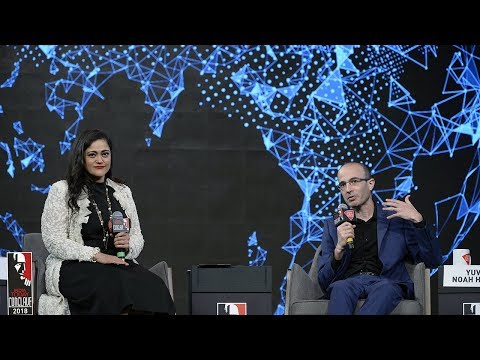
Nationalism in the 21st Century - Yuval Noah Harari at the India Today Conclave 2018
What this covers
In the twenty-first century, humankind faces a set of unprecedented challenges, such as nuclear war, climate change and technological disruption. Are nations still capable of handling such challenges effectively? Watch Prof. Harari explore this question in detail at the India Today Conclave, in Mumbai - March 2018.
Source description (no synthesized summary yet).
Harari argues that nationalism, while historically necessary for solving large-scale coordination problems, is now an obsolete framework for addressing 21st-century global challenges—nuclear war, ecological collapse, and technological disruption—which require global political solutions, not national ones.
- Nations were created to solve coordination problems tribes couldn't (river management, irrigation), but modern global challenges (nuclear weapons, climate change, AI) transcend national boundaries and require global cooperation
- The mismatch between globalized ecology, economy, and science versus nationalist politics prevents effective governance and threatens human survival
- Patriotism and national identity remain psychologically valuable but must be supplemented with loyalty to humanity and the planet to prevent catastrophic outcomes
This asset isn't compiled yet
You're seeing its claims, ranked. Compile it to build the argument threads, weight them, and check each claim against your library — the full view.
Nationalism is not a natural and eternal part of human psychology or biology, but a very recent evolutionary development that emerged only in the last 5,000 years as small clans and tribes coalesced into larger nations comprising millions of strangers.
“Contrary to what many people think, nationalism is not a natural and eternal part of the human psyche, or of human biology, it's actually a very, very recent evolutionary development; yes homo sapiens is a social animal by nature but for millions of years, until about 5000 years ago, humans lived in small, intimate communities, in which everybody knew everybody else. Only the last 5000 years or so, these small clans and tribes unite to form larger and larger groups, until they formed large nations comprising millions of strangers.”
The avoidance of nuclear war and the general decline of war were not due to divine intervention or miracles, but to human wisdom and wise decisions—but there is no guarantee this will continue, as humans and leaders might start making very stupid decisions, and human stupidity has been one of the most powerful forces in history.
“The reason that humankind avoided nuclear war and that war in general declined, it wasn't because some God came to our help, it wasn't because of some divine miracles, it was because of human wisdom; humans making wise and decisions. But there is not guarantee that we'll continue to make wise decisions... As an historian I can tell you that human stupidity has been one of the most powerful forces in history and it is still a very powerful force.”
Nations are ecologically dependent, not independent—India, for example, is powerful politically and militarily but is not an independent nation ecologically because it depends on what other countries do; therefore, even good climate policies adopted only by India (or any single nation) will fail to save Mumbai or prevent ecological disaster without global cooperation.
“And this is something that no single nation can prevent by itself, however powerful, because nations are not ecologically suffering. India for example is a very powerful nation but it is not an independent nation when it comes to the ecology. Ecologically it is dependent on what other countries are doing.”
We cannot predict what future post-human entities will look like because anything we can imagine is still on the same level as us; entities from future evolution will be beyond our imagination, just as modern civilization would be incomprehensible to Neanderthals.
“By definition we cannot say. It maybe beyond our imagination. Anything that we today can imagine and understand it's still on the same level as us. The next phase of evolution, the next kind of entities, they are beyond our imagination.”
If some nations are willing to develop autonomous killer robots and other nations place bans on such weapons, those nations that maintain bans will be forced to break them because they cannot afford to fall behind militarily in a 'xenophobic dog eats dog world,' creating a race to the bottom where nobody can avoid the development of dangerous weapons.
“If one nation, let's say the US, places a ban on the development of killer robots, but other nations like China or Russia develop such weapons then very soon the US itself will feel compelled to break its own ban because it wouldn't like to stay behind, especially in a xenophobic dog eats dog world. Even if one country chooses a high-risk, high-gain technological path, nobody could afford to remain behind. Everybody will be forced to follow.”
The first large-scale nations and kingdoms emerged 4,000-5,000 years ago in the Indus Valley, Nile Valley, Euphrates Valley, and Yellow River Valley specifically to solve large-scale coordination problems that small tribes could not—particularly managing rivers that were sources of both prosperity and danger (drought and flooding).
“The first big groups of people, kingdoms and nations, appeared about four to five thousand years ago in the Indus Valley, the Nile Valley, the Euphrates Valley, and the Yellow River Valley. Until that point those river valleys were populated by many small, independent tribes. The river was the life-blood of these tribes... There was nothing that the small, independent tribes could do about these problems, because each tribe commanded just a very small part of the river, and could mobilize only a few hundred people to dig canals, and build dams, and so forth. This was one of the main reasons why the small tribes coalesced to form large kingdoms and nations.”
For thousands of years, nations provided essential services and greater security and prosperity, and milder forms of nationalism and patriotism have been among the most benevolent human creations because they enabled cooperation between strangers and allowed people to care about and cooperate effectively with millions they would never meet.
“And indeed for thousands of years nations provided people with many essential services and with a greater degree of security and of prosperity. The milder forms of nationalism and patriotism have been among the most benevolent of human creations because they enabled cooperation between strangers. They enabled me to care about people that I never met and never will meet, and to cooperate effectively with them towards common goals. And this was very good.”
Global warming affects not just polar bears in the North Pole but also Mumbai and Delhi and all parts of India; politicians working only for their state or constituency should recognize that the global problems they perceive as external actually directly threaten their constituents, making global awareness enlightened self-interest rather than altruism.
“Their state, their city, their constituency will be impacted by global warming affects, not just the bears in the North Pole, it will also affect Mumbai and Delhi and all parts of India. So it's not a problem there, it's a problem here and really it's just a question of the stories that people tell and the stories that people think about.”
No technology is deterministic; every technology has both positive and negative potential, and we should not give up the enormous positive potential of biotechnology just because of negative scenarios.
“Well maybe yes and maybe no. No technology is deterministic. Every technology has both positive and negative potential and it would be foolish to give up all the enormous positive potential of biotechnology just because of the negative scenarios.”
Religious texts may contain some truth and deep wisdom alongside fiction, and the key is to distinguish reality from fiction using evidence and the scientific method, rather than to dismiss all religious texts as false.
“Now I'm not saying that all religions or all religious texts are fables, there is sometimes a lot of truth, and a lot of very deep wisdom in some of these texts and stories, but we need to be able to distinguish more clearly reality from fiction, and this is something that we do in physics, and this is something that we do in medicine, but when it comes to history a lot of people and especially a lot of politicians, they don't want to distinguish reality from fiction.”
Since 1945, no single war between great powers has occurred, few borders have been redrawn through naked aggression, and many countries have stopped using war as a standard political tool—this achievement was not due to any single nation but to the collective action of many nations changing fundamental rules of geopolitics.
“Since 1945, there has not been a single war between great powers. Few borders have been redrawn through naked aggression and many countries, not all countries, but many countries, simply stopped using war as a standard political tool.”
Zealous nationalists who prioritize their country first should ask themselves how their country alone, without robust international cooperation, can protect itself and the world from nuclear war—it cannot do so unilaterally.
“Zealous nationalists who cry my country first, my country's the most important, they should ask themselves how can your country by itself, without the help of a robust system of international cooperation, how can it protect itself and the world from nuclear war? It cannot.”
The Communist Party was a global political movement with branches worldwide, and universal religions and liberal ideologies (human rights, rule of law, democracy) are examples of global ideological movements that have spread across nations; this demonstrates that global political movements and ideologies are not impossible, though not all historical examples are encouraging.
“We have examples from this on the past. Not all of them are very encouraging but we examples like the Communist Party which was a global party and had branches all over the world and you can also view the universal religions as kind of global movements, global ideological and political movements, and so this is certainly not impossible, and we've also seen how liberal ideas of human rights, and the rule of law, and democracy they also spread between many countries, many nations.”
We don't understand ourselves well enough to responsibly answer the question of how we should augment human bodies, brains, and minds using biotechnology and genetic engineering; we might cause an internal ecological collapse or mental collapse through ignorance of the complexity of human systems.
“I think the key issue is that, and this is also the big danger, we just don't understand ourselves well enough in order to answer this question in a responsible way. I can have all kinds of fantasies about changing my body and upgrading my brain and my mind; we don't really understand what the consequences will be... In the past humans had the ability to manipulate the world outside them, but they didn't understand the complexity of the ecological system so all the changes we made in the world have caused ecological collapse, and we might do the same thing inside.”
History is often rewritten depending on which government is in power, and people confuse history with mythology because historians have the habit of dispelling and undermining favorite national stories and mythologies, and most countries don't want to listen to historians.
“Yeah it's a very common problem, I think that in much of the world what people call history is actually mythology and people have a very difficult time distinguishing history from mythology and in other fields of science the scientists have important authority. If you want to build a nuclear bomb you go to nuclear physicists, you have respect to what these nuclear physicists are telling you. But with history in most countries nobody wants to listen to the historians because they are the most problematic when it comes to national history; they have a habit of dispelling, of undermining your most favorite stories and mythologies.”
All the big challenges humankind now faces are global in nature and therefore demand global solutions: these are the nuclear challenge, the ecological challenge, and the challenge of disruptive technologies.
“All the big challenges we now face are global in nature and therefore they demand global solutions. These are the nuclear challenge, the ecological challenge, and the challenge of disruptive technologies.”
In almost all human societies, if you enjoy some kind of hierarchical advantage or benefit from a hierarchical situation, it becomes very difficult for you to see reality as it is because it endangers your privileges and position.
“And I think again in almost all human societies if you yourself enjoy some kind of hierarchical relations, if you yourself benefit, you have privileges from some kind of a hierarchical situation then it's very difficult for you to see the reality as it is because it puts in danger your privileges, your position, I'm not saying it's impossible, not in Israel and not in other places, some people are able to do it, but it is very difficult.”
One true fact within a larger narrative does not mean that everything in that narrative is true; for example, the Bible contains evidence that the Babylonian king Nebuchadnezzar destroyed Jerusalem, which is historically verified, but this single verified event does not validate other claims in the Bible such as the Garden of Eden story.
“One true fact doesn't mean that everything is true. I mean okay if I take the Bible for example so there are many incidents mentioned in the Bible that we have today very strong historical and archeological evidence saying that this really happened. The Bible says that the Babylonian king Nebuchadnezzar destroyed Jerusalem and the temple in Jerusalem and we have very strong evidence that this is true. But for events in the Garden of Eden, who is the Eve and the Serpent and all that, that's a bit--”
Some of the people in Israel are not having serious conversations about what Israelis are doing to Palestinians because Israelis are so captivated by their own story that it is very difficult for them to appreciate and sympathize with contradictory stories.
“In Israel there is not a serious conversation about what Israelis are doing to Palestinians. Again this is the power of the story. The Israelis are so captivated by their own story that it's very, very difficult for them to really appreciate and sympathize with contradictory stories and this is a very big problem, and not just for Israelis, I mean it's a universal human problem.”
Vipassana meditation is not a religious practice aimed at contacting mystical forces, but the most dogmatic method of observing reality as it is without imposing stories or trying to change it—the practice is just to observe what is happening right now, as it is.
“No, I practice the Vipassana meditation to see reality more clearly, to be able to see what is reality, what is really happening right here, right now. I'm doing this as any kind of religious exercise to get in touch with this force or that force, with this story or that story, it's really for me then the least dogmatic thing I ever encountered in life is Vipassana meditation. It just tells you, just observe what is really happening right now as it is without trying to impose any story on it, without trying to change it any way.”
Science fiction movies about robots and humans are not really about humans being afraid of intelligent machines but about men being afraid of intelligent women—the scientist is male and the robot is female, revealing gender anxiety beneath the sci-fi narrative.
“All these movies about the scientist falling in love with the robot, then tries to kill him and so forth they are not about robots at all. If you notice in most of these movies the scientist is a man and the robot is a woman and these movies are not about humans being afraid of intelligent robots, they are about men being afraid of intelligent women.”
In 2017, fewer people died from human violence than from obesity, car accidents, or suicide—for the first time in history, humans are their own worst enemies, with greater statistical chance of killing oneself than of being killed by a soldier, terrorist, or criminal.
“In 2017, last year, despite horrendous conflicts in some hotspots like Syria, and Yemen, and Ukraine, actually fewer people died in 2017 from human violence than from obesity, or car accidents, or suicide. For the first time in history you are now your own worst enemies. You have a greater chance of killing yourself, statistically, you have a greater chance of killing yourself than of being killed by any solider, or terrorist, or criminal.”
There is not a generalization we can make about religious people or leaders—some are open-minded and some are closed-minded, and it depends on the person, not on their worldview; the same is true for secular people.
“Depending on whom, I mean some are very open-minded and some are close-minded, I mean I think that you cannot generalized about any group of people and that's true also about religious people or about religious leaders. So I can't really make a generalization I have encountered some very religious people in Israel who are extremely open and also I've encountered some secular people who are very closed minded.”
Humans have a biochemical operating system and human desires, decisions, and feelings are not the result of free will or metaphysical spirit but of biochemical processes in the body and brain, though until now we lacked the knowledge to understand and manipulate these systems.
“Well the basic wisdom today, the life science, says that humans have a biochemical operating system. Our desires, our decisions, our feelings, they are not the result of some free will, or some metaphysical spirit, they are the result of biochemical processes in the body and in the brain. Until today we didn't have enough knowledge and information to understand it so the human body was like a black box.”
Radio was used as a propaganda tool by Nazi Germany, with Hitler and Goebbels broadcasting speeches to millions of Germans daily to brainwash them, but this doesn't mean radio is bad or should be destroyed; rather, we should understand the options and possibilities and hopefully make the right choices regarding technology.
“Just as it would've been foolish to give up the inventions of previous ages, just because they could support a dictatorship. If you think about radio, so in Nazi Germany radio was the main propaganda tool of the regime, like everyday Hitler, or Goebbels, or somebody would go on the radio and give speeches to millions of Germans, and this is how they are brainwashed. Does this mean that radio is bad and we should destroy our radio sets? No.”
Humans have proven to be an ecological serial killer responsible for the extinction of numerous animals, plants, and organisms, and now face danger to their own species' survival and that of much of life on Earth through climate change and ecological collapse.
“For thousands of years homo sapiens proved itself to be an ecological serial killer. We have been responsible for the extinction of numerous animals, and plants, and other organisms. Now we are putting in danger the survival of our own specie as well as of much of life on Earth”
If governments and corporations understand what is happening inside us better than we do, they will be able to manipulate and control us without us even realizing it, potentially leading to digital dictatorships and total surveillance regimes where resistance is impossible.
“and therefore they can manipulate us and control us and we won't even realize it. Until today governments could control your external activities, they could see where you go, what you read, what you say, but it didn't really understand what was happening inside. Very soon they will be able to understand what is happening inside and if we are not careful this will lead to the creation of digital dictatorships, of total surveillance regimes, in which resistance is absolutely impossible”
We should change legal systems from being based on responsibility and punishment to being based on deterrence, prevention, and correction, because if there is no libertarian free will then punishment for its own sake is unjust, but incapacitation and rehabilitation remain justified.
“and I think that it will require that we change our legal system from a legal system that is based on the idea of responsibility and punishment to deterrence, prevention, and correction. Even if there is no free will it's still a very good idea to put a murderer in prison, especially if there is no free will and somebody has proven that he has a tendency to murder then it's very important to protect society against that”
Wheat did not simply provide benefits to humans; rather, wheat domesticated humans by trapping homo sapiens into investing all their time and effort in wheat cultivation, creating a trick where humans believed their lives would improve but actually worked harder for less benefit while elites monopolized grain surpluses.
“How did wheat do it? By enslaving a poor ape, homo sapiens that got trapped and wheat kind of convinced this ape to invest all time and effort in just taking care of this plant... Now how did wheat manipulate or enslave this poor ape? By promising that if you take care of me and spread me all over the world your life will be much better. You will have much more food. And this was a trick because for most people it didn't work. Most people when they became farmers, they worked much harder than before, but all the surpluses, all the grains that were produced were monopolized by a small elite of kings, and priests, and aristocrats.”
Science is about to replace natural selection with intelligent design as the chief motor of evolution—not the intelligent design of a God but human intelligent design and the design of our clouds (IBM Cloud, Google Cloud), which will be the driving forces of evolution.
“Science is about to replace natural selection with intelligent design as the chief motor of evolution, not the intelligent design of some God above the clouds, but our intelligent design, and the intelligent design of our clouds, the IBM Cloud, the Google Cloud, they will be the driving forces of evolution.”
Contrary to the assumption that without nationalism we would live in peaceful paradise, the more likely scenario without nationalism would be chaos—countries without strong national identity like Afghanistan, Somalia, and Congo are typically chaotic and poor, while peaceful and prosperous nations like Sweden, Switzerland, and Japan have very strong nationalism.
“Some people imagine that without nationalism we will all be living in a peaceful paradise, but actually far more likely without nationalism we would be living in tribal camps, and indeed if you look today at the world, then most of the peaceful and prosperous nations of the world like Sweden, and Switzerland, and Japan they have a very strong sense of nationalism. Countries that don't have a strong sense of nationalism like Afghanistan, and Somalia, and Congo are usually chaotic and poor.”
The test for whether something is true or false is simple: if you have evidence, I'm willing to believe it; if you don't have any evidence, I'm skeptical.
“I think that the test is very simple. If you have evidence then I'm willing to believe. If you don't have any evidence then I'm skeptical.”
Climate change and ecological collapse are a present reality already happening (unlike nuclear war which is a future potential), and if current trends continue, it may be impossible to live in Mumbai in 50 years either because the Indian Ocean will rise and swallow the city or because it will be so hot that no one could live there, at least not during March, April, and May.
“And whereas nuclear war is just a future potential, it might happen, but not yet, it hadn't happened yet, climate change and ecological collapse are a present reality. It is already happening all around us. And if things continue in the present course in 50 years it might be impossible to live in Mumbai, either because the Indian Ocean will rise and swallow up much of the city, or because it will be so hot that nobody could live here, at least not in the hot season of March, and April, and May.”
The rise of artificial intelligence and automation might completely disrupt the global job market, creating an 'useless class' of billions of people who have been pushed out of work and lack economic value and political power—just as the industrial revolution created the working class, the automation revolution might create the useless class.
“The rise of artificial intelligence might completely disrupt the global job market. As AI, and computers, and robots outperform humans in more and more jobs, in more and more tasks, billions of people might be pushed out of the job market and we will see the creation of an enormous new class, the useless class. Just as the industrial revolution in the 19th Century created the older working class, the automation revolution of the 21st Century might create the useless class.”
We should be very careful when politicians use messianic language (claiming they will save the world) or invoke words like 'eternal,' 'redemption,' and 'purity'—these are warning signs of dangerous nationalism.
“Whenever politicians start talking in messianic terms we should sound the alarm... There are several key words that when you hear a politician uses any of these words, be very careful. These words are as I said like Messianism, like I will save the world, I am the savior, very dangerous, also when politicians start using words like eternal, like redemption, like purity, these are the three big no-nos: eternal, redemption, and purity. If you hear a politician says this or that will redeem the purity of our eternal nation, head for the exit.”
Life is about to break out of the limited organic realm and spread into the inorganic realm; humanity will create the first inorganic lifeforms after four billion years of evolution, and in this process, homo sapiens is likely to disappear—not through self-destruction but through self-modification and upgrade into something very different.
“And at the same time life is about to break out of the limited organic realm and start spreading into the vastness of the inorganic realm. We are about to create the first inorganic lifeforms after four billion years of evolution and in the process our own specie, homo sapiens is likely to disappear, not because we will destroy ourselves but because will change and upgrade ourselves into something very different.”
Consciousness might become disconnected from any organic structure, and alternatively, intelligence might decouple from consciousness, resulting in highly intelligent computer programs that have no minds, feelings, or emotions—and Earth could be dominated by super-intelligent but completely non-conscious entities.
“Consciousness itself might be disconnected from any organic structure, or alternatively, we might see the decoupling of intelligence from consciousness. And Earth will be dominated by entities that are super-intelligent but completely non-conscious: highly intelligent computer programs that have no minds, no feelings, no emotions.”
The same trick could happen again with AI: we are promised that if we invest in AI and spread it, our lives will be much better, but if we are not careful, billions of people will lose their power and most unequal societies ever will be created, so we should try to learn the lesson from wheat and not repeat it in the 21st century.
“Well we can't look past that. Now we're in the same situation then you have the new technologies, like the AI, and again there is this promise if you invest in me and spread me your life will be much better, and this might be true for a small elite, but if we are not careful billions of people will actually lose their power and we will create the most unequal societies that ever existed. So we should try and learn the lesson from what happened with wheat and try not to repeat it in the 21st Century.”
To avoid a race to the bottom in dangerous technologies, we need some kind of global loyalty and global identity that transcends national allegiance.
“So if we want to avoid such a race to the bottom that endangers all of humanity, we need some kind of global loyalty, and global identity.”
People often mix together real events with fictions to create myth, and this is true of the Ramayana, the Mahabharata, and all other mythologies around the world.
“People very often mix together real events with fictions in order to create myth and I guess this is true of the Ramayana, in Mahabharata, and all other mythologies around the world as well.”
A person can and should have simultaneous loyalty to multiple groups: family, profession, neighborhood, nation, humankind, and planet Earth. This requires dealing with conflicts between these loyalties, but life is difficult and people should accept this complexity rather than seeking simple solutions.
“In order to survive and flourish in the 21st Century humankind, humans must complement their national loyalties with an obligation, with a loyalty towards a global community and a person can and should have loyalty simultaneously to many groups, even today a person can and should be loyal to her family, her profession, her neighborhood, and her nation. So why not add humankind and planet Earth to this list?”
The key to a good life is to observe reality as it is and know the truth about oneself and the world without running away to fantasies, stories, and fictions—the deep source of personal and collective problems is that we create fantasies and mistake them for reality, then become upset when reality doesn't conform to our fantasies.
“Well I think the key to a good life is to be able to observe reality as it is, to really know what is the truth about myself and about the world without running away to all kinds of fantasies, and stories, and fictions, and I think if you can observe to some degree reality as it is you're won't just be a much better person but you'll probably be a much more peaceful and happy person because the deep source of so much of our personal and collective problems is in the fantasies that we create and then we mistake them for reality, and then we try to impose them on reality and we get extremely upset when it doesn't work, when reality doesn't conform to our favorite fantasy.”
Computers are becoming better than humans at recognizing and identifying human emotions through analysis of facial expressions, tone of voice, and word content.
“computers are becoming better than humans in identifying human emotions. If you want to know how another human is feeling then you basically analyze data. You look at the face, at the facial expressions, you listen to the tone of voice, you listen to the content of the words, and you know from experience that if you see this kind of an expression and this tone of voice, the person is angry, or the person is frightened. This is just part of recognition and this is something that now computers are becoming better than humans.”
Humankind is about to gain godlike powers of creation, and the big question facing us in coming decades is what to do with these new godlike powers; nationalism cannot provide the necessary ethical guidelines and goals because it thinks at the wrong level—thinking about territorial conflicts between nations lasting decades and centuries rather than about cosmic processes lasting billions of years.
“Really humankind is about to gain divine powers of creation; we are in the process of becoming gods and the big question that faces us in the coming decades is what to do with our new godlike powers? We need ethical guidelines and goals, and nationalism just cannot provide us with the necessary guidelines and goals because it thinks on the completely wrong level.”
When people are separated from their phones for five minutes, they experience unpleasant bodily sensations and become anxious; this is data about how they are enslaving themselves and can be used for personal insight and change of harmful habits.
“So observe that and what's happening to you when you're away from your phone? What's happening in your body? You will see that there are a lot of unpleasant sensations in your body at the time, what's happening in your mind? This is how you get to know yourself. You get to know yourself not by observing some blissful, metaphysical, mystical experience, you get to know yourself by observing what happens to me when the phone is away, and once you witness how much misery I am inflicting on myself by my own habits this can help you in changing these harmful habits.”
People care deeply about small stories like a destroyed temple in one city, making it a burning issue for people across the country, but humans can destroy the Great Barrier Reef—thousands of kilometers of unique habitat with countless species—and nobody gives a damn; this difference is not based on the scale of destruction but on the stories we tell ourselves and teach our children.
“If we care so much about one temple we should care about all the ice world in the North Pole. We should care about it, I just heard somebody says that if you destroy one wall in the Middle East you'll have a World War about it, but humans can destroy the Great Australian Reef Barrier, thousands of kilometers of a unique habitat with countless species, we are destroying it. It's the first habitat that is likely to be completely destroyed is the Great Australian Reef Barrier, thousands of kilometers long, we can destroy it and nobody would give a damn, and this is just because the kind of stories that we tell ourselves and we tell our kids and we become used to listening, and to worrying about these stories.”
A nation is a fictional community of strangers, not a real entity that can suffer or have interests—soldiers and civilians suffer in war, but the nation itself has no mind, feelings, or sensations, so we should not treat national interests as if they were equivalent to human interests.
“A nation, for example, is just a human creation. It's a fictional story created by humans. How do you know? Just ask yourself can a nation suffer? If you lose a war does the nation suffer? No. The nation has no mind, no feelings, no sensations; soldiers who die in war they suffer. Civilians who lose their house or their loved ones in war they suffer, animals can suffer. But a nation cannot suffer. It's just a story we created.”
Harari does not present his books as definitive truth but as invitations to further research and investigation; his hope is to inspire people to question, discuss, and investigate rather than to accept his ideas as final answers.
“Well my main recommendation to people is don't take any book including my own as kind of the truth about history or about humankind. I see my own books more as an invitation to further research, they're more about the questions than the answers. My hope is that they will inspire people to question, to have discussions, to investigate further and not just to say okay, this is the truth, now we know everything”
It does not mean nationalism should be abolished or humankind turned into homogenous gray goop; there is still room for good patriotism that celebrates national uniqueness and special obligations towards one's nation, but one should not confuse being unique with being supreme, and uniqueness does not negate obligations towards other groups.
“It does not mean that nationalism has no role to play in the 21st Century or that we should abolish all nations and turn humankind into some kind of homogenous gray goop. There is still plenty of room in the world for the good kind of patriotism that celebrates the uniqueness of my nation and my special obligations towards it. But we shouldn't confuse being unique with being supreme. Yes my nation is unique, every nation is unique and I have special obligations towards it but it doesn't make my nation supreme and it doesn't deny the fact that I have obligations towards other groups as well.”
Suffering is a test for whether an entity is real or merely fictional; if an entity can suffer, it is real; consciousness is defined by the capacity to suffer; therefore one can distinguish real entities from fictions created by politicians and religious leaders by asking whether they can suffer.
“The best test to know whether an entity is real or whether it's a fiction invented by politicians, and religious leaders, and so forth, is to ask can this entity suffer?”
When it comes to wisdom, you need global wisdom, but when it comes to stupidity, one is enough.
“You don't need global stupidity, when it comes to wisdom, you need global wisdom, when it comes to stupidity, one is enough.”
In a scenario of total biometric surveillance like North Korea with mandatory biometric bracelets monitoring blood pressure and brain activity, if a bracelet detects signs of anger during a government speech, the wearer faces dire consequences, illustrating the ultimate danger of surveillance technologies.
“Just think about a place like North Korea, in 20 years, or 50 years were everybody have to wear a bracelet, a biometric bracelet which monitors their blood pressure, their brain activity all the time, and if you listen to a speech by Kim Jong-un and the bracelet identifies the signs of anger, that's the end of you.”
When many people believe something for a long time, it becomes accepted as truth or religious truth, rather than remaining identifiable as fake news—the durability and scale of belief transforms false stories into truth.
“If a thousand people believe it for one month it's fake news; if millions of people believe it for a thousand years, that's not fake news. That's the truth or that's the religious truth, or whatever.”
A temple is just stones, bricks, and wood, and when destroyed, it is the people who care about the temple that suffer, not the temple itself—our emotional and psychological investment makes us suffer, but the physical object has no intrinsic value or ability to suffer.
“If you have some temple and somebody destroys the temple, the temple doesn't suffer. Only people suffer. The people who care about this temple when they hear that it is destroyed they have a very unpleasant sensation in the body; they have very unpleasant emotions in the mind, they suffer, but the temple it's just stones, and bricks, and wood, and so forth.”
The deep purpose of a place like a temple should be to bring peace and harmony to the world; if a temple brings violence and disharmony to the world, it is a broken temple and there is no reason to need it.
“the deep purpose of a place like a temple is to bring peace and harmony to the world. I go to a temple to experience peace and harmony. Now if a temple brings violence and disharmony to the world it's a broken temple, what do you need it for?”
Meditation reveals the ordinary daily natural patterns of the mind and body—anger, pain, joy, boredom—rather than providing special experiences; many people mistake meditation for an amusement park where they expect extraordinary experiences, but the most important part of meditation is understanding the patterns you must deal with in life, not having vacation-like special experiences.
“I think many people make a mistake about meditation that they think meditation is a tool to get all kinds of special experiences. Like I go to an amusement park and this is another kind of amusement park, I'll use meditation to have all kinds of special experiences, and actually I think the most important part of meditation is to get to know the most ordinary, daily, natural patterns of your mind and of your body, to get to know your anger, your pain, your joy, your boredom, because this is what you have to deal with in life”
If a force is responsible for the great mysteries of life, universe, black holes, and galaxies, it is unlikely to care about female dress codes or who people have sex with, suggesting that specific religious laws about behavior are projections of human concerns onto the universe rather than divine mandates.
“If there is a force responsible for the great mystery of life, and the universe, and the black holes, and the galaxies, I don't think he really cares about female dress code.”
Deterrence still has a role in a legal system without free will because people's decisions are influenced by the knowledge that breaking the law will lead to imprisonment; even though desires are the product of biochemical processes beyond our control, the threat of punishment is still part of the input into the system that affects decisions.
“there is still also room for deterrence because part of the input that goes into this very complex system is I know that if I do this I will be put in prison and this still affects my decisions.”
Teaching national history rather than human history shapes how children think about problems—if children learn to view everything through the lens of 'how does this affect my nation,' they will continue thinking this way as adults; teaching human history alongside national history can change how people think about present problems.
“I mean, I'm an historian so one of the things I can suggest is start teaching in school the history of humankind and not just the history of your nation, or your culture, or your religion. I mean if I child from an early age gets used to thinking about everything in terms of what happened to my nation, how is this affecting my nation, then it's not a big surprise that when this child grows up he or she still thinks about the world all the time in terms of my nation. But if from early age you're used to, you learn the story of humankind, as well as the story of your particular group, this can change the way that people think also about present problems.”
You can have religious parties focused on religious questions and environmental movements focused on global warming in the same way; the key is what do you care about and what do you think about.
“You can have religious parties and you care very deeply about religious questions, so you can care in the same way about global warming, or about the danger of killer robots.”
The master trick of fundamentalism is switching between two concepts of God mid-argument: claiming that God is mysterious and incomprehensible but then asserting detailed knowledge about God's will regarding dress codes, sexuality, and political behavior.
“And it's like a magic trick, if you have a magician that tries to fool you, shows you one card and then you don't notice he changes a card to some other card. So it's the same with God. When you ask people about God they say it's a big mystery and we don't know and science can't explain this and that, okay and then somehow they then switch gods, and then because of this women should put a hat on their head, and two men shouldn't have sex with one another, and you should vote for this party or that party.”
Universal basic income could address the useless class problem, but only if implemented globally; if implemented only nationally in some countries while others adopt business-as-usual, wealthy regions like Silicon Valley will prosper while regions dependent on cheap labor will collapse, leading to chaos, violence, and destabilizing migration waves.
“One popular idea is to have universal basic income. The government will tax the big corporations who will become very wealthy from all these robots and computers and use these taxes to provide unemployed workers with basic income or basic services. Now this is a very interesting idea but to be effective it must be implemented on a global level, not on a national level.”
Harari is afraid of being placed in the position of a guru that knows everything because there is a danger he might start believing it, which he describes as 'the greatest stupidity of all.'
“I'm very afraid of being placed in the position of a kind of a guru that knows everything because the danger is that I might start believe that. You know it goes up to the head and this is the greatest stupidity of all.”
The practice of Vipassana is difficult because the mind constantly runs away to fantasies, memories, and stories rather than observing reality directly; even after 18 years of practice, sustaining attention on breath for extended periods is challenging.
“I remember the first time I went to a course and the first instruction I got from the teacher was observe your breath, not observe God, not observe the soul, just observe your breath coming in and out of your nostrils and just accept the breath, whatever it is. And what amazed me was that I couldn't do it for more than 10 seconds. Immediately the mind ran away to some story, some fantasy, some memory”
To have effective politics, humanity must either de-globalize the ecology, economy, and science (making them local), or globalize politics; since it is obviously impossible to de-globalize ecology and science, and extremely costly to de-globalize the economy, the only real solution is to globalize politics.
“To have effective politics we need to do either of two things, either we de-globalize the ecology, the economy, and the science we make them local, or we globalize our politics. Now it is obviously, actually impossible to de-globalize the ecology and the march of science. And it will be extremely costly to de-globalize the economy. Therefore the only real solution is to globalize our politics.”
Harari does not believe in God, specifically not in the 'concrete law-giver God' that claims to know everything about fashion, sexuality, and politics; he is comfortable with the mysterious God about which nothing is known.
“No. The word is problematic, there are two kinds of gods in the world and people tend to mix them. There is one God, they mystery God about which we know nothing... Then there is a completely opposite kind of God, the concrete law-giver god, and about this god we know far too much, we know exactly what this god thinks about female fashion, about human sexuality, about who you should vote in elections, everything.”
There is a paradox in Harari's message: he advocates for sitting quietly in meditation while technology constantly calls out to us; checking your phone 80 times a day shows how difficult this quiet observation is to maintain.
“But it's also part of the paradox 'cause what you're saying is sit quietly in meditation, go in, and then we have all this technology constantly calling out to us; I mean everyone here I'm sure would agree with me that if your phone is away from you for five minutes, you're like where's my phone? You're checking your phone 80 times a day.”
The hope is first to understand the inner world before starting to manipulate and upgrade it.
“my hope for myself is first to understand my inner world before I start manipulating and upgrading it.”
I have been practicing meditation for 18 years and have noticed that meditation provides the focus, discipline, and clarity necessary to write books; this year I attended a 60-day meditation course in India.
“I don't think I could have written any of my books without the help of the focus and the discipline and the clarity that this kind of meditation gives.”