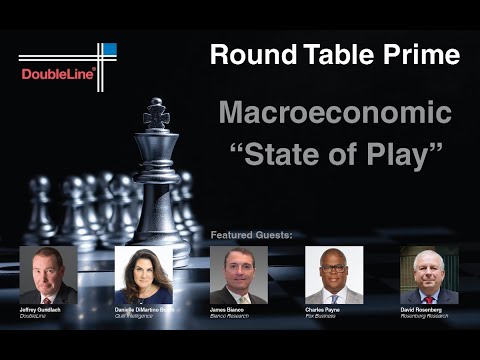
DoubleLine Round Table Prime, 2023 - Part 1: Macroeconomic State of Play 1-4-23
What this covers
2023 could offer cyclical downturn in a landscape of secular change as the world appears on the threshold of global recession. Moreover, trends that for decades have driven economies, markets, monetary policy and governance might be staging reversals. In this first of three segments (0:08), DoubleLine CEO Jeffrey Gundlach and moderator DoubleLine Deputy Chief Investment Officer Jeffrey Sherman on Jan. 4, 2023, discuss the Macroeconomic State of Play with their guests James Bianco, President and Macro Strategist at Bianco Research; Danielle DiMartino Booth, CEO of Quill Intelligence; author and Fox Business anchor Charles Payne; and David Rosenberg, President of economic consulting firm Rosenberg Research & Associates.
Mr. Sherman (2:28) begins the segment asking what is “the path setting forward” for inflation in 2023 and “how that dictates into the macroeconomy.” Among the answers, Ms. DiMartino Booth notes recent Federal Reserve paper would indicate monetary tightening filtering into the economy in 12 months, thus reaching the economy in March. She already sees “disinflationary pressures multiplying left and right.” Citing declines in ISM prices paid and quits in transportation and warehousing jobs, Mr. Payne expects (3:37) people’s predominant preoccupation will shift to recession “quicker than anyone’s anticipating,” a downturn which he expects to be “huge.” Mr. Gundlach (6:27) expects inflation to fall to “about 4% for the May (CPI) report.” He takes issues with “completely implausible” consensus forecasts of the CPI falling rapidly from 9.1% to make a dead stop at 2.5% for three years. In the event of a rapid decline to 2.5%, Mr. Gundlach thinks the CPI will continue to fall and might make a negative year-over-year print sometime during 2023.
Much of the discussion focuses on monetary policy at the Fed, which is being driven by more than inflation, the panelists observe, the killing of the “Fed put.” The unspoken aim of the Fed? Mr. Rosenberg (22:02) thinks “they want to do a reset of valuations in the markets, and, I mean, principally the stock market. Powell can’t come out and say, I want to destroy your 401K.” Powell, Mr. Bianco notes (33:55), “wants the Fed put gone. He wants the markets to stop trading on liquidity. The problem is that’s exactly what they are trading on right now. Bad news is good news.”
The panel discussion turns (41:59) from the Fed to Congress and the White House. “I’m more worried about the politicians,” Mr. Gundlach says, “because once the economy rolls over what we’ve seen is massive relief, free-money spending…. We thought that $700 billion was a big stimulus back in ’08. Now we’re doing trillions and trillions. Maybe the next time it’s not $1,000 or $1,200 a month. Maybe it’s $50,000 a month.” Mr. Payne says politicians would see such transfer payments as “a good way to get re-elected.” Ms. DiMartino Booth, however, thinks the Republican majority in the House of Representatives, “is going to want their pound of flesh” and could resist cutting those checks.
The panelists are generally bearish on the U.S. economy’s ability to avoid entering recession in 2023. Mr. Rosenberg (46:30), for example, finds no significant sources of “vitality for the economy,” ticking off a corporate profits recession, no capital spending; little excess savings, with “what’s left in the wrong hands... the fat cats who aren’t going to spend it.” Meanwhile, the lagged effects of Fed tightening, he notes, are going to kick in, with consumers facing rising unemployment and housing “in a tailspin.”
Some people are putting their hopes in the reopening of China’s economy after the most recent lockdown regime. Mr. Bianco (53:19) pours cold water on that idea. While China is going to reopen, he says, “they’re not going back to 2019. They’re not going to get 40 million people riding the subway, which is what they used to have in the major cities a day, going to 12-hour shifts, manufacturing stuff to ship to the West.”
Source description (no synthesized summary yet).
The panel argues that the Fed will be forced to pivot to rate cuts in 2023 due to recession pressures and deflation risks, despite Powell's stated commitment to fighting inflation, fundamentally reshaping market dynamics and creating significant challenges for asset valuations across equities and fixed income.
- Money supply is contracting at historic rates (M2 near zero, M1 down 2% annually) alongside supply-side easing, which will force substantial disinflation or deflation regardless of Fed intent
- The Fed's own forecasts imply ~2 million job losses (unemployment rising from 3.5% to 4.6%), making a recession inevitable and necessitating a policy pivot the Fed will try to delay but ultimately cannot resist
- Current equity valuations at 17x forward earnings and bond valuations offer no margin of safety, leaving assets vulnerable to simultaneous compression as recession earnings miss and multiple contraction accelerate
This asset isn't compiled yet
You're seeing its claims, ranked. Compile it to build the argument threads, weight them, and check each claim against your library — the full view.
Inflation will settle at a structurally higher level (closer to 4% than 2%) over the medium-to-long term due to three secular shifts: the end of cheap goods (peak globalization), the end of cheap labor (quiet quitting, hybrid work, worker power), and the end of cheap energy (Russia cut off European energy supply).
“I think that there's been some secular movement in the economy, global economy, US economy that's going to create higher inflation. And I've called it, you know, the end of the end of cheap goods because we're at peak globalization, the end of cheap labor, which is what we see now, whether it's quiet quitting or hybrid work or workers have more say and we're getting higher inflation, and the end of cheap energy.”
The bottom 50% of households have already spent through their excess savings (from government stimulus checks), but the top 25% have accumulated excess savings through wages; the Fed's attempt to 'dry out' excess savings by breaking the economy will only impact the bottom cohort who are already gone, not the wealthy who won't spend anyway.
“The bottom 50% have already gone through theirs. Those were the stimmy checks. And the top 20 top 50%, particularly the top 25%, they were able to get that excess money through wages and just go to fashion savings. So, you're not going to dry them up.”
40% of the American public owns no assets (no home, no portfolio) and depends solely on paychecks; they face negative real wage growth and are buying less each month/year than previously, lacking any financial cushion (house price gains, portfolio gains) that higher-income households have.
“40% of the American public, 4 0, they don't have any assets. They don't own a home. They don't own a portfolio. They only get a paycheck. And we've got negative real wages. They're buying stuff, whether it's at the grocery store, at the mall, they're buying less every month, every year than they did the previous year because they don't have a cushion to fall back on”
There is no historical correlation between recession severity (mild vs severe) and stock market performance; a 'mild recession' can produce a severe bear market as happened in 2001 with the mildest GDP recession on record but 'a mother of a bear market'; profit volatility is higher than GDP volatility, so even mild recessions see 20% earnings declines.
“there is no correlation between the severity of the recession uh and uh the market performance. We we had the mildest GDP recession of all time in 2001 and it was a mother of a bear market. Uh and a lot of the times it depends in the stock market. Stock market is really earnings times the multiple. And we started off this cycle with a 22 multiple. Last year was just, you know, you said goodbye to 2022. The earnings recession hasn't even started yet, okay? That was a five-point multiple contraction cuz of the Fed in 2023 will be the lagged impact of what the Fed has done on corporate earnings. So, even at a mild recession, you see the thing is that profits are volatile. GDP is more stable. So, you could have actually a mild GDP recession, but equity market You see, this is what they don't say. It's going to be a mild recession. But maybe it'll be a mild GDP recession, but will will it be a mild profits recession? So, even in the mildest GDP recessions, profits go down 20%.”
Income tax refunds of $165 billion over the past 12 months created a fiscal boost that flowed into services inflation through increased travel and dining spending, but this tax-refund-driven stimulus is going away in 2023, removing a major inflationary impulse.
“there's been a tremendous tax break for businesses, income tax refunds uh were 165 billion dollars in the last 12 months. That has filtered into tons of services inflation as people have sprung out and gone to travel and out to eat and and spent a lot of it. That's going away.”
The Bank of Japan did not panic during the pandemic and inflation spike (unlike other central banks); their mistake of yield curve control will eventually fail, but their refusal to overreact was the correct policy approach, and they may prove to be the smart central bank retrospectively.
“I'll be the lone defender of the Bank of Japan cuz I would say they are the only central bank that didn't panic. Uh and I think that in the overall annals of economic history, this will have proven to have been transitory. Okay?...I think the Bank of Japan actually got it right.”
The interest rate level itself will move up or down independent of the Fed's direct control, following the two-year Treasury; the Fed essentially follows the two-year yield rather than leading it, and the two-year is currently down 40-50 basis points from its peak.
“it's actually always true. Because the Fed simply follows the two-year Treasury. I've been saying all year in my webcast we should replace the Fed with the two-year Treasury...the two-year Treasury was going vertical. It was up at 1% and 1 and 1/2% and the Fed raises rates 25 basis points. And next thing you know, they're doing 75s. So, the Fed will follow the two-year Treasury. And the two-year Treasury is down roughly 40 50 basis points from its peak.”
The Fed's current monetary tightening will filter fully into the economy within a 12-month lag rather than the historical 18-month lag, putting maximum disinflationary impact at March 2023, which should materially reduce core PCE through falling housing and rental costs.
“the Fed actually did an interesting paper recently that showed that rather than an 18-month lag that they figured it was closer to 12-month lag this current cycle in terms of when monetary tightening filters its way fully into the economy. That would put us in March of 2023 of this year.”
The lack of fresh fiscal stimulus in 2023, combined with the IRS warning that tax refunds will be lower than 2022, means households expecting tax refund deposits will not receive the same cash to pay off accumulated Christmas credit card debt; rents will rise further before falling, and fixed living expenses are higher, while unemployment claims are up 31% off their May lows.
“The IRS has already started warning individuals that a lot of the the factors that amplified to 2022 income tax refunds for individuals are going to be going away this year. So, a lot of households who are expecting to get the same amount of cash deposited to pay off those Christmas credit card bills that we know have been run up to kingdom come, that cash is not coming in in the same form. Their rents have gone up. They're going to come back down, but their fixed living expenses right now are higher than they would otherwise be, and we have continuing claims up 31% off of their May lows.”
China is not the China of 2008-09 or 2015-16 that could bail out the world economy; China announced it is stopping semiconductor investment to address healthcare crisis; Chinese subway ridership is less than half pre-pandemic levels and the assumption that China will return to 2019 consumption patterns is wrong.
“China is not what This is not the China of '08-'09. This is not the industrial recession of '15-'16 that China bails out. China's got its own domestic problems right now. It announced today that it was going to stop investing in the semiconductor industry so that it could address the healthcare crisis...you're not seeing an impulse in the property sector that would suggest some massive commodity supercycle is in the making”
Japan is running a deficit (recently started), creating a different dynamic from past surpluses; this makes Japan's fiscal position more precarious and adds urgency to the yield curve control trap.
“And and now they're running a deficit, right? So, that's a whole different dynamic in Japan.”
A rise in continuing unemployment insurance claims of 31% off their May lows historically predicts recession: since 1967, every time continuing claims have risen 31% from their base, the economy has been in recession, making current claims level a recession signal.
“We've always been in recession We always came off very We came off very very low levels, but if you look back to the history since 1967, anytime you've come, doesn't matter what the base is, anytime you've gone up 31% in the number of Americans collecting unemployment insurance, meaning they cannot get a new job, we have been in recession since 1967.”
The Fed's 2018 tightening cycle saw a ~20% stock market decline from the peak, and Powell pivoted in January 2019 after the December 24 selloff; now in 2023, the market is down ~20% again from its peak, but Rosenberg expects a different outcome if Powell maintains discipline.
“David, when you mentioned the the Fed listening to the markets, 2018, four rate hikes, we're almost down 20%, right? So, January 4th, 2019, J. Powell, he's at this American Economic Association conference with Bernanke and Yellen. And he gives his speech that all of a sudden he says, 'We're going to take a patient approach.' This is a Fed who's been pounding with a mallet. He's hiking rates a week before Christmas. He doesn't care. Uh and so, and we're going to listen very carefully to the markets. And that was the turn right there. That was J. Powell 2.0.”
The 'pivot' in Fed policy historically lags deterioration by 6 months minimum; Powell was late to tighten (started in 2022 after 2021 inflation spike) and will be late to ease, guaranteeing policy is always behind the curve.
“The pivot doesn't happen like the month after. So, they'll by definition be late. They were late to tighten, they'll be late to ease.”
Janet Yellen invented the 'labor market conditions index' in the past, another made-up Fed statistic that gave her answers she didn't like 2 years later, so she discontinued it and found another one—the Fed's pattern is to create new metrics until they find one that justifies their preferred policy.
“Janet Yellen, you know, 7, 8 years ago I did labor market conditions index, another invented out of whole cloth statistic that the Fed had. Gave her the 2 years later it was giving them a statistic that they didn't like, they discontinued it. Right. And they found another one.”
The Fed's minutes tell you 'what they want you to hear' while meeting transcripts (released 5 years later) reveal actual internal dynamics; comparing minutes to transcripts from past meetings shows significant discrepancies between public narrative and closed-door reality.
“We're not going to find out the truth for uh 5 years when we get the transcripts. Cuz the minutes are just really um almost like a policy document. They tell you what you what what they want you to hear. You don't know what's going on behind closed doors. Uh I'll show you what I do for fun, so you'll see what a great fun-loving guy I am. I I I I've done this a history of taking the minutes of a meeting and looking at the transcripts. And you sometimes wonder, is this Was this the same meeting?”
The last global dual shock of similar magnitude (war + pandemic) occurred a century ago with World War I followed by the Spanish Flu, which produced 4 years of 15% inflation; when F. Scott Fitzgerald wrote The Great Gatsby (1925), there was no mention of great inflation, and the 1920s-30s saw a decade of no inflation followed by deflation.
“The last time that we had a dual shock of this magnitude globally uh was a century ago with World War I. We had a world war uh that was followed by um the Spanish flu. This time around, we had a global health shock compounded by the first shooting war in Europe in 80 years. Uh and that was 4 years of 15% inflation. Interestingly enough, when F. Scott Fitzgerald wrote The Great Gatsby in 1925, there is no mention of the Great Inflation...And then we went through a decade, once these supply pressures subsided, as they are right now, we went through a decade of no inflation.”
There's a broad disagreement within the Fed: Lael Brainard (Vice Chair) is positioned near the most dovish end while Powell is positioned near the most hawkish end, at 'wide ends' of the spectrum; historically they would be closer to the middle, indicating extraordinary tension.
“there is a broad disagreement within the Fed. And we're at a rare point now where if you put that hawk-dove scale, who's the most dovish, who's the most hawkish, you might very well have the vice chairman, Lael Brainard, near if not the most dovish, and the chairman, J. Powell, if he's not the most hawkish, he's very close to it. They're not somewhere in the middle anymore. They're at wide ends.”
The assumption that Chinese reopening will lead to massive commodity demand and goods inflation relief is flawed; the real risk is that Chinese demand doesn't materialize and commodity prices fall further, which would amplify goods deflation in the West.
“And the assumption that we have going into '23 is big demand for industrials and raw materials, especially energy. China sucks up all the raw materials. Out the other side's going to come a huge boom of finished goods. It's going to It's going to depress goods inflation, so the Fed can pivot, and the stock market can take off. I think it all stops with the China story.”
Once the economy rolls over into recession, the Fed will cut rates 500 basis points cumulatively (despite recent comments about higher-for-longer), as this is the historical pattern in recessions regardless of inflation conditions; Paul Volcker cut rates 1,200 basis points during double-digit inflation in the early 1980s.
“In recessions, they always cut. Now, maybe this is You're going to say it's a totally different Fed...they cut rates 500 basis points, irrespective of what your view is on inflation, Jim. In recessions, they always cut. Now, maybe this is You're going to say it's a totally different Fed. What I'm saying is that once they break this link, cuz I'm in your camp, then rates are going to come down, and I think Jeff Gundlach is right, they're going to come down quite a lot. Now, not not immediately, cuz it's never quite immediate...And you got to remember that to a T, it doesn't matter what the inflation is. Paul Volcker had double-digit inflation. The guy cut rates in the early '80s by 1,200 basis points.”
The Japan BOJ has controlled three specific bond issues (keeping them at 48bp) while the 9-year and 11-year are breaking higher, and the swap market (not subject to yield curve control) is trading 85bp on the 10-year, indicating market strain against BOJ controls.
“They don't have yield curve control, they have three bond control. They they basically they target the 10-year, the old 10-year, the old old 10-year. And if you look at their yield curve, it kind of goes up like this, and then you got these three issues that are down at 48 basis points because that's where the target is. And the 9-year and 11-year, you know, just kind of break without it. So, it's obvious that And if you look at their swaps market, which is not subject to yield curve control, the 10-year swap is trading about 85 basis points.”
Biden is giving Powell 'carte blanche' because Biden got blamed for inflation, removing political pressure that existed under Trump; without Twitter attack pressure, Powell has more room to pursue aggressive tightening, though political pressure will likely re-emerge when unemployment rises in 2023-24.
“he doesn't you know, Biden's But Biden Biden is is giving him carte blanche cuz of course Biden got blamed for the inflation. Um and uh you know, we'll see what the political pressure is going to be going forward”
Much of corporate debt was refinanced in 2020-21 at significantly lower coupons; this means the bulk of the corporate bond market is NOT sensitive to rising rates in 2023-24, but bank loans (which have floating-rate coupons) will reset immediately and cause pain.
“the amount of refinancing that took place in '20 and '21 was massive. And so you look at current coupon on the outstanding stack in sort of IG and high yield paper...the bulk of it was refinanced at significantly lower coupon. The one thing that's what I would throw against that though, not Treasury. We were financing very short. Right? The cost of of issuing the public debt is simply higher. And you have 80% of the mortgage universe outstanding with a two or two and a half percent coupon.”
Japan's situation is like a person jumping from an 80-story building saying 'so far, so good' at 70 stories down—they've been able to sustain unsustainable policy for so long that the eventual crash will be severe.
“They're not as a guy jumping out of an 80-story window. 70 stories down says, 'So far, so good.'”
Rosenberg argues that supply-side pressures are clearly easing as evidenced by ISM vendor delivery delays dropping to their lowest level since March 2009 (the worst recession since the 1930s), coinciding with demand growth slowing due to monetary policy lags
“today's ISM number, what was very important, by the way, uh beyond just the fact that the prices paid, you know, went down to the lowest level since April 2020. Uh so, we've dialed all the way back to when the economy was locked down. Uh but the vendor delay, the vendor performance, delivery delays are down to the lowest level since March of '09 when we were frozen in the worst recession since the 1930s.”
92% of the government-guaranteed mortgage market was non-refinanceable as of October-November when rates peaked, even if rates fell 200 basis points from there; with no refinancing, the economy needs to return to near-zero rates to drive any refi-driven stimulus.
“As of October, November when rates were at their peak, 92% of the entire government guaranteed mortgage market was non-refinanceable even if rates fell 200 basis points from here. There's no refinancing. That's why you get into this discussion. Do we have to absolutely go back to the zero bound to generate any economic growth?”
ISM prices paid component has fallen at a pace over the past 9 months that has only been matched twice in history—in 1975 and during the Great Financial Crisis—indicating a rapid shift toward disinflation that historically precedes recession.
“the ISM number, prices paid, which we want to come down. This 9-month the last 9 months, the pace of the prices paid coming down has only been matched twice in history. You got to go back to '75 and the great financial crisis.”
Money supply (M2) year-over-year growth is now zero, which has never happened since data started in 1959; M1 is contracting at 2% annually; and these contracting money measures are a great leading indicator of falling inflation, contradicting the consensus view of persistent inflation.
“we have a situation where M2 year-over-year is now zero. Since 1959, that's when the data started, it's never been that weak. M1 is now contracting at a 2% annual rate. Pick your favorite money measure, it's contracting.”
The housing market is 'simply doomed' in terms of activity because the monthly mortgage payment on the median home has risen over 100% since pre-pandemic, despite some relief from recent interest rate declines, making affordability impossible.
“the housing market of course is simply doomed in terms of activity with the monthly payment on the median mortgage up by over 100% uh since pre-pandemic”
The Fed did not have to blink in December 2018 because the corporate bond market had a complete 'bid' and deals weren't being pulled; in contrast, there was no systemic financial stress, so Powell's pivot was based on market psychology, not financial system stability.
“Firstly, it wasn't down We're down 20% in a year. We're down 20% in a month back in December 2018. Like it was vertical down. And and the and the corporate bond market, the high-yield market was closed. Deals were being pulled. There was There was nothing There was no bid in That was a scary period, okay? That was totally different.”
The global yield curve is inverted for the first time ever, not just the U.S. yield curve; this strongly suggests the coming recession is not a U.S.-only phenomenon but global.
“there's such a an indicator as the global yield curve. And it's inverted for the first time ever. So, that rather strongly suggests that this isn't simply a US phenomenon.”
The Fed's unemployment forecast rising from 3.5% to 4.6% (a 1.1 percentage point increase) implies roughly 2 million job losses, which the Fed has essentially announced as its policy goal through its projections.
“they told us that the unemployment rate is going from 3 and 1/2 from the cycle low to 4.6. And you don't have to be the world's best historian to know in the post-World War II experience that you've never failed to have a recession when the unemployment rate is up more than a percentage point. They've told you that. And depending on what your assumptions are for the participation rate, that's going to mean roughly 2 million jobs lost.”
The Fed's balance sheet has shrunk from extremely high levels, but not long ago people thought it 'structurally impossible' for the balance sheet to fall to current levels ($2-3 trillion); this suggests the Fed has more ammunition than consensus believes.
“I just think that they've crossed the Rubicon on that. I'm just not sure, you know, considering where the Fed balance sheet was not long ago, you would have asked anyone, can it can it be $2 trillion? Can it be $3 trillion? And not long ago people would have laughed at you. You said it's just structurally impossible.”
Aggregate demand (GDP) growth has averaged just under 2% in the three years before COVID and just under 2% in the three years since COVID through stimulus, reopening, and Fed tightening—demand has been flat, but multiple supply shocks (COVID, Omicron, Russia-Ukraine invasion, China lockdowns) drove inflation.
“when you're taking a look at the trend, say the three-year trend in real GDP leading up to COVID, uh it averaged uh just under a 2% annual rate. Uh and then in the three years since COVID and through the pandemic and through the lockdowns and through all the stimulus, uh and now through the reopening, uh and now through the Fed tightening, uh what is aggregate demand average? GDP growth has averaged in the past three years, less than 2%.”
Services spending has caught up to its pre-pandemic trend and durable goods spending was already pulled forward during the pandemic, leaving no remaining growth sources outside of a weaker dollar or government spending.
“Services have pretty much caught up to their pre-pandemic trend. So, I I can't find where this is supposed to come from except if you get I don't know, maybe a a weaker dollar or something.”
18 months ago, achieving 5% yield required leveraging junk bonds 50% and praying for no defaults; now yields of 10-12-14% are available on non-junky bonds due to widened spreads and higher rates, making risk/reward much more favorable.
“18 months ago to get 5% yield out of the bond market, you had to leverage junk bonds 50% and hope for no defaults. Because the yields were in a three handle. As of a couple of months ago, you could get 10s, 12s, 14s out of bonds. And I'm not talking about the junkiest stuff even. Because spreads had widened rates had gone up.”
The ECB is in a difficult position: they need to get their overnight rate above inflation to tighten policy, but high energy costs (from Russia-Ukraine war cutting off Russian energy to Europe) make this harder to achieve, and the ECB has fallen behind the Fed's tightening path.
“The Bank of England is in a pickle. The ECB is in a pickle. I mean, they need to get their overnight rate above inflation. That's harder to do unless summer sets in immediately. So, and China is not what This is not the China of '08-'09.”
When the West (including U.S.) reopened after COVID lockdowns, work patterns changed permanently: the five-day office workweek ended for service sector office employees and won't return to 2019 norms; China will face similar structural changes and won't return to 2019 work patterns (40M people per day on subway doing 14-hour manufacturing shifts).
“The big headline thing that we've seen in the West is the end of the five-day workweek for service sector office employees. Uh and and I don't think we're going to go back to it...China's going to reopen. I don't know where they're going to go, but they're not going back to 2019. They're not going to get 40 million people riding the subway, which is what they used to have in the major cities a day going to 12-hour shifts manufacturing stuff to ship to the West.”
Consumer borrowing rising in 2022 (for food and gasoline specifically) is not a sign of economic strength but of necessity-driven spending by distressed consumers who feel comfortable using credit cards not by choice but out of desperation.
“when consumer borrowing goes up, that's a sign of a really healthy economy. Particularly in 2022 when the borrowing is going up for food and gasoline. That's the it's just so idiotic to say that well, this this is a great sign for the future because people are feeling so comfortable with using their credit cards more extensively. It's it's just absurd. They're doing not out of choice, but out of necessity.”
Powell enabled the current bad-news-is-good-news market dynamic by his emergency policies in 2020-21, and now he is trying to undo his own damage by proving the Fed will stay tight even as the economy falters.
“after 2020 into '21, he did more than anybody else to enable people to think about that cycle, to rethink that that's the way that the Fed is going to react. So, he's trying to undo kind of his own damage.”
The Fed's own inflation target framing has shifted from '2% is a ceiling' to '2% is the target' to '2% is a floor', indicating the Fed overshot by allowing inflation to reach 9.1% because they wanted it to reach 4% but miscalibrated stimulus.
“they talk about first two was a ceiling, then two was going to be the the target, then two was turn into a floor. And they were having such a hard time getting above two that they overstayed their welcome by a lot in the midst of all that stimulus and so it didn't go up to four, it went up to 9.1.”
The Fed wants to do a 'reset of valuations' in the stock market, particularly equity valuations, but Powell cannot say 'I want to destroy your 401k' publicly—instead he signals this through his statements about job losses and tighter financial conditions.
“I think that they want to do a reset of valuations in the markets. Uh and I mean principally the stock market, but Powell can't come out and say I want to destroy your 401k. You got to remember when he was But he can say I want job losses. That's what he's implying”
Political pressure and direct stimulus (checks, infrastructure spending) will force the Fed's hand; politicians will run on nominal GDP growth and will push massive fiscal stimulus in a recession (potentially $50,000/month checks vs. current $1,000-1,200), which will re-ignite inflation.
“But I'm more worried about the politicians. Because once the economy rolls over, what we've seen is massive relief free money spending, which I've been predicting for years and years and years...So, when you have distress in the economy, I think Charles is on to something. You know, we thought that 700 billion was a big stimulus back in '08. Now we're doing, you know, trillions and trillions. Maybe the next time it's not $1,000 or $1,200 a month. Maybe it's $50,000 a month.”
Applying a 15x multiple to consensus 2024 earnings of $190-195 yields S&P 500 target of ~2,900; at this level, credit spreads will be wider, financial conditions tighter, and policy will shift to easing—but the timing is uncertain and likely requires first-half 2023 weakness.
“If you slap a 15 multiple and let's take Mike Wilson. Michael Wilson, God bless Michael Wilson at Morgan Stanley. He He's got it more right than wrong, okay? Despite the fact he's a Wall Street guy. Uh Where is he? He's on earnings uh for next year like 190, 195. You got to slap a 15 multiple on that. You got to slap a 15 multiple on that and that takes you down to like 2900 on the S&P.”
Transportation and warehousing job quits have jumped from 2.9% to 3.9% in the past month as companies like Amazon and FedEx cancel contracts and cut back on plans, signaling that the labor force transition from low-paying leisure and retail jobs to higher-paying transportation jobs will break quickly, accelerating recession.
“I looked at transportation uh and warehousing jobs. 3.9% quits from 2.9% one month and this has gone back to November, so one of the one of the great things about the labor force over the last couple years has been in a transition from the lowest paying jobs, leisure and retail, uh into other low paying skill low skill jobs but higher paying like transportation and warehousing. So Amazon's canceling all of its contracts, they're cutting back on their plans, FedEx, everyone's doing the same thing. I think that transition's going to break really quickly.”
The bond market has been 'sniffing out' that inflation will fall not only to 4% but potentially to a negative year-over-year CPI print sometime during 2023 due to Fed tightening and economic weakness, which explains why the yield curve is so inverted and why recent Fed rate hikes have caused minimal market reaction.
“I think that the bond market has been uh sniffing out the idea that the inflation rate is going not only down to four, but thanks to the Fed doing its thing and the economy weakening further, we might get a negative year-over-year CPI print sometime during 2023. And that's really kind of shocking when you think about where the mindset was about six months ago. And this is why one of the reasons why the curve is so inverted”
David Rosenberg argues that Powell's current 2024-2025 hawkish stance echoes his January 2018 appointment when he came 'guns a-blazing' before pivoting, and the real Powell is the 'hawkish 2018 Powell' who wants to break the unhealthy link between the financial economy and real economy
“remember when he got appointed in January 2018 and confirmed, he came out guns a-blazing, right? And I think that what Powell is trying to do and then of course he pivoted, right? He pivoted. They're trying, in my opinion, to eradicate something called the Fed put. And when they the first time they sound dovish this year and the stock market doesn't react or goes down, that'll be the day that they'll say, "Okay, we're done." Uh I think that they'll be cutting rates in the second half of the year, okay?”
Charles Payne expresses deep concern that the Fed's stated goal of raising unemployment, stopping wage growth, and 'breaking things' will have devastating consequences for Main Street America beyond just markets
“if the Fed is so fixated now on not only stopping a new four-letter word, growth, uh but, you know, sucking out as much uh you know, from this economy, breaking it down, creating, as they say, breaking things. Higher unemployment, more people not working, stop wage growth, and stop the wage spiral dead in its tracks. If they're going to do that, I just fear so much beyond markets, what's going to happen to Main Street America, and I think it's going to be devastating.”
The consensus expectation that inflation will fall from 9.1% to 2-2.5% and then stabilize at that level for 36 months is 'completely implausible' because inflation does not move sideways for 36 months in a row; the pendulum analogy suggests the downward momentum from 9.1% will carry inflation well below 2% given Fed tightening and recession.
“what's weird is that the CPI fixings in the market and the consensus of economists believes that actually inflation rate is going down to 2% ish, maybe two and a half by the end of next year and then magically is just going to stop and live at that number for the next three years, which is completely implausible. The inflation rate does not go dead sideways for 36 months in a row. And so with the Fed still resolute on tightening and with the economy clearly slowing down and many recessionary indicators putting a recession uh at the doorstep here or six months away, I don't see any reason why the inflation rate is just going to stop with that type of downward momentum from 9.1.”
There is no correlation between the Fed's job openings metric (JOLTS) and wage growth; JOLTS is an unreliable metric with only two decades of history (starts in 2000) and is highly gaming-able (e.g., whispering job openings at a job fair counts as an opening), yet the Fed is using it to justify continued tightening.
“The JOLTS data is very strange because people talk a lot about it. Yet there's no reason to believe that they're real. I mean, what I I'm going to start a distressed uh hedge fund for corporate bonds. I want to hire 1,000 20-year veterans of distressed debt. Oh, I'm paying minimum wage. Right? That's not real jobs. That's a very fabricatable number...There's no correlation with wages.”
Jeffrey Sherman asks about the Fed's stated goal of 'tighter financial conditions' when markets have actually tightened meaningfully (rates rally, spreads tighten, equities rally in Q4), creating a disconnect with Fed rhetoric
“we've seen a very meaningful rally at some point during the fourth quarter... this was addressed in the press conference, right? Where the question was asked that you keep talking, you Chairman Powell keep talking about tighter conditions, and here the market flies in the face of what your objective is, right? We've seen rally in rates, we've seen equity markets go up”
The Republicans control the House and may oppose direct fiscal stimulus in 2023 due to the pendulum effect after two years of Democratic stimulus spending; however, this political stance could shift dramatically in 2024 when a presidential election appears.
“I happen to notice Jim was talking about this before the round table started, you know, they can't even elect a speaker of the house. Right. So, I'm not so sure that the the Republicans have their act together. So, I'm not sure that they're going to be that much of a bull work...Maybe come 2024 they're like, 'Oh god, there's a presidential election. People are suffering.'”
Rosenberg predicts that within 24 months the CPI will see at least one month of negative year-over-year headline print, going well below the 2% consensus forecast, driven by goods deflation and services disinflation from housing supply.
“in the next 24 months, I will go on record as saying we will see at least one month of a negative year-on-year print on the CPI headline”
David Rosenberg argues that December 2018 was different from current market conditions because it saw 20% declines in a month (vertical down), corporate bond market closure, and risk-off across the board, whereas 2022's declines were spread across 12 months, and there's no comparison between the two
“we're down 20% in a month back in December 2018. Like it was vertical down. And and the and the corporate bond market, the high-yield market was closed. Deals were being pulled. There was There was nothing There was no bid in That was a scary period, okay? That was totally different.”
David Rosenberg warns that asset deflation (residential real estate and equities) will become the dominant narrative replacing inflation concerns, making the discussion about whether to cut rates to 0% and beyond irrelevant to fighting inflation
“the level the level of assets, not just equities, but residential real estate, are going to be you know, we will not be talking about inflation anymore. We're talking about deflation and asset deflation, which is already starting.”
When stock market earnings multiples start at 22x and compress to current 17x (as in 2022), but earnings themselves are about to enter recession, the real multiple on recession earnings is closer to 20x, not 17x, and stocks are still overvalued despite the 2022 decline.
“This stock market, I know you said wave bye-bye, oh, get rid of 2022. This market is still really expensive, especially benchmarked against where interest rates are...If you slap a 15 multiple and let's take Mike Wilson. Michael Wilson, God bless Michael Wilson at Morgan Stanley. He's on earnings uh for next year like 190, 195. You got to slap a 15 multiple on that. You got to slap a 15 multiple on that and that takes you down to like 2900 on the S&P.”
The fiscal impulse in 2023 from the $1.7 trillion government spending bill is only about 50 basis points of growth, and the Fed's next two rate hikes will offset this, making fiscal stimulus negligible relative to Fed tightening.
“With all With all deference to the 1.7 trillion, it's not about that number. It's about what does it mean for growth? And the fiscal impulse is the grand total of 50 basis points. 2023. So, we're talking about 1.7 trillion. But a giant elephant. What's the fiscal impulse on growth? It's about growth. Uh 50 basis points. Well, the Fed's going to look after that in the next two meetings, okay?”
David Rosenberg argues that all the growth engines are broken: profits are in recession with no capital spending, excess savings mostly depleted, unemployment rising, consumer spending 70% of GDP is weak, and the only remaining growth engine is state and local government infrastructure spending, which is insufficient to prevent recession
“I'm struggling with that. Profits recession, no capital spending. Uh as Charles had said, the the excess savings, most of it's already done. What's left is in the wrong hands. It's in the fat cats. They aren't going to spend it. Uh we have a you know, cascading um all the lags from what the Fed's done is going to kick in. Unemployment is going to go up. Uh consumer 70% of GDP. Housing is in a is it really in a tailspin? Uh the only thing that's left is municipal and state governments have a lot of cash. And so anything that's infrastructure related to state and local governments is probably going to be the the one lone growth engine of the year this year. Not enough to prevent a recession.”
Jeff Gundlach argues that the stock market at 17x multiple is not reasonably valued given current interest rates, as this implies only 150bp of equity risk premium, which is abnormally low and inconsistent with 5%+ risk-free rates
“a 17 multiple right now is not reasonable. Not reasonable given where interest rates are. Unless you think somehow that 150 basis point equity risk premium is somehow normal.”
David Rosenberg argues that the fed was never clear on what 'transitory' means in terms of duration, causing confusion, but that the Fed thought transitory was 'a couple of months' when proper precedent from 100 years ago shows such supply shocks take years to resolve
“The Fed just never explained. I guess the Fed thought transitory was a couple of months. They never explained cuz it has no definition really in terms of length of time. This was transitory.”
The inflation rate will fall from 9.1% to approximately 4% by the May report published in June 2023 based on DoubleLine's six-month predictive inflation model, which has been accurate, though it may stabilize or go somewhat higher after that point.
“At DoubleLine, we have a fairly simplistic but it's a pretty good predictive inflation model. It's good for about six months. And we've been looking for the inflation rate to fall pretty quickly uh really ever since uh late summer, early fall. And we think it's going down to about 4% for the May report that's going to be uh published in June.”
The Republicans currently lack coherence and party discipline; they couldn't even elect a speaker, suggesting they may not form a cohesive opposition to Democratic stimulus proposals, especially as recession pain mounts.
“they can't even elect a speaker of the house. Right. So, I'm not so sure that the the Republicans have their act together.”
The Fed's November or December press statement included language about being 'mindful of lags' in monetary policy for the first time, which caused the stock market to rally for 30 minutes before Powell went to the podium and said the terminal rate would be 'much higher' than previously guided, causing the market to reverse.
“I think it was the November meeting. It might have been the one earlier where they snuck in for the first time in the press statement that they're being mindful of the lags. The markets ripped for half an hour. Do you remember the market the stock market ripped. And then Powell goes to the podium and says, uh oh oh, I forgot to tell you that um not only that, the terminal rate is going to be much higher than we're telling you in September. Oops. And then the market went up.”
The U.S. is not in the recession yet (as of January 2023), though the Fed's own forecasts and leading indicators are pointing to one in the coming months; the debate is about timing (Q1, Q2, or Q3 2023) rather than whether recession happens.
“to be debating whether or not we're going to have a recession, we just have to really debate this to whether it's starting in the first quarter, second quarter, third. It's going to be sometime this year.”