Avoiding Crisis in Iran: George Friedman on the Path to Negotiation
What this covers
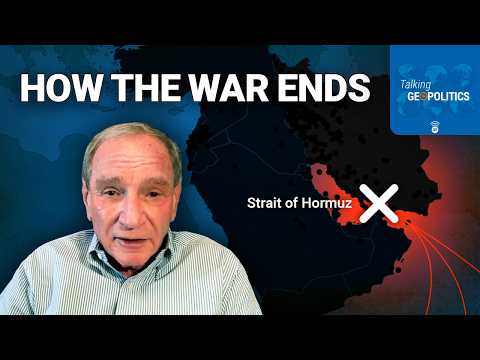
As we enter the second month of war in the Middle East, bombs continue to fly, and the closure of the Strait of Hormuz threatens a global crisis.
On this episode of Talking Geopolitics, GPF Chairman George Friedman joins host Christian Smith to discuss the military pressures facing Washington and Tehran, the expanding scope of the conflict, and what it can tell us about the future of war.
Visit http://www.geopoliticalfutures.com/gpf-newsletter for a free download from our Special Collection on the Middle East.
0:00 State of the Middle East War 1:48 US Strategic Objectives and the Nuclear Threat 6:48 Evaluating Military Options and Ground Forces 10:12 Internal Pressures and the Iranian Regime 18:27 Global Food and Energy Impact 19:42 The Complexity of Opening the Straits 22:15 The Future of War: UAVs as Bombs 24:06 Winning the War by Destroying Weapons 28:51 Tactical vs. Strategic Combat 30:05 Space Warfare and Intelligence 32:07 External Pressure on the US and Iran 35:01 The Role of China and Pakistan 38:39 Regional Powers and Final Negotiations 40:40 Israel's Stance and Conclusion
Source description (no synthesized summary yet).
Friedman argues the US-Iran conflict will end in negotiated settlement rather than military victory because both sides face unsustainable costs, modern drone warfare makes traditional invasion impossible, and Iran's nuclear capability—the core issue—is negotiable if both sides perceive mutual benefit.
- Modern drone warfare and precision strikes at distance make traditional ground invasion strategically prohibitive for the US
- Both the US and Iran lack political will for prolonged conflict: US cannot sustain another land war, Iran cannot withstand extended economic isolation
- The war's fundamental cause—Iran's nuclear capability—is the negotiable core; both sides can achieve acceptable outcomes through settlement rather than escalation
This asset isn't compiled yet
You're seeing its claims, ranked. Compile it to build the argument threads, weight them, and check each claim against your library — the full view.
The Israelis are even more terrified by an Islamic nuclear weapon than the United States is because Israel is a very weak country geographically with its widest part being 85 miles long, has no strategic depth, and is surrounded by hostile forces.
“The Israelis are even more terrified by an Islamic nuclear weapon than the United States is. Um Yes, the Israelis have fundamental problems. Israel is a very weak country geographically. It's widest part is 85 mi long, deep. They have no strategic depth.”
Natural gas, not oil per se, is the critical bottleneck for global food production because natural gas is a major component of fertilizer; the closure of the Strait of Hormuz threatens fertilizer production in the northern hemisphere at planting season, creating a potential food crisis.
“it's not going to be oil per se that's a critical thing. But natural gas because that's a major component of fertilizer. And so the center of gravity here is if in northern hemisphere we don't have enough serve fertilizer plant food that's going to be a major problem.”
The Islamist Iranian regime has fundamental cultural, religious, and ideological differences with Israel that are unchanging regardless of regime changes, making resolution of Iran-Israel tensions difficult through political means alone.
“Whatever happens in Iran to this regime, it is still an Islamic country, a Persian country, not Arab country. And at the same time, it has a fundamental cultural, religious, ideological differentiation with Israel.”
When Friedman wrote 'The Future of War' in 1997, he anticipated unmanned aerial vehicles would be aircraft that drop bombs without pilots, but he did not anticipate that the unmanned aerial vehicle itself would become the bomb—that is, drones are not dropping ordnance but are themselves the ordnance, which makes them a much more efficient form of attack.
“when I wrote that book, unmanned aerial vehicles in my mind were aircraft that would drop bombs but wouldn't have pilots on board. All right? What I didn't anticipate is that the unmanned aerial vehicle would itself be a bomb. In other words, they're not dropping bombs, you fire at them. They are actually the bomb itself. That makes it a very different and much more efficient form of attack.”
Warfare has changed fundamentally because distances involved are much greater than in the past; no longer is hand-to-hand combat or artillery-range warfare the dominant form—now precision strikes can target from 1,000 miles away using drones, making traditional invasion and occupation strategies obsolete.
“What has changed since then is it is no longer infantry on infantry combat. Mhm. Artillery used to be the thing, but it had to be brought straight up. At this point, there are drones, and they can be targeted from 1,000 mi away. So, the process of invading a country is very different than it was, say, 20 years ago.”
The US may need to rapidly deploy anti-missile and anti-drone systems to the Strait of Hormuz, but even with such systems, the fundamental problem remains: no insurance company will insure valuable ships through a narrow strait where drones can sink them, so insurance and shipping will not resume even if military defenses are deployed.
“we may wind up taking it rapidly deploying anti-missile anti-drone systems there. But still, uh do you take a incredibly valuable ship with necessary products and pushes through there seeing it sink and now block the straits again. So, it becomes a much more complex issue.”
It is very difficult to know when an enemy is truly out of drones or weapons; even if you believe you have destroyed most drone capacity, an invading force might land and then get 'pounded by forces you missed,' making confidence in victory extremely dangerous and uncertain.
“Knowing that you succeeded is even harder because you might wind up thinking you've done it, put three or four divisions on the ground, and they get pounded by forces you missed. So, one of the questions is, how do you know when they're out of drones? Or if they just stopped sucking you in, it becomes a very different sort of war that we have not experienced yet.”
Commando-style raids to capture or destroy Iranian nuclear material are impractical because Iran is a large country able to defend itself, intelligence on material locations may be unreliable, Iran moves the material around, and successful covert operations of this type are rare historical exceptions rather than reliable strategy.
“What happened in Venezuela was extraordinary and lucky. US attacked and took no casualties and captured Maduro. In the annals of covert warfare of these sorts of actions, that's rare rare. And Iran is a big country and it's able to defend itself against infiltrating forces... The Iranians have those people. So because it's very difficult to stage these kind of fancy attacks where you go in flawlessly and take everything out. And so also, is our intelligence on where this stuff is located good enough to carry it out? And are they moving it around in various ways to drive us crazy?”
Outside pressure on Iran from countries like Australia, Japan, South Korea, and other nations dependent on Strait traffic is unlikely to be decisive in forcing Iran to reopen the strait, because Iran weighs that pressure against its core interest in avoiding nuclear weapons, which it considers a survival issue.
“what pressure can they put on Iran to give up fundamental interests that they think they have?... The idea that great pressure is going to be a likely weapon in this or that displeasure with the United States or Iran is going to change the direction is really simplistic.”
Iran has implemented a mosaic strategy where the country is divided into smaller autonomous areas, each commanded by a local commander able to operate independently; this structure means that even if the US destroys Iran's political leadership or high command, the mosaic units will continue to operate because they have decentralized command and control.
“the way the Iranians have done this in the mosaic strategy they did is they expected to lose both the high command and communications. So, that each one of these mosaics, these smaller smaller areas are able to operate under the command of the local commander. And try to build systems to collaborate on using drones.”
Tens of thousands of people (7,000 to tens of thousands) were killed in protests in Iran in January, meaning that many people who might have protested against the war in current circumstances are no longer able to do so, reducing the potential for internal dissent against the war.
“you had you know, depending on the number that you're looking at, 7,000, 10,000, tens of thousands of people killed in the protests in January. Um, it's a lot of people who would have been out on the streets now, who no longer are able to be, and people who don't want to go out there because of that.”
The Iranians are fighting for their country and homeland defense, while the US is not, and this asymmetry always makes a significant difference in wars; this is a lesson that should have been learned from many prior conflicts.
“Remember one thing, the Iranians are fighting for their country. We're not. And that always makes it a big difference. And that's what we should have learned in many of these other countries.”
The Israelis claimed, probably incorrectly and perhaps deliberately, that their actions would provoke a rising or uprising within Iran; such an uprising did not occur, though it is not inconceivable that one could occur in the future, but it would take a long time for such dissent to develop.
“one of the things the Israelis said, probably incorrectly, certainly incorrectly, perhaps deliberately, was that there would be a rising in Iran. Now, that rising didn't happen, but it's not inconceivable. But not for a long time. It takes a long time for people to become bitter at a war.”
The US strategy involves isolating Iran economically, accepting that Iranians will not send oil to the rest of the world, and betting that the rest of the world can endure this isolation longer than Iran can sustain it.
“we tried something else, which is essentially isolating Iran, accepting the idea that the Iranians are not going to be sending oil to the rest of the world, and betting that the rest of the world can stand this longer than the Iranians can. And that's what's working itself out out now.”
Past military invasions (Vietnam, Iraq, Afghanistan) created generational memory of costly occupation, causing the US public and political leadership to be highly resistant to another land war, which constrains US willingness to fully commit ground forces to Iran.
“the United States does not want to fight another land war and there'll be great opposition to it in the United States...after that the blood of the Americans has not been shed sufficiently.”
The US does not want American blood to be shed in Iran because doing so would obligate continued commitment to the war regardless of costs—but since blood has not yet been shed significantly, the US can still withdraw without losing face.
“The nice thing about this negotiation is if the Iranians are prepared to give up the nuclear weapons possibilities. Uh the Americans has not yet put ground forces in. They not have not suffered thousands of casualties that they don't want to just leave there and so on and so forth. You know, after that the blood of the Americans has not been shed sufficiently. And the Iranians have too much to lose.”
The United States went to war with Iran fundamentally because it feared nuclear weapons in the hands of Iran, a country that still harbors al-Qaeda, and that a nuclear attack or weapons launched by missiles at the United States would be catastrophic.
“The US went to war because it feared nuclear weapons in the hands of Iran, a country that still harbors al-Qaeda, which was a force that led to 9/11 disaster in the United States. A nuclear 9/11 or nuclear weapons launched by missiles at the United States would be catastrophic.”
Russia made a critical military mistake in Ukraine by not realizing how much intelligence the Ukrainians were receiving from Americans and Europeans about where Russian troops were massing, and by not realizing that drones would destroy infantry forces; this caused the Russians to suffer badly and prevented them from breaking through or achieving massed movement.
“One of the mistakes the Russians made is they didn't realize how much intelligence they were getting the Ukrainians were getting from the Americans and the Europeans on precisely where the Russians were massing troops. Nor did the Russians realize that the drones that they had would destroy infantry forces. One of the reasons that the Ukrainians survived and the Russians did so badly was the introduction of the drones made mass movement by infantry very very costly.”
A ground force invasion of Iran would require occupying a country that is 2.5 times the size of Texas and would consume almost all of the US military capability; the US military currently has only about 10,000 troops available for such an operation, which is insufficient.
“We could invade Iran, but Iran is a vast country. It's two and a half times the size Texas, where I live, and that's really big. To take that country and occupy it would take just about all of the military capability of the United States. 10,000 men are nothing for that terrain.”
Both the US and Iran have incentive for the war to end in their favor, but each side would prefer to pay as little as possible for that victory; therefore, negotiations are the natural expression of both sides' desire to minimize costs while achieving essential objectives.
“each side has a desire for the war to end in its favor. But, I think each side would like to pay as little as they could for that favor. And, therefore, negotiations are taking place.”
Fighting in Ukraine occurs at small scale (surrounding villages) and is tactical rather than strategic, meaning winning individual villages does not change the war's outcome—the fight is now between decentralized drone-equipped units rather than massed formations.
“The fighting is taking place in very small places... There it's hard to very discriminate who's where and what. This is kind of combat but it's tactical combat. It's not strategic. Winning this village is not going to win the war for the Russians nor win the war for the Ukrainians.”
The outcome of every war is that each side expects to do better than the other, but one side always ends up disappointed—this fundamental asymmetry of expectations is what drives conflict initiation and continuation.
“The outcome of war each side expects to do better than the other. One side doesn't.”
Russia also provides intelligence to Iran via satellite, similar to how the US provides satellite intelligence to Ukraine, which extends Iran's capability to target at distance.
“the Russians are apparently giving them intelligence on satellites as we did to the Ukrainians.”
Prior to the war, Iran had already experienced massive public demonstrations against the regime, suggesting existing conditions of internal discontent that could resurface as war pressure increases.
“Before this, there were massive demonstrations against the regime. It may be that in Iran, there's still unrest. Or it may be the population, because of patriotism, now has rallied to the flag, in a given way.”
Underground weapons storage makes destroying Iran's drone weapons even more difficult than destroying exposed weapons, because bunkers protect weapons and add verification challenges.
“many of those weapons are underground as well, which makes which makes things harder.”
Israel and the United States initially shared interest in preventing Iranian nuclear weapons, but now their interests diverge on other issues; Israel cannot continue to conduct a war if the United States does not want it to because Israel is heavily dependent on the US.
“The Israelis and the Americans had one interest in common. You know, they said that Israel persuaded them to It was the nuclear weapon. The nuclear weapon going off the scale, now the Israelis and Egypt and the Americans have different interests. And the Israelis cannot continue to conduct a war if the United States doesn't want them to because they're heavily dependent on the United States.”
In April (one month into war), the ongoing economic impact on the world—including food price inflation in the UK of 8%, nitrogen fertilizer shortages in Australia, and energy disruptions—creates economic pressure on the world to find a settlement.
“In the UK they're saying that food prices in supermarkets could rise by up to 8% or so. Um and of course there's the energy side of things as well...an Australian farmer who was talking about how he had about a quarter of the nitrogen fertilizer supply that he had that he needed for the coming season”
The fundamental question determining how long Iran can sustain the war is how many drones it has, when it will use them up, and whether it is producing enough replacement drones; if Iran can be forced to use up drones ineffectively, the war reverts to the old model, but if Iran can maintain production, the US faces indefinite drone conflict.
“the fundamental question in terms of Iran's ability to survive is just how many drones they have. When will they use them up? Are they producing enough to replace them? Because if there's a way to get them to use up their drones relatively ineffectively to the point that that's not an issue, then we're back to the old model of war. If on the other hand, and on I I I would like to think that American intelligence knows to a great extent how many they have and so on and so forth. I don't.”
Wars last much longer than a month or two; after the first month of war, the outcome still depends on how the war ends—through victory, defeat, or negotiation—and given the facts presented, it will likely not be too long before this war ends.
“Wars last usually much longer than a month or two. And whatever was promised here was that this would be over in very quickly. And it may well be because there are negotiations going on. But the outcome of war each side expects to do better than the other. One side doesn't. So, the question is, how does the war end? Does it end with a victory? Does it end with a negotiation? But they end. And given the facts that you put out there, I think it will not be too long before this war ends.”
Saudi Arabia, Egypt, and the Turks have now involved themselves in negotiations, including countries that are not particularly close to Iran and which are hostile to it; the involvement of many regional players in negotiations suggests a negotiated settlement is likely.
“countries like Saudi Arabia and Egypt and so on have now involved themselves in this negotiation. Which these countries are not particularly close to Iran. Saudi Arabia is quite hostile to them. The Turks are involved in this now. So other nations in the region are coming into the equation.”
UK supermarkets are predicting food price increases of up to 8% due to supply chain disruptions from the Strait of Hormuz closure.
“Here in the UK they're saying that food prices in supermarkets could rise by up to 8% or so.”
Trump is not easily persuaded by foreign leaders, so Israel likely did not convince Trump to go to war; rather, Trump's independent assessment of the Iranian nuclear threat drove the decision.
“I suspect that Donald Trump is not very good at being convinced of anything. I think the fundamental reason we went to war is we did not want Iran to become a nuclear power.”