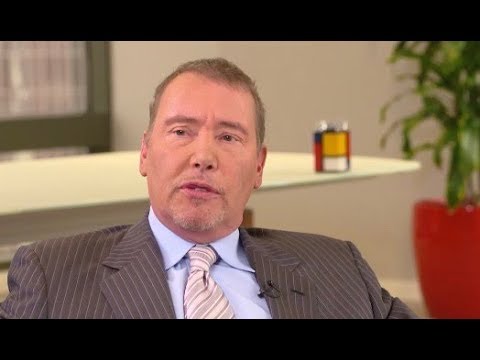
Jeffrey Gundlach on the market, millennials, cannabis, taxes, and the 2020 election
What this covers
Jeffrey Gundlach CEO of DoubleLine Capital sits down with Julia La Roche of Yahoo Finance for an extended conversation.
Subscribe to Yahoo Finance: https://yhoo.it/2fGu5Bb
About Yahoo Finance: At Yahoo Finance, you get free stock quotes, up-to-date news, portfolio management resources, international market data, social interaction and mortgage rates that help you manage your financial life.
Connect with Yahoo Finance: Get the latest news: https://yhoo.it/2fGu5Bb Find Yahoo Finance on Facebook: http://bit.ly/2A9u5Zq Follow Yahoo Finance on Twitter: http://bit.ly/2LMgloP Follow Yahoo Finance on Instagram: http://bit.ly/2LOpNYz
Source description (no synthesized summary yet).
Gundlach argues that the U.S. is at an unsustainable fiscal tipping point due to $123 trillion in unfunded liabilities, requiring politically difficult benefit cuts and eligibility age increases, while the corporate credit market presents significant distressed opportunities when the next recession arrives due to widespread mispricing of risk.
- The U.S. cannot mathematically fund $123 trillion in unfunded liabilities without a 16% swing in fiscal position from current deficit to surplus
- Corporate credit is currently mispriced because investors bought distressed assets assuming safety that they did not actually have, creating layered selling when corrections occur
- The opportunity set in corporate credit will be vastly better post-recession, making current equity gains not worth the opportunity cost of waiting
This asset isn't compiled yet
You're seeing its claims, ranked. Compile it to build the argument threads, weight them, and check each claim against your library — the full view.
Gundlach's primary investment principle is risk aversion: thinking more about what you shouldn't do than what you should do, because fatal risks (defaults, refinancing losses) permanently destroy capital while avoiding them preserves optionality.
“that's what kills particularly fixed income investors if you buy a lot of junky bonds and they default your money's gone forever if you buy a bunch of mortgages and they refinance at the wrong time you kind of lost money forever”
Relationships and correlations in markets don't hold up forever because the world changes, variables change, and coefficients that drive correlations shift, requiring continuous monitoring rather than reliance on static historical patterns.
“relationships don't hold up forever you've got if the world changes the variables change the coefficients change that drive things and so it's really important that you sort of just stay on top of it”
Market participants require confirmation of their ideas from financial media commentators before they will deploy capital, not realizing that by the time consensus emerges to ratify their view, the opportunity is already priced in.
“they want to see the idea that they have get ratified or corroborated by a crawler on some financial program and they oh I see now it's safe to do this because everybody else saying that this is the conclusion you're supposed to draw but by then it's priced in”
The U.S. has $123 trillion in unfunded liabilities across Social Security, Medicare, and state/local pension systems, with state and local pensions averaging 50% underfunded, making these obligations mathematically impossible to meet.
“we also have 123 trillion dollars in unfunded liabilities the state and local pension systems the United States on average are 50 percent underfunded”
Gundlach made a public declaration at a prominent June 2007 conference that 'subprime is a total unmitigated disaster and it's going to get worse,' which was captured by media on five continents when triple-A and double-A subprime securities were still trading at par.
“I made the declaration I'm gonna get to the credit markets later on in this talk but I'll just give you a hint subprime is a total unmitigated disaster and it's going to get worse that phrase was captured in the media on five continents and at that time the subprime sector the triple A's the double A's they were still trading at a hundred cents on the dollar”
When investors realize they were 'lied to' or that their assumptions about risk were wrong, they don't gradually adjust positions but accelerate selling before losses mount, creating additional layers of forced liquidation.
“they now realize that they were fooled they thought it was safe but they were wrong or someone they were lied to and so they decide I never signed up for this I'm getting out before it gets worse and that creates another layer of selling”
The market is currently in a bear market despite not having declined 20% (the arbitrary threshold), because a 'crazy' mania (Bitcoin) peaked and is being followed by broader asset class peaks in succession, which is how bear markets actually develop.
“yeah oh yeah it's a bear market I mean this this is a bear market there's nothing to do with this 20% arbitrary thing it has to do with something crazy happening first and then the crazy thing gives it up and yet more traditional things continue to march on but one by one they give it up”
Distressed opportunities in fixed income come from securities that are mis-rated at issue (rated investment grade when they contain significant risk), leading to panic selling when market conditions reveal the hidden risk.
“when you're looking for distressed opportunities and fixed income the best ones come from things that are mis rated going into the problem because the people that buy investment grade corporate bonds are looking for safety they think they have safety when you buy a triple-a rated subprime floater you're a triple-a person you didn't sign up for a lot of risk you signed up for a little bit of reward hoping that the risk was de minimis but then it ends up being a big risk”
Running money for other people is evaluated through 'painfully objective' numerical comparison: your returns to decimal points versus the market index versus other investors' numbers, eliminating any subjectivity in performance judgment.
“what I do running money other people's money is amazingly at the end of the day non objective as to whether you've done a good job or not it's actually painfully objective because it's a number to two decimal points or more and see your number versus that market number some other investors number and there's kind of no getting away from that”
Republican Senator Marco Rubio is proposing legislation to curb stock buybacks, indicating that limiting buybacks is becoming a bipartisan priority before Democrats claim it as their own signature issue.
“it is interesting that a Republican is proposing legislation to curb buybacks that shows you that Marco Rubio wants to get in front of this issue before somebody on the other party claims it as their own”
The U.S. government spends seven times more on people over 65 than on people under 21, demonstrating a structural misdirection of investment toward dying populations rather than future growth.
“the ratio was seven to one how much we of the budget goes to paying for things for people over 65 compared to paying for things for people under 21”
Instead of raising wealthy people's taxes from 52.6% to 85.6%, the 'forty-niners' (those in lower income brackets) should be raised to 52.6%, making tax rates consistent across income groups and addressing inequality through inclusivity rather than confiscation.
“instead of raising me from fifty two point six to eighty five point six I think the forty nurs should come up to fifty two point six that's what should be happening”
Facebook's business model is fundamentally problematic because it operates as a 'diabolical data collection monster' rather than the safe platform it presents itself as, despite being unrepentant about privacy violations.
“I think that Facebook their big problem is obviously their business model... they sold themselves as comfortable and safe but there's really just a diabolical data collection monster and they don't they're unrepentant”
Gundlach called the housing market collapse in December 2006 (predicting 35% price decline) when prices had only fallen 0.5%, and raised a distressed fund in February 2007 before subprime crisis became widely recognized.
“I actually raised a distressed fund starting in February of 2007 and it was an interesting period because the institutions that I was suggesting this idea to they were debating whether I was right more than anything they were saying like well what no one else says this you say the housing prices go and dropped 35% which I said in Barron's in December of 2006 when they were down by 1/2 of 1%”
Gundlach finds it 'incredibly horrifying' that high school smoking increased 38% year-over-year due to vaping, with over 50% of high school students either smoking or vaping, which may represent a gateway to cannabis industry growth.
“I saw a statistic this week that the increase in smoking among high school students year over year 38 percent because of vaping Wow that the there is an explosion in smoking which I suppose is probably like a gateway for the cannabis industry so maybe there's something there but I I find that to be an incredibly horrifying statistic in one year 38 percent increase and now over 50% of high school kids are either smoking are there mostly vaping”
The stock market bear has been temporarily saved by Fed pivot and bond rally reducing pressure on equity valuations, but if long-end rates rise (particularly past 3.5% on the 30-year), the bear market resumes because bonds compete with buyback-dependent equity valuations.
“and I think that it's been saved by the feds pivot it's been saved by the bond rally taking some pressure off the stock market but if the long end of rate starts to rise as I expect and if we break through 350 on the thirty-year I think I think it's over because the competition from the bond market particularly against a climate of limiting one of the engines of stock price appreciation which is buybacks”
If marginal tax rates were raised to 70% as proposed by some politicians, Gundlach's combined rate would reach 85.6%, at which point he believes he would 'stop work' rather than accept such confiscatory taxation.
“if they raise it to 70 percent that'd be a 33% increase I would go to eighty five point six percent I really think I would stop work yeah who would even work with them I think I really think I would stop working at eighty five point six”
Benefit cuts and eligibility age increases for Social Security and Medicare are inevitable and will happen 'remarkably easily' once the unsustainability becomes obvious to the public.
“the solution is you have to cut benefits when you have 123 million dollars of unfunded liabilities you have to deep you have to decommitted them to fund them... and it will happen remarkably easily”
Interest rates have structural bias to rise on the long end due to late-cycle leverage and corporate economy dynamics, meaning investors should forgo current equity gains and wait for recession-driven credit dislocations with superior opportunity set.
“I just think that interest rates have a bias to rise on the long end and I'm I I think it's late enough in the cycle with enough leverage and the corporate economy that if we continue to roll on with attractive gains and risk assets I'm pretty sure it's at the end of the game and you're going to be better off waiting and forgoing those gains because your opportunity set will be vastly better when the next recession comes”
Gundlach's marginal tax rate combining California and federal taxes is 52.6%, and he finds it 'deeply offensive' when people claim that wealthy people like him pay only 15%, as was reported about Mitt Romney's tax rate.
“my marginal tax rate is presently combined California and u.s. 52.6% I I'm deeply offended when people tell me no it's not I actually have pet people say that to me no it's not rich people like you only pay 15%”
Emerging European and UK regulation of Facebook will likely trigger stock price declines similar to historical patterns, where healthcare stocks collapsed after regulatory arrivals, suggesting Facebook faces significant regulatory downside.
“I just saw yesterday they're talking about more regulation in Europe in the UK and when the regular show up usually the stock prices go down like healthcare ahead of meteoric rise until the regulator's showed up a few years ago then a big decline”
The key investment skill is living in the gap between news flow and market interpretation: identifying moments when news doesn't change but interpretation shifts, or news changes but interpretation doesn't—and being faster to act on these gaps than other market participants.
“I think what's important is to look for harbingers and instances of the cusp of change we actually get a moment you can act on it... what's important is to look for harbingers and instances of the cusp of change we actually get a moment you can act on it”
In 2011, when Ben Bernanke pre-announced three years of zero interest rates, certain bond instruments that should have appreciated significantly in response actually didn't, remaining 20 points undervalued for about two weeks before repricing—indicating that markets wait for confirmation from financial media before adjusting positions.
“I remember the one Ben Bernanke when thinks we're looking pretty grim back there in 2011 or so he said we're going to keep short-term interest rates at zero for at least three years he pre announced three years of zero interest rates and shockingly many instruments in the bond market that were sure to profit tremendously from zero interest rates for three more years they didn't go up in price for like half a day and I bought them all”
The double line in the middle of a highway is a legal prohibition on crossing that exists for protection and safety, making it a perfect metaphor for DoubleLine's investment philosophy of avoiding fatal risks.
“the meaning was in the everyone's life that they experienced more frequently than a double line there's a double line in the middle of a highway and it's by law you're not supposed to cross it but it's really there for your protection”
Gundlach's primary information source is news wires rather than other people's analysis, and he tries 'very hard to pay no attention to other people think' to avoid groupthink and consensus distortion.
“I look at news wires more than anything else and I try very hard to pay no attention to other people think”
Gundlach deeply admires Donald Judd, a 20th-century sculptor who rejected the New York art scene's groupthink, moved to Marfa Texas, and created his greatest works away from artistic consensus and peer influence.
“what person I really admire is someone that nobody's most people don't know the person's name his name is donald judd and donald judd was one of the great i call him a sculptor if you want to of the 20th century he broke rules and made people angry because he actually didn't make the sculptures himself”
The October 3rd to Christmas Eve 2018 stock market decline was 'a taste of things to come' and foreshadows larger dislocations when the next recession arrives.
“well we saw what happened from October 3rd into Christmas Eve I mean there was a pretty big drop and I think that that's just kind of a taste of things to come”
Gundlach prefers to hire people fresh out of school with no preexisting training from other firms, rather than experienced professionals with 8+ years at competitors, to avoid ingrained habits and enable alignment with DoubleLine's methodology.
“I generally like to hire people who either I know or who know nothing I don't like bring in people from other firms who have like eight years experience because they've learned some other way and it does not that the other way is wrong but it's not the way we do things”
Gundlach attributes success from the top through personal leadership: 'everything that goes right the team did it and everything goes wrong it's my fault,' creating a culture where people appreciate being protected from blame.
“everything that goes right the team the team did it and everything goes wrong it's my fault and I think that people appreciate that”
Attending 'Titans' dinners and groupthink events where prominent investors present bullish and bearish theses on the same stock leaves one confused and unable to form independent conclusions, because good arguments exist on both sides.
“I would sit there and here's mr. great a you know number one and he's massively bullish on Apple and then they turned to mr. great number two and he's massively bearish on Apple and both of their arguments sound really good to me so I'm so like I don't know what I think now about Apple”
DoubleLine hires analytically-minded people who believe in shared success, explicitly prohibiting the competitive killing mentality of many financial firms where employees succeed by undermining colleagues.
“we like people are very analytic we like people who are believed in shared success I tell people and I start working here at many firms you succeed by killing the person next to you if you even if you even go in that direction you're gone I want people to want the person next to them to do well”
Gundlach was invited to speak in Bakersfield at an event attended by wealthy farmers and oil entrepreneurs in overalls, who warned him about 'Blood Alley' (a road with fatal head-on collisions due to tractor traffic), which he saw as a perfect real-world example of his double line philosophy.
“the guy says whatever you do don't take this one maybe well why not he said it's called blood alley I said really he goes yep there's more fatal head-ons on that road than any other one in the state and the reason is that it's tractor country and it's very windy and it's one lane each way and tractors go slow and people are impatient”
DoubleLine was named after Piet Mondrian's artistic device—'the double line'—which appears in his last great classical painting from 1931, representing the ambiguity between line and plane that interested Gundlach.
“I bought my first Mondrian and it's his last great classical painting were two devices are used one was an early device called a progression which is basically rectangles that progress another was a device he came up with in 1931 which is called the double line”
DoubleLine's analytical advantage derives from identifying stable correlations that are commonly-sense but empirically verified, such as the Fed's underlying inflation gauge correlating to core CPI at approximately 80% with an 18-month lag.
“we just look for correlations that might be common sense but then you've you verified them some things that just correlate well like for example things like the feds underlying inflation gauge which doesn't get nearly enough attention it correlates incredibly well to CPI core CPI on about an 18 monthly basis it's got about an 80 percent correlation”
The corporate bond market will experience 'another leg down' consistent with the equity market downturn pattern, creating additional distressed opportunities beyond equity losses.
“I think and that will happen the corporate bond market - there's another leg down come in”
Recession indicators are not currently showing clear signs of imminent recession, but they are 'starting to show signs of cracking,' making the timing uncertain but the eventual correction probable.
“as we said earlier can't really see a recession in say by middle of this year we always get surprised but our indicators don't show it but once they roll but they are starting to show signs of cracking not convincingly that you have to act today”
Gundlach announced to investors in March 2008 that he would 'buy so much of this stuff that it's probably gonna take us like a year to get fully invested,' and achieved full investment by March 2009, which coincidentally turned out to be the market bottom.
“I said I want to buy so much of this stuff that it's probably gonna take us like a year to get and we didn't really get fully invested until March of o.9 which as good luck would have it turn out to be the bottom”
Gundlach could have retired long ago but continues working because he finds processing human behavior and understanding what makes the world work 'very interesting' and 'that's that's why I do what I do.'
“I mean I could have retired a long time ago I I find it very interesting as a way of processing human behavior society and just understanding what makes the world go around”
Gundlach doesn't trust Facebook and dislikes them both from a business fundamentals perspective and emotionally, making him want their stock to go down—an admission that emotional dislike influences his investment views.
“I'm not I I don't really trust Facebook so the fact that I don't trust them makes me not like them and the fact I don't like them makes me want their stock to go down”
A third-party centrist candidate like Howard Schultz cannot win a presidential election in 2020 without a prior recession and associated 3 trillion dollar budget deficit to shift political conditions.
“no you're not gonna win in 2020 I'm talking about debt unless we have a recession first and we're running a three trillion dollar budget deficit”
DoubleLine's smart beta equity fund using CAPE ratio methodology has been the best-performing large-cap strategy in the U.S. since its launch, managing over $10 billion in assets.
“it turned out that that strategy had tremendous successes I think it's the best performing large-cap strategy in the country since we launched it and it's that was good because it was successful that's over ten billion dollars”
Millennials will likely have Social Security eligibility ages around 75, and some people (like Gundlach himself) may not receive any benefits, representing a significant reduction from promised entitlements.
“certainly the Millennials are gonna have eligibility eligibility that's probably 75 and some people like me you won't get anything”
By October 3rd (presumably 2019 given context), the stock market bear pattern had tightened to only two stocks (Amazon and Apple) representing market gains, and then 'it was over,' marking the culmination of the bear market progression.
“and then on October 3rd it was over and so that's how a bear market develops”
Vaping is 'probably far worse' than traditional cigarettes, though Gundlach admits he has never been a cigarette smoker and would not use any chemical-concentration products.
“I I find that to be an incredibly horrifying statistic in one year 38 percent increase and now over 50% of high school kids are either smoking are there mostly vaping I think which is probably far worse far worse than traditional cigarettes I don't know I've never been a cigarette smoker but I wouldn't get anywhere near any this chemical concentration stuff”
DoubleLine launched a liquid real estate fund in partnership with Colony Capital that invests not just in traditional retail REITs and nursing homes but also in newer economy digital assets like satellite towers, using smart-beta methodology.
“that's a liquid real estate fund which i think is really interesting with Colony Capital which we just started launching that actually invests in all manner of REITs then a brick and mortar reads but also includes digital assets it's it's not just malls feelings like malls and nursing homes that's part of it it's much bigger than that almost like newer economy yeah there's love its new economy like satellite towers”
Gundlach is committed to 'a couple of terrible enterprises that basically need a lot of money,' which is a reason to work so money can be directed to meaningful causes rather than 'some rathole of administrative waste.'
“I'm committed to a couple of terrible enterprises that basically need a lot of money so that's a it's a good reason to to work so that it can be funneled not just to the Internal Revenue Service and the United States Treasury which I am a very significant contributor to but also something I think matters”
Gundlach believes art is subjective and doesn't influence his investment philosophy, serving as a 'yin and yang' balance to the objective, measurable nature of investment performance management.
“I don't really think it does I I think it's just very different I mean art is you know it's it's very subjective so I think it's a balance more than a tie into what I do”
Cannabis mania is difficult to justify because it's not clear why cannabis receives speculative premium relative to corn or other agricultural commodities, beyond the fact that it was previously illegal and carries psychological appeal.
“I'm pretty simplistic I don't know why there wasn't a corn mania right how could this in a corn mania grow corn - right I don't understand why just because it used to be illegal and you know that somehow it's got this special magic to it but you know it's interesting the cannabis thing does seem kind of like a mania”
The most probable 2020 election scenario involves four major candidates with funding: Trump (right), Biden or Romney (center), Bernie Sanders (left), all backed by meaningful financial support.
“and so maybe you'll get like a Biden and a Romney and a Trump and as a placeholder Bernie Sanders type of thing so and I think all four of those would get funding I'm clear there's funding for socialists”
Gundlach has no social media presence beyond Twitter (which he joined in 2018), follows nobody, and deliberately avoids Facebook, Instagram, and apps, using Twitter only occasionally to correct misreporting of his views.
“I have no presence I do I follow nobody... we'll never see Jeffrey Gunlock on Facebook never never never on Facebook I don't know what Instagram is I've never downloaded an app in my life”
Howard Schultz lacks the temperament and resilience for presidential campaigns, as evidenced by his retreat after being heckled 23 seconds into a CNBC interview at his campaign announcement.
“I was in the room yeah it just seems to me I don't think he expected to be insulted you know profanely insulted by somebody 23 seconds into his coming out party so I he's kind of disappeared into a shell a little bit since then”
The two-year Treasury yield is approximately equal to the ten-year Treasury yield (both around 2.5%), representing an unusual flat yield curve that creates opportunity cost in waiting for rate increases and recession-driven credit dislocations.
“right now in the fixed income market strange thing is I think the most exciting thing is the two year Treasury not that it's great but its yields about the same as the ten year it's you know it's a two and a half”
Cannabis industry growth appears to be a potential mania, with the game being to gain shelf space, build brand, and engineer buyout by larger companies, though Gundlach expresses skepticism about the logic.
“I don't crypto cannabis that's kind of the one that people are talking about now if you haven't I I've got young guys working for me that are big believers and the cannabis thing and they claim that it's all about getting shelf space and branding and getting bought out by another big company that's like the game I mean it sounds plausible to me but I don't know”