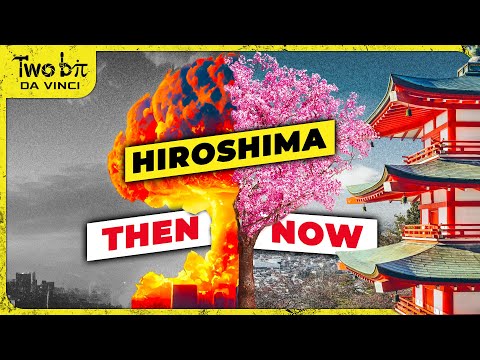
Why Isn't Hiroshima a Nuclear Wasteland Like Chernobyl?
What this covers
Hiroshima: Thanks DeleteMe for sponsoring this video! Protect your online Info Today! https://JoinDeleteMe.com/TwoBitDavinci
I've often wondered, why different nuclear disasters in history have had some different outcomes. Chernobyl is still deserted and uninhabitable for thousands of years, while Hiroshima and Nagasaki are beautiful thriving Metropolises. But why? What happened in these disasters that have lead to such different outcomes all these years later? The engineer in me just had to figure this out, so I got digging. Let's Figure this out together!
》》》SUPPORT THE SHOW!《《《 Become a MEMBER! https://twobit.link/Member Join our Newsletter! https://twobit.link/Newsletter Join our Discord! https://twobit.link/Discord
》》》OUR PARTNERS《《《 Protect Yourself Online: https://twobit.link/DeleteMe
》》》GOING SOLAR?《《《 Energy Sage for Solar ⟫ https://twobit.link/EnergySage
》》》COMPANY OUTREACH 《《《 Sponsor A Video! sponsors@twobit.media
》》》CONNECT WITH US 《《《 Twitter 》 https://twitter.com/TwoBitDaVinci Facebook 》 https://www.facebook.com/twobitdavinci Instagram 》https://www.instagram.com/twobitdavinci/
Chapters 0:00 - Introduction 0:30 - History of the Bombs 2:00 - Chernobyl: What Happened 5:00 - The Difference 7:10 - Nuclear Fission 8:00 - The differences 11:50 - Quantities
what we'll cover two bit da vinci,hiroshima bomb,nuclear bomb,Why Isn't Hiroshima a NUCLEAR WASTELAND?,hiroshima and nagasaki vs chernobyl,hiroshima vs chernobyl,hiroshima vs chernobyl radiation,why isnt hiroshima a wasteland,why isnt hiroshima a nuclear wasteland reaction,why is chernobyl still radioactive but hiroshima is not,why is chernobyl dangerous,why is chernobyl radioactive,why chernobyl is still,why chernobyl is still a problem,why is chernobyl still radioactive, Why Isn't Hiroshima a Nuclear Wasteland?, Why Isn't Hiroshima a Nuclear Wasteland Like Chernobyl?
Source description (no synthesized summary yet).
The contrasting fates of Hiroshima/Nagasaki versus Chernobyl stem from fundamental differences in explosion type, detonation altitude, fuel quantity, and fallout dispersal mechanism—air bursts over cities minimize ground contamination while reactor meltdowns release massive quantities of long-lived isotopes into the environment.
- Air bursts at 2,000 feet prevent the fireball from touching ground, avoiding soil activation and minimizing fallout compared to ground-level reactor explosions
- Chernobyl contained 190,000 kg of uranium (29,000× more fuel than Fat Man) in a ground-level containment vessel, dispersing 5% into atmosphere as long-lived isotopes like Cs-137 and Sr-90
- The Chernobyl explosion was a hydrogen-driven steam explosion, not nuclear fission chain reaction, yet released vastly more radioactive material than deliberately optimized air bursts
This asset isn't compiled yet
You're seeing its claims, ranked. Compile it to build the argument threads, weight them, and check each claim against your library — the full view.
Both atomic bombs were detonated at approximately 2,000 feet above ground level, which was a deliberate strategic choice, not an accidental detonation malfunction.
“both bombs were detonated almost 2,000 ft above the ground when I saw that I was like wait what really at first I thought it was a typo so I went and corroborated it with different sources but no that's actually true so I thought then maybe it was a glitch in the detonation mechanism but it turns out that that explosion at 2,000 ft was completely intentional”
The 1945 debate about which fuel to use in atomic bombs resulted in the design of two different bombs (Little Boy with uranium-235 for Hiroshima, Fat Man with plutonium-239 for Nagasaki) partly to test two different detonation mechanisms and nuclear fuels.
“I remember reading once that there was a debate in 1945 about what fuel to use in the atomic bomb and that part of the reason for the two bombs horribly as it may sound was to test two different detonation mechanisms and two different nuclear fuels”
Reconstruction in Hiroshima and Nagasaki began almost immediately after the atomic bombings and has continued uninterrupted since, with population graphs showing steady uphill growth after the initial sharp decline from the blast.
“it was so short in fact the Reconstruction began almost immediately and hasn't stopped since”
The Red Forest near Chernobyl consisted of trees that were exposed to radiation and died, turning a ginger-brown color and earning the nickname 'Red Forest'; this area remains visibly affected even approximately 40 years after the disaster.
“radiation killed everything in the four square miles directly around the reactor the trees exposed to the radiation died and turned a Ginger Brown earning at the nickname the red Forest even today almost 40 years after disaster the place is still deserted and a nuclear Wasteland”
Hiroshima and Nagasaki are thriving metropolises today, approximately 70 years after nuclear bombing, with no remaining radiation or exclusion zones outside the protected Atomic Dome memorial.
“both cities are beautiful thriving metropolises”
80% of residual radiation from the atomic blasts in Hiroshima and Nagasaki decayed within the first 24 hours, and by one week after the explosions, radiation levels had decreased to one millionth of their initial levels.
“80% of the residual radiation from the blast in Hiroshima and Nagasaki had burnt out in the first 24 hours and a week later it had already decreased to 1 millionth”
Air bursts minimize radioactive fallout from nuclear detonations because the fireball never touches the ground, preventing soil, water, and other materials from becoming radioactive; the only radioactive byproducts are fission products and weapon debris dispersed in the atmosphere and carried away by wind until diluted.
“if you detonate it above the ground which is called an air burst that doesn't happen this maximizes the blast radius and the damage on the surface and that's exactly what the US was looking for not only that it also turns out that besides maximizing destruction Air Bursts also minimize the radioactive fallout of the explosion”
Chernobyl's explosion was not a nuclear fission chain reaction explosion; instead, it was caused by hydrogen buildup inside the reactor and subsequent steam/hydrogen explosion—a fundamentally different mechanism from nuclear weapons despite similar radioactive consequences.
“the only reasonable explanation is that Chernobyl wasn't in fact a nuclear explosion it was nuclear meltdown which are two very different things the explosion was caused by hydrogen buildup inside the reactor not by a runaway nuclear Chain Reaction if that had been the case Lord knows how large the crater would have been”
Nuclear meltdowns cannot result in mushroom clouds and city obliteration even if mismanaged, because uranium fuel in power plants is too dispersed and diluted to ever reach critical mass required for nuclear chain reaction—the fuel rods are physically incapable of achieving criticality.
“that explosion at 2,000 ft was completely intentional...when many of us think about nuclear meltdowns we immediately default to the image of a big mushroom cloud over the power plant and the surrounding City being obliterated from what I found out it turns out that really can't happen because the uranium and the fuel rods are too diluted it's never enough to reach a critical mass so no not even putting Homer Simpson in charge of a nuclear power plant will result in a nuclear explosion”
Radiation levels in Chernobyl have decreased to approximately 10% of their initial levels at the time of the accident, and the exclusion zone is now teeming with plant and animal life despite ongoing contamination.
“radiation levels in Chernobyl have decreased to about 10% of what they used to be at the time of the accident except for the Red Dead Forest the exclusion Zone surrounding the remains of the Chernobyl power plant is actually teaming with both plant and animal life in fact you can even visit the site for a short time without risking your life”
Chernobyl reactor 4's safety test was initiated on April 25-26, 1986, with the core cooling system shut down at 2 p.m., the inexperienced night crew taking shift at 11:10 p.m., and the test officially beginning at 1:23 a.m. on April 26 after control rods were removed to restore power following a power plunge.
“it is April 25th 1986 everything looks good so they shut down reactor 4's core cooling system at 2 p.m. in preparation for the test at 11:10 p.m. the less experence night crew of operations takes their shift...at 1228 a.m. power plummets in the reactor so the inexperienced operators remove the control rods in an attempt to bring the power back up it is now 1:23 a.m. on April 26th with the control rod still removed the operators began the test by shutting down the turbine”
There are four different detonation heights for nuclear warheads, each producing distinct effects: high-altitude bursts for ionizing radiation and EMP pulses; subsurface bursts for crater formation and shock waves against hardened targets; surface bursts for concentrated blast/thermal energy; and air bursts for maximizing surface destruction while minimizing radioactive fallout.
“you can choose to detonate a warhead from four different heights depending on the effect you're looking for leading to four very different outcomes you have high altitude bursts which are mostly used for the ionizing radiation and strong EMP pulse to disrupt Communications and advanced electronics then there's subsurface burst used to create a large crater and a powerful shock wave that can destroy hardened targets like bunkers missile silos or tunnels then there are surface bursts where you can concentrate most of the blast and thermal energy in and directly around the detonation site but if you want to cause as much damage as possible to the buildings and infrastructure on the surface a surface burst doesn't really cut it because the buildings themselves around the epicenter act like a shield that reduces the blast radius but if you detonate it above the ground which is called an air burst that doesn't happen this maximizes the blast radius and the damage on the surface”
The implosion detonation mechanism used in Fat Man was significantly more efficient than the gun-type mechanism in Little Boy, requiring only 1/10th the fuel mass while producing 40% more explosive force.
“Fatman used an implosion type mechanism that proved to be way more efficient than little boy gun type the bomb dropped over Nagasaki only needed a tenth of the amount of fuel to yield 40% more explosive power”
Chernobyl's explosion was nowhere near as powerful as the atomic bombs (about 100× less powerful), yet the aftermath proved much worse than the bombings, making Chernobyl the worst nuclear disaster in human history.
“the magnitude of the explosion and the fires of the Chernobyl power plant is nowhere near that of the atomic bomb yet the aftermath is much worse making it the worst nuclear disaster in human history”
The town of Pripyat next to Chernobyl shows a completely flatlined population graph with no recovery, in stark contrast to the steady population growth of Hiroshima and Nagasaki.
“now look at the population graph for the town of prat next to Chernobyl that's quite the difference isn't it it's just flatlined”
Little Boy (Hiroshima bomb) was made with uranium-235 as fuel, while Fat Man (Nagasaki bomb) was made with plutonium-239, but despite the different fuels, both cities recovered equally well from radiation.
“little boy was made of uranium 235 it turns out and fat man was made of plutonium 239 that's not encouraging despite the different fuels both cities recovered just fine from the radiation”
At Chernobyl, the reactor explosion occurred at ground level inside a containment vessel, expelling large and small chunks of highly radioactive reactor core into the environment, with the resulting fire producing tons of radioactive smoke dispersed across Ukraine, Belarus, and beyond.
“there the explosion wasn't just a ground level but it was inside a containment vessel that blew up while it was nowhere near as powerful as Hiroshima the Chernobyl explosion spat out large and small chunks of the highly radioactive nuclear reactor core even worse the fire in the reactor produced tons of radioactive smoke that was carried by the wind far beyond the borders of Ukraine into bellarus and other countries”
Little Boy carried 64 kg of uranium-235 and achieved explosive yield through gun-type mechanism, while Fat Man contained only 6.2 kg of plutonium-239 and achieved 40% more explosive power through more efficient implosion-type mechanism—requiring only one-tenth the fuel mass.
“little boy carried 64 kg of uranium while fat man contained only 6.2 kg of plutonium when I looked into why that was it was only because of the different detonation mechanisms...Fatman used an implosion type mechanism that proved to be way more efficient than little boy gun type the bomb dropped over Nagasaki only needed a tenth of the amount of fuel to yield 40% more explosive power”
Chernobyl reactor 4 contained 190,000 kg of uranium fuel, and approximately 5% of it (roughly 10 tons) ended up in the atmosphere and surroundings after the explosion as radioactive fuel rod pieces with high concentrations of fission products.
“the amount of fuel in chernobyl's fourth reactor it had and this is not a typo 190,000 kg of uranium and at least 5% of it ended up in the atmosphere and the surroundings after the explosion that's almost 10 tons of radioactive uranium fuel rods with high concentrations of vision products and other radioactive voice spread out in pieces”
Typhoon Makurazaki struck Japan on September 17, 1945, weeks after the atomic bombings, causing massive flooding and washing away bridges across Hiroshima, Nagasaki, and other cities; the typhoon killed another 2,500 people but also dragged much of the residual radiation out to sea.
“only a few weeks after the bombing and even after surrendering unconditionally Japan was attacked once again but this time it wasn't a foreign Nation it was Mother Nature on September 17th 194 5 typhoon makurazaki hit the island of Japan causing massive flooding and washing away Bridges all over Hiroshima Nagasaki and other cities the typhoon took another 2500 lives however the floods also dragged much of the residual radiation out to sea”
The magnitude of the Chernobyl explosion was approximately 100 times less powerful than either of the atomic bombs dropped on Hiroshima or Nagasaki.
“both nuclear blasts were roughly 100 times more powerful than the explosion at the power plant”
Fission products released at Chernobyl include iodine-131 (most dangerous but very short half-life, now virtually none remaining), cesium-137, strontium-90, and plutonium-241—the latter three persist for decades and remain highly dangerous radiation sources.
“these fishion products include iDine 131 cium 137 strong tm90 and plutonium 241 I D 131 is the most dangerous of all but it has a very short halflife and there is virtually none of it left at this point in troville the story is very different for cesium 137 strontium 90 and plutonium 241 these last for decades and they're highly dangerous sources of radiation”
Chernobyl's exclusion zone of 19 miles around the reactor is so radioactively contaminated that it will remain uninhabitable to humans for approximately 20,000 years.
“after Chernobyl a radius of 19 miles around the reactor was designated as an exclusion Zone because of the heavy radiation contamination”
During the Chernobyl reactor test, a power surge occurred, operators attempted to insert all control rods to shut down the reactor, but the rods jammed, followed by a series of explosions that destroyed reactor 4.
“there's a power surge The Operators panic and try to insert all the control control rods to shut down the reactor but they Jam moments later they hear a series of explosions”
Nuclear fission is the process of splitting unstable atomic nuclei, which releases energy and additional neutrons that cause a chain reaction as those neutrons split other atoms.
“nuclear fision literally means splitting the nucleus some atoms are unstable and naturally break apart those are the radioactive isotopes but we can also force them to split by bombarding them with other particles like neutrons for example that initial fision also releases three other neutrons that can make three other atoms break apart and so forth and so forth causing that dreaded Chain Reaction”
The key difference between nuclear power plants and nuclear bombs is that power plants maintain slow, controlled fission reactions, while bombs produce fast, violent uncontrolled chain reactions.
“the only difference is that in power plants we want that reaction to be slow and controlled while in bombs we want it to be fast and violent”
Critical mass is the minimum amount of fissile nuclear fuel required to achieve a self-sustaining chain reaction; in nuclear weapons, the fuel is separated into two subcritical masses and the detonation mechanism brings them together to achieve criticality and explosive chain reaction.
“for an atomic bomb to explode you need a critical mass of nuclear fuel so that you can get a runaway Chain Reaction that's sort of like YouTube videos that need a critical mass of viewers like you watching sharing smashing the like button and subscribing to tell the algorithm to go viral anyway in a bomb you can't have the critical mass of fuel together in one place well because it'll go off so what you do is separate it into two subcritical masses and the detonation mechanism puts them back together to make it explode”
The atomic bomb dropped on Hiroshima (Little Boy) detonated at 8:15 a.m. on August 6, 1945, and immediately claimed nearly 880,000 lives, with thousands more succumbing to radiation effects.
“at 8:15 a.m. the first atomic bomb little boy was unleashed decimating the city and immediately claiming nearly 880,000 lives with thousands more succumbing to the effects of radiation”
Sources comparing Chernobyl and Hiroshima often overlook the obvious difference that Chernobyl released vastly more radioactive material—not only was the fallout milder due to air-burst design in Hiroshima/Nagasaki, but the absolute quantity of radioactive material released at Chernobyl was on a completely different scale.
“it was a bit strange to see that most of the sources I checked comparing Chernobyl and Hiroshima overlook this obvious difference between the two it's not just that the Fallout in Hiroshima Nagasaki was milder because of an air burst it's also the sheer scale of the amount of radioactive material released in Chernobyl”
The speaker visited Hiroshima in 2019 and found it to be an absolutely gorgeous place with no radiation hazards outside the protected Atomic Dome UNESCO World Heritage site.
“I visited hoshima in 2019 and it's an absolutely gorgeous place there's no radiation and no exclusion Zone other than the protected Atomic dome which is in a UNESCO world heritage site and part of the Hiroshima Peace Memorial Park”
Deputy chief engineer Anatoly Dyatlov refused to believe the reactor had exploded and ordered the chief of reactor control to climb to the roof and inspect it, where he witnessed the reactor 4 core destruction.
“a dumbfounded DLo who is in the control room refuses to believe that the reactor has exploded and orders the chief of reactor control to climb to the roof and inspect it once on the roof senkov cannot believe the hellscape unfolding before him reactor 4 of the Chernobyl nuclear power plant is gone”
The nearby city of Pripyat had to be evacuated following Chernobyl, along with several other towns near the power plant.
“the nearby city of prat had to be evacuated as well as several other towns near the power plant”
Three days after Hiroshima was bombed, Nagasaki suffered a similar attack with the detonation of the second atomic bomb (Fat Man), marking the end of World War II and ushering the world into the atomic age.
“3 Days Later Nagasaki suffered a similar fate with the detonation of the second bomb fat man marking the end of the war and thrusting the world into to the atomic age”
President Harry S. Truman, who assumed office in April 1945 following Roosevelt's death, was informed about the Manhattan Project by Secretary of War Henry Lewis Stimson and received news in July that the first nuclear test (Trinity) was successful.
“Secretary of War Henry Lewis Dimson discreetly disclosed to the newly appointed president about a secretive Endeavor the Manhattan Project...fast forward to July President Truman is having conversations at the potom conference when he finally receives the news he had been eagerly awaiting the first nuclear test code named Trinity was a resounding success”
Chernobyl (1986) is the worst nuclear disaster in human history, while Fukushima's meltdown in 2011 ranks as the second-worst nuclear disaster.
“now we spoke a lot about Chernobyl as the worst nuclear disaster in human history but the second worst disaster was fukushima's meltdown in 2011”
Ricky conducted systematic research into the Chernobyl vs. Hiroshima/Nagasaki comparison by investigating explosion magnitude, fuel mass, blast radius, fuel type, and other data points to explain the paradox of why a smaller explosion caused worse long-term contamination.
“I pondered this question for a long time so I did what any good engineer would do I started researching we dug deeper and deeper to try to find any evidence that would help explain why this is I looked at everything the magnitude of the explosions the fuel Mass the blast radius the fuel type and any other data point I could to try to figure this out”