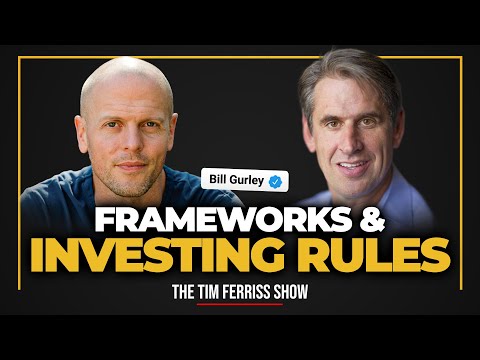
Legendary Investor Bill Gurley on Investing Rules, Insights from Jeff Bezos, Must-Read Books, & More
What this covers
Brought to you by AG1 all-in-one nutritional supplement https://drinkag1.com/tim and Shopify global commerce platform providing tools to start, grow, market, and manage a retail business http://shopify.com/tim
Resources from this episode: https://tim.blog/2023/01/25/bill-gurley/
Bill Gurley (@bgurley) has spent more than 20 years as a general partner at Benchmark. Before entering the venture capital business, Bill spent four years on Wall Street as a top-ranked research analyst, including three years at Credit Suisse First Boston.
Bill also maintains a blog on the evolution and economics of high-technology businesses called Above the Crowd.
Over his venture career, he has worked with such companies as GrubHub, Nextdoor, OpenTable, Stitch Fix, Uber, and Zillow.
Bill has a BS in computer science from the University of Florida and an MBA from the University of Texas. He is also a chartered financial analyst. Bill is a board trustee at the Santa Fe Institute, a research and education center focused on the study and understanding of complex adaptive systems.
Please enjoy!
00:00 Start 01:19 The book Bill calls “the most efficient short-form MBA one can find.” 03:03 Sell-side analysts vs. buy-side analysts. 05:20 Financial models, rules of thumb, and making (sometimes wrong) decisions. 13:34 Howard Marks and Stan Druckenmiller. 15:42 Micro vs. macro investing. 16:57 Institutional Investor’s All-America Research Team. 21:00 Expanding distribution. 24:07 Return On Invested Capital (ROIC). 30:30 Repurposing good ideas for alternative applications. 34:40 The conviction of network effects. 36:42 SaaS and open source. 38:51 Bet sizing. 40:21 Equal partnership over hierarchy. 46:54 Lessons learned from partners. 49:58 Recommended resources. 55:56 Problems open source can solve. 1:07:05 Building a better network with the interest graph. 1:11:36 Dissecting Bill’s Twitter thread about risks and sudden valuation resets. 1:22:06 The Metaverse. 1:27:30 Revenue and earnings quality matter. 1:29:41 Undervalued competitive advantages. 1:33:52 Jeff Bezos: corporate mad scientist? 1:40:21 The counterintuitive condemnation of company camaraderie. 1:45:06 Tobi Lütke. 1:48:34 Books Bill has gifted frequently. 1:52:17 The Santa Fe Institute. 1:54:35 Bill’s board. 1:56:46 Cultivating anti-tribalism. 1:58:36 Twitter: what is it good for? 2:02:05 Newsletters and other resources Bill relies on. 2:03:44 Bill’s book in progress. 2:04:56 Regulatory capture. 2:10:04 Predicting what America will look like in 10-20 years. 2:11:48 Parting thoughts.
Tim Ferriss is one of Fast Company’s “Most Innovative Business People” and an early-stage tech investor/advisor in Uber, Facebook, Twitter, Shopify, Duolingo, Alibaba, and 50+ other companies. He is also the author of five #1 New York Times and Wall Street Journal bestsellers: The 4-Hour Workweek, The 4-Hour Body, The 4-Hour Chef, Tools of Titans and Tribe of Mentors. The Observer and other media have named him “the Oprah of audio” due to the influence of his podcast, The Tim Ferriss Show, which has exceeded 900 million downloads and been selected for “Best of Apple Podcasts” three years running.
Sign up for "5-Bullet Friday" (Tim's free weekly email newsletter): https://go.tim.blog/5-bullet-friday-yt/ Follow the Tim Ferriss Podcast: https://tim.blog/podcast/ Visit the Tim Ferriss Blog: https://tim.blog/ Follow Tim Ferriss on Twitter: https://twitter.com/tferriss/ Follow Tim Ferriss on Instagram: https://www.instagram.com/timferriss/ Like Tim Ferriss on Facebook: https://www.facebook.com/TimFerriss/
Source description (no synthesized summary yet).
Gurley argues that venture investors and entrepreneurs must fundamentally reset their mental models after a prolonged bull market, recognize that recent valuations and strategies are unsustainable, and adapt to a new investment discipline based on fundamentals like cash flow, earnings, and competitive advantage rather than growth-at-all-costs.
- An entire generation built perspectives on valuation during a 13-year bull market and must now 'unlearn' dangerous habits like valuing companies on price-to-revenue multiples
- Valuation multiples are crude proxies; profitability, free cash flow, earnings, and revenue quality matter far more than previous frameworks suggested
- Risk-on dynamics work like a sawtooth (slow climb, sudden crash every 7-15 years), and entrepreneurs who believed the easy-money environment was permanent must accept that it was a fantasy, not normal
This asset isn't compiled yet
You're seeing its claims, ranked. Compile it to build the argument threads, weight them, and check each claim against your library — the full view.
Founders calculate their net worth by multiplying their ownership percentage by the peak valuation they've seen, which creates a psychologically destructive problem once the valuation resets; this is not just a paper loss but creates real psychological suffering.
“Founders, whatever that peak valuation is, they ran the math where they took their ownership, they multiplied it by that number, and they thought about their net worth that way. And that can just be super destructive once it's no longer true. It's just — You mean psychologically destructive? Psychologically yeah, I think it's super difficult to come to terms with once you've been through that.”
In venture capital, the asymmetric outcome structure means you can only lose your money once on the downside but can make 10,000 times your money on an outlier like Google, so investors must bias toward 'yes' in high-potential situations because the mathematical odds are ridiculously different; getting a 'no' right is not the job—the job is to find outliers.
“In a case like Google, you make, what? 10,000 times your money. And that asymmetric result means you have to bias towards positive in a situation like that because the odds are just ridiculously different... The job is to find the outliers.”
In open source business models, you cannot charge based on the product itself (which can be freely downloaded) but rather on packaging support and reliability; large consolidated companies like Google and Yahoo would not pay for MySQL and instead hired people who knew the product, so open source succeeds when it reaches the corporate market where companies want handholding, not in serving big companies that can hire expertise.
“In open source, with that business model, which is you're basically packaging support and reliability, because someone could just download it for free so how do you charge? And this goes back to Michael Porter, but if you have a very consolidated industry of big companies, they don't pay. They just hire the people that know how to use the product. MySQL is an example. Google and Yahoo were two of the biggest customers, never paid us a penny. You need that product to go into the corporate world where people want that kind of handholding, and that's where you get paid.”
Range by David Epstein is a counter-punch to Malcolm Gladwell's 10,000-hour rule; Epstein demonstrates that many big scientific breakthroughs come from people who changed disciplines or genres—they bring different mental frameworks that let them see things differently; there's a concept called 'far analogies' (borrowing ideas from far away fields) that Gurley finds fascinating.
“A lot of the big breakthroughs in science have come from people that have changed disciplines or changed genres, which you're talking about a lot, which I just find super fascinating. If you go on Twitter, which obviously, there's a lot of people shouting, but you'll constant refrain is like, 'Shut up. You don't know anything about this field. Leave it to the people in the field.' But if you study science and history, that's not actually — the biggest breakthroughs come from people that had a different middle framework and move over and then see things differently.”
Linux has been operating as a decentralized autonomous organization (DAO) for over 25 years through the Linux Foundation, which acts as a steward, manages patent defense, and prevents internal litigation while defending against external attacks; this is a long-standing real-world example of how open governance structures can scale.
“The Linux Foundation acts as a steward much in the way that the crypto world thinks DAO manages this loose federation. The Linux Foundation does that. Linux has been a DAO for 25 years, it's super interesting. So that group, they're like a nonprofit overseer of the project break ties. They do patent defense, which I think is super interesting. So they pull patents in, no one sues within the open source project, but if someone were to come attack it, you'd go out after.”
Facebook created the Open Compute Foundation to define open standards for how hardware equipment (networking, storage, computers) works in their data centers so that if suppliers want to be on their purchasing list, they must be compatible with the standard, which commoditizes equipment and prevents suppliers from holding Facebook hostage through proprietary lock-in.
“Facebook has all these equipment in their data center, networking equipment, storage equipment, computers, software. So they just created this thing called the Open Compute Foundation that defines open standards for how all these products work. And so if you want to be on their purchasing list, you say, 'Yes, we are compatible with this open standard.' And once again, it basically commoditizes that equipment.”
Because the 2009 reset wasn't as hard as the 2001 reset, and from 2009-2013 many entrepreneurs who grew up seeing only risk-on conditions never experienced a reset; they adjusted their mental models daily to match current conditions rather than maintaining a 30-year perspective, shortening their time horizon to 3-5 years or even 12 months; greed took over and people weighted confirmatory data points.
“From '09 to 2013, because so many entrepreneurs are young, you had people grow up that had never seen a reset and risk on is a lot like the bull frog. You don't know what's happening. You're just — their mental models and their frameworks adjust daily to what's happening. And so their thought about how the world works is really a window of five years, or maybe three years, not 30 years. Because for many of them, they don't have the 30-year perspective and when the going gets good, greed takes over and you weigh the data points that feel good to you and are going to make you look —”
Valuation frameworks like DCF (discounted cash flow) are difficult to apply to young, immature companies, so price-to-revenue became the common language despite being crude; this is a case where convenience drives adoption of poor frameworks.
“It's hard to do DCF. It's hard to do something more sophisticated. It's the common language of the group. But things changed overnight.”
Boom-bust cycles in venture are structured like a sawtooth (risk building very slowly, then crashing suddenly) rather than a sine wave; this pattern happens every 7-15 years; Gurley predicted one six years prior to spring 2022 but was early; it finally happened in 2022 but reached 'ridiculously crazy' heights in the interim.
“There's an unfortunate reality in the venture world that really became very crystal clear to me through a conversation with Howard Marks, actually. But it's structurally set up. People talk about boom, bust, and cycles, but this is set up more like a sawtooth. So risk on happens very slowly, almost like the rollercoaster [makes sound of slowly climbing roller coaster].] But when it crashes, and if it's interesting to you, I explain or do my best job of explaining why it's structured this way, when it crashes it happens all at once so it's more like a sawtooth than a sine wave and it just crashes and it's painful. And that just happened and it looks like it happens every 7 to 15 years.”
The change in how people value companies is so foundational and radical that the best outcomes come from people who can adjust their mental models fast and move forward; Sequoia's 2009 '[R.I.P.] Good Times' deck helped the industry adjust faster by giving structure and smart communication to the reset.
“The change is so radical that the best thing you can possibly have happen is if you can adjust your mental models fast and get on with the new world, but it's very hard for people to do. And, by the way, I write that kind of stuff in part to help the industry, and I'm super grateful, Sequoia in '09 put out, there's a famous deck they put out '[R.I.P.] Good Times' or something like that. And these things help people adjust faster, right? Having minimal models that — having structure, having smart people tell them, 'Okay,' it gets them there faster.”
Startups can compete with big companies partly because startups run many more experiments (iterations 1-8+) while big companies run one experiment and quit if it fails; startups can't quit because shutdown means death, so they keep iterating while big companies abandon due to bureaucratic constraints.
“One of the reasons startups can compete with big companies is because most big company experiments, they run one test and if it fails, they quit. And a startup can't quit because they have to shut down if they quit. So they run experiment one and two and three and four and five, and then they pivot and do six and seven and eight, and they stay up all night because it has to work. And so they just get way more shots on goal than the big companies do.”
Santa Fe Institute attracts multidisciplinary thinkers: biologists hang around with epidemiologists, who interact with physicists; this multidisciplinary cross-pollination is what makes it valuable; Cormac McCarthy (famous novelist) also hangs out there.
“Another big thing about Santa Fe is that it's multidisciplinary, so they have biologists hanging around with epidemiologists, hanging around with physicists, and they all interact together. And Cormac McCarthy hangs out there too, which is kind of cool.”
Michael Porter's Competitive Strategy is an extremely well-known business book and approximately 80-90 percent of entrepreneurs would benefit greatly from reading the first three chapters, as most entrepreneurs make the common mistake of developing a technological breakthrough without analyzing industry structure or whether go-to-market is feasible.
“I would say 80 percent or 90 percent of the entrepreneurs I meet would benefit greatly by reading the first three chapters of this book. And it's really just about trying to understand the dynamics of industry. One of the most common mistakes entrepreneurs make is they come up with some kind of technological breakthrough in their own mind, but they don't spend any time analyzing the industry structure or whether the go-to-market is going to be possible or not.”
Matt Ridley's books The Rational Optimist and How Innovation Works are fantastic for understanding high-tech macro; Ridley's core point is that the vast majority of wealth creation and increased standard of living comes from commerce and ideas, particularly when "ideas have sex" (spread and build on each other); the marginal cost of sharing an idea is zero, so when ideas spread, productivity improves dramatically.
“The first book, Ridley has this point of view that I think is very hard to dispute, that the vast majority of wealth creation and increase of standard of living for humans on the planet come from two things, commerce and ideas. What he calls 'ideas having sex.' So if you think about if someone comes up with a new farming technique, the marginal cost of that is zero. And if you pass it along to someone, their productivity improves. And so it's super powerful in my mind”
Macroeconomics is the study of economies at large scale (in contrast to microeconomics which focuses on firm interactions within industries), and complex systems like economies are nearly impossible to predict because there may be variables you're not tracking that have never flipped from zero to one, and when they do, all your models and planning are invalidated; this is why no one can predict weather more than five days in advance.
“Macro is the study of economies writ large. And I'm fascinated with complex systems. Our economy is certainly one of those things as is weather and whatnot, which is why I've gotten involved with the Santa Fe Institute. But they're nearly impossible to predict. And it's where you get into real, real trouble. There might be a variable you're not tracking that has never flipped from zero to one. And when it does flip from zero to one, all your models, all your planning are out the window because this other thing's different this time.”
The U.S. healthcare system is neither free market nor single-payer, combining the worst of both and the best of neither; this hybrid creates dysfunction without benefiting from either system's advantages.
“The healthcare system, they're just so messed up. It's not a free market and it's not single payer, it's the worst of both, and it's the best of from neither.”
The most broken industries with severe regulatory capture are pharma, banks, and telcos; these three sectors show the most distorted competition and highest barriers to entry.
“we have really broken industries with the most regulated pharma, banks, telcos, these are the ones.”
Deng Xiaoping's introduction of capitalism to China unlocked more standard-of-living increase than perhaps any other human in history, demonstrating the power of economic system changes to compound across billions of people.
“And I look at what Deng Xiaoping did in China and say, I don't know that any other human in the history of the world has unlocked as much standard of living increase as this one human by bringing capitalism to China.”
Gurley missed the Google investment in 2002 because the company presented to many VC firms but Benchmark did not pursue it; at the time, Yahoo was collapsing, Excite was bankrupt, search didn't appear exciting externally, Larry and Sergey were PhD founders with no CEO experience (normally a red flag), yet even the two best venture capitalists at the time (John Doerr and Mike Moritz) said yes, suggesting it was not obvious in hindsight that Benchmark should have known to invest.
“And we didn't lay chase. We should have laid chase, but we didn't. At the time, Yahoo was at $10 down from, like, 80. Excite was going bankrupt. So search didn't look that exciting from an external viewpoint. You had two PhD founders who had never been a CEO before and were insistent they were going to be good as a CEO. Normally that's a red flag. Now I'd like to highlight, and I always do, the two best venture capitalists in the world at the time, John Doerr, Mike Moritz kind of locked hands and said yes.”
Google created Kubernetes as an open source orchestration layer for containers and gifted it to an open source consortium managed by the Linux Foundation, recruiting IBM and HP to support it, because Google wanted to ensure customers weren't locked into Amazon Web Services; Kubernetes became so successful that Amazon had to announce support for it, allowing workload portability between cloud providers.
“Amazon was very afraid of — I mean Google was very afraid of Amazon running away with the cloud services business in AWS. And so they had a piece of technology called Kubernetes, and this was right around when Docker and containerization took off, and Kubernetes was an orchestration layer for containers. And Google decided, Hey — ... They decided that it was in their best interest to take this technology and gift it to an open source consortium. They got the Linux Foundation to manage it, and they went out and recruited IBM and HP and all these other vendors to say, 'Oh, yeah, we'll support Kubernetes,' because everyone wanted to make sure that people weren't locked in to Amazon.”
A lawyer told Gurley to arrange meetings with congressmen by getting 15 people together to each donate the maximum campaign contribution ($10k each), which Gurley did three times; spouses were also pushed to donate; this is how regulatory meetings work in practice—it's a form of pay-to-play that requires raising $100k+ just for initial access.
“When one of my first companies I worked on that had a potential regulatory hurdle, a lawyer told me, 'Oh, well, you should talk to these congressmen or whatever. Did you want me to introduce you?' 'Sure.' Get a phone call. 'He's going to be in your neighborhood. Can you get a bunch of people in a conference room?' I'm like, 'What do you mean a bunch of people? I just wanted to say hello.' 'No, I need you to get 15 people in the conference room.' I go, 'Why?' He goes, 'And they all need to bring the maximum check that they can donate.' And I'm like, 'Really?' I call a few people, I felt horrible. 'Oh, yeah. You've got to give 10 grand. I just want to talk to this guy.' And then a week before they show up, they go, 'Your spouse can give, too. Tell everyone their spouse can give.' This happened to me three times. To me, someone in Washington — You need to get 100 grand together just to —”
Both gerrymandering and regulatory capture are horrible regardless of which party does them, but tribal people can't say so; examples include big pharma/banks capturing Republicans while teacher unions/police unions capture Democrats—but tribal people excuse their own side's capture while condemning the other side's.
“Gerrymandering. Horrible. They both do it. It's horrible. Yeah, just say it's horrible. But they don't. They say, 'Oh, look. Those guys are horrible when they do it. Capture is horrible. And on the Republican side, that's banks and big pharma. But on the other side it's unions, the teacher's union and the police union. George Floyd doesn't happen if the police union doesn't have the power they did because Derek Chauvin would've been off the force. But the police union protected him. And if you're on the left, you can't say that. You can't make that statement. You can't be anti-union.”
Government was far more collegial across the aisle 30 years ago than today; most tribal people view their side as near perfect when there's no sign of that anywhere, suggesting that tribalism has intensified dramatically.
“There are a few orgs that I'm starting to learn about. Nonprofits that give money to centrist candidates or things like that. And I think the world, if you could go back 30 years, it was just more collegial across the aisle.”
The Obama administration paid doctors $44 billion to implement EHR systems, with the CEO of Epic (the leading EHR software provider) sitting on the healthcare advisory board that designed the program; Epic then received another $20 billion from a second phase called 'meaningful use' where doctors were paid again to prove they were using the software.
“The Obama administration came up with this program where they spent 44 billion dollars paying doctors to implement EHR systems. And the idea that you would pay someone to implement software when you need to do it on your own for your own competitive survival — but there was a healthcare advisory board, the CEO of Epic sat on that board and they came up with this program. Then, once they came up with this program, the thing that you would obviously think is, well, what's wrong with paying someone to use software? Well, they probably won't use it. Then they put up another 20 billion for the second phase called meaningful use where if you proved you were using the software, you got paid to implement, you get another check.”
Five other industrialized nations have moved to instant inter-bank transfer systems run by government; the UK's Faster Payments system has existed for 17 years; in America, ACH (Automated Clearing House) still takes three days to clear because banks and Visa have too much power with the financial services committee and have prevented the Federal Reserve from implementing FedNow (which has been on the books for 10 years).
“Five other industrialized nations have moved to insta transfer run by the government between banks. In the UK, it's called UK Faster Payments. It happened 17 years ago. You can read the Wikipedia page on it. ACH in America still takes three days to clear. It's fucking ridiculous. But it's because the banks and Visa have too much power with the financial services committee, and they've prevented — Powell wants to do it. It's called FedNow. It's been on the books for 10 years, but they block it because of how we operate.”
Michael Porter's 'Competitive Strategy' is often cited as innovative, but Porter synthesized ideas from ~14 other economists who had already written about competitive advantages, differentiation, and industry structure; what made Porter's work distinctive was the compact, readable presentation that made complex ideas accessible.
“Michael Porter, Competitive Strategy,' 14 other people had written that stuff before. Well, he wrote it in a really compact way that's easy to read. That's super helpful.”
Despite regulatory capture and tribalism concerns, Gurley observes that the UK has done a better job than the U.S. with things like 'losing party pays' (loser funds the winner's legal costs in litigation), which dramatically reduces frivolous lawsuits and provides leverage to prevent litigation-based wealth extraction.
“I think the UK, which is much older than us, has done a better job than we have... They have something called losing party pays. And so we live in the United States of litigation, and a lot of the friction that exists that slows down the gears and messes things up is because of the vigilante nature of our legal system. And losing party pays just makes the number of initial litigations filed, dropped by 10X.”
To be right in investing, you must be both right AND contrarian; being right alone is not sufficient because if the market has already priced in your view, you make no money, so the asymmetric returns come from having unpopular correct views.
“But you're looking for a reality that you think is going to emerge. It's not priced into the stock. So that requires you both to know or to think you know where the world's going. And also to know what the expectations are currently embedded in the stock because if you just have the same opinion that's already embedded, you're not going to make any money. There's a great piece by Howard Marks where he talks about you have to be right and contrarian. Yeah, you can't just be right. You have to be right and contrarian, and that's more difficult.”
Google created Android as an open source platform to prevent Apple from locking in the mobile market through AT&T exclusivity; at the time, the iPhone scared competitors (other handset makers, telcos) and Google's strategy was to offer an open source competitor that would unite the industry against Apple's closed ecosystem.
“Apple had come out with this smartphone, you could only get it on AT&T. It's scared the shit out of everybody, not just Google, but it's scared the out of all the other telcos. It's scared the out of all the other handset manufacturers. And so Google did this clever thing they said, 'Oh, we're going to create a competitor, but it's going to be open source so you can trust us.'”
UCLA professor Keith Holyoak studies 'far analogies'—the intellectual skill of borrowing ideas from distant fields and applying them to new contexts; this is more difficult than near analogies (borrowing from adjacent fields) and represents a high-value cognitive skill.
“There's a professor at UCLA named Holyoak who did a piece on something he calls far analogies where he views it as an intellectual skill, but who can borrow ideas from farther away than where they are.”
Zoom is a much better substitute for in-world meetings than virtual avatar meetings; competitive strategy frameworks suggest that when a better substitute exists, the original product's value proposition diminishes, making Meta's metaverse bet less compelling.
“Zoom is an amazing substitute, which is one of the frameworks from competitive strategy, to the notion of being in world. And so it's got even harder, because I think Zoom's way better for a board meeting than making everyone get an avatar and sitting around. I just don't think that's going to happen.”
Gurley would put 'Be less tribal' on a billboard if he could reach everyone; tribal affiliations (especially political) turn off more brain cells than any other activity; all the cognitive bias literature (confirmation bias, sunk cost, etc.) is weaker than political bias.
“I think circa 2023 and everything that's happened over the past five or six years, I would put 'Be less tribal.' 'Be less tribal.' And I have friends on both sides of the political spectrum, and I can't imagine an activity that turns off more brain cells than tribal affiliates. All the books that have been written on bias and all the Kahneman [inaudible] and Thinking, Fast and Slow, and all the Nobel prizes for that stuff. I think political bias is stronger than confirmation bias, sunk cost, all those things.”
In 2023, the ability to rise up in any industry or endeavor is easier than ever because you can get close to mentors, leaders, and best practitioners through Twitter, DM, podcasts, and hybrid work; geographic constraints are removed and information access is democratized.
“One of my core beliefs is that in this day and age circa 2023, your ability to rise up in any industry or any particular endeavor is so much easier than it ever was before because your ability to get close to the mentors, leaders, best practitioners, and learn from them is unlike it's ever, ever been before. And add in hybrid work, maybe you can work for a company that's not even near you. It's really awesome for people that want to pull themselves up.”
If government-funded research (NIH grants at $40 billion per year) were required to be open source rather than becoming proprietary, we would avoid the situation where taxpayer dollars fund research that becomes privately controlled with 17-year patent lives and $300k annual price tags; the current system is backwards.
“And I wonder about other things like the NIH gives out $40 billion a year and many of these projects end up as research that leads to a drug that leads to having a 17-year patent life and gets sold at 300 grand a year or whatever. Why wouldn't we say, if you take NIH dollars, your research is open source? Why do we use government dollars to fund stuff that becomes proprietary? That didn't make any sense to me.”
Second Life, which Gurley was on the board of for 12 years, revealed that people love escapism and role-play (especially young people and a small percentage of adults), but not living in virtual worlds in the way Meta envisions (e.g., board meetings in-world); people who heavily use immersive worlds often have mental health issues or are in tough spots in life; Snow Crash and Ready Player One were dystopian novels about people escaping worlds that sucked.
“The number of people that love escapism, first of all, young people do. They role-play a lot and so that makes sense. And then a handful of adults do it. They have wooden swords in the park or Burning Man is that experience. But it's not a high percentage of humans. And one thing we found quite interestingly is a lot of the people that love it are looking for an escape so they may actually have mental health problems or they're in a tough spot in their life. And it reminds you that both Snow Crash and Ready Player One were dystopian novels, right? People were escaping a world that sucked.”
Regulatory capture is Gurley's core belief area and the most likely TED Talk topic; he believes capitalism and democracy will eventually destroy one another because regulatory capture allows incumbents to lock themselves in through legislation, creating moats that prevent startup competition.
“Probably regulatory capture. I have this core belief that capitalism and democracy will eventually destroy one another.”
RISC-V is an open source processor instruction set with significant momentum, particularly backed by China, because it allows countries to develop processors without IP theft concerns; ARM (the dominant proprietary alternative) executives mention RISC-V on earnings calls as a potential competitive threat.
“There's something called RISC-V, which is an open source processor, believe it or not, that has a lot of momentum now. You'll see people on the earnings calls for ARM, they'll start, 'Is this a competitor? Is this going to be a problem?' Because it's completely free licensed and China is a big backer of open source, and you could understand why because the West has accused them of IP thefts. So this is where you can't be accused.”
Open source is particularly effective at solving complex problems where a single company would struggle because complexity drives the need for many people working on different edges, making the bazaar-style development superior to centralized architecture; simple problems don't benefit as much from open source.
“And open source is way better at complex problems than simple problems. And it's the very complex problems that'd be hard for a single company to do...Building an operating system, it might have all kind of edges on how it integrates with other systems, different drivers you might need, and the world is able to build that, whereas an individual company would be very difficult.”
Silicon Valley has average financial sophistication of about 2 out of 10, while a sophisticated New York investor is about 8.5; this is ironic given that Silicon Valley mocks Wall Street out of ignorance rather than actual knowledge.
“Silicon Valley, if there was a scale of financial sophistication between one and 10, and you would say a really smart person in New York is an 8.5, the average Silicon Valley person on financial literacy is a two. And it's funny because they make fun of Wall Street, but it's just out of ignorance, they don't know anything.”
AWS is perhaps the top-5 greatest business move in history because it transformed Amazon from a consumer internet company into one of the most important enterprise companies; the move was unprecedented in scope and success.
“I think AWS is maybe top five business move in the history of the world. I don't even know what — just the notion that they launched that out of a consumer internet company and became one of the most important enterprise companies it's fairly unprecedented, it's just amazing.”
Reversing Citizens United is the first action needed to address regulatory capture; Citizens United allows too much money in the system; you can observe this by looking at Open Secrets data on financial service committee members who argue against FedNow—you'll see they have big banks as donors in their regions.
“The first thing you would do, and no one will agree to it, is you reverse Citizens United. There's too much money in the system. You can go to Open Secrets, I think it is, on almost any one of these decisions and you'll see someone — you can just watch the financial service committee. Someone argues against FedNow and then you look them up and there's a big bank in their region, and that big bank's the donor.”
Brian Arthur published 'Increasing Returns and the Two Worlds of Business' in Harvard Business Review in 1996, which was the first major piece discussing network effects, noting that some industries are structured for winner-take-most dynamics where the more successful you are, the more locked in you become due to switching costs and collaboration benefits.
“In 1996, Brian Arthur, who was at the Santa Fe Institute back then, published an article in Harvard Business Review called 'Increasing Returns and the Two Worlds of Business.' And it was really the first piece that talked about network effects. Of course, Microsoft was already starting to really take off, but this idea of network effects is that some industries are going to be structured where you get win or take most, and the more successful you are, you get locked in. And Brian talked about things just like the Microsoft UIs. You know how Word works, you get comfortable with how it works, and then switching has cost and those kind of things, and sharing documents and collaboration.”
The percentage of companies that are profitable at IPO follows a cyclical pattern tied to boom-bust cycles: around 90% in dark times, but by 2020-2021 dropped to around 5%, with the vast majority of companies going public while losing money; Wall Street encourages this behavior because investors want high-growth money-losing businesses.
“There's a great graph, we should try and find it one so that someone can see a link of the percentage of companies at IPO that are profitable and it's this nice cyclical wave that goes with these boom-bust cycles because Wall Street does risk on also, right? And so in really dark times, the percentage of companies that are profitable is like 90, but by 2020, 2021, that number's five percent. The vast majority of companies are losing money as they go public and Wall Street's encouraging that behavior.”
Previous all-time highs in stock prices are completely irrelevant in valuation decisions; it's not 'cheap' because a stock is down 70 percent from its peak; these past prices should be forgotten entirely.
“Previous 'all-time' highs are completely irrelevant. It's not 'cheap' because it is down 70%. Forget those prices happened.”
Price-to-revenue is a cruder tool for valuation than more sophisticated approaches; Gurley wrote a blog post called 'The Keys to the 10X Revenue Club' analyzing public tech stocks laid end-to-end by price-to-revenue multiple, finding them ranging from 20X to 0.1X with no clear line or pattern, demonstrating that price-to-revenue is meaningless as a valuation tool.
“Most of them think about valuation by a price to revenue multiple, which couldn't be a cruder tool. And at one point I wrote a blog post called 'The Keys to the 10X Revenue Club,' and I took all the public tech stocks and laid them end to end based on price to revenue and one of them was at 20 and one of them was at 0.1 and it was just a big curve. So there's no line there. There's no reason to believe that that price to revenue is how you should value anything.”
Revenue quality refers to the characteristics of revenue that indicate whether a company can monetize consistently and defensibly; examples include: margins (a used-car reseller at 10% margin vs. SaaS at 90% gross margin are completely different businesses despite both having revenue), churn (whether customers stay long-term or leave tomorrow), competitive advantage, and defensibility.
“A simple one is margins. If you are reselling used cars and your revenue is the price of the cars you're selling, but you're only making 10 percent on a car, that's really low revenue quality compared to a SaaS vendor with 90 percent gross margins. When their incremental dollar of revenue creates 90 cents of gross margin, yours creates 7 cents of gross margin. You can't value those companies both on price to revenue.”
Competitive advantages that matter include: network effects, lock-in/switching costs, uniqueness/scarcity (are you an N of one?), performance (e.g., Snowflake's database does things no other database will do), and how hard it is for customers to find an alternative and trade you out.
“Network effect, that's one that just comes to mind right away. Lock in we had hinted at is there reasons why switching costs, which is also it's in the Porter book. Are there switching costs that make it hard to leave for a customer to leave? How many substitutes are there for your product? How unique is it? Right? That's a competitive advantage. It's like are you an N of one? And some of the network effect companies become that way... It could be performance like an enterprise product, you look at something like Snowflake. People just say, 'This database does things no other database will do,' and so then that becomes a competitive advantage.”
Strong opinions loosely held is the framework all investors must work within because there are many dynamic variables, none are constant, and the minute you set very hard rules, you risk setting yourself up for a mistake.
“There's a famous saying that I'm sure it's been uttered on your podcast before, but kind of strong opinions, loosely held. I think all investors have to work within that framework because things change. There's many, many variables. None of them are constant, they're all dynamic. And the minute you set a very hard rule, then you might be setting yourself up for a mistake.”
Valuation multiples are always a crude proxy and dangerous to use; if multiples must be used, 10X should be considered amazing and an upper limit, and anything over that is silly.
“Valuation multiples are always a hack proxy. Dangerous to use. If you insist, 10X should be considered AMAZING and an upper limit. Over that, silly.”
Twilio's valuation went from 70X gross margin to 3X gross margin in a very short window—a radical reset demonstrating how valuation multiples can completely collapse when sentiment shifts.
“Still, Twilio went from 70 times gross margin to three in a very short window. I mean, talk about valuation reset, that is just radical.”
Writing as a thinking tool: when you write a six-page paper (as Bezos requires for Amazon meetings), you are forced to think more deeply than a five-slide PowerPoint because it's harder to hide weak reasoning in prose; writing clarifies thinking by forcing you to articulate premises and defend them.
“By the way, mirror back to what we talked about earlier about writing and thought process, if you're forced to write a six-page paper, it's much harder to put that together than it is a five-page PowerPoint. It's easier to leave stuff out. You really have to think through everything.”
Gurley believes that if Meta/Facebook shut down the VR effort (currently spending 5-10 billion per year), not only would profitability soar, but the stock would double; Wall Street agrees with this assessment, suggesting the VR investment is value-destructive rather than value-creative.
“If they shut down the VR effort, not only– Well, the profitability would soar because they're spending real money, like five to 10 billion a year, but I think the stock doubles. Doubles.”
Investor bedrock comes from reading widely (Buffett letters, Peter Lynch, Mike Mauboussin, Burton Malkiel) and building an understanding of financial history that constrains overly optimistic or pessimistic biases.
“I think any investor starts with just building bedrock and that comes from reading. And there's a ton of books in history. You can go through all the Buffett letters as an example. You can read Peter Lynch's One Up On Wall Street. There's my good friend Mike Mauboussin who has put out some amazing books that are a lot more nuanced about stock prices, that kind of thing. A Random Walk Down Wall Street by Burton Malkiel.”
Howard Marks and Stan Druckenmiller are two of the very few individuals known for being successful at macro investing; most experts including Buffett say macro is impossible and shouldn't be attempted, but these two have demonstrated sustained success in macro through different approaches—Marks through long tenure in bond markets, Druckenmiller through single-individual macro bets and recent success predicting inflation.
“There aren't many people, if you study financial history, most people in Buffett included will tell you, 'Macro is impossible. You shouldn't even try.' And the two individuals you mentioned are two of the only ones that are known for being successful in macro investing. Howard mostly by being one of the most successful and longest tenured investor in the bond market and Stan for taking more kind of single individual bets that are macro in nature going back to his success with Soros, he's become re-famous in the past 12 months for predicting the inflation situation we're in and being very loud about it.”
Facebook (Meta) in spring 2022 was trading at 14X GAAP earnings while growing at 23 percent; this was a historically low multiple for such a successful company, contrasting sharply with Coca-Cola which traded at 30-35X earnings but only grew 3-5 percent, suggesting Facebook was undervalued on earnings-based metrics.
“Facebook trades at 14X GAAP EPS… and is growing 23%. What earnings multiple are you assuming?... here's one of the most successful companies of all time that is producing massive amounts of positive cash flow and GAAP-audited earnings that's trading at a very low multiple of those GAAP earnings... they're trading at 14. Or you may not even have earnings... Coke is less than 10 percent growth, like five or three.”
Institutional policies that were developed on university campuses around individual accommodation and anti-fragility have crossed over into corporate environments, where they are particularly inappropriate because they undermine the performance and coordination necessary to run a high-functioning company.
“This happened in the university and this did get out into the companies and so these companies were being basically held accountable for delivering an experience for the individual. It's like your goal as a company is to help the individual have a great life. And I think it's very hard to be high performant. Imagine if Coach K. had that problem, like he had to make everyone make sure everyone on the team felt happy and safe and included and that was true north. It would be very hard for him to be performing.”
Earnings quality relates to cash flow; a company might have strong GAAP earnings but weak cash flows due to timing differences or other factors, creating a divergence between reported earnings and actual economic performance.
“Earning qualities typically relates to cash flow. So you might have really good GAAP earnings, but because of different factors in your business, your cash flows may not be nearly as good. It could be timing differences, those kind of things.”
Coach K. (Mike Krzyzewski) at Duke built a culture around three tenants: expect the very best from each player, team first (if you need to be an individual, don't be here), and a singular goal (winning the national championship); this type of high-performance culture has become harder to implement in 2020-2021 because companies are held accountable for delivering an experience for the individual rather than focusing on collective performance goals.
“Coach K. told us that he expected the very must out of us. Each individual had to perform at their highest level. He said, 'It's always team first. If you need to be an individual, you don't need to be here.' And Shane was talking about how people remember the winners more than they remember whether you were the third or fourth scorer on a team. They remember the winners, and I think that's true in startup world as well. And then three, he said, there's a singular goal for this organization and it's to win the national championship...if an internet entrepreneur stood up and said those things out loud about what he wanted from his company, he might get canceled. Company first, you have to perform at your absolute best and the only goal here is the one goal of the corporation, we're all on a team together. We wandered to a place that's very different than that.”
Brian Armstrong at Coinbase and Tobi at Shopify have publicly taken stances that the company's one objective is the company itself, and if employees are hyper-passionate about something else they need to discuss, they should go do that instead, reestablishing performance accountability that had been lost.
“Brian Armstrong at Coinbase has very publicly spoken. I think Tobi at Shopify took a little more nuanced stance, but the same stance that like we have one objective here, which is this company. And if you're hyper passionate about something else that you got to talk about it all the time with this company, maybe you should go do that. But this performance awareness had kind of gone away because of everything I talked about.”
A CFO hired for OpenTable quit because his financial model showed the business would never work, having frozen market penetration at 17 percent based on his experience in retail where no business gets more than 17 percent market share; Gurley believed in network effects and predicted 99 percent penetration instead, and was vindicated when OpenTable later filed its S-1 with massive cash flow.
“So this was in '99, so this is a 23-year-old story, but I had successfully recruited a CFO from a public company, which you could do back in those glory days to come into OpenTable. And one day I showed up early for a board meeting, and the CFO comes to me and he says, 'Bill, I'm going to quit.' And I said, 'Okay.' I go, 'Why are you going to quit?' And he goes, 'This business will never work.' And I said, 'Okay, why will it never work?' And he says, 'Well, my model says it'll never work.' So I said, 'Show me your model.' So we look at the model and I dive in, and he has frozen penetration in each city at 17 percent... And I go, 'Why'd you freeze it at 17 percent?' And he said, 'Oh, no one gets more than 17 percent market share, all the businesses I've worked with.' And because I believed in network effects, I was like, 'We're going to get 99. We're not stopping at 17, we're going to get 99 percent.'”
Michael Mauboussin, a food analyst at Gurley's firm, was a natural learner who shared the Return on Invested Capital (ROIC) framework with analysts; Gurley applied this framework to all his covered companies and found that Dell had unusually high ROIC numbers (20 to 1 compared to the rest of the industry) despite the stock being in poor condition, which contributed to Gurley's strong buy recommendation and 100X return in the public markets.
“He had just read a bunch of books on a framework called Return On Invested Capital, which Stern Stewart had published on... And he was spreading it. It was the word proselytizing through the analyst group. And I was a sponge at that point in time. So I took the framework and ran it on all of my companies. It turned out just by happenstance that Dell stood out like a sore thumb with ridiculously high ROIC numbers versus the rest of the industry. Like night and day, like 20 to one, wasn't even close.”
Benchmark focuses on several repeatable venture models: network effects, open source, social networks, and SaaS (software-as-a-service), among others; they have been successful with multiple companies in each category and have developed intuition about what works, though they remain cautious because rules can mislead.
“There's like four or five different ones that we look for, network effects, open source, and you get good at it. You start to understand what works, what doesn't, what leads to success, what doesn't. I mean, there's nuances. In open source, with that business model, which is you're basically packaging support and reliability, because someone could just download it for free so how do you charge?”
Gurley became an All-America Research Team analyst for Institutional Investor largely because three top analysts in his category retired within one year, creating an opening; he then used a framework of contacting salespeople to ask for 20 introductions to clients who would spend 30-45 minutes telling him what they wanted before he had any research output, which allowed him to understand what clients valued.
“But when I showed up on Wall Street in one of the very first weekly meetings, they introduced us to the sales force... And somewhere in my youthful wisdom, I decided to ask each salesperson, is there one client that will spend 30 to 45 minutes with me as a new analyst and just tell me what they want. I'm just going to ask them questions. I'm not going to have anything for them. I just want to know how I can serve them best. And I did 20 of those interviews before I had started the job. And that's a roundabout answer to how do you get on the list because I knew what they were looking for at that point.”
At OpenTable, network effects were working when one salesperson in San Francisco—where they had 90 percent market penetration—closed 35 restaurants in a month compared to the target of four per salesperson, demonstrating that the last 10 percent of restaurants in a saturated market were easy to close because consumers were already on the platform.
“And so I asked the question, 'Who is that salesperson?' And OpenTable started in San Francisco, and we played local game. We didn't go everywhere at once. We built liquidity city by city. Anyway, at the time, that salesperson was the one salesperson left in San Francisco where we had 90 percent penetration. And so the 35 were coming out of that last 10. And that individual was basically taking orders. And that to me was like, 'Oh, yeah, the network effects really working here.'”
Jeff Bezos is probably the best entrepreneur Gurley has ever been around or gotten to know, and it's remarkable and multifaceted; his ability to build organizational frameworks that embody his beliefs at radical scale is underappreciated.
“I mean he's probably the best entrepreneur that I've ever been around or got to know. It's remarkable and it's multifaceted. Here's one that I think is not well discussed so he has a bunch of traits that make him a great entrepreneur. The company today is at such a radical scale that there's no way, and I mean he's in the chairman role, he's not touching all the decisions, he's not touching all the product decisions, he has built a organizational framework to take what Jeff Bezos believes and run the whole company that way and that's not well dissected, not well understood.”
Bruce Dunlevie at Benchmark learned to 'have a really big tent' and be super open-minded about information sources because it increases the chance of discovering opportunities; he developed deep relationships within companies and when an engineer from a portfolio company approached him with eBay, he made an intro to Bob Kagle who was more excited, demonstrating how equitable partnership allows deal flow to follow the most passionate partner.
“From Bruce Dunlevie, is just have a really big tent. We're in a networking business where you're trying to look under every rock for the next possible deal. And cutting off avenues of information or flow is just a really stupid idea. And so Bruce had been involved with a company that I think was in a software tool space, the name escapes me. We could look it up. And had developed a lot of friendships, went down the organizational chart at the company. And one day, one of the engineers from that company comes to him and says, 'I'm working on this marketplace thing called eBay.' And he was from a different industry, Bruce, but because he had developed that relationship that came in, now, it turned out that Bob Kagle was much more excited about eBay than Bruce was. And so Bruce made that intro because we're equal partnership, that's all cool.”
Gurley calls the use of open standards by large tech companies 'defensive corporate strategy' and sees it as an emerging pattern where incumbents use open source not altruistically but to prevent competitors from monopolizing markets and to reduce supplier leverage.
“I call it defensive corporate strategy.”
Benchmark's founding partners created an equal partnership structure (unlike most business partnerships which are hierarchical), where each partner has equal voice, equal ownership stake, and equal upside incentive; this structure creates emergent properties where partners root for each other's success rather than compete, which enables contrarian thinking and risk-taking in partner meetings.
“The founding partners of Benchmark did something that hadn't been done before in venture, which is they created an equal partnership. And most business partnerships, and this includes private equity and law firms and real estate firms, there's a hierarchy. And the people that have been there the longest sit at the very top, and they take an outsized amount. And some of our founding partners had worked at those firms and felt like the young people did more of the work, and therefore it wasn't conducive to the right type of internal behavior. And so they created this notion of an equal partnership.”
When Benchmark invested in OpenTable with only three restaurants, they had to believe that if they acquired enough restaurants, consumers would follow, and if consumers came, restaurants would have to participate; they had to install broadband alongside the PCs sold to restaurant owners, which would normally be a "don't do that" decision, but network effects fundamentals made the asymmetric bet worthwhile.
“When I met with Chuck Templeton, the founder of OpenTable, and he had three restaurants. You had to believe a lot to get from that point to the global phenomenon that it became. And the bet that we talked about making when we said, 'Okay, let's go do this thing,' is 'If we get enough restaurants on this thing, then the consumers will come. And if the consumers come, then people will have to get on.' And that's what happened. But you had to believe it because otherwise, at the time, we were selling PCs to restaurant owners, and guess what? They didn't have connectivity at the time. So we had to partner with someone to get broadband installed, which wasn't easy.”
Most venture capitalists don't have a liquidity event until year eight or nine, so it's easy to doubt yourself; three years into a portfolio, companies resemble "12-year-olds becoming 13-year-olds, your whole portfolio's like that with acne all over their face"; partners can become anxious and lose confidence, so support from more senior partners saying "it's going to be okay, get back out there" is more helpful than people realize.
“Unless you're super lucky... they don't have a liquidity event till year eight or nine. And so it's easy to doubt yourself. And three years in, people like to use the child age analogy, you've got 12-year-olds becoming 13-year-olds, and your whole portfolio's like that with acne all over their face, and you can really lose confidence. So one thing that a lot of my partners did was just like, 'It's going to be okay, get back out there. You're good. You're doing fine.' That kind of thing, which was way more helpful than you could possibly imagine because the anxiety was spiking.”
A professor at Santa Fe gave a presentation on electric grid problems in North America and concluded that 'the best solution is smaller communities that are loosely coupled'; Gurley realized this same framework explains why the Euro (tightly coupled) is problematic, and why distributed systems that aren't hyper-integrated avoid global failure modes while remaining scalable.
“The professor that presented it at the end said, 'The best solution is smaller communities that are loosely coupled.' And that is a really interesting — you could use that framework. I walked up to her afterwards and I said, 'You just explained why the Euro's a bad idea, because you tightly coupled this thing too much.' And you can just imagine even a computer system that's distributed, that learning could have other applications. If it's too distributed there's no scale. But if it's hyper integrated, then you have this failure problem, this global failure.”
If Gurley were to give a lecture on cultivating anti-tribalism, he would start by demonstrating that people are turning off their brains; then explain why people want to be intellectually consistent and what intellectual inconsistency means (e.g., excusing spouse infidelity when your side does it but condemning it when the other side does).
“I think the first thing I would try and do is just highlight the fact that people are turning off their brains. The way that people have proven how confirmation bias works, how loss aversion works. There's 20 different cognitive biases that we're all aware of. The first thing I would do is just run some — there's been stuff done. Then, why does anyone want to be intellectually inconsistent? If you think it's an ends to a means, then you're just in a fight. You're just in a fight. I don't even want to have a discussion with someone if cheating on your spouse and philandering is okay when your side does it, but it's horrible when the other side doesn't like, right. What's your principle?”
Benchmark changed their decision-making framework after missing Google by adopting the principle 'What could go right?' drawn from Matt Ridley's 'The Rational Optimist,' which better aligned with the asymmetric payoff structure of venture investing.
“And around that time I remember we used to give a book out to our LPs, our limited partners, our investors at every annual meeting. And I think Bruce had just read The Rational Optimist, which is a Matt Ridley book. And he started using a phrase at our partner meeting, 'What could go right?' And because of this asymmetric outcome thing where you could make 10,000 times your money and only lose once on the downside, it was the right frame of mind.”
Jeff Bezos tweeted positive comments in response to Gurley's spring 2022 valuation reset thread on Twitter, providing external validation of his analysis that the industry needed to reset its mental models.
“Jeff Bezos, I think either retweeted or replied to that tweet thread and with was very complimentary.”
In spring 2022, Gurley tweeted that an entire generation of entrepreneurs and tech investors built their perspectives on valuation during a 13-year bull market, and the 'unlearning' process would be painful, surprising, and unsettling; he anticipated denial about what was happening.
“'An entire generation of entrepreneurs and tech investors built their entire perspectives on valuation during the second half of a 13-year amazing bull market run. The 'unlearning' process could be painful, surprising, and unsettling to many. I anticipate denial.'”
Bezos was asked 'When do you stop an experiment?' and answered 'When the last person with good judgment gives up'; this is not how other big companies operate, and contrasts with typical big company experiments that are killed after one test failure.
“Someone asked him, 'When do you stop and experiment?' And he said, 'When the last person with judgment gives up.'... This happened in the university and this did get out into the companies and so these companies were being basically held accountable for delivering an experience for the individual.”
Shopify's Shop app was very cool because Shopify is a B2B platform company but created a consumer network effect product; very few companies can successfully cross over from B2B to consumer with network effects, making this a remarkable achievement.
“I thought what they did with the shop app was super cool. So the previous Christmas I started noticing websites I'd never been to before, knew who I was and allowed one click checkout. And very few companies can make their business as a B2B company and then have this crossover product, which has a consumer network effect. And they did that with that app and I thought it was just super cool that they pulled that off.”
Amazon, while a company worth tens/hundreds of billions and running mature businesses, ran an early same-day delivery experiment using Uber, burning phone numbers and manifests to drivers—something most large companies wouldn't do because of accounting/governance concerns; this demonstrates Bezos's institutional commitment to experimentation and risk-seeking.
“This is a company that's worked tens, hundred billions of dollars that is running an experiment on top of Uber and I know for a fact that most of the companies I've worked with that have gotten over 20 or 30 million in revenue would not run that experiment because someone would say, oh, we won't know how to do the accounting, that's too much of a hack, like whatever. But this large company was super comfortable running this kind of hack experiment on this other company.”
Tobi Lutke (Shopify CEO) told Gurley a brilliant framework: when dealing with a problem in a meeting, he starts by saying 'The one option we know we're not going to leave doing is the status quo'; this removes the default and forces real decision-making rather than inertia.
“He said, 'Whenever we're dealing with a problem and we call a meeting to talk about the problem, I always start with this structure. We are here to solve a problem. So the one option that we know we're not going to leave the room doing is the status quo. That is off the table. So whenever we finish this meeting, I want to talk about what option we're taking, but it's not going to be what we're currently doing.'”
Autonomous vehicles should be open source because safety improves, communication layers are better, and test suites can be shared; treating traffic light detection as an ML problem is 'really stupid' when it's a state machine (red, yellow, or green) that could be communicated directly; academia and corporations could work on the same standard, making government involvement easier.
“First of all, I think autonomous vehicles should definitely be open source. I think everyone benefits, safety's higher, communication layers are better. The idea that you would use artificial intelligence to figure out whether a light is red, yellow, or green is really stupid because it's a state machine. It is in one of those three states and that could be communicated into the software. You don't need to infer that, that's a known thing, but you need a common language. And your test suites could all be used by everyone. Academia could be working on the same thing that the corporations are, safety's higher, easier for government to get involved if it's a single standard.”
Global nuclear energy standards could reduce costs and improve safety; if the globe had a standard for fission-based nuclear reactors, we would get lower price points, safer products, and more participant involvement, contrasting with current situation where high costs are due to regulation, not the actual product.
“I look at the state of nuclear energy where the costs are high because of regulation, not because of the actual product and I wonder, what if the globe had a standard for fission-based nuclear reactor? Wouldn't we get to lower price points, wouldn't we get to safer products, wouldn't they get more involved?”
Benchmark operates under a constraint where board seats are the limiting factor more than capital itself because they choose a strategy where they place their money with their work and involvement, becoming the largest shareholder and serving on boards, so they cannot do 20 investments 'like not well'.
“And we have another challenge, Tim, which is we've for a variety of reasons have chosen a strategy where we don't let our money walk around without our work product and our involvement. And so we go on a board if we make an investment and we usually become the largest shareholder on the board. And as a result, our limitation is our board seats more than the capital actually.”
HackerOne was an obvious 'yes' investment because when it was founded, only four companies (Microsoft, Google, Facebook, Mozilla) ran white-hat hacker bug bounty programs; the founding team came from Facebook's program and the insight was tautological: if it works for these four companies, it obviously works for every other company in the world, so Benchmark said 'yes' immediately.
“At the time of HackerOne's founding, there were four companies that used white hat hackers to make their sites more secure. Microsoft, Google, Facebook, and Mozilla, they were the only four. No one else did it... And when they presented, we didn't even discuss the company. The minute they left, we were like, 'Okay, how are we going to close this?' Everyone had just jumped to 'Yes,' because it seemed so tautological, that there's no way this thing's great for these four companies and no one else.”
Twitter's mechanisms incentivize polarization through its feed structure, reward system, and engagement model, yet Gurley posts on Twitter because it offers unparalleled ability to get close to experts and leaders in fields through direct conversation and DM relationships.
“I find Twitter just to be super fascinating as your ability to get close to experts, leaders in your field, like — It's unbelievable. More so than LinkedIn. And there's a chance that some reply you give to them, they might like or they might follow you. And now you, you've developed a mentor or a peer partner. It's really just shocking, amazing the amount of information you can take out of this thing if you use it properly.”
Gurley intentionally expanded the distribution of his weekly analyst pieces as far as he could, leveraging the sales force for fax numbers and developing industry relationships through investor days and company meetings, then found a major distribution hack by attending Stewart Alsop's Agenda conference where he bought a Palm Pilot loaded with contact information for 400-500 of the most influential people in tech and spammed his newsletter to them at approximately 70 cents per name.
“I leveraged the sales force and get them to give me fax numbers. That's that's where I started. I then started developing industry relationships, which is important because you're covering these companies, you start going to investor days. The buy-side is talking to these companies as well. And so I started getting some of them on board. And then probably the most successful hack of my career happened when I was invited to attend Stewart Alsop's Agenda conference... And I ran some quick math. People weren't really doing cost of customer acquisition back then, but I think it was like 70 cents a name or something like that of the most influential people in the entire tech industry. And so I bought the Palm Pilot, I took it home, and I spammed the 400 or 500 most important people in the tech industry with my weekly newsletter.”
LinkedIn has stalled for about ten years; there's potential for a new take on LinkedIn using page rank for people where private opining about who's smartest on particular topics (rather than public skill claims) could develop unique product experiences based on who each individual trusts.
“I'm highly interested in people, feel free to reach out in any variation or new take on LinkedIn. I just think it kind of stopped and it stopped 10 years ago... What if you had people maybe privately opining on who they think is smartest on particular topics? You can develop a really cool product that would be unique to each individual. Because what you see, Tim, would be different than what I see because it starts by who you trust and then what you see is there”
Twitter could build a top-down version of itself (rather than feed-based) that uses algorithmic scoring to identify experts on particular topics (e.g., a page for each stock showing top stories from Twitter about that stock, pulled by identifying who the 'axes' are on that topic), and could extend this to other domains like sports teams, presenting curated expert content rather than algorithmic feed noise.
“What if you had a page where, for each stock, you had a list of the top stories of the day, and that could be pulled out of the Twitter feed by knowing which people are the axes on that individual stock, which you could infer simply with the data that's already in there. And so you could imagine that for sports teams. So I could have Twitter sports that is a top-down version that's using the information in the feed, but then presents it more like a standard newspaper would, if you understand what I'm getting at.”
Aswath Damodaran made a classic TAM analysis error by calculating Uber's ceiling as the size of the existing taxi market, but Uber created a product 10X better than taxis (convenience and availability), which expanded the TAM by 20X in San Francisco alone, illustrating that TAM conservatism causes bigger losses than TAM optimism in venture investing.
“He basically took the taxi market and said, 'That's the upper limit,' and that's just the wrong, like, math we made, or Travis and the team made this thing so convenient and so available that it was a product that's 10x better than the taxi market. And by the time I wrote that, I already knew that Uber in San Francisco was 20x bigger than the taxi market in San Francisco. So I already knew he was wrong with that analysis...I have found you get into more trouble with this kind of TAM conservatism, then it hurts you more than it helps you as an investor.”
Complexity by Mitchell Waldrop, about the rise of the Santa Fe Institute, is the book Gurley has gifted most frequently; it introduces the concept of complex adaptive systems and helped Gurley understand network effects.
“The first one that I've gifted the most is called Complexity by Mitchell Waldrop, which is about the rise of the Santa Fe Institute... That book introduced me to network effects.”
Mr China by Joe Studwell is a fantastic book about someone who went to China in the mid-1990s and started a fund to privatize industries; he was from London, got his head handed to him, but survived to write a humorous story about it; it's valuable for understanding business risks in foreign lands.
“Mr China is fantastic. He went to China in the mid '90s and started a fund to privatize a bunch of industries. He's from London and got his head handed to him and survived enough to write a humorous story about it.”
Startup by Kaplan is a fantastic book that chronicles the early portable computer industry where every single company failed despite having the best venture capitalists, best advisors, and best executives; Kaplan maintained a diary on cassette tape on his commute, which provided exceptional detail; it's valuable to read books of failure alongside books of success.
“There's a book I love called Startup by Kaplan... He was in the — what do they call that world? Because it's where General Magic was. It was like the first portable computers. Every one of them failed, every one, but they all raised massive amounts of money. He, on his ride home every day, had a cassette tape and left an archive or a diary, which makes the book so good because the detail is fantastic. But they had the best venture capitalists, they had the best advisors, they had the best executives, and the executives that were in — this was GO Corp, I think, that were there. All went on to do amazing things. But this company failed hard, failed hard. And I think it's nice to combine a book of failure with all the books of success.”
Gurley is working on a book about chasing your dream job and how to succeed at it; his research shows 70 percent of people have career regret, which is a huge number indicating widespread dissatisfaction; the book builds on studying biographies of unusual people (Bobby Knight, Bob Dylan, Danny Meyer) to identify similar patterns.
“There's a speech I gave at the University of Texas that you could put in the show notes... And I've done some research since I gave the speech because people have encouraged me to turn it into a book. And some of the polling we've done show 70 percent of people have career regret. 70 percent, which is a huge number. And so we're doing some more work to better understand that and how people end up in that place. But the punchline, which I hinted at earlier is I just don't think there's ever been a better time to have a self-determined job process if you want.”
There is a gap in the market for an 'interest graph' company—a website linking everyone tied to specific interests; companies like Pinterest, Quora, Twitter, and Reddit come close but none have really nailed it; if created successfully, such a platform would provide unique unlocking for people by connecting them with others at their skill level and would have exceptional advertising performance due to precise audience bucketing.
“Everybody talks about something called the interest graph, and they wonder why there isn't an internet website that kind of links everyone that is tied to a specific interest. And there are companies that people talk about as being close, like Pinterest or Quora or Twitter, but I don't think any of them have really pulled it off... And if you did, you would have this combination of really cool unlock for people because you'd get connect– if you were into quilting, you'd be immediately connected with everyone else that's on your level and you could imagine that kind of thing. But then the advertising performance would just be off the charts because you've kind of bucketed everyone into these places.”
Zuckerberg's sunk cost bias and confirmation bias make it unlikely he will cancel the VR efforts despite years of people telling him the premise is wrong; historical examples like AWS and Android showed big bets that started off-mission but succeeded, but the VR effort has already exceeded the development costs of either and lacks comparable unit economics.
“It's funny, a lot of people love to discuss this, and what's that other– There's a bias when you get pot committed, to me that's confirmation bias too, but if you've already bought something, you like it way more...he's had people telling him what I just said for two years now...I think the two most amazing are AWS and Android...you've already run the clock, you've already spent way more than either of those did...And you just don't have the numbers.”
Meta's AI tools and WhatsApp are more promising than VR investment; WhatsApp has a similar role in India that WeChat has in China, and Meta has accomplished remarkable things with it.
“There's really good buzz on some of their AI tools and the world's super excited about that... WhatsApp has some interesting things going on... if you read about WhatsApp in India it has a similar place in the world that Tencent with WeChat does in China, they've accomplished more.”
Sell-side analysts provide research on behalf of investment banks to help sell stocks and get paid through trading desk activity, while buy-side analysts work at mutual funds or trading firms and do not publish their research because they use it as proprietary information; sell-side analysts are the ones whose rating changes appear on CNBC.
“So and the industry's changed over the years, but a sell-side analyst is someone who does research on behalf of an investment bank that is presumably going to make money from trading on their trading desk that someone sends your way because they valued the research. So you're providing research to help sell stocks. That's how you're going to get paid. The buy-side is anyone at a mutual fund who's trading for their own account. So if you're a buy-side analyst, you don't publish. It doesn't get public because you're using that as proprietary information.”