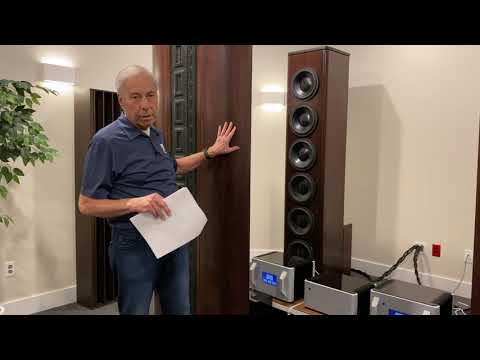
High pass filtering the main speakers
What this covers
Removing the demands of reproducing bass frequencies from the amplifier seems like a really good thing to do. Yet, not many amp manufacturers seem to support it. Why?
Source description (no synthesized summary yet).
High-pass filtering main speakers is not recommended because the phase shift and circuitry added by filtering creates greater audio degradation than allowing well-designed modern amplifiers to handle full-frequency reproduction with adequate headroom.
- Modern amplifiers are designed with sufficient power supply headroom and linearity to handle all frequencies without significant sonic penalty
- High-pass filtering introduces phase shift and extra circuitry that creates measurable degradation greater than the theoretical benefit
- Subwoofers should be added for low-frequency extension, not to relieve amplifiers via filtering—let speakers do what they're designed to do
This asset isn't compiled yet
You're seeing its claims, ranked. Compile it to build the argument threads, weight them, and check each claim against your library — the full view.
Confirmation bias leads people to believe in high-pass filtering benefits because the logical reasoning supporting it confirms what they already believe should be true.
“i've been told and i believe it because i can logically rationalize why it might be true ah yes what do we call that confirmation on bias we believe what confirms what we believe”
Subwoofers provide two benefits: extending low-frequency response, and relieving the main amplifier and speakers of the burden of producing bass, which frees up power headroom that can be applied to mid and high-frequency reproduction.
“the benefits of having a subwoofer beyond extending low end frequency response is that you relieve the rest of your system of the burden of making base if the amp no longer has to produce the more power intensive lower frequencies you'd have more headroom because there's more available power can be applied to the mids and high frequency bands”
The advantage of bi-amping is not fundamentally about the amplifiers being relieved of frequency duties, but about the ability to select and tailor amplifier types (tube vs. solid-state) to suit the sonic character desired for each frequency band.
“that's the advantage of bi-amping not so much that the amps aren't doing their jobs but you can tailor the kind of amplifier to the kind of job that it's doing”
The key question in evaluating high-pass filtering is how problematic it actually is for an amplifier to produce bass frequencies simultaneously with mid and high frequencies—and the answer depends on how well the amplifier is designed.
“the big question to me comes down to how bad of a problem is it for an amplifier to be producing base at the same time it's producing highs and mid ranges and i think the answer to that depends on the amp and how well it's designed”
High-pass filtering introduces phase shift and adds an extra set of unnecessary circuitry that has a sonic effect greater than the benefit of relieving the amplifier of bass production duties.
“but when you high-pass filter a speaker you are taking some liberties that are fairly extreme you're adding phase shift you're adding an extra set of circuitry to that that you don't really need and that's going to have an effect that i believe is greater than letting the amp do its job”
Paul does not advocate for high-pass filtering speakers because speakers and amplifiers are designed to do their jobs well and should be allowed to do so.
“i am not an advocate of doing that i never have been speakers and amplifiers are designed to do what they do and they do it pretty well there can be arguments so let them do it is the basic thing right especially speakers i really don't like the idea of limiting speakers”
Bi-amping—using separate amplifiers for bass and for high frequencies—was advantageous years ago because older amplifiers were poorly designed, but modern amplifiers are capable of handling all frequencies well, so the advantage of bi-amping today is different: it's the ability to choose amplifier types (e.g., solid-state for bass, tube for treble) that suit the character of each frequency band.
“we talk about biamping a lot in the past one of the advantages of biamping is that the base amp does base and the high frequency amp does high frequency so that would go toward towards kevin's theory but let me suggest that while that may have been true years ago because amplifiers weren't built very well years ago today's amplifiers are more than capable of handling all frequencies so today buy amping is good because you can pick an amplifier who has prodigious amounts of bass who's great in the bass maybe not so great on the top end you could put a vacuum tube on the top end and a big brood of a solid state on the bottom end that's the advantage of bi-amping not so much that the amps aren't doing their jobs but you can tailor the kind of amplifier to the kind of job that it's doing”
For high-fidelity audio systems, speakers should be left alone to do their designed job; subwoofers should be added for low-frequency extension and system power distribution, not for high-pass filtering of the main speakers.
“for my money leave the speakers alone let them do their thing add the subwoofer because of all the reasons we've talked about for years on subs”
Modern amplifiers today are more than capable of handling all frequencies without the separation that was necessary with older amplifiers.
“today's amplifiers are more than capable of handling all frequencies”
If high-pass filtering were truly as beneficial to sound quality as claimed, major hi-fi equipment manufacturers would include it as standard, yet they do not—suggesting high-pass filtering is not actually important.
“if removing the lows from the amp and main speakers is as important and beneficial as it is to be made out to be currently certainly the engineers for those reputable hifi equipment manufacturers wouldn't include a sub output but just forget to add high pressure to add oh a high pass filtering would i be correct in presuming that if the high pass filtering were actually so beneficial to sound quality all the best amps would have it and since they often don't it must not be important”
An amplifier that isn't challenged with producing bass frequencies will likely sound better in the mid-range and highs than one that is handling all frequencies simultaneously—but this is a matter of trade-offs where one problem is traded for another.
“of course there is a logical reason for that and of course you're right an amplifier that isn't challenged with making the base frequencies is likely to sound better in the mid-range and highs than it is if it's doing all of it no question about it but it's all a matter of trade-offs you're trading one thing one problem for another problem”
When designing amplifiers, engineers pay particular attention to power supply headroom, linearity, and overall capability (moxie) to handle all frequencies perfectly.
“when we design an amplifier we pay particular attention to its ability to have enough power supply headroom linearity moxie if you will to handle all of that perfectly”
High-pass filtering means allowing high frequencies to pass through while blocking low frequencies—the name derives from the mechanism.
“high pass filtering means we're going to remove the base so everything high passes through everything low doesn't that's where the name comes from”
High-pass filtering is a common practice in home theater, where users can choose speaker size designations (small, medium, large) representing different levels of high-pass filtering applied.
“in home theater we do a lot of that and that seems to be a pretty big practice in home theaters to and you can choose small speaker medium speaker big speaker right you've probably seen those and that's different levels of high pass filtering”