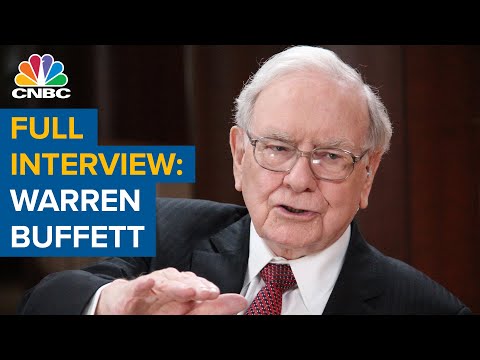
Watch CNBC's full interview with Berkshire Hathaway CEO Warren Buffett
What this covers
Berkshire Hathaway's chairman and CEO Warren Buffett sat down with CNBC's Becky Quick on Monday to answer viewer questions and discuss the top news stories of the morning.
For more Warren Buffett, check out Squawk Pod: » Subscribe on Google Play: https://play.google.com/music/m/Imbb7bptxdyljmmabn7svbhzd4m?t=Squawk_Pod » Subscribe on Apple Podcasts: https://podcasts.apple.com/us/podcast/ask-warren-buffett/id1480890290?i=1000466545028 » Subscribe on Spotify: https://open.spotify.com/show/6zG3vq4UQ0xDRVOs8eGAMi?si=J39_0ed9RNSOASe5xCQFlA » Listen on Stitcher: https://www.stitcher.com/podcast/cnbc/squawk-pod/e/67565551
For access to live and exclusive video from CNBC subscribe to CNBC PRO: https://www.cnbc.com/pro/?__source=youtube » Subscribe to CNBC TV: https://cnb.cx/SubscribeCNBCtelevision » Subscribe to CNBC: https://cnb.cx/SubscribeCNBC » Subscribe to CNBC Classic: https://cnb.cx/SubscribeCNBCclassic Turn to CNBC TV for the latest stock market news and analysis. From market futures to live price updates CNBC is the leader in business news worldwide. Connect with CNBC News Online Get the latest news: http://www.cnbc.com/ Follow CNBC on LinkedIn: https://cnb.cx/LinkedInCNBC Follow CNBC News on Facebook: https://cnb.cx/LikeCNBC Follow CNBC News on Twitter: https://cnb.cx/FollowCNBC Follow CNBC News on Instagram: https://cnb.cx/InstagramCNBC #CNBC #CNBC TV
Source description (no synthesized summary yet).
Buffett argues that long-term investors should focus on the intrinsic value and 10-30 year business outlook of companies rather than short-term market fluctuations caused by events like coronavirus or interest rate changes, and that current stock valuations remain attractive compared to bonds despite near-zero interest rates.
- Market declines of 3% should be viewed as buying opportunities for long-term business owners, not panic points
- The 10-30 year outlook for American businesses has not meaningfully changed from short-term shocks like coronavirus
- Current bond yields (2% 10-year, negative rates globally) make stocks substantially more attractive than bonds on a relative valuation basis
This asset isn't compiled yet
You're seeing its claims, ranked. Compile it to build the argument threads, weight them, and check each claim against your library — the full view.
Board compensation (typically $300,000+ annually for 4-6 days per year of work) creates conflicts with true independence—directors on lucrative boards are motivated to maintain good relationships with current CEOs rather than actively challenge them, making 'independent' directors often dependent on the compensation.
“I have often seen people that are qu uh classified as independent directors and they are getting $300,000 a year for a job that takes them uh a couple of days maybe six times a year, maybe four times a year. and uh uh the company flies them to their office and it's it's very enjoyable”
Buffett strongly supports increasing the Earned Income Tax Credit dramatically (to ensure workers get $15+/hour in effective income even without raising minimum wage) because it's more economically efficient than mandating wages while maintaining work incentives.
“I'm a big fan of increasing the earning income tax credit. And uh I'm uh I think there should be some changes made but but uh uh if given a choice I wouldn't certainly vote for Mike Bloomberg as opposed to Sanders.”
When buying stocks, investors should think of themselves as buying businesses, not trading ticker symbols, because this perspective changes how they evaluate price movements—a 2% daily decline in March 1942 should not have changed the fundamental value of a business if owned for 10-20 years.
“if you're buying a business, uh and that's what stocks are, businesses. In fact, people would be better off if they say, 'I bought a business today, not a stock today.' Because that gives you a different perspective on it. And presumably, you buy a farm, if you buy a apartment house, if you buy a business, you're going to own it for 10 or 20 or 30 years.”
Berkshire has specific criteria for board membership: integrity, business savvy, and strong personal interest in Berkshire's success—this contrasts with other companies' focus on director backgrounds, emphasizing that effective directors must have 'skin in the game' and understand operations.
“at at Bergkshire for decades, we've given the uh three factors in addition to integrity, but uh uh for board membership and and and uh we want people who are businesssavvy. Uh we want them uh to have a uh a strong uh personal interest in in in in in Bergkshire itself.”
Reaching for yield—trying to earn high returns in a low-rate environment by taking on excessive risk—is both 'really stupid' and 'very human,' and it has predictable consequences: the risks eventually materialize into portfolio losses.
“reaching for yield is really stupid, but it's very human. I mean, and I understand it.”
Bull markets distort investor perception: stocks that are genuinely cheap become expensive as prices rise, and people begin thinking stocks have 'gone up' instead of asking whether they are still attractively priced, losing sight of the original valuation discipline.
“So stocks started going up in the 20s and all of a sudden they were selling at five or six times the prices as when he bought the book. And the original correct uh perception on his part had experienced changing conditions. But people just looked they got their confirmation through stock prices and people that's what happens in bull markets. People people start out thinking stocks are cheap and then they start thinking stocks have gone up and and a stock can be a good buy or a bad buy.”
A 30-year bond yielding 2% is economically equivalent to paying 50x earnings for a stock with zero earnings growth—an obviously bad deal that people should recognize, yet long bonds are being widely purchased at 2% despite government policy to generate 2% inflation annually.
“if you buy a 30-year bond today with the yield 2%. You're paying 50 times earnings for an investment where the earnings can't go up for 30 years. Now, if somebody said to you, I want to sell you a stock that's at 50 times earnings and the earnings can't go up for 30 years, you'd say, that doesn't sound very good.”
Berkshire Hathaway is often criticized for carrying a 'conglomerate discount'—the market values a portfolio of diversified businesses less than it would value the same businesses if broken up and sold separately—but Buffett claims Berkshire's structure actually creates value through tax efficiency and capital allocation that is impossible to replicate through market transactions.
“we can move capital within if you move capital from one stock to another and you got a gain particular I mean you pay a tax and and uh may pay a dividend tax or if you sell part but there's a there's a lot of taxes incurred in moving from one business to another either at the corporate level uh in some cases uh but certainly at the individual level and uh we can move capital well just take seeds candy again we bought that in 1972, we've moved several billion dollars from the candy business to other types of businesses.”
The 1986 Tax Reform Act eliminated the General Utilities Doctrine, making it extremely tax-inefficient to break up Berkshire—whereas before 1986 companies could dispose of appreciated assets without corporate-level taxation, after 1986 selling off businesses triggers substantial tax liability.
“Up till 1986, it wouldn't have been. I mean, there was a general utilities doctrine that governed uh corporate breakups and uh so you could dispose of businesses or securities if you did it right. You could dispose of securities or businesses that had appreciated without a tax at the corporate level. That was done regularly in various ways up till 1986. They revised the tax code big time. They kill general utilities”
Insurance risk correlation is critical: auto insurers must properly price for risk differences (80-year-olds are safer drivers than 16-year-olds; 16-year-old females safer than 16-year-old males) and constantly improve at this, otherwise competitors will cherry-pick the best risks, leaving the company with a loss-making portfolio.
“There's a vast difference. In auto insurance I'm not sure. I I might prefer the 80 year olds over the 20 year olds. Well you might and uh you certainly would prefer the 80 year olds to the 16 year olds. I mean, yeah. And you'd prefer the 16-year-old female to the 16-y old male.”
Berkshire was a net buyer of stocks continuously since Buffett was 11 years old (beginning ~1941) through every presidency and market condition, with only rare periods of non-buying when stocks seemed very expensive, showing that market timing is not the investment approach.
“I've been actually been a personal net buyer of stocks ever since I was 11. Every year and and uh there's been 15 American presidents in my lifetime... I bought stocks under every one of them.”
Interest rates are the basis of all value—if you knew rates would be zero for 100 years, you'd accept 1% as terrific, but if you bought that 1% instrument and rates later went to 8%, you'd lose nearly all your capital, making interest rate uncertainty an enormous factor in valuations.
“interest rates are the basis of all value. If you knew interest rates were going to be zero for a 100 red years, you would think 1% was a great rate of return, but you also would know if you bought something was yielding 1% or that was what it paid and rates went to 8%, you'd lose practically all your capital.”
EBITDA ('earnings before interest, taxes, depreciation and amortization') is, in essence, 'BS earnings'—it's a non-GAAP metric that removes significant real costs and should be viewed skeptically, as Buffett and his partner Charlie Munger both emphasized.
“I don't like it when investment bankers talk about Ebida which I translate as earnings. [Charlie noted] he doesn't like EBITDA”
Cryptocurrencies (like Bitcoin) have zero intrinsic value—they don't produce anything, don't deliver earnings, can't mail you a check—and their only value comes from hoping someone else will pay more for them later, which is not an investment but a speculation on greater-fool dynamics.
“cryptocurrencies basically have no value and they don't produce anything. So you can look at your little ledger item for the next 20 years and it says you've got X of this cryptocurrency or that. It doesn't reproduce. It doesn't it doesn't deliver. It can't mail you a check. It can't do anything. And what you hope is that somebody else comes along and pays you more money for it later on”
Buffett does not try to make investment decisions based on predicting short-term business conditions; he does monitor rail car loadings and other indicators but for understanding what's happening, not to make specific short-term bets.
“You know, it has since 1776, but you still watch things like rail car loading very closely. I watch everything, but I don't do it to make in specific investment decisions. it. Uh uh but I I enjoy I mean I I I want to know what's going on, but I also don't think that I can make money by predicting what's going to go on next week or next month.”
In 1941 (when Buffett worked in a grocery store) and 1940 (when Munger worked in the same store), customers cared enormously about brand for items like ketchup (specifically wanting Heinz) but were indifferent about brand for items like peas and milk, showing that brand power has always been category-dependent rather than universal.
“I worked in a grocery store in 1941, Charlie worked in the same one in 1940. People would call and they'd ask for a can of peas and I'd write down a can of peas. They'd call in and they'd they'd ask for Hines's ketchup and I I better get give them Hines ketchup. They didn't care which brand the peas were”
Berkshire rents its headquarters office building rather than owning it and has intentionally only leased one floor of the 15-floor building—this reflects reluctance to build unnecessary overhead, as a larger headquarters would naturally attract more staff and bureaucracy.
“we don't want a big headquarters office. If we had a big headquarters office, we'd fill it. Believe me. I mean, if we had 15 floors of our own, we'd have 15 floors worth of people.”
Life and annuity insurance companies are hurt by low interest rates because they've promised returns of 3-4% to customers but can only reinvest at 1% or less, and the solution is to stop offering high-return products, not to reach for yield by taking on more risk.
“The ones that really get hurt on it are are either life or annuity companies that have promised returns. If you promise somebody an annuity that's going to pay them three or 4% and now you find that you're reinvesting your money at 1% or something, uh, you know, you're going to disappear.”
You cannot predict what the stock market will do in 10 minutes, 10 days, or 10 months, but you can come to a firm conclusion about what American business and global business will be like 20-30 years from now.
“I don't think there's any way to predict what the stock market will do 10 minutes from now, 10 days from now or 10 months from now. So, I work on what I think I'm able to do. And as desirable as it might be to know what was going to happen 10 minutes from now, I'm just that's just not something I'll ever be able to master. So, fortunately, I can come to a pretty firm conclusion that 20 or 30 years from now, America business and probably over the world will be far better than it is now.”
Private label brands (like Costco's Kirkland) can be extraordinarily successful if tied to a strong retailer brand, but strong consumer brands (like Coca-Cola) have proven nearly impossible to replicate with private labels, suggesting brand strength depends on consumer psychology rather than product quality alone.
“brands are always going to be in a fight with the retailer... try and give me a $10 billion budget and ask me to bring out another Coca-Cola that makes a dent in Coca-Cola and I can't do it.”
Berkshire achieved record GAAP earnings of $80 billion (highest in company history), but these earnings are 'misleading' because a large portion reflects stock market gains on paper, not operating performance of underlying businesses.
“we achieved the highest gap earnings of any company in the world has ever achieved uh that's investorowned... because a lot of that was just the stock market going up, which now gets counted in our earnings”
Berkshire Hathaway's shareholder base is uniquely aligned: individuals own the shares and many have held for 50+ years with intention to hold for life, which is why Buffett deliberately limits new shareholders rather than trying to expand the investor base through Wall Street marketing.
“Bergkshire has a very unusual shareholder base. I mean, we have individuals that own Bergkshire and a lot of them have owned it 50 years just like it's people buy it to own for for a lifetime”
Commercial banks earn 12-16% on tangible net assets, which is an excellent return compared to 2% bond yields, making banks significantly more attractive than bonds if the banking business remains stable—the key risk is if banks 'do something massively dumb'.
“banking is a good business if you don't do dumb things on the asset side. I mean, basically, and it's it it's a business that uh the banks we own earn between uh the commercial banks earn between 12% and 16% or so uh on tang net tangible assets. That's a good business.”
GEICO has been transformed from 2.5% of the auto insurance market (when acquired in 1995) to 13.7% (as of interview), becoming the #2 player and worth 'tens and tens and tens of billions' more than the purchase price plus all earnings retained—a success driven by CEO Tony Nicely's operational excellence rather than capital allocation.
“At GEICO, we bought control in 1995. uh we had about 2 and a.5% of the market for auto insurance and we're at about 13.7% of the market. Geico has been the envy of every other company in the uh, auto insurance business except for Progressive”
American Express is selling for ~$100 billion market value (126 per share × 815 million shares), and the real investment question is whether the company is worth more or less than that amount—not what the stock will do tomorrow or next week.
“American Express. We own American Express and there's 815 million shares out and sells it this morning is 126 or something like that. So it's selling for roughly hundred billion dollars. Now the real question is whether the company's worth more or less than 100 billion.”
General Motors had 19,000 dealers in 1932 (when US population was only 125 million) and once sold less than one-tenth of a car per dealer per month—that period was an excellent time to buy GM stock if you understood the business, not because the market was low but because fundamentals had become attractive.
“In in in 1932 General Motors had 19,000 dealers. They produced uh or sold in there was one month, I think, when they sold less than a tenth of a car, right at a tenth of a car per dealer.”
Conglomerates had a bad reputation in the late 1960s because of manipulative accounting practices (dirty pooling) and share issuance schemes designed to artificially inflate stock prices—practices that allowed companies to acquire other businesses at inflated valuations, creating chain-letter arrangements.
“there was a run a very abusive run in conglomerates where they played with numbers and they had dirty pooling as they called it of accounting. They they wanted to have their stocks up and put out stories to do it so they could issue more stock.”
Newspaper circulation has continuously declined and most print papers face structural obsolescence, with the only survivors being those that built strong digital franchises (NY Times, Wall Street Journal, Washington Post)—Buffett admits he was slow to recognize this and later bought some papers that haven't adapted.
“the circulation of the papers in every every print print circulation goes down... the three survivors so far that look promising online are the New York Times and the Wall Street Journal and the Washington Post. All three of those papers sold their smaller papers.”
Buffett is a Democrat but not a 'card-carrying Democrat'—he's voted for Republicans, contributed to Republicans, and once ran as a delegate to the Republican National Convention in 1960, showing political flexibility.
“I'm a Democrat, but I'm not a card carrying Democrat and and uh I I've voted for Republicans. I've contributed Republicans. Uh in fact, I I I've only run for two offices in my life. One was head of the uh young Republicans at the University of Pennsylvania and the other time I was actually on the ballot running for a delegate to the Republican National Convention in 1960.”
Index funds (S&P 500) are themselves ultimate conglomerates—500 separate companies with 500 management teams—yet Americans have enthusiastically embraced them, suggesting 'conglomerate' is not inherently bad if managed well.
“But they call them index funds. You buy you buy 500 businesses trying to figure out what you were talking Yeah. Well, 500 businesses all put together. I mean, that's the ultimate conglomerate, isn't it?”
The market system for developing goods and services has worked better than anything else in history, as evidenced by the fact that everything visible when you fly to Omaha today is a product of a system that's 'worked like nothing's ever worked in the history of the world', making it critical not to damage this system even while addressing inequality.
“I think the market system works very very well in terms of developing more goods and services. I mean, when you flew out here to Omaha, if you'd flown out here and you wouldn't have been able to fly in 1776, you wouldn't have seen anything. Everything you see is the product of a a system that's worked like nothing's ever worked in the history of the world.”
Berkshire's key advantage as a holding company is the ability to move capital between businesses while minimizing taxes, which has allowed moving billions of dollars from See's Candies to other businesses over decades.
“we can move capital well just take seeds candy again we bought that in 197 72, we've moved several billion dollars from the candy business to other types of businesses. And uh we'd love it if we could use it all in the candy business, but it just isn't that sort of business.”
Leveraged buyout financing of whole-business acquisitions has become easier and cheaper, allowing buyers to pay higher prices because they can borrow more money at lower rates with fewer restrictive covenants than historically.
“There's quite a premium and part of the premium is because you can borrow so much money so cheap so cheaply in buying those businesses. Obviously, you can pay more for a a business if you can borrow a very high percentage of the purchase price”
See's Candies loses money 7 months out of the year but is 'wonderful' because it makes enough profit during the peak season (Christmas) to offset losses the rest of the year, illustrating how seasonal businesses require long-term ownership perspective.
“Our our candy business is a wonderful business, but it loses money seven months out of the year. But the nice thing is Christmas comes every year.”
Edgar Lawrence Smith's 1924 book fundamentally changed investment thinking by demonstrating that stocks will outperform bonds over time because retained earnings compound, even when both assets yield the same current percentage (e.g., 4%)—a principle that has been true for a long time but most investors have ignored.
“Edgar Lawrence Smith... said if a stock yields 4%, a bond yields 4%... then the stock was going to outperform the bonds because there were retained earnings that were building beyond that yield. And that's that has been true for a long long time, but nobody paid any attention to it.”
You cannot predict the market by reading newspapers or listening to market commentators, so the proper approach is to analyze business fundamentals and make decisions based on whether you're getting value for your money, not on market predictions.
“if you can predict the market, you don't need to read balance sheets. You don't need you don't read you don't need to read anything. You certainly can't predict the market by reading the daily newspaper. That is for sure. And you really can't you certainly can't predict the market by listening to me.”
Monetary policy to stimulate the economy has been in effect since 2008 and was intended to be temporary, but central banks have accelerated stimulus further; what was supposed to be temporary has now become a long-term policy.
“particularly asset prices now for 10 years and what we thought was temporary in 2008 and n in the way of monetary policy to stimulate. We've just put our foot on the gas even further.”
The game of economics and markets always unfolds differently than expected, and while it looks puzzling prospectively, it looks obvious in retrospect—yet this dynamic is what makes the game interesting.
“the game always unfolds differently than you expect and and that's what makes it so interesting. You know the tenure speaking of these low rates just a little bit ago hit its lowest yield since July of 2016 this morning.”
Corona virus creates a fundamental difference from other black swan events—pandemics are 'frightening' in a distinct way because they involve biological transmission risk, government quarantine response, and unknown future trajectory (unlike discrete financial events).
“There's something something about a pandemic that just is different than other black swans. It's it's it's a frightening prospect.”
Even with a $10 billion marketing budget, it would be nearly impossible to launch a new Coca-Cola competitor today that could make a dent in Coca-Cola's market position, illustrating the depth of that brand's competitive moat.
“try and give me a $10 billion budget and ask me to bring out another Coca-Cola that makes a dent in Coca-Cola and I can't do it”
Apple's supply chain issues from Corona virus show that many Berkshire-owned companies have hidden supply chain dependencies they didn't anticipate—even 'boring' businesses like John's Manville (building materials) have China-dependent supply chains.
“I found that certain of our companies have got supply chain arrangements that are being affected by this that I didn't even know had this like what well I got one uh from John's Manville the other day for example you wouldn't normally think of them as having a big supply chain but Shaw carpets or you name it”
Berkshire Energy is capable of managing billion-dollar infrastructure investments and stands 'ready and willing' to invest in large transmission lines or other utility/energy infrastructure—this is an untapped opportunity given Berkshire's capital and management resources.
“Bergkshire Hathaway Energy I should say has the ability and the talent to manage big investments hundred billion dollars and more. I think you wrote we stand ready and willing and able on such opportunities.”
Bank of America is buying back 7-8% of its stock annually through share repurchases, so Berkshire's ownership percentage increases 7-8% each year without any capital investment—a scenario Buffett would like to repeat with any good business.
“Bank of America is buying in a lot of stock every year. So our ownership of the Bank of America this year probably will go up seven or eight% without us spending a dime. I I'd like to own any business, any good business where my ownership is up seven or eight% every year without me spending any money and on top of it I get a dividend.”
The existence of $13 trillion in negative-yielding debt worldwide is unprecedented in economic history and nobody—not even central banks—understands what it means or will result from it, despite it being presented as stimulus that has apparently worked for 10 years.
“you've got 13 trillion or something like that worldwide at negative interest rates and we don't know what that means. I mean we've got a lot of people can speculate what it means but 10 years from now or 15 years we'll from now we'll look back and say well it's obvious what would happen under that and we'll we'll see it but it is not a normal situation”
Boeing sought large cash loans (raising ~$13B) through bank financing rather than asking Berkshire, showing that traditional bank lending is still preferred for large corporate loans and Berkshire doesn't compete in that space.
“I think Boeing's raised about 13 billion. Uh but that's bank type money. In other words, I my memory is that it's maybe 1% you know plus flyway they're looking for they're looking for traditional bank loans and we don't make traditional bank loans.”
Federal government debt maturity is relatively short, so if interest rates rise substantially, the interest expense on $20 trillion in debt would explode from ~$200 billion annually (at 2%) to ~$1 trillion (at 5%), making fiscal sustainability dependent on continued low rates.
“if you take 20 trillion or and and you're borrowing it at at 2%, you've got you got 400 uh uh uh what have you got at two two trillion two 200 billion. You got 40 billion of of the expense. But if it goes to 5%, you got 100 billion of expense. I mean it uh No, 5% you got you got a trillion of expense.”
The baseball sign-stealing scandal (Astros) is bad but not unprecedented—Bobby Thomson's famous home run in 1951 also involved sign-stealing, and baseball has survived past scandals like the Black Sox, so it will recover from this one through institutional responses.
“Baseball will get past this. You're a huge baseball fan. Were you surprised to hear about Yeah, I was surprised to hear about it. Yeah. that uh but then I find out that Bobby Thompson's home run, you know, somebody just stole the sign”
Good ideas can be dangerous because they work repeatedly—once stocks proved they outperform bonds, people forgot the limiting conditions (bonds must yield comparable rates) and assumed stocks would always be superior, leading to the 1929 bubble.
“you get more trouble with a good idea than a bad idea because the good idea works. Stocks work out better than bonds most of the time. And after a while, people forget that there were some other limiting conditions.”
Buffett will never own any Bitcoin and doesn't own any cryptocurrency, and if pressed on the definition of personal integrity, would not recommend any cryptocurrency to investors—his position is firm and won't change based on dinner conversations.
“I don't have any Bitcoin. He You don't? No. Okay. No, you don't own Bitcoin. I I will. No, I do not own one. I don't own any cryptocurrency. I never will.”
Berkshire Hathaway's retained earnings are the only reason the company is worth significantly more than when it started, because the company uses retained profits to build new earning power and repurchase shares to increase ownership in the company.
“we don't get rich on our dividends that we receive although we happy to receive them. We get rich on on on the fact that the retained earnings are used to build new earning power repurchased uh shares which increases your ownership in the company and and uh uh and and Bergkshire has retained earnings ever since we started. That's the only reason Bergkshire is worth a lot more as we retain earnings.”
Berkshire Hathaway's board of directors are very conscious of representing shareholders and ensuring business operates in ways that shareholders won't be disappointed by, aligned with Buffett's estate plans to direct 80 billion to foundations.
“I I want directors that represent the shareholders. And you know in terms of my estate uh you know with with maybe currently $80 billion worth of shares to give to philanthropy. I I hope that we have a and I we do have a group of directors that I think will be very conscious of doing the right thing.”
A 3% market decline (approximately 800 point Dow drop from current levels) represents a buying opportunity if you believe in the business fundamentals, because you're purchasing the same businesses 3% cheaper.
“My reaction is that I like to buy stocks, so I uh I don't wish ill on anybody else, but I like to if they want to sell them to me cheaper, I prefer it. So, uh, if that's a, uh, you know, roughly a 3% decline or thereabouts, I don't know how many 3% declines I've had in my lifetime, but there have been a lot of them. And, uh, I I can't think of one that you shouldn't have bought on.”
The smartphone is a fundamental product transformation similar to the telephone in importance—it has become part of hundreds of millions of people's lives and provides utility in all aspects of their activities.
“the smartphone uh is part of hundreds and hundreds of millions of people's lives in all aspects of their lives. They it's used for has all kinds of utility. It's a consumer product.”
Brand power is still important in retail but retailers have gained ground against brands over time, suggesting the traditional manufacturer brand advantage has eroded somewhat as retailers have built their own brands and distribution power.
“the retailer has gained ground against brands to some degree but brands are still terribly important”
Apple is Berkshire's third-largest business position (after insurance and railroad), representing 5.3-5.6% of Apple, which is bigger than the single largest acquisition Berkshire has made, and Buffett considers Apple one of the best businesses in the world.
“we own five and a half or a little over a percent of Apple. It's a probably the best business I know in the world. And we own 5 and a half% of it. And that is a bigger commitment that we have in anything except insurance and the railroad. So, it's it's our third largest business.”
Buffett would vote for Michael Bloomberg over Bernie Sanders, and carries a 'Certified Capitalist' card in his wallet as a joke about his identity, showing alignment with market-based solutions over socialist alternatives.
“I would certainly vote for him. Uh uh I don't think I don't think another billionaire supporting him would be the the best thing to announce, but uh sure I would I uh I I would have no trouble voting for Mike Bloomberg.”
Kraft Heinz remains a 'great business' earning $5B annually on $7B of tangible assets with minimal working capital, but Buffett acknowledges 'we paid too much for it and took on more debt than we should have'—a rare admission of acquisition overpayment.
“It's still a great business in the sense that it earns, we'll say, $5 billion after depreciation uh pre-tax and uh on 7 billion of tangible assets... but we paid too much for for for kraft and we we took on more debt than that”
Wells Fargo's creation of millions of phony accounts wasn't profitable to shareholders and the phony accounts themselves were worthless—the real disaster was that management ignored the problem when discovered, violating the principle that 'an ounce of prevention is worth a ton of cure' in responding to problems.
“the shareholders didn't make money. People say, well, well, the incentive structure was set up so that some of the employees dumbest incentive system you can think and as soon as you learn, you can deise dumb incentive systems. But the big thing is they ignored ignored it when they found out about it.”
Berkshire describes its philosophy using restaurant metaphors: you can run a French restaurant or a hamburger stand, but you cannot run a hamburger stand that serves French food or a French restaurant that serves hamburgers, so you must advertise your philosophy and fill seats with aligned customers (shareholders).
“You can run a French restaurant or you can run a a hamburger stand. And if you serve good hamburgers, you'll do good business. the hamburger stand. You can at the French restaurant do the same thing there. But you can't run the French restaurant and then serve hamburgers inside. And you can't run the hamburger stand and serve French food inside.”
Business softening in recent months is due to tariffs creating a question mark for companies and front-loading of purchases ahead of tariff implementation, and something else (currently coronavirus) will be in focus six months and a year from now—the real question is where businesses will be in 5, 10, and 20 years.
“Well, it isn't really down. It's just it leveled off and a little softer maybe now. But well, tariffs, the tariff situation was a big question mark for all kinds of companies and and still is to some degree, but that that was front and center for a while. Uh uh now Corona virus is front and center. Something else will be front and center six months from now and a year from now and two years from now. real question is is where your where are these businesses going to be five and 10 and 20 years from now.”
Austria issued 100-year bonds yielding about 2%, but yields have since declined significantly (to perhaps 1.1% or lower), showing how unusual it is for long-duration sovereign debt to offer very low yields.
“Austria issued 100-year bonds you know at 2% or thereabouts and then they've gone way way up and I think maybe they yield 1.1 or something like that I I don't know where they are now but uh it's great if you're a borrower to have cheap money”
Todd Combres' role at GEICO is temporary—he was brought in from outside because Berkshire lacked a clear internal successor after CEO Bill Roberts announced retirement, but the long-term plan is to promote from within and ideally have Combres return to other roles within Berkshire.
“Todd Comolmes who's worked with Berkshire now for 10 years... Todd is there and I hope very much that uh that he's not there very long because I'd like to get him back in Omaha.”
Buffett and Munger are more interested in each other's views about current events than vice versa—specifically, Buffett claims he's more interested in Munger's perspective than Munger is in Buffett's, showing asymmetric relationship value.
“we're particularly interested in each other's view although I think I'm more interested in his view than he is in mine. And that that would be a correct decision to make for somebody overhearing us.”
Berkshire currently owns $240 billion in stocks (viewed as parts of businesses) and $125 billion in cash, positioning it to be a net buyer of stocks when prices decline—the cash position represents buying power rather than a bearish market forecast.
“we own $240 billion worth of stocks. Now, we look at that as $240 billion worth of businesses uh that we own parts of... You've also got more than $125 billion in cash sitting around.”
Berkshire Hathaway managers run their businesses more independently than S&P 500 managers because Berkshire doesn't require constant reporting to Wall Street analysts, saving managers approximately 25% of their time and allowing them to focus on operations rather than investor relations.
“they never have to finance their businesses. I mean we they never have to go to Wall Street. They never they probably save 25% of their time.”
A rational Treasury policy would be to lock in low rates by issuing longer-duration debt, but Buffett acknowledges he himself would have made poor timing decisions on this issue in the past, so he's uncertain whether it's optimal.
“it's great if you're a borrower to have cheap money I mean everybody should refinance their mortgage is that an argument for the Federal Reserve or I'm sorry for the Treasury Department here issuing longer longer notes yeah but I would have said the same thing five or six years ago and been Uh but uh if if we under the president's slope, it still would cost more to lengthen it out.”
Buffett agrees with some of Bernie Sanders' goals (addressing inequality, helping people left behind by capitalism) but fundamentally disagrees with his methods—specifically, Buffett opposes giving 20% of company stock to employees or putting workers on corporate boards, believing this damages the productive capitalist system.
“I actually agree with him in terms of certain things he would like to accomplish. I don't agree with him in many ways, but I in terms of the fact that that uh we ought to do better by the people that get left behind by our capitalist system. I don't think we should have killed the capital system in the process.”
Buffett is 89 years old and '99% of my money is in it' [Berkshire], so he has maximum incentive alignment to ensure Berkshire doesn't become a Wall Street takeover target—his retirement money and philanthropic giving ($80B+ to charity) both depend on Berkshire remaining independent.
“I am leaving every every share of Berkshire goes to charity and it's 99% of my net worth. So, I got nobody cares more than I do about getting the most money to those philanthropies”
Berkshire Hathaway has disclosed in its shareholder letter that it invites shareholders holding $20 million+ in shares to call directly to offer block sales, indicating eager buying at appropriate prices and attempting to bypass market intermediaries to buy stock directly from willing sellers.
“we did it because uh it's very hard to buy blocks uh in the market of Bergkshire...we'd like them to call us and we'll if it's if it's if we're buying at that price level, we'll be buying”
Greg Abel and Ajit Jain will play a larger role in Berkshire's annual shareholder meeting, sitting on stage and available to answer questions directly, allowing shareholders to direct questions to specialists (e.g., insurance questions to Abel, others to Jain or Buffett).
“It will mean that any shareholder or any of the journalists there who are presenting questions from shareholders that have been sent to them can direct those questions to either a Jeet uh or to Greg...They'll be sitting on stage with you and Charlie”
PG&E doesn't fit Berkshire's acquisition criteria not because it's a utility, but because the restructuring problem is 'too tough'—involving multiple state jurisdictions, 'not in my backyard' opposition, and complex stakeholder conflicts that make it operationally unmanageable.
“It's too tough. I don't I don't know the answer to it. I mean that uh uh rearranging that utility. I think I know Governor Nome, I think he's a very very very smart guy and and in terms of solving this problem, it's just not easy.”
Buffett doesn't disclose the specific investment performance of Todd Combres and Ted Weschler because it would be unusual for firms to publicly rank individual investors' performance—they're entitled to work 'in relative anonymity' and Berkshire keeps performance private like it does for other divisions.
“I think it would be very unusual uh for a firm to discover disclose everybody's sales last year among their salespeople or anything like that. I mean, they're entitled to work uh uh in relative anonymity.”
Bitcoin's primary economic contribution to society has been negative—it has facilitated illegal money transfers that were previously moved in suitcases—so the logical investment implication is to go short suitcases (bet that demand for physical currency smuggling will decline).
“Bitcoin has been used I think to move around a fair amount of money illegally... the logical move from the introduction of Bitcoin is to go short suitcases because the money that was taken in suitcases from one country to another suitcases will probably fall off in demand.”
BNSF railroad operating margins are close to best-in-class for railroads using precision scheduled railroading, but BNSF chose to gain market share by being more customer-friendly rather than maximize margins, which trades short-term profitability for longer-term competitive position.
“Our margins are close to what uh the better railroads well there's only a few they get from precision railroading. On the other hand, we've gained share uh because the customers don't like because the railroads apparently or railroad customers like us better”
Buffett considers Apple a consumer products company (like See's Candy) that happens to use technology, not a technology company—this reframing justified the investment despite his historical skepticism of tech stocks.
“I mean it is obviously it's a consumer product company that uses technology... Apple doesn't resemble IBM anymore. It re it resembles seas candy in a way more.”
Berkshire purchased $5 billion of its own stock last year, but this represented only 1% of market capitalization, indicating that while Buffett wants to buy shares, the buyback program is limited by liquidity constraints and his principle of not overpaying.
“we bought $5 billion worth last year, but that's only 1% of the market cap”
Bill Ackman's stake in Burlington Northern Santa Fe and comments about margin improvements reflect activist investor interest in Berkshire subsidiaries, but Berkshire is aware of peer performance and changes operations when businesses underperform—though most Berkshire managers are excellent and have capital available for improvements.
“we notice what other railroads earn and when their margins are better. I mean, and uh we certainly put way less pressure on than Wall Street might who would want it next week or but uh we uh our managers are well aware of what's going on in other industries and and we've made changes where we don't think some businesses are performing as well as they should.”
Berkshire will not outperform the S&P 500 in the next 10-15 years—Buffett expects it to be in the middle tier (not top 10-15% but not bottom 10-20%)—because the size of Berkshire ($550B+ market cap) limits the magnitude of its advantage over the market.
“I do not think it will be in the top 10% of stocks performing over the next 10 years. I don't think it'll be in the top 15% of stocks performing in the next 10 or 15 years. I also don't think it'll be in the bottom 10% or 20% or 30%.”
Charlie Munger, at age 96, continues to be Buffett's best thinking partner because he has the 'best 30-second mind in the world'—capable of filtering complex problems through multiple analytical lenses and reaching their essence within 10 seconds.
“Charlie has the best 30 second mind in the world. So I can go to him with an a new question, new problem of any kind, and it goes through about eight filters in his mind in in 10 seconds. and he gets to the essence of any problem.”
Charlie Munger recently stated there is a lot of wretched excess in the market and significant trouble coming, reflecting concern about current valuations and leverage in the financial system.
“Charlie said recently Charlie Munger the vice chairman at Berkshire Hathaway had his daily journal meeting just a couple of weeks ago and at that meeting he said that there's a lot of wretched excess out there and that there's a lot of trouble coming as a result.”
Berkshire Hathaway operates across 70 major businesses representing hundreds of subsidiary operations, and in aggregate these businesses have been slightly softer in recent months due to tariffs and other variables, but this represents softening from a very good level.
“looking at our 70 businesses and that actually they represent hundreds uh in addition uh they're a little softer. Uh on the other hand I was out with the fellows from the Nebraska furniture mark just Saturday night and and their business was up quite a bit in February but that's because weather was good.”
Berkshire's Dairy Queen franchises in China were largely closed due to coronavirus, and the ones still open were doing no business to speak of, illustrating near-term business impact.
“we have maybe a thousand Dairy Queen uh franchises in in in in uh China here and they're just treat only. So, they're the old older type, not with food, but a a great number of them were closed, but the ones that were open weren't doing any business to speak of.”
Berkshire is still committed to the newspaper business and has recently committed new money to Lee Enterprises, believing that Lee has the best chance of any newspaper company to maintain print operations and find an online solution.
“we put new money into the newspaper industry here or we've committed to do it. It'll close in a month or two. And then finally, very quickly, we are in the Berkshire Hathaways headquarters building here in Omaha. Stum writes in a question. It says, 'Why did you decide to rent your offices for all these years instead of buying the building or building your own office building?' Well, we only use one floor of the 15 floors here, but we have signed a lease for the next 20 years on one more floor.”
To exceed 10% ownership in any company triggers Hart-Scott-Rodino filings and additional rules; going beyond that level has many regulatory constraints.
“if to go beyond 15% in any company, we'd have to go in on Hart Scott Rodino. I mean, there's a lot of rules as you increase your ownership.”
Berkshire is 'pretty close mouthed' about current stock purchases because discussing them could influence prices, and the principle is that almost any stock Berkshire owns, it would like to own more of.
“All right. Uh I get pretty close mouthed when it comes to what we're buy. I feel my jaws lock up. But fair to say it's fair to say that anything that we own we like, you know, and and uh uh there's very few stocks that we own. And I look at them as part ownerships in businesses. there. Uh there's very few that are selling at some price where I would sell them a little higher.”
Berkshire owns roughly 10% of the four major US airlines (with largest position in Delta at about 10% individually), and buying them outright is unlikely due to regulatory complications and interplay between bank holding company regulations and airline investments.
“we the our largest position is in Delta. Three of the four positions are mine. One of the positions is one of the other fellows uh of the four positions, but we own a very roughly 10 close to 10% of of the four largest airlines.”
St. Louis Fed President Jim Bullard expects low interest rates to persist for a long time, which raises questions about implications for stock market valuations, banks, and insurance companies that rely on yield.
“we did have St. Louis Fed President Jim Bullard on the program last week and he said that he expects to see these low interest rates for a long time to come. That does raise a lot of questions if that happens about what this means for the stock market, what that means for banks, what that means for insurance companies”
Buffett recently transitioned from using only a flip phone to using a modern smartphone (provided by Tim Cook), and used it during the shareholder meeting, showing willingness to adapt technology use even at age 90.
“Uh, I've been given several of them, but uh uh including by Tim Cook. One finally stuck. What? Pardon me? One finally stuck. You're actually Yeah, absolutely. No, I I my flip phone is permanently gone.”
Justin Sun's $4.6 million dinner contribution to the Glide Foundation was very generous and will buy many meals and beds for people in San Francisco, showing that his interest in Bitcoin did not change Buffett's view but the dinner was pleasant and civil.
“And those people were they behaved more than well, and they gave 4.6 or Justin gave 4.6 million to Glide, and that will buy a lot of meals and provide a lot of beds for people in San Francisco. So, I I thank him.”
Buffett only uses his smartphone as a phone and doesn't use other features (unlike most users), and doesn't understand the detailed features of the device he carries, consistent with his general approach to technology.
“I don't I don't use all its facilities like most pe I mean most people are living their lives around it and uh uh uh I use it as a phone as a phone and nothing else”
Berkshire sold 55 million shares of Wells Fargo in the fourth quarter, with some sales to avoid exceeding 10% ownership, but sales beyond regulatory requirements occurred for other reasons that Buffett declines to specify.
“we've sold well more than that. Yeah, I think 8.4% was the last. Yeah, that sounds right. And and uh No, we we've uh we've sold we've sold well more than that. Yeah, we've uh we've sold we sold Wells Fargo in the fourth quarter and we sold it earlier.”