What this covers
An overview of Sonke Ahrens' "How to Take Smart Notes" is available on the book summary app Shortform! Sign up with my affiliate link to get a 20% discount on an annual subscription 🎉 ➡ https://www.shortform.com/morganeua
The Zettelkasten method of note-taking and knowledge management changed my life and saved my PhD! Originally used by Niklas Luhmann, a German sociologist who wrote hundreds of articles and over 70 books in his lifetime, "zettelkasten" means "slip box" because Luhmann's system was in a literal slip box filled with note cards. I host mine, though, in a program called Obsidian (link below). If my overview of this method got you intrigued, here are some other resources to check out that go into more detail:
The best book length overview of the zettelkasten system is "How to Take Smart Notes" by Sonke Ahrens. I find it useful for getting inspiration and there's an audiobook, too, if you just need a refresher/some motivation: https://takesmartnotes.com/
By far the resource I return to the most is a post by Sascha on the Zettelkasten website called "Introduction to the Zettelkasten Method." I also just surf that website whenever I run into an issue with my own zettelkasten, because 100% someone has answered my question there: https://zettelkasten.de/introduction/
Obsidian has a VERY useful "help" section once you download it. It's definitely worth checking out: https://obsidian.md/
Other software people use for a zettelkastem, other than Obsidian or a literal slipbox, are Notion (https://www.notion.so/desktop), Foam (https://foambubble.github.io/foam/), and Roam (https://roamresearch.com/).
There are so many YouTubers talking about zettelkasten and Obsidian!! Including Bryan Jenks (https://www.youtube.com/watch?v=wB89lJs5A3s), John Mavrick (https://www.youtube.com/watch?v=pmcAjMf5JoE), Martin Adams (https://www.youtube.com/watch?v=ziE6UExsOrs), and Artem Kirsanov (https://www.youtube.com/watch?v=E6ySG7xYgjY).
0:00 - Introduction 2:44 - Core Principles of Taking Notes 4:59 - Take Fleeting Notes 6:25 - Make Permanent Notes 7:47 - My Obsidian Folder 8:47 - Bibliographic Notes 9:40 - Transcribing Fleeting Notes 10:50 - Naming my Notes 11:49 - Forming Connections 14:22 - Graph View 15:29 - Conclusion
#gradschool #notetaking
Source description (no synthesized summary yet).
The Zettelkasten method is a non-hierarchical, interconnected note-taking system that transforms knowledge management from chaotic organization by source into a powerful, searchable network of atomic thoughts that generates creative insights and writing productivity.
- Traditional linear note-taking (organized by course/source) becomes increasingly useless as volume grows, whereas Zettelkasten becomes more valuable with scale
- Writing in your own words and making granular, atomic notes allows you to extract and reuse already-written, pre-connected thoughts across multiple writing projects
- The power of Zettelkasten emerges from quantity and quality of connections between notes, not from individual notes in isolation
This asset isn't compiled yet
You're seeing its claims, ranked. Compile it to build the argument threads, weight them, and check each claim against your library — the full view.
Nicholas Lumen's original Zettelkasten system used physical slip boxes with index cards, each assigned a unique identifier and manually cross-referenced to other cards by writing out identifiers, which was laborious compared to modern digital systems that automatically create and visualize links.
“nicholas lumens subtle casting system was in a series of slip boxes so he would write out his note on a little cue card and he would give it a unique identifier and then he would slot it in his box after a corresponding note and then he would literally write out connections to other little pieces of paper that were in his boxes with their unique identifiers so he knew where to look that seems awfully laborious to me in an age where we do have computers”
The first core principle of Zettelkasten is to write all the time in your own words, because if you do not write down or verbalize knowledge, it will be lost in your brain rather than stored externally.
“the first principle is write all the time whenever you can write in your own words that's how notes are going to be stored in this system is paragraph form writing in your own words you can take those notes any way you want you can even audio record those notes if you want but the point is if you don't write it down or speak it into a microphone or something then you're going to lose that knowledge in the recesses of your brain”
When creating permanent notes from fleeting notes, you should write in your own words, make each idea as irreducible as possible, and importantly, you must record the source location (page number, chapter) so you never need to reference the original source again when reusing the note in future writing.
“really the important thing when reading a book and taking notes is to remember the thought you were having and why you wanted to maybe save that idea but also to note down where you found that idea so that you can cite it and find it later”
When creating permanent notes from source material, you should avoid including the source quote directly in the new note and instead paraphrase or summarize the idea in your own words, then create a separate link back to the bibliographic source with the page number, as paraphrasing ensures you process and understand the idea rather than simply storing a quote.
“the first thing i do when i want to put a source like a book into my obsidian is i create a note for the book... the first principle of this system it's writing in your own words is the only thing that matters so i'm gonna go and turn this into my own words there it is i now have a note my note says while university should be a place where students discover who they are... in this way and then i link i'm going to link the book because this is actually going to be its own separate note from the bibliographic note so i'm i'm actually linking to this book so that i know where it came from directly so cohn 1993 writes grades reduce a student's sense of control”
The Zettelkasten method was originally developed by Nicholas Lumen in the 1960s as a physical system of interconnected index cards, and modern users have advantages over Lumen because computer software can automatically connect thoughts without manual cross-referencing.
“the system i'm going to be teaching you today and then walking you through how i use it is called the zettelkasten method and this was originally used by nicholas lumen in the 1960s and we are at an even greater advantage than lumen was because we have computers and there are so many softwares online that you can download to your computer and do all of the work of connecting your thought for you”
Obsidian is a software that stores notes as Markdown files on your local computer, allowing you to back them up to cloud services (like Google Drive) and ensuring you retain ownership and portability of your notes rather than being locked into a proprietary system.
“inside of the folder are markdown files which is like just a basic text file so at any point in time i can grab any of my notes and print them or print my entire note system if i want to i also have a backup of this folder in my google drive so that i never lose my subtle cast in system”
When creating permanent notes, you should actively ask yourself what other existing notes this new idea relates to and create explicit links to those notes, because linking to only the bibliographic source is insufficient; true value comes from connecting the new idea to your existing knowledge network.
“and then if we look at the right hand side you can see that there's one other note that has reference to this note and it's just the bibliographic note but that's not enough that's not a good enough connection just the book it came from that's not connecting to my other knowledge so i'm gonna think to myself what other ideas might this be related to”
Because you have written all your ideas in your own words in advance and made pre-existing connections between them while taking notes across your classes and readings, when you sit down to write an essay or paper, the writing is already substantially done; your work becomes simply ordering the already-written notes coherently and connecting them with prose to make the paper flow.
“when i go to write an essay on anything i've already written down that thought and i've already connected that thought to 20 other thoughts and i can just pull those notes out of my subtle casting they're written in my own words already and i can plop them into an essay and just put them in an order that makes sense to me then all i have to do is the work of connecting those thoughts and making the paper flow but the writing's already been done the writing's been happening throughout all of my classes and all of my readings all of the time”
The third core principle of Zettelkasten is that a single irreducible thought is the basic unit of knowledge, and when taking a note you should make it as atomically simple as possible while remaining one complete thought so that it will make sense and be useful later.
“the third core principle is that thought is the basic unit of knowledge in this system so when you do take a note you should think about how to make it as irreducible as possible and yet still one complete thought that's going to make more sense later”
The fourth core principle of Zettelkasten is that all knowledge is interconnected as a network of thoughts, and when storing a note you should actively ask yourself how it connects to existing notes and what you already know that relates to it, because the power and value of the system emerges from the quantity and quality of connections, not from individual notes.
“the fourth principle which is your knowledge is interconnected every time you store a note you should be asking yourself how does this connect to something that is already in my subtle casten system and what do i already know that connects back to this your knowledge is just a network of interconnected thoughts the power of this system comes in the quantity and quality of the connections between your thoughts”
The fifth and final principle of Zettelkasten is to trust the system and understand that a single note in isolation yields no benefit, but the power emerges in the scale and interconnection of many notes, making Zettelkasten fundamentally different from notebook systems which become increasingly chaotic and less useful as volume grows.
“i want to leave you with now is one last fifth principle that i'm going to tack on here at the end and that is to trust the system if you just take one note in your zettle castan nothing magical will happen it is in the number and quality of connections that your settle cast in is going to work for you and that's one of the big draws for me for zettelkasten as opposed to notebooks because the more notes you take in a notebook the more chaotic everything becomes and the less useful because the more notebooks you have to shuffle through to find your thoughts but in settle castin the more notes you take and the more connections you make between those notes the more valuable your zettlecaston gets”
Zettelkasten's increasing value with scale is a major advantage over notebook systems, which become increasingly chaotic and less useful as more notebooks accumulate, because the quality of your knowledge tool is inversely proportional to the amount of shuffling and searching you must do to retrieve information.
“and the easier it is to come up with ideas for writing projects and actually start writing the projects”
When converting fleeting notes to permanent notes, you should ask yourself whether each captured moment is important enough to warrant a full note, and you can choose to write notes on paper first and transcribe them into Obsidian later, or type directly into Obsidian, or even avoid computers entirely as Nicholas Lumen did with physical index cards.
“the second step is to take permanent notes based on your fleeting notes this is when you actually write down the ideas in your own words in paragraph form and make that idea as irreducible as possible so once i've tabbed up a book or just a chapter of a book i will go through each sticky note and i'll ask myself is this an important enough thing that i want to write a note about it and if it is then i'll write the note”
Organization of undergraduate notes by course and source location (when and where learned) rather than by logical knowledge structure makes retrieval difficult because you must manually flip through multiple notebooks to find a specific thought, and you cannot fully remember when and where you originally learned a thought you want to reuse.
“i would have like a stack of five notebooks i would have to be flipping through to see if i had written down the thought that i wanted to use for that paper but i couldn't even fully remember when and where i learned that thought and the only organizational method was when and where i learned that thought because you know it was organized by the courses i was taking not by logically where that information belongs in my brain”
Undergraduate note-taking strategies of highlighting quotes and writing margin notes fail in PhD programs because PhD-level work requires storing and retrieving huge amounts of information that is fully interconnected with existing knowledge to enable surprising connections and creative thinking.
“when i started my phd program i quickly realized that the way i was taking notes in undergrad just wasn't going to cut it for this new program so i started looking into different methods of note-taking that might help me out in my phd and specifically what i needed was a way to store huge amounts of information so that it was easily accessible at a later date when i needed it to write a paper and preferably all of that information would be fully interconnected with all of my other knowledge so that i can make surprising connections between my thoughts”
The second core principle of Zettelkasten is that everything is knowledge, including school textbooks, teacher lectures, personal experiences, memories, and shower thoughts, and the system treats all information non-hierarchically as equally valuable rather than privileging academic or formal sources.
“the second core principle you should remember is that everything is knowledge it's not just what is in your school books and what your teacher says that is valuable information it's everything you encounter like your experiences or your memories or your shower thoughts etc the zettlecaston system is a non-hierarchical way of organizing your knowledge so it doesn't think one bit of information is more valuable or inherently better than any other piece of information”
A knowledge management system is the missing piece that traditional note-taking tutorials on YouTube do not address, and the Zettelkasten method provides a holistic approach to storing and organizing interconnected notes.
“whenever i went onto youtube say to look for a tutorial on how to take better notes it wouldn't be a holistic system of how to like store and organize those notes and i now realize the piece that i was missing was a knowledge management system and i am so happy to tell you that i have found a method that works for me”
The Zettelkasten system makes taking, storing, and learning notes fun and efficient enough that the effectiveness of the system itself creates motivation to continue using it, despite the inherent work required.
“i think that the settle casting makes taking and storing notes and learning things actually like fun and efficient and almost easy dare i say it yes it still takes work but the effectiveness of this system just makes it so much fun to keep using the system because like you can feel the productivity oozing out of you”
Fleeting notes are the first step of Zettelkasten and are simply brief captures of knowledge, ideas, and thoughts that occur throughout the day, such as thoughts during a walk, audio memos, or lecture notes, which will later be processed into permanent notes.
“the very first step that i take is to make fleeting notes and this is just how you capture bits of knowledge and information and ideas and thought that occurs to you over the course of your day this can be anything it can be a thought that popped into your head while you're taking a walk and so you write it down on a little notepad or take an audio memo or it can be your notes from lecture”
When reading a book for Zettelkasten, you should not write notes in your own words during reading because doing so disrupts your immersion in the author's ideas; instead, you should use sticky notes to mark important moments and write down your own thoughts on larger sticky notes when the highlights alone would be insufficient.
“while i am reading a book i actually don't physically write out notes in my own words because i want to be immersed in the ideas of the book i don't want that disrupting my reading experience so instead i tab up the book with little sticky notes that are highlighting moments i want to remember from this book because i think i'm going to turn it into a note later and then if there's something that just highlighting it wouldn't suffice for the thought that was going through my brain i will put a larger sticky note on that page”
When naming permanent notes in Zettelkasten, you should name each note after the main idea or thesis it expresses, using double-bracket Markdown syntax to create the note title as a link, which allows you to immediately see the concept the note captures rather than using a date-based timestamp or arbitrary identifier.
“what is this note about because it needs a name i'm going to create a new note the way in obsidian you create new notes is you go double square bracket and then you put the name of the note in there so what is this note about i think the thesis of this note is something like grades inhibit students from becoming independent thinkers”
Unique note identifiers in Zettelkasten must be distinctive across the entire system so that when you create a link to a note, it points to exactly one note and not multiple notes with the same name, and semantic naming by idea/thesis naturally ensures uniqueness in most cases.
“you can use like a time date stamp as long as all of the names of your notes are unique identifiers so you're not pointing to multiple places at once”
In Obsidian, bibliographic notes are titled using the author's last name and publication date, followed by the full MLA citation, and then linked to a central bibliography note that automatically aggregates all sources referenced in the entire Zettelkasten system.
“i title all of my bibliographic notes after the last name of the author and the date when the book was published and then i put my mla citation right at the top there personally because i know what i'm going to be using these notes for it's going to be to write papers or blog posts or etc in the future and then i put my first link in here and i want to link this book to another note called bibliography”
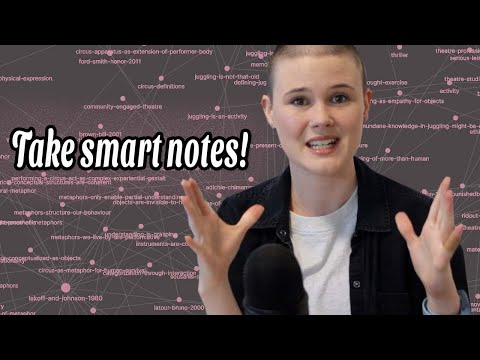
The Graph View feature in Obsidian visualizes all notes as nodes and connections as edges in a network diagram, and while the resulting image appears chaotic and messy, this mess actually represents the power of the system because it shows how extensively you have interconnected your knowledge.
“the last thing that i'll show you in obsidian which is just kind of a cool thing i think is the graph view you can see there's so many connections that i'm making between so much thought it's all interconnected and it looks like a mess when you look at this network and these nodes in this graph view and it is a bit of a mess”