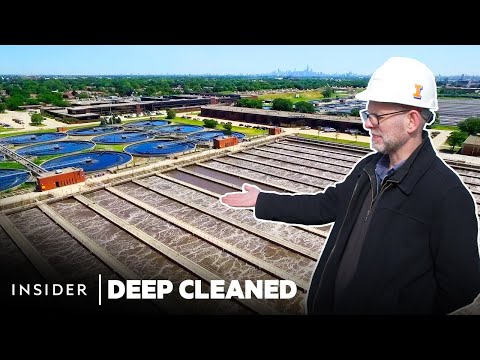
How Chicago Cleans 1.4 Billion Gallons Of Wastewater Every Day | Deep Cleaned | Insider
What this covers
The Stickney Water Reclamation Plant in Illinois is one of the largest wastewater-treatment facilities in the world, serving about 2.3 million people and cleaning an average of 700 million gallons of wastewater a day. During rainfall, the facility can handle a whopping 1.44 billion gallons of wastewater in a single day — that's a million gallons every minute.
The clean water is released into the Chicago Sanitary and Ship Canal, and the sludge that is removed from the water is converted to biosolids, which are a sustainable alternative to chemical fertilizers.
For more, visit: https://mwrd.org/what-we-do
MORE DEEP CLEANED VIDEOS: 51 Deep Cleaning Jobs You Didn't Know Existed | Deep Cleaned | Insider https://www.youtube.com/watch?v=DIJ6BTUptN8 5 Cleanings That Keep The Travel Industry Running | Deep Cleaned Marathon | Insider https://www.youtube.com/watch?v=qJBWsIdxGz8 Everything We Deep Cleaned In 2023 | Deep Cleaned Marathon | Insider https://www.youtube.com/watch?v=1oacL6OumyI
------------------------------------------------------ #chicago #cleaning #insider
Insider's mission is to inform and inspire.
Visit our homepage for the top stories of the day: https://www.businessinsider.com/ Insider on Facebook: https://www.facebook.com/insider Insider on Instagram: https://www.instagram.com/insider Insider on Twitter: https://twitter.com/thisisinsider Insider on Snapchat: https://www.snapchat.com/discover/Insider/2708030621 Insider on TikTok: https://www.tiktok.com/@insider
How Chicago Cleans 1.4 Billion Gallons Of Wastewater Every Day | Deep Cleaned | Insider
Source description (no synthesized summary yet).
The Stickney Water Reclamation Plant demonstrates how modern wastewater treatment transforms sewage into clean water, fertilizer, and energy through a series of physical, chemical, and biological processes that compress natural decomposition into hours rather than weeks.
- Sewage undergoes sequential treatment stages (screening, settling, aeration, digestion) that separate solids from liquids and neutralize harmful compounds
- Biosolids produced from treatment are converted into nutrient-rich fertilizer for agricultural and recreational use
- The plant recovers methane gas during anaerobic digestion to partially power facility operations
This asset isn't compiled yet
You're seeing its claims, ranked. Compile it to build the argument threads, weight them, and check each claim against your library — the full view.
Flushable wipes do not break down in the sewer system or inside the treatment plant; instead, they catch on jagged surfaces, form into large blocks, and require manual removal by treatment plant staff.
“Just because you can flush them doesn't mean that you should. Those wipes do not break down in the sewer system. They don't break down inside the plant. So what happens is they come here, they find any jagged surface, and they just what we call rag up. They form into large blocks, and then ultimately we have to get those removed.”
When used as fertilizers, biosolids have been shown to improve soil health, reduce nutrient loss, and increase the amount of water soil can retain.
“When used as fertilizers, biosolids can have several positive impacts. They've been shown to improve soil health, reduce nutrient loss, and increase the amount of water soil can retain.”
Toilets should not be used as trash cans; just because something can be flushed does not mean it should be, and people should concentrate on flushing only bodily waste and toilet paper.
“Toilets are not trash cans. Just because something can be flushed down the toilet does not mean that it should be. So what you should really concentrate on is your bodily waste, your toilet paper. That's what should go down the toilet.”
Ammonia is toxic to small fish and larger fish that live in waterways, and converting it to less toxic forms like nitrate and nitrite allows wildlife to tolerate the discharged water much better.
“Ammonia is toxic to the small fish and the larger fish that live in our waterways. So by turning it into nitrate and nitrite, it's a less toxic form that the wildlife can tolerate much better.”
The process at wastewater treatment plants recreates what happens organically in nature, but condenses what would normally take several weeks into just a few hours.
“What's happening at this plant recreates what happens organically in nature, condensing what would normally take several weeks into just a few hours.”
The remaining wastewater after primary settling passes through secondary treatment tanks where air is pumped into a tank of carefully maintained microorganisms that consume pollutants and other harmful substances in the water, with oxygen allowing bacteria to neutralize compounds such as ammonia and turn them into less toxic forms of nitrogen.
“Meanwhile, the remaining wastewater passes through a primary settling phase before moving on to the secondary treatment tanks. Here, air is pumped into a tank of carefully maintained microorganisms that consume pollutants and other harmful substances in the water. This oxygen gives the bacteria what they need to perform an important job.”
Flushable wipes that enter the treatment system never break down over time; samples examined at Stickney had been in the system for roughly four years without breaking down.
“When the flushable wipes go into the system, they never break down. These have been in here for roughly four years.”
Railcars transport biosolids from Stickney a few miles away on a private railroad, where the biosolids are dumped into a lagoon for additional treatment and drying before being used as fertilizer on farm fields, golf courses, parks, and recreational facilities.
“The railcars transport this material a few miles away on a private railroad, and the biosolids are dumped into a lagoon for additional treatment and drying. The final product is fertilizer that can be used on farm fields, golf courses, parks, and recreational facilities.”
The primary goal of Stickney Water Reclamation Plant and all wastewater treatment plants is to protect the water environment.
“The main thing that the Stickney Water Reclamation Plant and all of our plants are doing is to protect the water environment.”
The treated wastewater discharged from Stickney must meet specific quality standards set by the Illinois Environmental Protection Agency to ensure it does not harm the environment or pose a risk to the public.
“This treated wastewater needs to meet specific quality standards set by the Illinois Environmental Protection Agency to ensure it does not harm the environment or pose a risk to the public.”
Samples from treated wastewater are analyzed every day in the Stickney laboratory to ensure that treated wastewater is safe to be released.
“Samples are analyzed every day in its lab to ensure that treated wastewater is safe to be released.”
In the separation process at treatment plants, solid material (sludge) settles to the bottom while liquid material flows off to the river system, and the solids are further treated to produce biosolids cake, which is an earthy material good for use as fertilizer.
“We're separating out the solid material that will settle to the bottom, a sludge, and the liquid that goes off back into the river system. The solids have been treated further to produce what we call biosolids cake, which is an earthy material. It's very good for being used as a fertilizer.”
Rotating slats in aerated grit tanks skim off scum floating on the surface and scrape up sludge from the bottom of the tanks, with the sludge then sent to digesters and centrifuges to become nutrient-rich biosolids fertilizer.
“Next, a series of rotating slats skims off the scum floating on the surface and scrapes up the sludge from the bottom of the tanks. Joe: That sludge goes on to our digesters, to our centrifuges. Ultimately become our nutrient-rich fertilizer that we call biosolids.”
Raw sewage consists of 99.9% clean water and 0.1% solids, as demonstrated by laboratory samples at Stickney.
“Just starting from the beginning, this is what raw sewage looks like. You know, it's a mixture of 99.9% clean water and then all the solids that are in there.”
The liquid that comes off the top of settled wastewater samples is what goes back into waterways after treatment, and the solids are sent for further treatment, with the final water being clean-looking though not drinkable.
“The liquid that comes off the top of it, that's what goes back into the waterways, and the solids are sent for further treatment, and then that water, after it comes out of there, is this. Looks very nice and clean. It's not drinkable.”
The two main processes at a wastewater treatment plant are treating the wastewater so it's safe to be released back into rivers and transforming the solids into biosolids to be used as fertilizer.
“Once all that sewage arrives at the plant, there are two main processes at play: treating the wastewater so it's safe to be released back into rivers, and transforming the solids into biosolids to be used as fertilizer.”
Joe Cummings advises people not to flush flushable wipes, recommending that only bodily waste and toilet paper should go down the toilet.
“So my advice, my request to everybody, don't flush flushable wipes.”
In the aerated grit tanks at wastewater treatment plants, when the flow of water slows down, lighter materials like fats, oils, and grease (known as scum) float to the top while heavier solid waste (sludge) settles to the bottom.
“At this stage of treatment, the flow of water slows down. The lighter materials, like fats, oils, and grease, known as scum, float to the top of these preliminary tanks, while the heavier solid waste, or sludge, settles to the bottom.”
Anaerobic digestion is a process that breaks down organic matter in sludge through heating and microbial action, producing methane gas that is reused in the plant for energy purposes.
“The digesters break down the organic matter in the sludge through a process called anaerobic digestion. Here, solids are heated and broken down by microorganisms to produce a biogas product. Think of it as your stomach just digesting, breaking down the solids. And as part of that process, it actually produces methane gas that is reused in the plant for part of our energy uses.”
The Stickney Water Reclamation Plant removes more than 600,000 pounds of sludge from sewage and wastewater every day, which is then dumped into drying beds to be used as fertilizer in surrounding farms and fields.
“This facility removes more than 600,000 pounds of sludge from sewage and wastewater every day. It's dumped into drying beds after a lengthy process here, at the Stickney Water Reclamation Plant. Once dry, it'll be used as fertilizer in surrounding farms and fields.”
Coarse screens at wastewater treatment plants filter out larger objects like garbage and plastics, and flushable wipes are a particular item that treatment plant staff see frequently and must manually remove.
“The process begins by sending sewage through a set of coarse screens. These screens have gaps to filter out larger objects like garbage and plastics and one item in particular that Joe and his team see often.”
Sludge is mixed with a polymer and spun at high speeds inside centrifuges to further separate solids from liquids during the biosolids production process.
“Inside these centrifuges, the sludge is mixed with a polymer and spun at high speeds. This helps further separate the solids from the liquids.”
The final settling tanks at wastewater treatment plants are the last stop in treating wastewater, where solids and liquids further separate, remaining solids are removed, and treated wastewater is returned to the river.
“These circular tanks, known as the final settling tanks, are the last stop in the process for treating wastewater at Stickney. Here, solids and liquids further separate. The remaining solids are removed and the treated wastewater is returned to the river.”
Mixed liquor captured and treated in aeration tanks separates into solids and liquid when allowed to settle, with solid separation visible within minutes of settling.
“This is what is captured and treated in the aeration tanks and then settles out in the final tanks, the secondary treatment. So, as you can see here, I shook this up a few minutes ago, and you're already getting some of the separation of the solids separating out.”
Over the course of a normal day at Stickney, enough railcars are filled with biosolids to contain 1,000 to 2,000 wet tons of product.
“Over the course of a normal day, we might fill up enough railcars for 1,000 to 2,000 wet tons of biosolids.”
Biosolids produced from centrifuges are loaded onto railcars at Stickney to be transported, with roughly one railcar being filled with 70 wet tons of biosolids during one shift.
“This is where all of the biosolids that have been produced from our centrifuges that you saw upstairs that go onto the conveyor-belt system all go into our hoppers and then are deposited into our railcars. We fill up roughly one railcar with 70 wet tons of biosolids in one shift.”
Everything that arrives at Stickney will eventually be transformed into clean water, fertilizer, and energy to power the plant, and when at full capacity the facility can handle 1.4 billion gallons of wastewater in a single day, equivalent to over 2,000 Olympic-sized swimming pools.
“And everything that arrives here will eventually be transformed into clean water, fertilizer, and energy to power the plant. When it rains, the facility can handle a whopping 1.4 billion gallons of wastewater in a single day. That's over 2,000 Olympic-sized swimming pools' worth of wastewater.”
Stickney is located on the outskirts of Chicago and at 413 acres is one of the largest wastewater-treatment plants in the world, processing all sewage from roughly 2.3 million nearby residents.
“Stickney is located on the outskirts of Chicago, and at 413 acres, it's one of the largest wastewater-treatment plants in the world. It processes all of the sewage from roughly 2.3 million nearby residents.”
Stickney operates a greenhouse where biosolids are mixed with soils in different proportions and tested on many different species to determine the optimum use for the biosolid product.
“One of the research things that we have that might surprise people is we have a greenhouse. We will take our biosolids, that nutrient-rich fertilizer product, and we'll mix it with soils, blend it in different proportions, test it on many different species, and that's all to determine what is the optimum use for that biosolid.”
During peak operation, 1 million gallons of wastewater are treated at Stickney every single minute.
“So, when we're rocking and rolling, it's 1 million gallons getting treated each and every minute.”
After centrifugation and digestion, biosolids cake is produced, and on an average day, Stickney produces over 1,000 wet tons of biosolids cake.
“After this, it enters a set of centrifuges again, resulting in a biosolids cake. On an average day, this facility will produce over 1,000 wet tons of biosolids cake.”
Stickney is considered the biggest or one of the biggest wastewater treatment plants in the world, treating 1,440 times the average daily volume of Illinois plants during high flow, compared to an average Illinois plant treating about 1 million gallons per day.
“In general, Stickney is considered the biggest or one of the biggest plants in the world. In the state of Illinois, the average plant is probably treating about 1 million gallons a day, and we're treating 1,440 times that during high flow.”
Because of its size, Stickney performs many treatment operations in-house, including an entire laboratory that does monitoring and research on biosolids applications.
“One thing that's special about the Stickney Plant is because of the size of it, we do a lot of things in-house. We have an entire laboratory right here that we do the monitoring and the research.”
The Stickney facility does not produce drinking water, but treated water is returned to waterways much cleaner than it arrived.
“The important thing is we do not produce drinking water here, but it goes back out into the waterways much cleaner than it came.”
Street drains should be kept clear because when rain falls, water sweeps everything in the street drain into the wastewater treatment system.
“Street drains, you should keep those clear, because anything, when the rain falls, it's going to sweep everything into the street drain and it's all going to come here.”
Once trapped at coarse screens, debris is scraped by a rake onto a conveyor belt, transferred to a dumpster, and ultimately transported to a landfill.
“Once trapped, a rake scrapes up all the debris and transfers it to a conveyor belt. From here, it moves to a dumpster that will ultimately be transported to a landfill.”
Working in a wastewater treatment plant involves exposure to unpleasant odors from raw sewage, sewer systems, and outhouses, and one should not expect sugarcoated conditions.
“I'm often asked what it's like working in a wastewater-treatment plant. Now, I'm not going to sugarcoat it. You've walked past a manhole, a sewer, an outhouse. You know what those smells are. You are going to smell those things, because after all, it is raw sewage coming in.”
The staff at Stickney treatment plant do not mind what their job entails, contrary to what most people might assume about working in wastewater treatment.
“Contrary to what most people might assume, Joe and the team here don't mind what the job entails.”
Joe Cummings is the operations manager at Stickney and has been working there for over 15 years.
“That's Joe Cummings, the operations manager at Stickney, and he's been working here for over 15 years.”