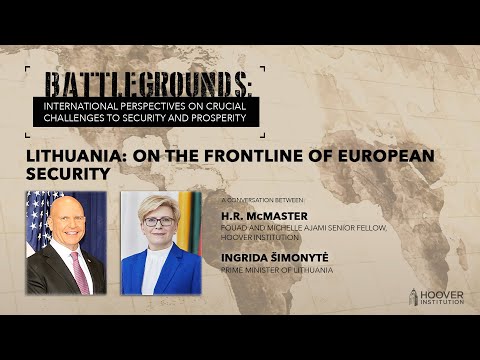
Battlegrounds w/ H.R. McMaster | Lithuania: On the Frontline of European Security
What this covers
In this episode of Battlegrounds, H.R. McMaster and Lithuanian Prime Minister Ingrida Šimonytė discuss the future of European security, energy security, the future of NATO, Russia's reinvasion of Ukraine and aggression against Europe and the West, and prospects for strengthening the free world for the long competition against authoritarianism.
H.R. McMaster in conversation with Ingrida Šimonytė, Prime Minister of Lithuania, on Wednesday, October 19 at 9:00am PT.
ABOUT THE SPEAKERS
Ingrida Šimonytė is Prime Minister of Lithuania and the second woman in the nation’s history to serve in that position. Before taking office, she was elected twice as a Member of the Parliament of Lithuania. Prime Minister Šimonytė served as the Director of the Tax Department from 2002 to 2004, the Undersecretary of the Ministry of Finance from 2004 to 2009, and the Minister of Finance from 2009 to 2012. She was later appointed Deputy Chairperson of the Board of the Bank of Lithuania and Chairperson of Vilnius University Council. Prime Minister Šimonytė holds a Master‘s degree in Economics at Vilnius University.
H. R. McMaster is the Fouad and Michelle Ajami Senior Fellow at the Hoover Institution, Stanford University. He is also the Bernard and Susan Liautaud Fellow at the Freeman Spogli Institute and lecturer at Stanford University’s Graduate School of Business. He was the 26th assistant to the president for National Security Affairs. Upon graduation from the United States Military Academy in 1984, McMaster served as a commissioned officer in the United States Army for thirty-four years before retiring as a Lieutenant General in June 2018.
ABOUT THE SERIES
Battlegrounds provides a needed forum with leaders from key countries to share their assessment of problem sets and opportunities that have implications for U.S. foreign policy and national security strategy. Each episode features H.R. McMaster in a one-on-one conversation with a senior foreign government leader to allow Americans and partners abroad to understand how the past produced the present and how we might work together to secure a peaceful and prosperous future. “Listening and learning from those who have deep knowledge of our most crucial challenges is the first step in crafting the policies we need to secure peace and prosperity for future generations.”
For more information, visit: https://www.hoover.org/battlegrounds_perspectives. Pick up a copy of "Battlegrounds: The Fight To Defend The Free World," by H.R. McMaster here - https://www.hoover.org/research/battlegrounds-fight-defend-free-world.
Source description (no synthesized summary yet).
Prime Minister Ingrida Šimonytė argues that Putin's aggression must be decisively countered through unwavering Western support for Ukraine and strengthened NATO deterrence, as appeasement has consistently failed and Russia's revanchist authoritarianism represents an existential threat to liberal democracy that cannot be negotiated away.
- Mirror imaging—evaluating Putin as if he were a democratic leader accountable to voters and courts—has been NATO's fundamental strategic error, enabling decades of miscalculation about Russian intentions
- Ukraine must win decisively; any compromise that allows Russia to claim victory will only provide breathing room for future aggression rooted in Putin's need to substitute imperial ambitions for failure to provide welfare
- Lithuania's experience under Soviet occupation and its rapid post-independence development embodies why smaller democracies cannot rely on bilateral deals; they depend on a rules-based international order that only survives if authoritarianism is deterred, not appeased
This asset isn't compiled yet
You're seeing its claims, ranked. Compile it to build the argument threads, weight them, and check each claim against your library — the full view.
Europe must make an irreversible strategic pivot away from Russian energy and accelerate the green energy transition because any illusion that Europe can return to business-as-usual with Russia is false; the decoupling must be permanent given that Europe is transitioning from fossil fuels anyway.
“we must do everything we can to make this uh process of decoupling from Russian energy irreversible because if there is an illusion that we will be able to come back you know to business as usual I would claim this is an illusion because it might happen maybe 50 years from now but but not in a in a very foreseeable future and given that Europe is on the track to get rid of fossil fuels whatsoever so we don't need to waste time we just need to move fast forward with our green agenda Renewables”
Russia was never sincere about the democratic transition in the 1990s, and unlike countries like Hungary and Poland that underwent genuine reckoning with their pasts, Russia never forced its leadership to reflect on Stalinist crimes or reconcile with nations it had occupied, deported, and exterminated, which is now fueling the current war.
“Russia was never even sincere in in this or maybe in the beginning of 90s you know but I think what was not done uh at that time um the country and the nation had no um obligation to rethink its past and what we see now is this you know Rebirth of this Grandeur... the stalinism uh crimes were never thought through there was no real reconciliation with what happened for example to Nations like mine who've been exterminated sent over to Siberia deported to sent to jails and and what what not I mean this is unfortunately now is is fueling this uh this war”
Countries that built prosperity after WWII (80 years of democratic peace and growth in Europe) and after Soviet collapse (30 years in Lithuania and other post-Soviet states) face the existential risk that a single conflict could undo decades of development and return them to autocracy.
“we might lose what we've created in 80 years after second world war my country in 30 years after occupation but the broader Europe 80 years of of the second world war were the years of you know of uh building the countries um increasing Prosperity building connectivity everything about you know staying together being richer uh more experienced and all of the sudden you understand that there is a [ __ ] in a in a red house that can actually uh create uh that can send your your previous life to just down down the road”
Authoritarian regimes manipulate the past (history, textbooks, symbols) to stoke nationalist sentiment and protect themselves from internal criticism about their failure to provide welfare and development.
“the moment when I understood that Russia is actually going backwards was when I heard that they reinstated the Soviet uh Anthem and that they started to rewrite the Soviet textbook about the second world war and this was a sign for me that I feel it like you know like going back to my childhood”
The most important lesson from Eastern European experience is that constant vigilance against erosion of democratic institutions is non-negotiable; there is no permanent rest or complacency available to democracies.
“this is something we have a very very thin ear to to to to to to to those noises and to those sounds and and to those smells and the countries that after second world war were occupied by building their country were sort of all the time uh striving for better competition better products better Services higher wages higher level of welfare I mean it it was so much farther from from them that's why they just take the the idea of liberal democracy for granted like it is the year and somebody has to say that you know air is this is crucial for our way of living but we must understand that we must be very careful so that nobody would poison this air”
Smaller countries like Lithuania cannot rely on bilateral negotiations with larger powers because they lack the economic and military weight to achieve favorable terms; they depend on a rules-based international order for protection, which is why Lithuania prioritizes the global rules-based system over bilateral arrangements.
“what what I think is important for countries like my country is that it's not just the alliances not just you know the the grouping of countries where you try to be with the ones of that are similar to you but the whole concept of the rules-based world is something that is a safety net for countries like mine because we do not have the comfort of you know of bilateral dealings right big countries often do have this privilege of sort of trying to bilaterally uh find the solution”
The core Western error in dealing with Russia is mirror imaging—evaluating Putin as if he were a democratic leader subject to public opinion, a free press, electoral accountability, and legal constraints—when in fact he operates under no such constraints and can portray any outcome as victory through propaganda, making concepts like 'saving face' strategically irrelevant.
“the idea that we we well we not me personally but quite many of my colleagues from other countries they tend to evaluate Putin uh as if he were one of us this is mirror Imaging this is this is part of strategic narcissism... he does not have to face neither his population no Free Press no opposition no a fair trial and and court if if need may be nothing of the things we have in our part of the world and if he wants to portray something as victory in his propaganda uh media that he will be very successful”
Lithuania's strong support for Ukraine predates the 2022 invasion; the country was among the first to provide military aid to Ukraine before the war, and now invests over 2.5% of GDP in defense spending, demonstrating sustained resolve when others were reluctant.
“I'm proud to say that my country was providing Ukraine with Military Support before this Invasion and we were in a very short list of of countries who were doing so including United States also some other countries other countries were reluctant”
With the Madrid NATO Summit, Russia is now formally recognized as a threat in NATO strategic doctrine, ending years of Lithuanian effort to persuade other NATO members that the threat was real despite skepticism from countries that did not experience Soviet occupation.
“we found it very complicated for so many years actually to persuade our colleagues in NATO that the threat is real and now we see the Madrid Summit uh conclusions where it is written black on white that Russia is a threat”
Putin miscalculated that the West would respond to a 2022 invasion of Ukraine with the same muted reaction it gave to Georgia (2008) and Crimea (2014)—deep concern but no real consequences—allowing him to consolidate control while the West engaged in performative outrage without action.
“I think here's uh pre uh condition of his uh initial idea was that uh it will be if he does something then it will be you know another round of very deep concerns from Western leaders and uh and not a real reaction like it was in 2014 not speaking about Georgia in 2008 and this will leave him you know with all the options on the table he will take over control of Ukraine uh everybody in the west will be unhappy some both the countries will go around a lot of shouting and screaming that look what what's happening somebody will be next but nothing will really change”
Russia's military, despite appearing impressive in parades, is fundamentally a 'Potemkin army' that lacks discipline, training, combined arms coordination, and logistics; its poor performance in Ukraine revealed structural weaknesses that no rational adversary would want to expose but Putin displayed anyway.
“it's a potemkin army I think it's clear that they you know they look really good at on May Day parades uh but don't look so good on the battlefield”
Russia's level of support among its population is divided and contingent on propaganda: polls show roughly equal shares wanting peace, wanting war, and deferring to Putin's decision, demonstrating that popular will is manufactured by state control and offers no constraint on Putin's actions.
“there was a a survey uh a week ago I think in Russia and people were asked do you want this war to stop or do you want this war to continue uh and of course you might say that you know the polls are not really a very much telling in a in a country like Russia of those circumstances like they are but still I think this is quite illustrative because there was like water of people who were saying we want this war to stop uh what just saying we want this war to continue and then the rest were saying whatever Putin decides”
Putin is using threats about energy shortages and economic hardship in Europe—'poisoning' the global South with the idea that Western sanctions are responsible for high food prices—to divide the transatlantic coalition.
“he tries to frighten us you know Europe will will freeze you will have energy bills that you cannot sustain and people will go bankrupt businesses will go bankrupt and this is something he's feeding through their media channels or some political groups that are sympathetic to to put in he is also uh poisoning the global South with the idea that it's because of Europe and this because of sanctions imposed by Europe uh those countries uh have high footprice and there is a a significant lack of of supply for wheat corn”
Germany's earlier strategy of economic engagement with Russia through energy dependency was flawed not merely because it bought Russian gas and oil (which many countries did), but because Germany's entire economy became structurally dependent on Russian natural gas, creating a critical vulnerability that Putin could exploit.
“it was not just about buying gas you know or buying oil because many countries were buying gas and buying gold it's a problem that the economy itself became hooked on on the um natural gas right yeah all of the supplies of Russian gas and that became a very significant weakness of economy”
Putin is attempting to negotiate now precisely because he is losing militarily and experiencing catastrophic mobilization problems; he seeks a ceasefire to regroup and recover, not because he genuinely wants peace, and the West must understand this as a tactical maneuver masquerading as diplomacy.
“Putin currently is speaking so much about peace negotiations and he does not want peace now that he wants negotiations he wants that somebody would make uh president zielinski and Ukrainian government to uh sort of uh take this what what happened on the ground as a feta complete so that because he he sees the losses he's suffering he sees this disaster with mobilization he sees that he has real problems with sort of uh counteracting the the Ukrainian uh Ukrainian Army so he wants some breathing space”
There is a sustained pattern of Russian political subversion and cyber attacks going back to at least 2003, particularly targeting Estonia and other Baltic states, that preceded the overt military invasions and should have signaled Putin's revisionist intentions.
“the sustained campaign of political subversion and disinformation the you know the the massive cyber attacks going back to 2003 on on especially Estonia but on your nation and others as well the invasion of Georgia in 2007 uh the speech he gave in Munich that same year”
The cost of deterring war is far less than the cost of war itself; if NATO had provided military capabilities to Ukraine years earlier, many lives would have been saved, demonstrating the value of forward deterrence.
“you're making such an important point that the cost of deterring war is far less than the cost of War itself and and uh I just wonder what would have happened if all the capabilities that have been provided to Ukraine now to defend itself have been provided a few years ago”
Lithuanian forces found evidence of genocide (corpses of soldiers) when territory was retaken from Russian occupation, confirming that Russian military conduct constitutes war crimes.
“we also see uh the way Russia is fighting uh and we see what's left when Russia is expelled out from the territories we see that it's only misery and deaths and corpses of short cyclists that you actually find on the ground”
Ukraine must win this war decisively and restore territorial integrity; any outcome short of victory will only provide Putin breathing space to regroup and launch renewed aggression, repeating the pattern after Georgia (2008) and Crimea (2014).
“what comes next first and foremost I think that we must do whatever it takes so that Russia loses this war and there should be no you know like way of going around this concept and saying that we we should do something in between you know no nobody's losing and nobody's willing I mean Ukraine must win this war and if Ukraine wins this war it means Russia loses”
The West responded to the 2022 invasion with unprecedented unity across the transatlantic community, including EU, UK, US, and Indo-Pacific allies, immediately imposing comprehensive sanctions and committing to supply Ukraine with military weapons—a response that violated Putin's core expectations and represents his greatest miscalculation.
“and all of a sudden uh there was a very strong Unity between European Union UK U.S also brought uh transatlantic Community meaning also South uh uh and in the Pacific countries of of the same of the same thinking there were sanctions that were introduced immediately there was immediate decision that we will supply Ukraine with weapons uh of course not all the countries but at least part of the countries and then other countries follow us here so I think this was his biggest miscalculation”
Finland and Sweden's NATO membership applications—traditionally neutral countries abandoning non-alignment for collective defense—represent the opposite of Putin's intended outcome and prove that his aggression has catalyzed exactly the alliance expansion he sought to prevent.
“this is one of the Putin's achievement uh because the the fact that Finland and Sweden decided to uh to uh appeal for membership in NATO was also something uh nobody would have been expecting a year ago... this Invasion changed uh their understanding about the security”
NATO's strengthened Eastern flank and forward presence in the region must be sustained indefinitely because visible Russian brutality—the corpses and atrocities left behind in Ukrainian territories—proves that deterrence requires demonstrating readiness and resolve to defend, which preparation itself provides.
“we see what's left when Russia is expelled out from the territories we see that it's only misery and deaths and corpses of short cyclists that you actually find on the ground it means that the preparation for for defense which in itself means deterrence because you deter by by uh by showing that you you are ready to defend um uh must be must be strengthened”
Ukraine's will to defend itself was underestimated by Putin as one of his core miscalculations; the Ukrainian resistance exceeded expectations and proved the determination of a free people to defend their sovereignty against imperial conquest.
“I very much believe so and it's not just a matter of belief because I think there is couple of things that Putin miscalculated when he started this Invasion first and foremost of course he miscalculated the um the Ukrainian um uh strength uh and their will and their uh commitment to defend their land which is I think a sort of a major a major thing here”
Defense spending increases across Europe—countries moving toward or exceeding 2% of GDP, with some moving beyond it—represents a permanent strategic shift driven by the realization that the post-Cold War stability was contingent and can be shattered, making defense investment no longer a luxury but a necessity.
“and there will be more and more countries that understand that two percent is not enough including my country so um so I think this is uh this is a very significant shift and this is not happening without reason this is happening for a reason because all of a sudden you know you you watch uh what's happening in Ukraine and you understand that oh my God we need to defend what we have because one day all of a sudden uh we might lose what we've created in 80 years after second world war”
The humanitarian consequences of the war extend beyond Ukraine—70,000+ Ukrainian refugees in Lithuania alone, plus global food price spikes and energy market disruption—demonstrating that regional conflicts in the modern international system create global humanitarian and economic spillovers.
“I think you have over 70 000 Ukrainian refugees uh in Lithuania and then of course we've seen the effect on on global energy markets as well as this this food crisis that some people are calling pharmageddon”
The U.S. should increase its LNG exports to help Europe decouple from Russian energy and reduce European vulnerability to Putin's energy coercion.
“I hope the U.S comes to our senses and we we become a big part of the Energy Solution as well in terms of uh I'm thinking in terms of especially LNG exports”
Lithuania's structural position as one of only four NATO countries bordering Russia creates an asymmetrical security dynamic where Lithuania bears disproportionate risk from Russian aggression but gains unique strategic insight into Russian intentions.
“you said the outset you know that you are much closer than we are to the to the problem of Russia in fact you're one of only four NATO countries that border Russia”
The NATO forward presence in Eastern Europe (increased troops and equipment) only appeared in the region after Putin invaded Crimea and Donbas in 2014, not before, contradicting Russian claims that NATO expansion caused Russian aggression—the sequence was reversed.
“he usually uh tries to to to say that you know we have NATO against us not just ukrainians so this is this is why uh this this is why we we need to fight this war because it's NATO who's been expanding uh towards the borders of Russia which is not true because the forward presence appeared in in the region only after he invaded uh Crimea and donbass”
Liberal democratic values—freedom of speech, human rights, private property, independent courts, free elections—are not given or inevitable but contingent achievements that require active defense; many people in wealthy democracies treat these values as air one breathes and forget they must be protected.
“people sometimes tend to think that uh liberal democracy and the the values of liberal democracy being that freedom of speech or human rights or private property for that matter that are very important and also independent courts uh free elections is something that is given you know it's like a air that you breathe uh and why should you bother about the air but if all of a sudden somebody would poison the air then that's the end of story”
The war in Ukraine is fundamentally a conflict between democracy and totalitarianism, not merely between two nations; it is an ideological struggle about whether people have the right to choose their own path and align with international organizations as they wish, or whether powerful neighbors can dictate these choices.
“this is the war of democracies against uh totalitarian authoritarian regimes you know”
Ukrainian civilian casualties, including women being raped and children being killed, as well as destruction of critical infrastructure like electricity and heating, constitute genocide driven by Russian forces and shape the level of Ukrainian resistance.
“Russia uh losing on the Battleground will be indiscriminately shelling and attacking civilians and there will be huge casualties and there will be huge losses of lives in playgrounds and hospitals and there will be losses of of critical infrastructure such as electricity or or or heating which is crucial for the winter so I mean what is happening on the ground is as a matter of fact the genocide”
The West must not 'blink' or show weakness in response to Putin's energy blackmail and food crisis threats, because appeasement has never brought peace and any signal of wavering resolve will cause Putin to escalate further, as he interprets accommodation as proof that continued pressure will force Western capitulation.
“what we need to do we definitely cannot blink because if we blink then it will mean that we will not be able to sustain our ground because appeasement never bring peace thus I know for sure this will never bring peace with button”
Any post-war reconstruction of Russia (e.g., a Marshall Plan) must be conditional on Russia undergoing genuine historical reckoning and rational reconsideration of its imperial past; otherwise, future leaders will repeat Putin's pattern of stirring nationalist sentiment when unable to provide welfare.
“what if there is at some point a situation where uh Western countries will have to offer something like Marshall plan to Russia uh this definitely must come with the condition of uh Russian Nation um sort of getting in in some uh in some uh rational uh uh rethinking of their past because otherwise this will be just buying time for for for some Next Period and and this will come up again because there will be another leader who will again speculate on the sentiment that people have because he will fail to provide a decent uh level of living and Welfare and public services and everything so he will ignite this uh imperialistic ambition uh time and again because this was Russian history was like that throughout I know centuries”
H.R. McMaster frames the transatlantic community's failure to deter Russia as connected to 'strategic narcissism'—the tendency to define world events primarily in relation to oneself and assume one's own preferences will determine outcomes.
“we have this team called strategic narcissism we Define that as our tendency to define the world only relation to us and assume that we would what we would like to do or not do is decisive toward achieving the desired outcome and and the corrective to that is strategic empathy to view this complex problem set associated with the revanchist hyper nationalist Kremlin through the perspective of others”
Ukraine's victory is contingent on sustained military support from Western countries, and the level of that support will be affected by political pressure from energy bills, low polling numbers, and war fatigue that might lead some Western publics to demand withdrawal—a scenario Putin is banking on.
“it is dependent on so many things that are Beyond Ukraine's control as unfortunately and one of the major factors is the level of military support that countries here will provide to Ukraine...I know that in other countries there will be voices that will say this is not our war let's leave it because energy bills are so high rating polls are so low everything is you know it's so bad we we became too committed to to this uh to this fight which is not of our own”
Peace cannot be achieved behind Ukraine's back; no third party can decide for Ukraine what constitutes victory or acceptable terms, as this would violate Ukraine's fundamental sovereign right to determine its own future.
“what what we also know as a rule-based community we also know that this piece cannot come behind the back of Ukraine I mean nobody can decide for Ukraine what is a victory for Ukraine and this is crucial”
The reinvasion of Ukraine in 2022 was a 'pink flamingo' rather than a 'black swan'—it was highly visible and predictable, not a genuine surprise, because Putin had clearly signaled his intentions through prior actions and rhetoric.
“I think the reinvasion of Ukraine was a pink flamingo I mean it was right in front of us and it was quite obvious”
Reinstating Soviet symbols (anthem, textbooks) is a warning signal that Russia is abandoning reform and reverting to authoritarian imperial expansion—this was the moment Šimonytė understood Putin's true intentions.
“the moment when I understood that Russia is actually going backwards was when I heard that they reinstated the Soviet uh Anthem and that they started to rewrite the Soviet textbook about the second world war and this was a sign for me that I feel it like you know like going back to my childhood where there was still be a childhood”
Trump's criticism of NATO members' low defense spending created an ironic precedent: now that European countries are increasing defense spending (partly due to Ukraine threat), Trump cannot claim credit, and his earlier warnings look vindicated but not appreciated.
“ironically president Trump was so unhappy about the expanding in in European countries as a percentage of GDP now I think there will be less and less countries that do not cope with two percent and there will be more and more countries that understand that two percent is not enough including my country”
Putin uses the argument that 'the West is colonialistic' to rally the Global South to his side, but Russia's invasion of Ukraine is itself a colonial war, making the claim structurally dishonest and deserving of stronger Western messaging to counter this manipulation.
“when I see those countries uh supporting Russia because the West is colonialistic and you see how Putin is using this argument in his speeches and everywhere I mean he is fighting a colonial war what he is doing is a colonial warp our excellence and so nobody in in Africa in Middle East have no good reasons actually to to to support Russia in this debate”
Lithuania became independent 32 years ago; many living Lithuanians still remember the Soviet period, making historical memory of occupation and Soviet oppression—sounds, smells, childhood experiences—a present and visceral reality that shapes Lithuanian threat perception in ways countries without such memory cannot easily understand.
“my country is independent has a restored Independence 32 years ago so so many people uh in this country living still remembers you know this sound of Soviets and even for me you were speaking about this rewriting of history and and this orbit I was a child and I had like a couple of grades in a Soviet school so uh the moment when I understood that Russia is actually going backwards was when I heard that they reinstated the Soviet uh Anthem and that they started to rewrite the Soviet textbook about the second world war and this was a sign for me that I feel it like you know like going back to my childhood”
Countries in Central and Eastern Europe that experienced Soviet occupation underwent rapid democratic transitions and grew quickly because they understood themselves as 'belonging' to the Western world and were motivated to align themselves with Western institutions and values.
“countries like Mai who after occupation were sort of hungry you know to become part of the western world because we always thought we belong there so uh for us this was a natural transition we were very quick and and fasting sort of uh adapting our legislation uh encouraging freedom of speech uh honoring human rights”
The U.S. issued the Sumner Welles Declaration in 1940 condemning the Soviet occupation and annexation of the Baltic states and maintained non-recognition of Soviet control throughout the Cold War—a policy that symbolized U.S. solidarity with Lithuanian independence.
“in June 1940 the United States issued the Sumner Wells declaration condemning the Soviet Union's illegal occupation and annexation of the Baltic states which became the centerpiece of U.S non-recognition policy during the Cold War”
Russia's occupation led to large-scale Sovietization policies including industrialization, urbanization, and deportations to Siberia; the Soviet period lasted until 1990 when Lithuania became the first Soviet state to declare independence.
“Lithuania became the first Soviet state to restore independence when its Parliament declared independence on March 11 1990”
Baltic countries and their experience with recent totalitarianism give them unique credibility and perspective on Russian threats that should be valued by Western allies.
“Lithuania was among the first allies to offer solidarity and support to the United States after the 9 11 attacks and it led the provincial reconstruction team in Afghanistan's core Province from 2005 to 2013”
Lithuania will host the NATO Summit next year, which will be an opportunity to consolidate political agreements from Madrid into practical military and defense measures for Eastern NATO.
“lithwini will host the NATO Summit next year I wonder if you might share your hopes and expectations for that Summit”
A large Lithuanian diaspora in the United States contributed significantly to Lithuania's Cold War independence struggle and continues to reinforce U.S.-Lithuanian relations today.
“a large Lithuanian diaspora in the United States actively contributed to lithuania's Freedom fight bolstering the country's relations following Independence and continues to reinforce relations today”
Even leaders who are 'equal war criminals' like Assad in Syria or Kim Jong-un in North Korea have no legitimate reason to support Russia, as the invasion is unjustifiable by any reasonable standard.
“nobody in in Africa in Middle East have no good reasons actually to to to support Russia in this debate unless the leaders of those countries are um equal war criminals like uh Assad in Syria or or or uh Kim and in North Korea”