What this covers
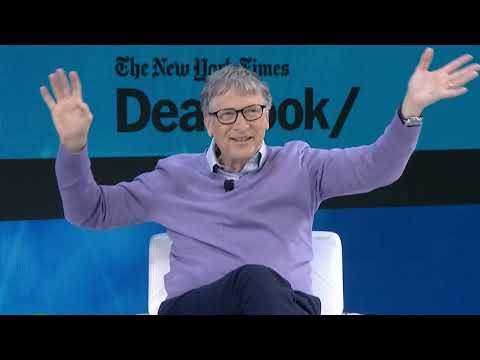
Bill Gates talked to Andrew Ross Sorkin at the New York Times DealBook Conference on November 6, 2019.
Source description (no synthesized summary yet).
Bill Gates argues that strategic philanthropy focused on global health, malnutrition, and climate adaptation can achieve massive human impact by funding innovation in disease eradication, agricultural resilience, and next-generation energy technologies, while advocating for progressive taxation that doesn't suppress capital formation or innovation.
- The foundation's microbiome research can eliminate childhood malnutrition affecting 40% of poor-country children, improving survival and cognitive outcomes at scale
- Next-generation nuclear reactors offer safer, cheaper climate solutions than alternatives if designed with physics-based safety and can be combined with renewable energy innovations
- Progressive tax systems (higher estate taxes, capital gains parity with labor income) can fund government services without threatening incentive structures for innovation and company creation
This asset isn't compiled yet
You're seeing its claims, ranked. Compile it to build the argument threads, weight them, and check each claim against your library — the full view.
The targeting of political advertisements rather than the content itself is what has 'really screwed this thing up'—because targeting allows hate ads to reach only specific individuals rather than being visible to the broader public.
“It's the targeting where you don't see the hate ad that's just appeals to that one person. It's the targeting that's really screwed this thing up according to me.”
Democracy is based on one person, one vote, and people with expertise—particularly in areas like software innovation—can appropriately advise policymakers without that consultation violating democratic principles.
“Well, we have a democracy which is one person, one vote. Uh and certainly the democracy is not electing all people that I vote for. Uh, and I do think it's okay to talk to experts. You know, during Brexit there was a person who said, you know, we've had enough of experts. I do think that if you want to talk about software innovation that at least listening to the ideas of people who've been successful in that area isn't such a bad thing.”
Wealthy people in the philanthropic phase of their lives have more free time, proven energy, and demonstrated success solving problems, making their contributions to policy discussion about issues like climate change, malaria, and education valuable.
“this group does have more free time. They have proven that, you know, they're energetic and can solve some things. And often they get into a phase of their life like Steve Schwarzman who's putting a lot of his energy and thought into very creative and I think what will be uh positively impactful philanthropy.”
If a founder is really doing a good job, they should not fear board accountability and should not worry about being outvoted or replaced if they make mistakes.
“How kind of hubris is that? I mean, if you're really doing a good job, you really think you're at risk of that?”
Addressing malnutrition in poor countries could short-circuit the historical pattern where societies needed food abundance to achieve adequate nutrition; the foundation's work could eliminate malnutrition even in resource-scarce contexts.
“Every society has benefited from the fact that the food input you got more and more protein and so less kids were had malnourishment. here we can short circuit that in even very poor countries we can essentially get rid of malnutrition”
Interest in climate change has increased dramatically over the last 2-3 years, rising from a lower baseline 10 years ago when Gates was relying on experts to inform him about climate models, effects, uncertainty, and feedback cycles.
“I've been pleased that the interest level in climate has gone up pretty dramatically over the last two or three years. It was about 10 years ago. I had some professors come to me four or five times a year. I bring other experts so I could learn, okay, how good are the models? What are the negative effects? What is the uncertainty? What are the positive feedback cycles?”
It's a 'winner take all game' in operating systems and mobile technology—the company that gains market dominance captures nearly the entire market value and becomes impossible to displace.
“it's a winner take all game. That is for sure. That you know, now nobody here's ever heard of Windows Mobile. Uh but oh well.”
Climate change requires addressing two distinct challenges: mitigation (reducing annual emissions from 53 billion tons to close to zero by 2050) and adaptation (helping people affected by temperature increases of 2-4 degrees Celsius that will still occur).
“There are two issues in climate. One is called mitigation uh where you're doing work to reduce the emissions which is currently 53 billion tons a year. U you know everybody agrees you've got to get that pretty close to zero by 2050. The other climate thing you have to do is called adaptation. That is help the people who will still be affected because the temperature is going to go up uh you know somewhere between 2 degrees 3 degrees centigrade and four degrees centigrade”
Since 2002, the Bill and Melinda Gates Foundation has helped save more than 32 million lives and enabled hundreds of millions of people to receive prevention, treatment, and care services for HIV, TB, and malaria.
“More than 32 million lives have been saved and hundreds of millions of people have received prevention treatment and care services for HIV, TB, and malaria as a function of the work that he's been doing.”
Network effects create lock-in: if you send a message to someone not on your particular messaging network, it cannot reach them; if you shop on Amazon, they have your credit card, shipping address, and purchase history, giving them advantage in offering additional services.
“the network effects that you get that say if you send a friend's message to somebody, if they're not on that particular network, it can't get to them. or you know if you're shopping on Amazon they have your credit card they have your shipping address they have your history”
Coal kills many people per kilowatt-hour of electricity produced, as do natural gas pipeline accidents, making coal more dangerous than nuclear power, yet nuclear fears persist despite this safety advantage.
“Coal kills a lot of people. Natural gas pipelines blow up and kill people per kilowatt hour. It's the safest.”
Breaking up companies is not certain to be a valid tool under current law for addressing antitrust issues in technology, making it a less fruitful approach than addressing specific anticompetitive practices like network effects and information asymmetries.
“I'm not sure whether the only tool being breaking companies up is either, you know, valid the way the law is written or is likely to be written. I think it's it's probably more fruitful to look at the network effects”
Philanthropy, representing 2% of the economy, plays a role that neither the private sector nor government is able to do in terms of innovative approaches to solving problems like malaria, nutrition, and education models like charter schools.
“I think it plays that 2% of the economy plays a role that neither the private sector or the government uh are able to do in terms of various innovative approaches to save malaria or nutrition or trying out new models of education through things like charter schools.”
Dual-class share structures (like those in Facebook and other Silicon Valley companies) where founders maintain voting control despite issuing other stock are a mistake because they allow founders to avoid accountability to boards even when making major strategic errors.
“I think it's a mistake and I've said that to everyone who's asked me. It's enough as an individual to really feel like you're responsible for the success of a company to actually go and s short circuit the governance mechanism where if you really are making mistakes that your board can't outvote you that you literally can just replace the board the next day. How kind of hubris is that?”
The mobile market is a winner-take-all market where being three months late results in the company losing its position entirely, and would have resulted in nobody having ever heard of Windows Mobile.
“Uh so yes, uh it's a winner take all game. That is for sure. That you know, now nobody here's ever heard of Windows Mobile. Uh but oh well.”
Gates advocates for coupling progressive taxation with increased transparency to reduce beneficial ownership hiding through trust-like structures at both corporate and individual levels.
“you do need to couple these things with more transparency. uh the fact that you can uh through trustlike structures hide lots of you know beneficial ownership and get away with a lot both at the corporate level and at the individual level uh we can do a lot better there.”
Multiple innovations are needed to solve climate change, but zero-emission electricity grids can be created without nuclear if there are breakthroughs in energy storage, though nuclear makes the transition faster and less expensive.
“We need lots of innovations to solve climate change. uh if we have certain other breakthroughs like in energy storage, you can actually create a zero emission grid without nuclear, but it's way more straightforward. It's way less expensive. It's way quicker if a meaningful part of it is this breakthrough new generation reactor.”
Nuclear power, particularly next-generation reactors, can solve climate change because it provides a path to zero-emission energy grids and is politically viable if people become rational about safety considerations.
“Do you think politically nuclear power will ever be something that will be a completely viable solution because it it will it solves a lot of the problems if people were rational? Yes. Uh which means there's like a 30% chance.”
The antitrust lawsuit against Microsoft distracted the company from mobile development, giving Google an opportunity to dominate, and Microsoft missed being only three months away from releasing a Windows Mobile phone through Motorola.
“the antitrust lawsuit was bad for Microsoft and if we would have been more focused on creating the uh phone operating system and so instead of using Android today, you would be using Windows Mobile. If it hadn't been for the antitrust case, uh Microsoft would [have]...We were just three months too late with the release that Motorola would have used on a phone.”
Interoperability rules similar to those required in Europe for financial institutions (allowing customers to share banking information with competing banks for loan bidding) could address network lock-in in technology companies.
“should there be a regulation like there is in Europe for the financial institutions where if you want to share all of your information uh about what you do with bank one with bank two so you can get them to bid to give you a loan that that's required that the network effects of that you might have of being locked into the one bank uh uh the these interoperability rules.”
Targeting in political advertising on social media should not be allowed, but Gates disagrees with calls for corporations to police the content of political advertisements for factual accuracy.
“targeting in that domain essentially targeting should not be allowed should not be allowed not be allowed. But would you do you think that the content should be policed or not? It I I wish I wish I thought there was such a thing that could be done. Uh but no, I I actually disagree with targeting, but I disagree with people who think that a corporation should sit there and do factchecking against those things.”
It is not bad or unrealistic for China to develop innovative technology, and objectively testing products (bugged vs not bugged) is better than blanket restrictions on goods from particular countries.
“It's good that China's doing innovative technology and anybody who thinks we should try and stop that is a being unrealistic and b it's it's it's not a good thing. Huawei like all goods and services should be subject to an objective test. Is it bugged or not bugged?”
Blanket prohibitions on goods from China while allowing US goods (like jet engines with embedded software) to be exported to China are contradictory and destructive to mutual economic interdependence that reduces war risk.
“The rule that everything that comes from China is bad if it tries to come to the US or everything from the US like jet engines, software, you know, you name it is bad. That is one crazy approach to trying to take advantage of innovation and really have the two countries mutually dependent enough that we minimize the chance of ever going to war with each other.”
Sophisticated technology like jet engines contains embedded software that could be remotely disabled, and restricting Chinese access to such technology while also restricting Chinese technology in the US is inconsistent.
“How can you tell China to buy a jet engine? The jet engine has all sorts of software in it. Now, you can send a funny command to it and say, "Okay, turn off the jet engine." Do you want them to buy any of our sophisticated goods and products or not?”
Gates argues that ethnicity-based restrictions on technology (e.g., excluding software written by people whose ancestors were Chinese) are absurd and that objective technical testing is the only rational criterion.
“What about Chinese employees? If if you're so paranoid, you know, what about the code that's being written by, you know, somebody whose grandmother was Chinese? I mean, or great-grandmother was Chinese. My god, just think about it. I mean, is there any piece of software in the world that you're willing to trust? Uh, you should use objective measures, not taint type measures.”
Gates considers nuclear power politically unlikely to gain acceptance (estimates ~30% chance of becoming viable) because of public fear, even though current reactors have better safety records than any other electricity source on a per-kilowatt-hour basis.
“Do you think politically nuclear power will ever be something that will be a completely viable solution because it it will it solves a lot of the problems if people were rational? Yes. Uh which means there's like a 30% chance. Uh it nuclear the current reactors actually have a better safety record than any other source of electricity.”
Over 40% of children in Africa never develop physically or mentally due to malnutrition from early age, manifesting as low IQ and low physical capacity; this is not simple starvation but reflects inadequate nutrient absorption.
“over 40% of the kids there never develop the either their physical body, their brain because of malnourishment from an early age. They have, you know, very low IQ, very low physical capacity. And so in Africa, that's over 40% of the kids. And it's never been understood why. It's not like starvation. they are getting enough feed.”
Children on normal growth paths are one-third as likely to die from pneumonia, diarrhea, or malaria as malnourished children, making malnutrition reduction a leverage point for overall child mortality reduction.
“not only will less kids die because kids on their growth path are a third as likely to die from pneumonia or diarrhea or malaria”
The First Amendment was not designed at a time when wealthy individuals could effectively purchase a 'big megaphone' for political speech, creating a modern challenge to democratic equality.
“the First Amendment wasn't designed at a time when rich people could essentially buy this big megaphone.”
Next-generation nuclear reactors can be designed without high pressure systems (eliminating the need for continuous human operation), with physics-based containment ensuring radioactive material never leaves the reactor, providing superior safety and economics compared to current reactors.
“You can design a reactor that is not capable. That is there's no high pressure in in the reactor anywhere. These existing reactors have lots of high pressure and they need humans sitting there pushing buttons. You can design a reactor that by multiple physics principles that the radioactive material never leaves the the reactor. You have, you know, the heat pool and the the low pressure anyway.”
Taxing too aggressively risks suppressing capital formation and driving innovative companies away from the United States to other jurisdictions.
“I do think if you tax too much you do risk the uh you know capital formation innovation US is the desirable place to do innovative companies. Uh I do think you risk that.”
Gates believes that if people create a company that becomes super valuable, it is reasonable for them to retain at least some portion of that wealth for consumption and the remainder for philanthropy.
“maybe I'm just too biased to think that if you create a company that's super valuable that at least some part of that uh you should be able to have uh a little bit for consumption and and hopefully the balance to do philanthropic things.”
The U.S. currently has significant room to raise taxes, including through philanthropy taxation, without being close to historical limits—there were previously 70% taxation rates, and both capital formation and philanthropy can function at higher tax rates than currently exist.
“We can raise taxes uh in a lot of ways including uh you know making uh some gifts to foundations more taxed. We we we have a lot of room. The current thing is not either in terms of encouraging philanthropy or uh discouraging and forming new business. We're not close to the limit. I mean, there was a time where we had 70% uh taxation rates.”
Gates acknowledges that wealthy individuals providing their expertise to policy discussions carries a risk of creating an imbalance of influence, but argues this is addressed through democratic mechanisms and that experts should be consulted on technical matters.
“I do think that if you want to talk about software innovation that at least listening to the ideas of people who've been successful in that area isn't such a bad thing. I mean, you could you literally say that we can't talk to politicians. If you really think that sharing our opinions about say climate change or malaria or malnutrition or charter schools, you know, if that's really bad”
Buffett taught Gates about competitive dynamics and market structure by asking fundamental questions like 'Why can't IBM crush Microsoft in a second?' which nobody else had asked him before.
“He asked me questions about Microsoft like why can't IBM crush you in a second? Uh that is the world's most obvious question and nobody had ever asked me before.”
The Giving Pledge faces challenges in identifying whether fortunes were derived properly or through corruption, and Gates acknowledges both the risk that the organization will accidentally admit someone with a disreputable fortune and the inherent difficulty of vetting wealth sources.
“In general, when we have something like the giving pledge, we it is tricky when you know somebody wants to sign up and you're like, well, but your fortune is really a question of fortune. There's some countries that we just haven't done any recruiting in at all because we're not, you know, in a position to really make those because you look and you see the corruption...I feel bad. we probably will at some point accept someone into the giving pledge and it'll turn out that their fortune uh you know is a is a disreputable fortune.”
The Gates Foundation's researchers have discovered that childhood malnutrition relates to stomach inflammation caused by specific bacterial species (microbiome imbalance), and trials are underway with low-cost interventions to reduce this inflammation and allow children to return to normal growth paths.
“We've discovered the foundation's uh researchers we fund that you get inflammation in your stomach that relates to the bacterial species, the so-called microbiome. And so we are in trials right now with very lowcost things that can get rid of that uh inflammation and allow the kid to get back on their growth path.”
Gates does not aspire to be remembered; instead, he wants people to forget that diseases like polio and malaria ever existed, and hopes only his children and grandchildren remember him favorably.
“Well, I certainly don't have a goal to be remembered. Uh I want to work on things that in a sense what people will forget. I want you to forget there was ever polio or malaria. Now there are a few people I would like to remember me. My, you know, children, my grandchildren, uh, and I hope they remember me, uh, favorably. But outside that pretty small group, uh, you know, if you really get rid of problems, then, you know, nobody ever has to think about it again.”
Warren Buffett entrusted his entire fortune to the Bill and Melinda Gates Foundation, which is described as a remarkable thing.
“Warren Buffett of course uh has entrusted his entire fortune to them and uh that is a remarkable thing as well.”
When wealthy and powerful individuals spend time with people of disreputable background, they risk providing an undeserved sense of credibility and mainstream acceptance to those individuals, as Gates did with Jeffrey Epstein.
“any people with a reputation spending time with him probably gave him an undeserved sense of you know being back in the mainstream or not uh being a pariah.”
Bill Gates would not run for president because his comparative advantage is in innovation, backing scientists, and orchestrating resources for scientific breakthroughs rather than political leadership.
“Well, I am good at innovation. You know, backing scientists, whether it's climate change or HIV or malnutrition, that's what I'm good at. And it's very much a full-time job”
Gates limits his public appearances because they are 'distortive' to his personal identity and life, and relies on close relationships with Warren Buffett and Melinda Gates to 'cut him down to size' when he appears 'puffed up' from public prominence.
“part of it is that you limit the amount of time you go out into the world because it's a little bit distortive and you have people around you like Warren Buffett or my wife Melinda who, you know, if I come back and I look like I'm all puffed up, they, you know, cut me down to size uh a a little bit.”
Large fortunes like those of tech billionaires are not simply returns on capital, but rather returns on creating companies that achieve very strong market positions, particularly in the technology industry.
“The big fortunes are not, as Petti says, a return on capital. The big fortunes are the return on creating companies that achieve very strong positions, particularly in the technology industry. That's where you get these super big numbers.”
Gates chooses not to participate in large political donations because he does not want to 'grab that gigantic megaphone' of political influence available to wealthy individuals.
“I choose not to participate in large political donations. Uh there are times it might feel tempting to do so and you know there are other people who choose to do so but I just don't want to grab that gigantic megaphone.”
Gates acknowledges that every extra thousand dollars raised for global health causes saves one life, making resource constraints extremely consequential for his philanthropic work.
“every extra thousand dollars we uh uh raise for that cause saves one life.”
The Gates Foundation is focused on climate adaptation work, including developing seeds that can withstand drought and maintain higher productivity during good years for buffer stock in equatorial regions that will face crop failures.
“there that's where the foundation is trying to create seeds that can deal with drought that are more productive for the good years so you have buffer stock.”
The last U.S. presidential election was not a money-driven phenomenon, as the candidate who spent more money did not win.
“the last election was not or at least the presidential piece was not a money-driven phenomena. Uh, you know, the candidate who spent more did not did not win in that case.”
Gates' meetings with Epstein were a mistake in judgment motivated by the hope of raising billions of dollars for global health, but that money never materialized—it 'turned out to be a mirage.'
“I thought that that those discussions would lead literally to billions of dollars going to global health. Uh turned out I that was a bad judgment. That was a mirage. None of that money ever appeared.”
The span between the two major political parties in taxation has never been broader, with one party reducing corporate taxes and supporting carried interest deductions while maintaining low capital gains taxes, and the other proposing a 6% wealth tax on billionaires.
“I think the span of the two parties in terms of where they are in taxation has never been so broad. You have, you know, one party reducing corporate taxes, you know, still supporting carried interest. Taxes on capital are way way less than on labor.”
Gates prioritizes professional governance approach over specific policy positions when evaluating political candidates, and expects to weigh the 'more professional candidate' most heavily in voting decisions.
“I do think no matter what policy uh somebody has in mind, a professional approach uh is even, as much as I disagree with some of the policy things that are out there, I do think a professional approach to the office, whoever I decide would have the more professional approach in the current situation probably will weigh is the thing that I'll weigh the most.”
Gates views his public appearances as valuable because they provide him with interactions with top scientists working on problems like malnutrition, obesity, and gene editing that can benefit disease eradication in the poor.
“I get a huge benefit when I go out in public of these interactions of of how can we uh drive things forward. So the idea that okay, I give up some privacy in certain settings as long as it's not when I'm with my kids, you know, it it it's fine.”
Gates has no interest in space exploration, viewing malnutrition, HIV, and malaria as more impactful problems than space-related ventures.
“No. Your neighbor in Seattle likes space. He can have it. Uh why is that? Because malnutrition is so much more impactful. Uh you know, HIV is more impactful. Malaria is more impactful.”
Gates' current life's work is eradicating diseases like malaria and reducing childhood mortality in poor countries to rates equivalent to rich countries (less than 1% vs current global 5%), which will require all remaining years.
“This is the work that I do in partnership with Melinda and a great team at the foundation and many other uh co-founders. This is the my life's work. This is what I'm my current life's work. I have two careers, my Microsoft career and this career. And it will take all of the years I have remaining to make big progress. For example, to get rid of malaria and to get childhood death in poor countries so that it's not any greater than in rich countries. That's the sort of equity goal. Less than 1% of children dying, which today is still 5% on a global basis.”
Gates did not initially want to meet Warren Buffett because he viewed the financial industry (buying and selling undervalued assets) as value-neutral or parasitic, not creating genuine value for society.
“I didn't even want to meet Warren uh because I thought, hey, this guy buys and sells things and so he found imperfections in terms of of markets. That's not value added to society. That's a zero- sum game that is almost parasitic. That was my view before I met him.”
Gates acknowledges that his criticism of Microsoft antitrust policy may be biased because Microsoft was the defendant, and makes no claim to objectivity on this question.
“I'm not sure and but believe me there's another one where you can say I'm just super biased. Uh I didn't think Microsoft should be broken up. I argued against it.”
A middle-ground tax approach should include: (1) equalizing tax rates on capital income and labor income; (2) returning to higher estate taxes; (3) creating a taxation event for people holding large gains for approximately 10 years; and (4) increasing transparency in trust structures and corporate ownership to prevent tax avoidance.
“I happen to believe something in the middle. You know, I think you can make the estate tax higher. You could even take people who've sat on huge gains for, you know, say 10 years and say, okay, that there you should create a taxation event there. Uh I think just by treating capital income the same as labor income that goes a very long distance. So I'm all for super progressive tax systems, you do need to couple these things with more transparency.”
Warren Buffett's friendship with Gates is not based on money but on shared frameworks for understanding the world; both attempt to model how the world works and judge markets, people, and systems through deep pattern analysis.
“certainly not. Uh, and I didn't even want to meet Warren uh because I thought, hey, this guy buys and sells things and so he found imperfections in terms of of markets. That's not value added to society. That's a zero- sum game that is almost parasitic. That was my view before I met him. Uh and no, he wasn't going to tell me about uh inventing something. But then I meet him and I realize that everything he does is based on a framework of the world where he's judging judging markets, judging people, judging uh how things work in a very deep way.”
Much of the foundation's adaptation work overlaps with its existing health and agricultural improvement work because baseline climate stress (uncertain weather) creates conditions that worsen health, nutrition, and agricultural outcomes.
“A lot of it's the work we would do anyway of improving nutrition, improving agricultural output. You know the the weather is already very uncertain. It just gets worse in in a in a negative way.”
Gates initially asked Buffett questions like 'Why can't IBM crush Microsoft in a second?' which Gates found surprisingly insightful despite being 'the world's most obvious question'—this exchange of deep questions about business and markets initiated their intellectual partnership.
“He asked me questions about Microsoft like why can't IBM crush you in a second? Uh that is the world's most obvious question and nobody had ever asked me before. Uh, and so I got to ask him about newspapers and retailers and, you know, good investments, bad investments, uh, and how, you know, how he figured all that out.”
Gates' charitable deduction was capped at 30% of adjusted gross income, meaning 90% of his potential tax deduction from philanthropic giving was not used.
“In my case, I had because of the amount of money I put in, uh, my deduction expired. You know, you can only take 30% of adjusted gross income. And so 90% of my potential deduction uh you know didn't get used.”
Warren Buffett's yearly gift to charity of over $2.5 billion provides him with minimal tax advantage because he has little personal income, unlike Gates who receives significant income.
“The way Warren does it, he doesn't have much personal income. So his uh gift, yearly gift, which is worth over two and a half billion, he doesn't get that much tax advantage.”
Polio eradication is near—Gates expects to achieve zero cases in a small number of years, with only Pakistan and Afghanistan remaining as sources; once polio reaches zero globally, vaccination can stop as with smallpox, the only other disease eradicated.
“uh polio hopefully we're you know not many years away from getting zero cases we have two countries Pakistan and Afghanistan and I'm putting a lot of time into that because uh ma zero is a magic number. As long as there's cases in those two countries, it can spread back and so we have to keep vaccinating kids all around the world because it could go anywhere. If we can get to zero, then you can stop vaccinating and you know it's like smallox, the only disease ever eradicated. We don't spend any money on treating people or vaccinating people because it's gone.”
Gates retiring earlier than he otherwise would have (as a result of antitrust case distraction) was 'net good' for him personally because it allowed him to focus on learning about the foundation and partnership with Melinda in the foundation's early days.
“the fact that I retired earlier probably net was good for me because I got down the learning curve on the foundation I got partner with Melinda in the early days of the foundation”
Gates has paid over $10 billion in taxes and would be willing to pay more (he mentions $20 billion is 'fine'), but expresses concern about being expected to pay $100 billion, which would force him to consider what assets he has remaining.
“I've uh paid over 10 billion in taxes. I paid more uh than anyone in taxes. Uh but I, you know, I'm glad to have p, you know, if I'd had to pay 20 billion, it's fine. Uh but you know, when you say I should pay a hundred billion, okay, then I'm starting to do a little math about uh what I have left over.”
Gates started Terrapower, a nuclear power company, not to make money but as a research venture focused on developing next-generation reactor technology to address climate change.
“that's the whole reason I started this nuclear power company called Terrap Power was not to make money. Uh and I've avoided that.”
Smallpox is the only disease ever eradicated, and once eradication is achieved, no further money needs to be spent on treatment or vaccination.
“it's like smallox, the only disease ever eradicated. We don't spend any money on treating people or vaccinating people because it's gone.”
Gates has invested in artificial meat companies and expects to make more profit from those investments than he has lost in other climate-related ventures, suggesting market-driven profitability can emerge from climate solutions.
“although the artificial meat companies I put money into, I'm going to make more from those than I lost in the other ones.”
Gates did not believe Microsoft should have been broken up as a remedy for antitrust violations, and maintains this opinion despite the argument that the antitrust case itself may have distracted the company from mobile phone development.
“I didn't think Microsoft should be broken up. I argued against it. Uh and I wouldn't wish that on uh anyone.”
Gates has been studying climate change carefully over the past 10 years through expert meetings, learning about model quality, negative effects, uncertainty, and positive feedback cycles, and is currently writing a book about climate solutions to be published next summer.
“I'm working on a book that'll come out next summer about what a climate solution would look like. And you know, I've been pleased that the interest level in climate has gone up pretty dramatically over the last two or three years. It was about 10 years ago. I had some professors come to me four or five times a year. I bring other experts so I could learn”
Malaria eradication is a 20-30 year quest that the foundation is 'just at the beginning of,' suggesting this is a longer-term goal than polio eradication.
“malaria is a 20 to 30 year quest that we're just at the beginning of”
The government's role in healthcare and education requires more resources than it currently has, creating a fiscal need that must be addressed through increased tax revenue.
“the government does need more resources than it has today”
Elizabeth Warren's proposed wealth tax of 6% on billionaires would cost Bill Gates close to $6 billion annually in addition to what he already pays in taxes.
“Elizabeth Warren has a true wealth tax uh on the table. 6% for billionaires. Uh it would cost you, I believe, close to $6 billion annually if you had to pay it uh in on top of what you already pay.”
Bill Gates felt enough responsibility for Microsoft's success that he did not want to be a dictator, explaining why he did not create dual-class share structures despite his founding role.
“I didn't want I felt enough responsibility for making sure Microsoft succeeded that I didn't want to be the dictator of Microsoft.”
Gates performs routine domestic tasks including doing dishes and driving his children to school, grounding his identity in ordinary family life despite his public prominence.
“I do the dishes. I have kids. Do you? Oh, absolutely. You do the dishes. Uh, you know, I drive kids to school.”
Gates' children perceive him as not modern enough in technology use, finding it remarkable that he is not as phone-centric as they are and relies heavily on email and large screens.
“I have kids that think I don't see the world in a modern enough way in, including even some technology things they use that they find it amazing. Uh, like what? Oh, I I'm not as phone centric as they are. I mean, I have, you know, I have to tell myself, oh, I've got to check Instagram because my youngest daughter likes to communicate there. I have to uh check WhatsApp because another uh child likes to communicate through that.”
Bill Gates does not complain about his life outcomes because 99% of things have worked out very well for him.
“you know I don't have a life where I'm allowed to complain uh because basically you know only 99% of things have worked out very very well.”
Bill Gates considers the malnutrition/microbiome solution to be the coolest technology he is working on, making him the most optimistic about it.
“that is the most cool thing I'm working on uh how close”
Gates' first Microsoft career and his current foundation career constitute two separate careers that will both consume the remaining years of his life.
“I have two careers, my Microsoft career and this career. And it will take all of the years I have remaining to make big progress.”
Gates has given away $50 billion so far and another $50 billion remains in the foundation itself, representing wealth transferred from the private sector to a foundation without capital gains tax or step-up basis.
“you have given away your your vast fortune $50 billion so far uh we should say and another $50 billion is in the foundation itself.”
Gates has not discussed wealth taxation with Elizabeth Warren directly and expresses uncertainty about whether she would be open-minded to meeting with someone of large wealth.
“I'm not sure how open-minded she is uh uh or that she'd even be willing to sit down with somebody, you know, who has uh large amounts of money.”
Elon Musk is interested in Mars, while Jeff Bezos is interested in 'artificial planets' (likely referring to large orbital habitats or space-based construction).
“Elon likes Mars. Jeff likes uh artificial planets.”