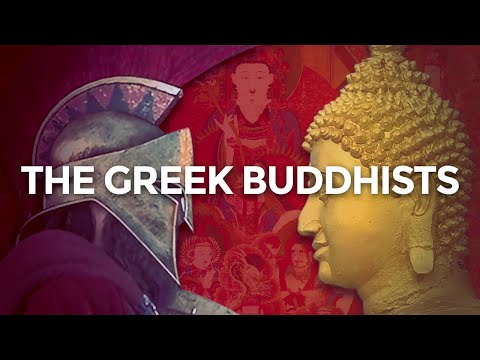
The Ancient Greeks Who Converted to Buddhism
What this covers
Get Nebula using my link for 40% off an annual subscription: https://go.nebula.tv/religionforbreakfast Watch Archaeology Quest here!: https://nebula.tv/videos/realscience-pottery?ref=religionforbreakfast
Join our Patreon community!: https://www.patreon.com/religionforbreakfast One-time donations here!: https://www.paypal.me/religionforbreakfast Sign-up for my mailing list to be notified of online classes: https://classes.religionforbreakfast.com/
Greece is very far away from the heartland of early Buddhism in India and parts of Afghanistan and Pakistan. But thanks to Alexander the Great, Hellenistic and Buddhist cultures came into contact in the 4th century BCE, creating a cultural synthesis known as Greco-Buddhism.
00:00 A Greco-Bactrian Buddhist Inscription 1:41 The Hellenistic "Far East" 4:10 Pyrrho: A Buddhist for Greece? 7:42 Ashoka and his Dharma Conquest 10:23 King Menander: The Most Famous Greek Buddhist 13:26 Greco-Buddhist Art of Gandhara 15:23 Syncretism? 16:44 Nebula! Indie creators being awesome
Thumbnail art by @hotcyder Select imagery/video supplied by Getty Images and Reuters
Source description (no synthesized summary yet).
Greco-Buddhism represents a complex process of cultural syncretism where Greek and Buddhist ideas, practices, and artistic traditions merged through deliberate adaptation and localization rather than simple blending of two monolithic cultures.
- Greek-speaking populations in Central Asia and the Mediterranean actively translated and reinterpreted Buddhist concepts using their own cultural frameworks
- The process was asymmetrical and selective—not all aspects of each culture were adopted, and individuals made deliberate choices about what to preserve or adapt
- Artistic, religious, and philosophical evidence shows mutual influence between Greco-Roman and Buddhist traditions across multiple centuries
This asset isn't compiled yet
You're seeing its claims, ranked. Compile it to build the argument threads, weight them, and check each claim against your library — the full view.
A Buddhist inscription in Greek letters from eastern Afghanistan demonstrates Greco-Buddhist cultural synthesis, with Sanskrit Buddhist devotional formula 'Namo Budd Namo Dham Namo Sang' transliterated into Greco-Bactrian script derived from the Greek alphabet
“this is an ancient Buddhist inscription etched on a rock in eastern Afghanistan it reads Namo obodo Namo oo Namo oo... this is a rough transliteration of Sanskrit into Greek well technically Greco Bactrian a helenistic script directly based on the Greek alphabet”
Ashoka's Greek translators deliberately chose the Greek word 'eusebeia' (piety/reverence toward gods/filial respect) to translate the Buddhist concept of 'Dharma,' representing active cultural adaptation where translators sought to render Buddhist ethics intelligible in Greek conceptual terms rather than creating a neologism
“the concept of Dharma was translated with the Greek word Yia Yia like Dharma is a semantically rich word that we could translate as piety reverence towards the gods or filial respect ashoka's Greek translators appar ly chose this as the best way to translate the Buddha's message”
Hellenistic Greek cities founded in Central Asia such as AI Khanoum (possibly Alexandria on the Oxus founded by Alexander's General Seleucus) featured markers of Greek culture including theaters, gymnasiums, Greek columns, temples dedicated to Greek gods Hermes and Hercules, Greek philosophical papyri, and inscriptions of maxims from the Oracle of Delphi
“some Scholars think the archaeological site I condum in Afghanistan was one of those alexandrias Alexandria on the oxis a city founded by Alexander's General ccas on the oxis river which runs through Central Asia now this identification is debated but whatever this city was originally called historians call icum an outpost of helenismo code it had all the essentials for sophisticated Greek living a theater gymnasium and Greek column everywhere and it wasn't just the architecture archaeologists have also found evidence of Greek religion and Greek philosophy here as well the gymnasium was dedicated to the God Hermes and the hero Hercules archaeologists have found a Papyrus fragment of Greek philosophy here and a local politician even inscribed a few maxims from the Oracle of Deli on his tomb”
Buddhist artwork from Gandhara (Northwest Pakistan and Northeastern Afghanistan) appears influenced by Greek artistic methods, with Buddha and bodhisattva figures depicted with realistic naturalistic features and Greek-style drapery, leading early 20th-century French scholar Alfred Foucher to argue only Greek artists could produce such masterpieces
“Buddhist sculptures like these portray the Buddha or the bodhisatta mraa with real to life features wearing a robe resembling drapery seen in Greek sculptures back in the early 20th century the French scholar Alfred fuche coined the phrase Greco Buddhism to refer to these sculptures saying all these technical details indicate in a striking manner the hand of an artist from some Greek Studio”
Trade between the Greek Mediterranean world and the region now encompassing Afghanistan, Pakistan, and Northwest India predates Alexander, with evidence including the Greek explorer Skylax's expedition for Persian ruler Darius I around the 500s BCE and Greek coins circulating in the region
“cultural exchange between the Greek Mediterranean world and what's now Afghanistan Pakistan and Northwest India stretches as far back as the 500s bcee the Greek historian Herodotus mentions a Greek Explorer named skyx who went on an expedition for the Persian ruler Darius I sailing down the indis across the Arabian Sea to the Suz and archaeologists have also found a bunch of Greek coins circulating in the region as well”
Pyrrhon developed a philosophy of radical agnosticism and suspension of judgment, denying that anything is honorable, dishonorable, just, or unjust, and holding that 'there is nothing really existent,' which represents radical disengagement from dualistic judgments that plague perception
“it was here that he met with the gymnos sists of India the so-called naked wise men and this led him to adopt a most noble philosophy now we don't know who these naked sages were presumably some sort of Indian athetic group and it's possible they were not even Buddhists but a lot of Scholars think they were and in any case Piro returned home to develop a pretty Buddhist sounding philosophy to finish that quote from diogenes this led him to adopt a most noble philosophy taking the form of agnosticism and suspension of judgment he denied that anything was honorable or dishonorable just or unjust and so universally he held that there is nothing really existent in other words P was suggesting a radical disengagement from the judgments and dualities that plague our perceptions”
Emperor Ashoka of the Mauryan Dynasty (c. 268-232 BCE) governed almost the entire Indian subcontinent and experienced a dramatic conversion to Buddhism, reportedly becoming remorseful for having ordered deaths of tens of thousands in his conquests, leading him to shift toward sponsoring Buddhist missionary efforts across his kingdom and abroad
“Emperor Ashoka of the Moran Dynasty who governed almost the entire Indian subcontinent from around 268 to 232 BCE like many Larger than Life historical figures later generations crafted all sorts of fantastic legends about him and for the longest time that's really all we knew about him as a historical figure until 1837 that's when the brahi script was deciphered and suddenly historians realized they had near direct access to Asoka himself by translating the edicts of Ashoka... Ashoka was less about the Conquering and more about the converting well at least initially Ashoka may have had a dramatic conversion experience himself and a few times in his edicts he references being overcome with remorse for having ordered the deaths of tens of thousands of people in his conquests one edict reads from that time onwards compassion and sadness overcame him and he was heavily distressed by the ways he had acted after turning to Buddhism he apparently sponsored missionary efforts across his kingdom and abroad even sending missionaries as far away as the Mediterranean”
Ashoka established a government position called 'Dharma Commissioners'—officials who traveled around major towns and cities helping to establish Buddhism, demonstrating institutional infrastructure for Buddhist missionary activity in Hellenistic regions
“Ashoka called his efforts a Dharma conquest and even references a special rank within his government called Dharma Commissioners presumably some sort of government official who traveled around helping to establish Buddhism in major towns and cities”
Menander's son Strato issued coins labeled 'dhaca' (follower of the Dharma), demonstrating that Buddhist religious identity became institutionally embedded in Indo-Greek royal succession and legitimacy
“menander's son stro issued coins like this one where he's labeled as dhaca follower of the Dharma”
The Seleucid Empire dominated Central Asia until ruler Diodotus I seceded to form the independent Greco-Bactrian Kingdom, which later invaded Southern Afghanistan, Pakistan, and Northwest India to establish the Indo-Greek Kingdoms with populations integrating Greeks, Indians, Persians, and Central Asians who adopted each other's names
“first you have the sald Empire which dominated the region until the ruler diodotus I decided to shake things up and secede forming his own independent Kingdom that historians call the Greco bactrians fast forward to the 2 Century bcee the Greco bactrians invaded what's now Southern Afghanistan Pakistan and Northwest India establishing dynasties that historians call the indog greek kingdoms these were kingdoms with diverse populations descendants of Greek speaking people from the Mediterranean integrating with Indians Persians and other Central Asian people groups Greeks were taking Indian names and Indians were taking Greek names”
The Shahbazgarhi reliquary, a stone container discovered in Northern Pakistan with an inscription mentioning Maharaja Menander and describing itself as holding bodily relics of the Buddha, suggests that Menander was more than a Buddhist admirer but likely a significant patron or possibly believer who may have commissioned stupas and reliquaries to gain public favor and moral authority
“check out the so-called Shin cat reliquary this was a Roundstone container discovered in Northern Pakistan and is said to have originally held a casket inside it with some ashes an inscription on the lid of the Box references the reign of Maharaja manra the great king Mander it goes on to describe that it holds the bodily relics of the Lord the shakya sage the Buddha himself now this inscription is not much to go off of and it doesn't definitively prove that menander was a practicing Buddhist himself but it does suggest he's more than just a fan and maybe even a patron of Buddhism menander may have commissioned reliquaries like this and endowed buildings called stupas to house them perhaps to gain public favor moral Authority or enhance his own legitimacy as a ruler”
Alexander the Great's conquests introduced Greek language, philosophy, and urban living to Central Asia, resulting in cultural exchange where Greek populations adopted Buddhist practices and ideas
“the king of Macedon who conquered a massive Empire stretching from Greece across Central Asia all the way to the indis river heniz the populations along the way introducing the Greek language Greek philosophy and Greek Urban living but the cultural exchange didn't just go one way”
Pyrrhon of Elis, a Greek philosopher who traveled with Alexander to India, spent months or possibly years in Northwest India and the city of Taxila in Pakistan where he met Indian ascetics described as 'gymnos sists' or 'naked wise men,' interaction that likely influenced his development of skeptical philosophy
“Piro traveled with Alexander to India as part of Alexander's Entourage and yes Alexander traveled with a bunch of philosophers while at War because who doesn't need some existential debate while on the battlefield... Piro himself spent months and possibly years in Northwest India as well as the city of taxila in Pakistan and according to the Greek biographer diogenes larus it was here that he met with the gymnos sists of India the so-called naked wise men and this led him to adopt a most noble philosophy”
The connection between Pyrrhon's philosophy and early Buddhist thought, while not definitively proven, is supported by too many correspondences (metaphysics, epistemology, logic, soteriology) to be coincidence, though critics note the Madhyamaka School emerged centuries after Pyrrhon
“these connections LED n himself to call Piro a Buddhist for Greece now to be clear this connection has has not been definitively proven and critics of the theory have pointed out that the mamica school emerged a few hundred years after Piro but many scholars think that there are too many connections with early Buddhist philosophy to be a coincidence”
Both Pyrrhonist and Madhyamaka Buddhist texts describe the ultimate goal of their philosophical practice as attaining ataraxia (Pyrrhonism) or a state of serene tranquility comparable to Buddhist Awakening, where freedom from rigid beliefs and acknowledgment of uncertainty in all truth claims allows one to remain undisturbed by the world's variability
“paronian texts also say that the ultimate goal of this suspension of judgment is to attain aoia a state of serene Tranquility which some have compared to the Buddhist concept of Awakening by not adhering to rigid beliefs and acknowledging the uncertainty and contradictions and all truth claims one can remain undisturbed by the world's variability”
Modern historians have rejected Foucher's assumption that only Greek artists could produce sophisticated Buddhist sculptures, recognizing that local artists were certainly capable of creating such works, leaving the question of authorship (Greek vs. local vs. hybrid) contested and not definitively resolvable from available evidence
“basically fuche was arguing that only Greeks could produce such masterpieces this of course is not true local artists definitely could make these and so historians have since debated how to characterize this art the historian Olga kubaka argues that we can't exclude the idea that Greek artists manufactured them but we also can't assess their role accurately”
The bodhisattva Vajrapani is frequently depicted as a Hercules-like figure in Kushan art, with Vajrapani recognized as a protector and companion of the Buddha; artists apparently drew on the attributes of Hercules as a powerful hero to communicate Vajrapani's own qualities as a guardian.
“the bodhisatwa vajrapani for example is frequently depicted as a Hercules like figure vajrapani is recognized as a protector and companion of the Buddha and these artists apparently were familiar with Hercules as a powerful hero and used these attributes to communicate vran's own qualities as a guardian”
Both Madhyamaka Buddhist thought and Pyrrhonism employed the tetralemma as a logical tool for evaluating truth claims, a four-part logical structure where a proposition can be true, not true, both true and not true, or neither true nor not true—an epistemological method particularly popular in Indian philosophy
“moreover both manam and paronian thought employed The Logical tool known as the tetralemma when evaluating a truth claim it's called a tetralemma instead of a dilemma because it has four parts proposition can be true not true both true and not true or neither true nor not true the tetralemma is very popular in Indian philosophy so its appearance in piro's philosophy is notable”
In his edicts, Ashoka name-drops Hellenistic kings like Antiochus II of Syria and Ptolemy II of Egypt, and states that if he is not exaggerating, Buddhist missionaries were mingling with Egyptians and Greeks by the 3rd century BCE.
“and he goes on to Nam drop helenistic Kings like Antiochus II of Syria and tmy II of Egypt if he's not exaggerating this means that Buddhist missionaries were mingling with Egyptians and Greeks by the 3rd Century bcee”
Roman historian Plutarch writes that Menander I died in a military camp with his ashes distributed among several cities and stored in 'memorials,' which scholars interpret as stupas, suggesting Menander may have achieved exalted Buddhist status as an awakened being whose relics were venerated by Buddhist subjects
“Plutarch writes that mander the first died in a military camp and his ashes were equally distributed among several cities and stored in what he calls memorials which Scholars think is a reference to stupas if Plutarch is right this may lend credibility to the idea that menander the first had converted and may have even achieved an exalted status as an awakened being with his Buddhist subjects venerating his relics”
King Menander (likely Menander I, ruled 165-130 BCE) of the Indo-Greek Kingdom was the most famous Greek convert to Buddhism, featured in the Buddhist text 'Milinda Panha' (Milinda's Questions, possibly dating to 100 BCE) as a dialogue partner with Buddhist monk Nagasena where Menander plays skeptic and is ultimately convinced to convert
“Chief among them was King menander the most famous Greek who converted to Buddhism at least according to the historian Olga kubaka well It's Tricky CU it's possible that there were two King Manders King menander the first who ruled an indog Greek Kingdom from 165 to 130 bcee and a later King menander II who may have been his grandson but in any case a king menander is the main character in an early Buddhist text the Melinda panha or Melinda's questions this text possibly dates as far back as 10000 BCE and it's a philosophical dialogue between King Melinda identified usually as king menander the first and a Buddhist monk named Nagina in the text Mander plays the skeptic grilling nagasena with a bunch of questions about Buddhism but Nagina expertly answers each and every question and finally Mander decides to convert”
The Brahmi script was deciphered in 1837, allowing historians to access the Edicts of Ashoka directly through translation, which revealed Ashoka's own words including his reverence and faith in the Buddha, the Dharma, and the Sangha.
“until 1837 that's when the brahi script was deciphered and suddenly historians realized they had near direct access to Asoka himself by translating the edicts of Ashoka in one inscription he declares it is known to you how great is my reverence and faith in the Buddha the Dharma and the S”
Syncretism is often oversimplified as a Venn diagram of two distinct monolithic entities (Hellenistic culture and Buddhism) merging, but the actual historical process is better understood as complex, asymmetrical interaction where ideas, practices, and artistic expressions from different cultures combine and influence each other in non-uniform ways
“examples like this are often labeled as syncretism commonly understood as the blending or mixing of different religious Traditions but I think syncretism is often oversimplified the term itself implies two distinct monolithic entities helenistic culture on one side and Buddhism on the other side merging like a ven diagram but in real world scenarios ideas practices and artistic expressions from different cultures often combine and influence each other in complex and asymmetrical ways”
The Indo-Greek populations may have been particularly predisposed to religious syncretism because, as historian Yorgos Hulas argues, most Indo-Greeks were followers of several Hellenistic and foreign cults simultaneously, so adopting the hero-cult image of the Buddha would have been embraced without much difficulty alongside all the ritual practices of everyday Buddhism like reciting prayers, propitiating deities, and venerating relics.
“the historian yorgos hulas who I mentioned earlier has argued that indog Greek religious attitudes may have helped this syncretism he says for the most part the indog Greeks were followers of several helenistic and foreign Cults so adopting the hero cult image of the Buddha would have been embraced without much difficulty along with all the ritual practices that go along with everyday Buddhism reciting prayers propitiating deities venerating relics and so on”
Local goddesses like Ardoksho and Hariti are sometimes portrayed with attributes of the Greek goddess Tyche, such as holding a cornucopia or ship's rudder, demonstrating that Buddhist artists borrowed visual conventions from Greco-Roman imagery to represent local deities.
“likewise local goddesses like ardoo and hariti are sometimes portrayed with the attributes of the Greek goddess taii holding a big Cornucopia or a ship Rudder”
Some Gandharan Buddhist sculptures may date to a century or more after the Indo-Greek kingdoms fell, suggesting they likely stemmed from later interactions with the Roman Empire, with local artists imitating imported Roman art or Roman artists moving to Gandhara to create prestigious commissions for wealthy local patrons.
“others argue that these sculptures and others like them actually date to a century or or more after the indog Greek kingdoms fell so it's more likely that these Works stemmed from later interactions with the Roman Empire with local artists imitating imported Roman art or Roman artists moving to Gonda to create prestigious commissions for local wealthy connoisseurs”