What this covers
Check out the 10X Shift Workshop: https://openexo.com/10x-shift?video=df7hm1R-fLI
Get access to:
The Exponential Organizations Living Book and the AI Chat Interface: This means that all 1000 employees will be able to read the new book online and also leverage our AI to ensure that they are following ExO Principles in their day to day work. They can leverage the AI in a number of daily tasks from writing emails to putting together marketing materials or new strategic initiatives. This alone if used well is well worth the monthly subscription
ExO Foundations and other learning material: The members will get access to our ExO Foundations Certification as well as other learning material to give them a good understanding of the Exponential Organizations Model.
Access to a wealth of resources and knowledge: Your team will gain access to a vast library of resources, including case studies, best practices, and toolkits. These resources can provide valuable insights and guidance on how to implement exponential strategies and drive growth in your organization.
Networking opportunities: Being a Premium ExO Pass Holder will allow your team to join a growing community of exponential thinkers and doers. This community provides a platform for networking, collaboration, and knowledge sharing. By connecting with like-minded individuals and organizations, they can expand their network, learn from others’ experiences, and potentially form partnerships that can accelerate your growth.
Bi Weekly Masterclasses: Your team will be able to join the ExO Masterclasses that take place every two weeks to learn from ExO practitioners thus giving your teams an edge.
Access the ExO Marketplace: Your team will have access to the ExO Marketplace and thus have the ability to find and work with Exponential and Technology leaders to drive Exponential Growth within Emaar.
ExO Feeds: Your team will be able to access Technology and Exponential Organizations content that will inspire them in their thinking to drive 10x growth and impact within your organization.
Transformative future: By becoming Premium ExO Pass Holders, your team are joining a community of individuals and organizations that are committed to transforming the world for a better future. By leveraging the principles and strategies outlined in the book, they can drive exponential growth and impact in your organization, and contribute to solving some of the world’s most pressing challenges.
A Playbook for the Future. The only proven formula to 10x your business
Start your Exponential Journey. Read Exponential Organizations 2.0, Leverage our AI Chatbot, connect with global community and so much more: https://link.exos.to/2
Take a look at this post where Salim gives a shoutout to all the book contributors: https://www.linkedin.com/feed/update/urn:li:activity:7065309557299781633/
Connect with our Global Community. Read Exponential Organizations 2.0, Leverage AI-X, our AI Chatbot and so much more: https://link.exos.to/2
#ExponentialOrganizations #ExO2 #PeterDiamandis #SalimIsmail #LivestreamLaunch #10xGrowth #EcosystemThinking #Innovation #Disruption #NewEconomy #BusinessTransformation #GlobalImpact #OpenExO.
00:00 - 04:15 Introduction 04:16 - 07:29 What is an ExO? 07:30 - 17:20 Linear to Exponential 17:21 - 23:32 Death to the Linear Organization 23:33 - 31:29 Diving Deeper into Exponential Organizations 31:30 - 41:50 Massive Transformative Purpose 41:51 - 44:10 Staff on Demand 44:11 - 48:55 Community and Crowd 48:56 - 54:00 Algorithms and AI 54:01 - 55:58 Leveraged Assets 55:59 - 1:01:08 Engagement 1:01:09 - 1:02:35 Bonus: Future of Brands 1:03:36 - 1:12:42 Q&A 1:12:43 - 1:16:02 Interfaces 1:16:02 - 1:17:45 Dashboards 1:17:46 - 1:22:56 Experimentation 1:22:57 - 1:25:08 Autonomy 1:25:09 - 1:30:23 Social Technologies 1:30:24 - 1:41:42 Q&A 1:41:43 - 1:47:45 OpenExO Community Members Share 1:41:44 - 1:50:52 Parenting in Exponential Times 1:50:53 - 1:55:17 Implications of ExO's 1:55:18 - 2:03:10 Mindsets 2:03:11 - 2:36:40 Building an Exponential Organization 2:36:41 - 3:11:43 Q&A
Source description (no synthesized summary yet).
Exponential organizations—agile, purpose-driven entities leveraging accelerating technologies and distributed networks—outperform linear legacy firms by 40x on shareholder returns and represent the only viable organizational model for a world of exponential technological change; the 12-step playbook shows how founders, intrapreneurs, and legacy enterprises can build or transform into exos.
- Fortune 100 data: top 10 most exo-friendly firms outperformed bottom 10 by 40x CAGR over 7 years, 6x on profitability, 3x on revenue growth
- Exponential technologies (AI, sensors, biotech, 3D printing) are democratizing—dropping to near-zero cost—enabling small teams to disrupt legacy industries from anywhere
- The 12-step exo playbook—MTP, community, team, business model, MVP, validation, scale attributes, culture, retesting—is reproducible and crowdable across startups and large organizations
This asset isn't compiled yet
You're seeing its claims, ranked. Compile it to build the argument threads, weight them, and check each claim against your library — the full view.
AI is exploding now (67 years after Dartmouth 1956) due to four converging factors: (1) computational power (Moore's Law sustaining), (2) structured data (doubling year-on-year, training LLMs), (3) algorithmic efficiency (training cost down 99.5% in 5 years), and (4) massive capital investment (accelerating, not slowing).
“The idea of AI began at a conference in 1956 at at Dartmouth, 67 years ago. So why now? Well, there are four reasons. It's important for you to to know them because they're going to give you a path of where things are going. The first reason is computational power. Here we see 50 plus years of Moore's law uh not slowing down. The death of Moore's law has been predicted so many times. But in the last five years, we've had a tipping point in enough computational power to run these neural networks, these deep learning networks. The second reason is the amount of structured data out there. Um, these large language models are being trained on all the data that we've produced and we're doubling the amount of data year on year. It's every tweet, every Facebook post, everything online. And that data is allowing these large language models to learn and anticipate what is next, right? They're learning from us. Third, really important is that the algorithms are becoming much more much more efficient. Over the last five years, the price of training an AI algorithm has gone down 99.5%. And the fourth reason, no surprise, is the massive amount of capital going in.”
Kevin Kelly's 'Better Than Free' framework identifies 8 ways to add value to digitized/dematerialized information: immediacy, personalization, interpretation, authenticity, accessibility, embodiment, patronage, and findability; these are the business models of the digital age.
“If you have an information-based industry, you're using one or more of these. And we think what Kevin's identified here are the business models of a digital world. And we think more and more 21st century business models will focus on this aspect of this.”
In 30 exponential steps (doublings), you travel 1 billion meters or approximately 26 times around the planet, whereas 30 linear steps take you only 30 meters from your starting point; this illustrates the fundamental disconnect between human linear intuition and exponential technological reality that entrepreneurs must understand.
“But in 30 exponential steps, where an exponential is a simple doubling, 1 2 4 8 16 32. In 30 doublings, you're not across the street. You've gone a billion meters away. Put differently, you've gone 26 times around the planet.”
Your mindset is pervasive throughout your organization; if you're in fear and scarcity, so are your employees; CEO mindset becomes organizational mindset through structures (posters, conversations, hiring filters)—leaders must actively guard and guide their mindset every moment.
“And by the way, as a CEO, as a leader, your mindset becomes the pervasive mindset inside your organization. If you're in fear and scarcity, so are your employees, right? uh you need to lead by example and the mindset and build the structures. I don't care if it's the posters on the walls, the mugs, the conversations, the filter by which you employ people.”
Social technologies—an internal IDEAS attribute—are peer-to-peer collaborative tools (Discord, Slack, Asana, Zoom) that enable distributed teams to coordinate without hierarchy; peer-to-peer collaboration is more effective than top-down command-and-control.
“Social technologies is the peer-to-peer collaborative technologies that allow you to communicate and collaborate peer-to-peer. We have really good evidence today that peer-to-peer uh working is much more valuable to traditional top down command and control.”
WeWork's failure to track adequate dashboards meant leaders didn't realize the company was losing money on every location opened; they scaled losses before achieving unit economics (product-market fit), illustrating why dashboards are critical before scaling.
“Let me take a negative example of Weiwork. Okay, WeiiWiWork didn't have adequate dashboards and didn't realize they were losing money every time they opened an office and when what they did was they scaled the company before and lost money on every transaction. So they scaled their losses.”
Kodak's failure to capitalize on the digital camera invention despite inventing it internally (1976, by Steven Cassan) and viewing digital as a disruptive threat to its core paper-and-chemicals business demonstrates how the organizational immune system prevents legacy firms from disrupting themselves, even when positioned to do so.
“a guy named Steven Cassan in Kodak Labs had invented the digital camera and he takes it into the board of Kodak and goes here's the future of Kodak and they said it's a toy for kids. It takes 01 megapixel images and besides it's in black and white and we're in the paper and chemicals business, our profit center.”
Moore's Law has sustained for 50 years, producing a 28-billionfold increase in the number of transistors per silicon integrated circuit from the first Intel circuit (1958) to today, and is expected to continue through 3D computing, photonics, and quantum computing paradigms.
“Well, it's continued for 50 years. And today we're seeing literally integrated circuits that have a 28 billionfold increase over the last 47 years.”
In the same year Kodak filed for bankruptcy (2012), Instagram—a startup with 13 employees acquired by Facebook for $1 billion—was undervalued by the market; Instagram's valuation subsequently exceeded $100 billion, illustrating the speed and magnitude of exponential organizational disruption.
“In the same year that Kodak goes bankrupt, another company called Instagram gets acquired by Facebook for a billion dollars, but they've got 13 employees. And people laughed at that acquisition. Well, they're not laughing now, right? Where the valuation of Instagram has been and above hundred billion dollars.”
TED transformed from a 1,000-person conference into a global media brand reaching millions by establishing a massive transformative purpose ('ideas worth spreading'), publishing talks on YouTube for free, and enabling the community to create TEDx events globally, all at near-zero cost.
“TED was just a nice conference. A thousand people here are going to Mterrey. Chris Anderson takes it over. He does three things. Establishes a huge purpose ideas worth spreading. Then he allows uh puts all the TED talks on YouTube leveraging rich media, right? Then he allows anybody in the TED community to go create a TEDx event and in a few years he's created a global media brand at a cost of near near zero.”
Example MTPs include: Google's 'Organize the world's information and make it universally accessible and useful', SpaceX's 'Revolutionize space technology with the ultimate goal of enabling people to live on other planets', X-Prize's 'Incentivize and accelerate radical breakthroughs towards an equitable and abundant future for humanity', and Peter's 'Inspire and guide entrepreneurs to create a hopeful and abundant future for humanity'.
“You know, organize the world's information and make it universally accessible and useful. That one is Google. Google's. Yes. uh to revolutionize space technology with the ultimate goal of enabling people to live on other planets. That's SpaceX. To incentivize and accelerate radical breakthroughs towards an equitable and abundant future for humanity, that is the X-P prize.”
Staff on demand—using independent contractors, gig platforms (TaskRabbit, Fiverr, Amazon Mechanical Turk), and contractor management services (MBO Partners)—enables exos to scale with minimal fixed headcount and reduce labor cost while building organizational flexibility and resilience.
“the first of these is staff on demand the poster child of this is Uber right as much as possible don't hire your own employees you have to manage people etc., etc. Hire independent contractors or there are platforms that allow you to do this.”
Leverage and shared assets—the third SCALE attribute—includes sharing economy (Getaround, Turo), outsourcing, leveraging open data, fractional IP and real estate ownership, and becoming a platform; Waze's use of smartphone GPS data (instead of buying proprietary sensor networks like Nokia's NavTech) exemplifies scalable asset leverage.
“The sharing economy sits inside this category, right? Um outsourcing uh leveraging cars like Getaround or Turo does or rent the runway. Uh opening up data sets, making those available. Fractional ownership of both IP and real estate are both aspects of leveraging other people's assets. So either you should be leveraging another asset or if you have one, make it available for others to leverage which makes you a platform.”
Dashboards—internal SCALE attributes—track two elements: external real-time engagement metrics (free/paid users, churn, MRR) and internal OKRs (objectives and key results); Google makes OKRs fully transparent, allowing employees to see others' performance and assess collaboration opportunities.
“because if you're building an exo and things are going wrong or things are going right, you want to know as fast as possible. There are two pieces and two sides of dashboards. One is the external dashboards which is the uh real time engagement metrics that your organization is tracking and on the inside OKRs or what stands for objectives and key results. Okay. So if I go uh up a level, almost every Silicon Valley company uses OKRs uh to manage the control framework, performance management, team and individual performance. Google has taken it to an extra step by making their OKR system completely transparent.”
Experimentation—an internal IDEAS attribute—is a culture where data-driven, founder-led teams run constant experiments; Amazon's Jeff Bezos says 'Our success is a function of the number of experiments we run per day, per week, per year', building organizational learning and adaptation into the company's DNA.
“uh there are two principal elements in experimentation and to a large degree, this is a culture that you need to build into your company from the beginning. Uh, the most successful companies are datadriven, founder-led experimental companies, companies that it's they're second nature to run experiments constantly. Um, part of this is lean startup thinking and the other is creating a culture of risk.”
Eric Yuan wanted to experiment with WebEx features while at Cisco; Cisco wouldn't permit it, so he left, built Zoom independently, and became the world's dominant video conferencing platform—a case of organizational immune system preventing innovation that external entrepreneurs captured.
“uh let's take the example of Eric Yuan who was building WebEx for Cisco. He wanted to try a bunch of things with WebEx and Cisco wouldn't let him. So he went outside, built Zoom and boom, we have the world's most popular uh video interface.”
IBM in the 1990s surveyed Fortune 500 CIOs: 95% said they don't use open-source software; when asked system admins doing the actual work: 94% said they do; IBM recognized admins held real decision-making power and made a massive strategic bet on open-source, validating that peer-to-peer distributed work is more effective than top-down mandates.
“I'll give you this great example is IBM in the '9s uh was trying to figure out how important was social was open- source software. So they went to all the CIOS of the Fortune 500 and said how many of you are using open-source software in your technology stack and 95% of the CIO says no no no we don't use open source we use Oracle we use Microsoft centralized we need control etc so IBM was like huh so they went to the CIS admins that were running the technology stack themselves said how many of you use open open source 94% said yes they are so IBM went okay who's more in control the CIS admins who are doing the work so they made a massive bet on open source which worked”
The Lean Startup Business Model Canvas (by Alex Osterwalder) and the Exo Canvas (developed by the exo community, available at exocanvas.com) help fill out ideas before building anything; they tease out mistakes early and avoid sunk costs in unvalidated directions.
“You have a fill out a lean startup business model canvas coming from um a Alex Austerwald uh or the exo canvas which was developed by our community. You can find it at exocanvas.com. If you fill those two out basically it talks you through how to think about partners, channels, customers, vendors, value proposition etc etc.”
Amazon Web Services (AWS) was not on any roadmap, originated as an experiment, survived despite institutional resistance, and now generates ~75% of Amazon's operating profit; this exemplifies how internal autonomy and low-friction experimentation can unlock massive value.
“One of the results of this policy was actually Amazon Web Services. Nothing to do with their core strategy, not on any roadmap. Nobody could figure out how to say no to it. And now it's one of the most successful products of all time and delivers 75% of Amazon's project profits globally.”
SpaceX reduced launch costs from ~$1 billion (Space Shuttle) to ~$60 million per launch (10x improvement), with further 100x reductions possible via Starship (targeting ~$1 million per launch); relativity space's 3D-printed rockets (90% 3D-printed) exemplify rapid manufacturing innovation.
“When NASA was doing space shuttle launches, it cost about $600 million per launch, right? Actually, it was a $4 billion budget of people infrastructure, 20,000 individuals. And if they launched zero shuttles, it was infinite per launch. If they launched one shuttle, it was 4 billion to launch. Two shuttles, two billion to launch. Four shuttles a year. The average was like three or four a year. It was a billion dollars a launch. Okay, so that's the average. SpaceX of a space cadet. You are. So SpaceX comes up with their total paradigm shift and drops it by 10x to about $60 million a launch.”
The amygdala scans for danger and is 10x more sensitive to bad news than good news (evolutionary survival mechanism); when encountering new technologies (autonomous cars, AI, drones), the amygdala triggers fear and risk aversion ('ban it until we understand'); evidence-based policy should override this bias.
“The most insightful thing that you and and Steven put in abundance was the fact that we have an amygdala. Okay. And that amigdala is there for scanning for danger. So when we were running around on the plains of Africa, if you heard a noise in in the bushes, you ran. Why? Because bad news can kill you. Good news doesn't kill you. So if I miss some good news, I might miss some fruit that I could eat. If I miss some bad news, I died. So we're 10 times more likely to pay attention to bad news than good news because of the danger factor.”
Kickstarter as a platform for founders to validate demand without building the product; Eric Mikojawski (Pebblewatch) was rejected by VCs but raised $10M on Kickstarter for a $100k ask, proving demand; this rendered traditional VC gatekeeping partially obsolete.
“Kickstarter, right? Hopefully you've all heard of Kickstarter, played with Kickstarter. Uh, you know, it was thought of as a platform for young companies to try their product out, get commitments early on. What we're seeing is large corporations actually trying things on Kickstarter as well to get early information about who wants what color, who wants what different product elements. My my fellow Waterlou grad, Eric Mijikovski, Mikovski, right? Pebblewatch. Pebblewatch wanted to he went to this is a great little story. He came out of Y Combinator, right? best incubator in the world with the best network in the world trying to raise $100,000 to to build a prototype of his running watch. All the investors said no because Silicon Valley is very biased against hardware at the time. So now he's got three weeks of cash left, right? He's like about to run out of money. So he puts up a a project on Kickstarter desperately saying, 'Can I raise $100,000? Can I pre-sell my watch?' Raises $10 million on Kickstarter.”
GitHub: a platform where developers share code, rate code quality, and build reputations; had no traditional assets/IP/workforce but was valued at $7.5B by Microsoft who wanted the community; salary for software developers correlates 100% to GitHub rating, zero correlation to university/degree/GPA.
“The highest rated exo that we ever saw because we scored them all on the that model is GitHub, right? GitHub was a is a platform where developers can share uh code and watch each other and and kind of and I can rate your code, you can rate my code. So they've created and they put in all the elements gamification uh algorithms staff on demand etc. Now they were eight and a half years old and Microsoft bought them for 7.5 billion right talking to the accounting partner that was managing the acquisition for Microsoft and he was freaking out. He's like, I don't know what to put on the balance sheet. Uh, this has company has no assets, no intellectual property, and basically no workforce. Like, what are we buying? So, he's literally trying to kill the deal because he can't figure out how to put any value against it in the Amazon in the Microsoft accounting systems. And finally, Satya Nadella says, 'Just buy the damn thing. I want the community.'”
Access to parenting knowledge and resources has expanded 100x since previous generations (books, communities, experts, online support); today's children benefit from vastly superior parenting science compared to 20-30 years ago.
“the amount of available information to do parenting properly today is 100x what we had two generations ago. Right? So this is why the kids today are so unbelievable. They're going over just much better parenting. gone from a scarcity to an exponential uh point.”
Human brains evolved in the savanna of Africa hundreds of thousands of years ago where everything that affected you was within a day's walk, nothing changed generation to generation, making our minds linear and local, while we now live in a world that is global and exponential where things change hour to hour.
“our brains, the 100 billion neurons, the 100red trillion synaptic connections, they evolved in a very different world. They evolved in a savas of Africa hundreds of thousands of years ago where everything that affected you was within a day's walk and nothing changed generation to generation, you know, literally millennium to millennium. And our brains evolve for that world. And our minds are local and linear. But we're living in a world that is global and exponential. Things are not changing daytoday. They're changing hour to hour.”
Traditional linear organizations are derived from military context with top-down hierarchical command-and-control structures, good for scarcity and short-term aggressive goals in stable markets, push innovation from inside outward, are risk-intolerant and slow, with KPIs and performance reviews designed to mistrust employees, reflecting organizational design from the industrial revolution to today.
“our organizations globally government departments corporations etc are typically derived from a military context top down hierarchical command and control uh really good for scarcity really good for short-term aggressive things finding a market that doesn't change very much and then doing uh uh products and services in that marketplace. Innovation almost always comes from inside and then you push it out. These organizations tend to be risk intolerant and very slow and the whole org structure KPIs performance reviews are designed to mistrust the employees.”
David Rose, the 'godfather of angel investing,' stated: 'Any company designed for success in the 20th century is doomed to failure in the 21st'—a reflection of the structural mismatch between 20th-century organizational design and 21st-century exponential environments.
“David Rose who's the godfather of angel investing uh kind of said this summarized this well. He said any company designed for success in the 20th century is doomed to failure in the 21st.”
Google received 340 investor rejections before securing funding, meaning if founders had stopped 10 pitches earlier, a trillion-dollar company would never have existed, illustrating that resilience and persistence through repeated failure is essential for exponential entrepreneurs.
“for some of the big products out there how many times did they have to do an investment pitch before they got funded...for Google it was 340 investor pitches. So, Larry and Sergey got told, 'No, we will not invest in you 340 times because there's a dozen search engines out there already until what if they'd stopped at 3:30, right?”
Interfaces (APIs)—an internal SCALE attribute—automate interactions between organizations and customers/stakeholders, enabling platform scaling; YouTube's user interface for uploading and monetizing video content, Uber's driver-passenger interface, Apple's App Store, ChatGPT as a UI moment for LLMs exemplify how interfaces unlock exponential growth.
“So interfaces you can think of them as APIs as well. If you're a rapidly growing organization and you're bringing on customers, you're bringing on community, there's no way that humans enable you to scale at the rate of thousands, tens of thousands, millions. You need to automate that really. And that is your interface. Those are your APIs. These allow you to scale uh your organization. They also allow you to turn your organization into a platform, right?”
The idea is less important than execution; a shared MTP, customer feedback, and iterative testing matter more than IP protection; if you're dependent on IP to compete, you'll lose to better executors; Elon and first-principles thinkers succeed by constantly improving execution, not by guarding secrets.
“uh an idea is the easy part. Uh, I remember uh a conversation with Elon who said when you look at the relative value of the idea to implementation, the value of the idea rounds to zero. It's all about implementation, manufacturability, uh, and implementation.”
If a piece of paper 0.135 millimeters thick is folded 50 times, the resulting thickness would extend from Earth to the sun (93 million miles); by contrast, folding 13 times yields approximately 1 meter, and 38 folds reaches around the planet.
“If you doubled it 20 times, uh, how far is it? Well, it's about a football field. Wow. US, European, doesn't matter. Roughly the same. Uh, 38fold and you have gone around the planet. And 50fold the original question it's from here to the sun 93 million miles”
Steve Blank formulated: 'No business plan survives contact with the first customer'; this validates the MVP-first, plan-second approach and the need for data-driven iteration over strategic prediction.
“As as Steve Blank said, no business plan survives contact with the first customer, right?”
An MVP (minimum viable product) with the fewest features possible gets to market to get customer feedback; building full-featured products before launch leads to misdirection; Katarina Fake (Flickr founder) advised building only the 2 most critical features out of 20 to accelerate feedback loops.
“I remember when I was running brick house inc Yahoo's incubator we had Katarina fake uh the founder of flicker come in and talk to the engineers and she said talked to a team and they go she goes what's so great about your product and they go we have 20 features in this product it's going to be beautiful etc and she said all right build the two that you think are going to identify the two features out of the 20 that you think are going to make it work and make it succeed launch those two and then get a feedback loop going.”
Reed Hoffman says: 'If you're not embarrassed by your product when you launch it, you've waited too long'; waiting for perfection ensures you'll miss the market and build wrong features.
“I remember Reed Hoffman saying it a different way. If you're not embarrassed by your product when you launch it, you've waited too long.”
Product-market fit is achieved when customers are paying for a product AND expressing genuine excitement/satisfaction; without both elements, the organization should return to MVP iteration or explore a new breakthrough idea.
“So now you have at this point you should have what's called product market fit which is you have a product that people are paying for and with feedback from customers that they're excited about your product. If you don't have both those things you don't have product market fit. Go back to MVP or go back another step or figure another breakthrough idea.”
Solar energy has been doubling every 22 months for 40 years; at this pace, the world's energy needs will be met in 4 more doublings (~8 years); 50% of new electricity on the US grid in 2023 is from solar; lithium-ion battery costs have dropped 90% in 10 years.
“solar energy is on a doubling pattern. It's doubling every 22 months. Okay. And by the way it's been doing this for 40 years. So at this pace, we will be able to deliver the entire world's energy needs in four doublings. We're like eight years away. Yeah. 50% of the US solar new energy is uh I'm sorry, 50% of all electric new energy on the grid this year in 2023 is from solar. Um lithium ion batteries have dropped 90% in cost over the last 10 years.”
Vertical farming yields 5 times the output of traditional horizontal farming; 35 skyscrapers in Manhattan converted to vertical farms could feed the entire city sustainably; the Netherlands, a country the size of a city, is the world's second-largest food exporter due to technology-enabled agriculture.
“vertical farms deliver five times the yield of traditional farming. The best calculation we have seen is if you took 35 skyscrapers in Manhattan, turned them into vertical farms and ran that just that would feed the entire city sustainably. So you don't need millions of square kilometers. I just want to make one more crazy point but then I'm going to continue. Go ahead. The five uh most uh prolific food producing countries in the world are the ones you'd expect. US, Brazil, China, Russia, the biggest countries in the world, right? Because they have the most land. Guess what? The five most top food exporting countries in the world. Okay? So, the number one country in the world that exports food is the US. Number two is Holland, the Netherlands.”
Figma achieved a $20 billion market cap in 7 years by building a collaborative design platform using exo principles; Mercado Libre, a Latin American exo, is now the top stock market performer in Argentina, demonstrating that exos emerge across geographies and industries.
“we've talked about what you know, we've defined the exponential organization and look at like Figma, right? gone from 0 to$20 billion market cap in 7 years. Marcado Libre out of Argentina is now the number one stock market performer in Argentina.”
94% of new jobs in the US from 2005 to 2015 were in the gig economy, indicating a structural shift toward independent contracting; this trend will continue as platforms and services make contractor management frictionless.
“in the last from 2005 to 2015 94% of new jobs in the US were in the gig economy. Okay. So the overall economy is shifting to that.”
Vitalik Buterin, 18 years old and raised middle-class in Toronto, co-founded Ethereum with friends while ignoring professors; Ethereum is now a $300-400B ecosystem with ~8 founders; this proves that age, credentials, and geography are irrelevant to building world-changing exos.
“Take Vitalik Bhutan, 18-year-old kid, middle class kid growing up in Toronto. gets together with a few friends. They ignore their professors and boom, we have Ethereum, a three to400 billion dollar ecosystem with eight guys.”
Amazon Prime was initially proposed as a foolish idea but Jeff Bezos green-lit it as an experiment; it is now estimated at ~25% of Amazon's value (previously reported estimates suggested it could be worth $100B+ as a standalone company).
“You know when Amazon Prime was first proposed as an experiment uh it was considered a foolish idea. You know Bezos basically said try it and now it's you know what percentage of Amazon's uh Amazon Prime is a like I think it's 20 no it's 25% the killer one is Amazon um web services”
Tesla's drivetrain has 17 moving parts versus a combustion engine's 2,000, yielding orders-of-magnitude advantages in maintenance, design cost, and reliability; this exemplifies 10x performance improvement driving market disruption.
“A a combustion engine and car has about 2,000 moving parts in its drivetrain. The Tesla has 17, right? So, in terms of maintenance, design costs, reliability, it's just street lights ahead”
ATM machines were feared to eliminate bank tellers in the 1970s, but actually the cost of running a branch dropped 10x, banks created 10x more branches, and total bank teller employment remained flat, showing that automation doesn't eliminate jobs but transforms them and enables more business growth.
“when we created ATM machines in the 1970s, there was all this hand ringing. What will we do with millions of bank tellers? We'll have mass unemployment...Except what actually happened was the cost of running a branch dropped by 10 times. The banks created 10 times more branches and the number of bank tellers has not changed at all.”
Abundance mindset: instead of seeing a pie (fixed resources) that shrinks as more people arrive, abundance mindset knows you can bake more pies; 2/3 of Earth is water, 97.5% is salt, 2% ice, only 0.5% is fresh water—but there's no water scarcity, just technology scarcity; upcoming X-Prize for large-scale desalination will unlock abundance.
“with a scarcity mindset. If you have a pie and people are coming over for dinner and more people come over, you have to slice the pie into thinner and thinner slices. In an abundance mindset, you know, it's no, we're going to bake more pies, right? It's a perspective shift. We don't have water scarcity on the world. We live on a planet 2/3 covered by water. Yes, 97.5% is salt, 2% is ice. We fight over half a percent. But there's technologies coming. We're about to launch a 100 plus million dollar X- prize for large-scale desalination coming up. So technology is a is a resource liberating force, right? Technology enables you to liberate resources like solar, like fusion, like water.”
Technological socialism: Uber's algorithm matching drivers to passengers is hyper-efficient socialization of assets (sharing); crypto-enabled token economics allow socialism without centralization, avoiding corruption and inefficiency that plagued 20th-century government socialism.
“another one that we love is called technological socialism. Okay. Traditional centralized government socialism fails because you get inefficiencies and you get corruption. Invariably you get corruption. But when Uber is matching a driver to a passenger, an algorithm is running that matching. It's hyperefficient. Um it's kind of a socialist application. the sharing of assets amongst a large group of people. And now you can have the benefits of socialism of asset sharing amongst a large group of people without centralization and without a lot of government oversight needed.”
Trust beats control; scarcity mindset = abundance mindset minus trust; if teams are aligned on MTP and have autonomy, you can trust them to make good decisions; open systems outperform closed systems.
“trust beats control and open beats closed. Right. Uh Jerry Mcowsky, one of our community members, really framed this beautifully. He said uh scarcity equals abundance minus trust, right? So just think about that for like an hour. Um and if we can trust our people, if we're all aligned on an MTP, then you can basically let them do what they do and be an open environment, it's always going to be the closed environment.”
Coase's Law—which posited that large organizations exist because internal transaction costs are lower than external transaction costs—is now obsolete; today, external transaction costs (via platforms, gig networks, APIs) are lower than internal organizational costs, enabling exos to scale with minimal headcount.
“and with the rise of what we call the exponential organization operating at this speed, we declare Kosa's law obsolete. Okay? And this is a dangerous thing to say about a Nobel Prize winner, but basically the time when he formulated this law. Today, transaction costs are lower outside than inside.”
Cost of starting technology company has dropped 100x in 20 years: from ~$5M (servers, software, landlines, bandwidth) 20 years ago to ~$500 today; with generative AI, entrepreneurs are starting new AI-based EXOs with zero dollars using evening/weekend time because access to tools is effectively free, enabling zero-capital startups at scale.
“If you go back 20 years, uh if you were starting a tech company, uh it was on the order of $5 million for the servers, for the software, for the landlines, for the uh access to uh to bandwidth... That has dropped down uh orders of magnitude to the point where you can start the equivalent company today uh for 500 bucks. And what we're seeing in particular is with the generative AI world is that entrepreneurs are starting new generative AI based uh exos with zero dollars.”
A massive transformative purpose (MTP) is a decade-long, emotion-driven, authentic commitment to solving a fundamental problem; it acts as a magnet to attract community, align teams, provide focus, and differentiate an organization from competitors seeking incremental improvements.
“at the end of the day doing anything big and bold in the world is hard work right uh if you're trying to make a dent in the universe and you need to be driven with clarity and emotion so I want to talk about the attributes of an MTP and we're going to hear over and over again this is the first step for you in building your exponential organization or retooling your existing company you know an MTP it's massive uh it inspires you it inspires your team you're proud to be doing this”
Community and crowd is the second SCALE attribute; it consists of concentric rings: core team (founders, employees), community (customers, alumni, direct relationships), extended network (vendors, fans, partners), staff on demand, and the crowd (everyone else); community enables marketing, product development, training, and hiring with minimal cost.
“At the core uh is your core team right these will probably be your founders your employees your personal network around that core team is your customers and alumni you have a direct relationship right this is not the crowd this is part of your community you have a direct relationship with those individuals directly around the customers and alumni uh you've got your vendors your fans your partners one step removed but still a direct relationship ship with those individuals. Around them is staff on demand.”
Xiaomi, the second-largest phone manufacturer in China, operates with no PR, product development, or marketing costs by building a community of 1,000 super users who vote on features they want to see in new phones, receive early access, and promote via word-of-mouth, capturing market share through community leverage instead of traditional marketing.
“the Chinese company Xiaomi, which is the second largest phone company in China. Out of now place, I went and and met with the leadership team. They're extraordinary what they built. It's amazing. And how have they done it? They're they are the second largest. They do no PR, no product development, no marketing costs at all. They have a community of a thousand super users. And what they do is they say to those super users, you guys vote on what features you want to see in the new phone. And then those super users get to get the phone a few months early and can boast to their friends. Here's the new phone and look, I voted for this feature.”
Engagement—the fourth SCALE attribute—uses incentive prizes, gamification, and token economics to turn crowd into community and keep community sticky; Micro Strategies' Lightning Rewards gives employees Satoshis (crypto incentives) for desired behaviors (punctuality, training completion), directly monetizing desired actions.
“Engagement is about how do you engage the crowd to make it community and how do you engage your community to keep it sticky and together. So incentive prizes is a great way to turn crowd into community. We do this X-P prize all the time. We put out this challenge and those who who connect with that challenge with the MTP of that challenge join in form a team support a team and they go from the crowd to community. Gamification uh is how you make it sticky, right? U token economics is blowing this all up. One of my fraternity brothers um uh Michael Sailor who runs Micro Strategies just announced something called Micro Strategies Lightning Rewards. And what are they doing? Uh, everybody inside your company gets a wallet and they when your employee behaves well, meaning they show up on time to the meeting or they watched that particular training video or they went and did whatever, they get Satoshi's in their wallet.”
Octalysis, developed by Yukai Chou, maps 8 human motivations (empowerment, epic meaning, ownership, social influence, scarcity, unpredictability, avoidance, social inclusion) to 150+ game mechanics (leaderboards, progress bars, Easter eggs); this prescriptive model enables exos to embed human motivation directly into products and services.
“So um Yukai Chow who's a PhD in Burke out of um Berkeley in gamification put this framework together and if you see the slides um what he did was he identified eight major mo human motivations like um empowerment and epic meaning and ownership and then four four white hat positive ones and four negative ones fear of missing out unpredictability avoidance etc. And these are like a Maso's hierarchy almost of of major human motivations. Then he identified 150 plus game dynamics like leaderboards, progress bars, Easter eggs and map them to these motivations.”
The three most robotics-prolific countries (South Korea, Sweden, Germany) have the lowest unemployment rates in the world, showing that automation does not cause unemployment and that there is no causal link between robotics adoption and job loss.
“The three most robotics prolific countries where they use the most robotics automating the human manual worker are South Korea, Sweden and Germany. The lowest unemployment countries in the world are South Korea, Sweden, Germany. So automation does not take away jobs.”
Future of brands: MTP + Octalysis engagement model + NFT architecture backend, where NFT provides 'permanent cookie' that is programmable and allows direct brand-customer relationships routing around Web 2 gatekeepers (Facebook, Instagram, LinkedIn); 2015 Paul Pullman (Unilever CEO) ordered every brand to take on MTP; 4.5 years later, five most profitable Unilever brands were ones most adopting MTP model.
“the future of brands is going to be an MTP to give you purpose to that brand. Octalysis type engagement models to give you a prescriptive way of engaging with the customers and an NFT architecture at the back end. Why? because that gives you a permanent cookie that's programmable and you can route around all the web two, LinkedIn, Facebook, Instagram, gatekeepers and have direct relationship with your customers. So this is our view of the future of all brands going forward.”
Curiosity mindset (asking great questions, beginner's mind) is foundational; it drives creativity, adaptability, and agility; without curiosity, leaders become trapped by their own expertise and unable to pivot or evolve.
“I think mindsets, uh, I could add purpose-driven mindset to this list, which is your MTP. It should be, you know, step zero on here, but I think your mindset is the most important asset you have. So, we talk about a curiosity mindset. Really, it's about asking great questions. It's about driving creativity. It's about staying adaptable. It's about being able to pivot and evolve. The curiosity mindset that beginners's mind as See mentioned is fundamental uh to you. And if you're stuck reacting because of this is the way it used to be in fear and scarcity, you're stuck. You're not adaptable. You're not agile.”
Autonomy—an internal IDEAS attribute—is decentralized decision-making where the people closest to customers/problems make decisions; Valve Software (400 people, no CEO, no reporting lines, no job descriptions) operates like a beehive, generating more revenue per employee than Microsoft by enabling self-selection of work.
“Uh and it's about decentralizing decision-m and pushing it down to the edges of the company. Why? Because the people at the edge of your company have the closest contact with the end customer. Um Valve is a great example of this. Valve software is about 400 people. They have no CEO, no reporting lines, no job descriptions, no management meeting, no meetings of any kind. They literally operate like a beehive. So if there's a bug in the software platform, I grab three people, we go fix the bug, and we disband. Every employee thinks self- selects as to what they want to do. And it sounds kind of like a joke, but they get more revenue per employee than Microsoft for doing this.”
Building an exo on an exponential trend (e.g., drones doubling every 9 months) means the company grows along with the underlying technology; Bezos noticed the internet was growing 2,300% per year and built Amazon to ride that wave; exo founders should identify exponential trends and piggyback them.
“when you build a company on an exponential trend, say drones that are doubling every 9 months, that your company will grow along with the underlying technology, right? Um when uh Jeff Bezos was scanning around to start a company, he noticed the internet was going 2,300% a year. So he said, 'All right, I'm just going to sell books over the internet.' And the bookstore grew 2,300% a year along with that.”
The Six Ds of exponentials—digitize, dematerialize, demonetize, democratize—enable entrepreneurs to apply Moore's Law to any business or industry by converting physical/scarce goods into digitized, replicable, free or low-cost, globally accessible services.
“Your mission is to digitize any aspect of your business possible because when you begin digitizing something, you're able to dematerialize it, make it zeros and ones. And if that's the case, you can demonetize it because the cost of replicating those zeros and ones is effectively zero and democratize it because your ability to transmit it to the corners of the planet is effectively zero.”
Guazi, a Chinese used car sales platform, captured 80% of China's used car market in 7 years by using machine learning (audio analysis of engine sound to assess quality), real-time pricing, transparent margins, and elimination of middlemen, scaling from zero to 2 million cars per month.
“What they do is when somebody wants to sell a car, they show up, they gather 250 data points, audio, video. They take a an audio of the engine and they use machine learning to sense the purbation in the engine and they can tell if your engine is high quality or not. They come up with a real-time price in their engine of what that car is worth. In 7 years, they captured 80% of the used car market in China. Okay? They sell 2 million cars a month.”
At Yahoo, feature releases for Yahoo Personals took 8 months due to systems testing, integration, brand, security, and privacy testing; Facebook under Zuckerberg gave developers autonomy to deploy code directly to the live site with ownership of consequences, enabling weekly feature releases and allowing Facebook to outpace Yahoo and MySpace.
“When I was at Yahoo, I was the head of innovation running their incubator. When we tried to launch a new feature on on say Yahoo personals, it took about 8 months to get the feature live. You develop it, systems testing, integration testing, brand testing, security testing, privacy testing, etc. About eight months. MySpace was roughly similar. Zuckerberg is building uh Facebook and he said to his developers, if you think your code is ready, take it live on the live site. developers are like, 'Are you kidding? You actually trust us and you give us autonomy, but your your code better be right otherwise you're fired if you take down the live site.' So that they were rolling out a feature a week at Facebook.”
Lab Central rents wet lab space to biotech startups by-the-bench, eliminating capital barriers and regulatory approval timelines; this model demonstrates how shared infrastructure (like Fab Labs) enables entrepreneurs to launch high-capital-intensity startups with minimal upfront investment.
“So if you're a biotech startup uh you have so many requirements and it's so difficult to get all the approvals. So what uh a very enterprising entrepreneur did is he bought large lab uh facilities and he rented it out by the lab bench. So you could be an entrepreneur of one and have access to all of the equipment you possibly could want and get going.”
Failure tolerance is measured in four levels: (1) failure = career-limiting move (CLM), (2) we tolerate risk but don't really (lip service), (3) tolerance in innovation/sandbox areas only, (4) pervasive and measured; Amazon asks each team quarterly: How many experiments did you run? How many succeeded? How many failed? Insufficient experiments = trouble.
“Most big companies around the world have a really tough time with experimentation, right? Um one of the questions we ask in our survey of when we do a quantified score of a company is to what extent do you tolerate risk-taking and failure inside your organization? And level one is if you fail, you're done. And it's what we call a CLM, a career limiting move. Level two is we say we tolerate risk, but really we don't. Really, you're toast. So, but at least you say you do. Level three is you tolerate risk in innovation areas or sandbox areas but not in the mission critical aspects of the company. And level four is pervasive across the company and measured. So for example, Amazon for every team in in Amazon is asking how many experiments did you run this quarter? How many succeeded? How many failed? If you don't run enough experiments and not enough are failing, you're in trouble”
Small companies adapt to the exo model more naturally than large organizations because they lack immune system antibodies; small startups can jump to new exo models directly, while legacy firms (using 50 years of MBA thinking) must unlearn old paradigms; emerging markets are hungrier and more flexible than Western incumbents.
“So the smaller the better in a sense, and they actually adapt more naturally. Think about the biggest companies in the world today. Apple, Facebook, Microsoft, Google all started out as small startups adopted these characteristics over time and boom, they're the biggest companies in the world.”
The 12-step exo playbook: (1) Establish MTP, (2) Build/join communities, (3) Assemble team (CEO, product, builder, business model/finance), (4) Develop breakthrough idea, (5) Build lean startup and exo canvas, (6) Test and iterate idea with customers, (7) Validate MVP and marketing/sales, (8) Achieve product-market fit, (9) Implement SCALE and IDEAS attributes, (10) Establish culture, (11) Continuously retest assumptions, (12) Become a platform.
“we have a 12step program. Um, it had to be 12step. It had to be 12step. You want to hark back to kind of things that work. Oh, by the way, just to as a thing, could I go back to the full shot? So, we have behind us a wonderful rocket. I call this the spinal tap rocket.”
Amazon's 'Institutional Yes' policy: managers are not allowed to say 'no' to employee ideas; if they must decline, they write a 2-page public thesis explaining why; this creates friction to saying no and increases surface area for experimentation.
“They came up with a policy and it's called the Amazon institutional yes. So if you're inside Amazon and you come to me with an idea and I'm your manager, I'm not allowed to say no to your idea. My default answer has to be yes. And if I need to say if I want to say no, I have to write a two-page thesis as to why it's a bad idea and post it publicly on the internet. Right? So they've created friction and embarrassment to saying no.”
Nine major implications of the exo model from the first book; nine additional new implications added in second edition; together these 18 implications reshape how we think about organization, strategy, policy, and governance.
“In the first book we identified nine major implications uh like have we have a section death to the five-year plan. If you're creating a five-year plan by the time you've done your the plan is out of date or you're spending more time maintaining the plan than doing what you're supposed to be doing. Rent don't own. We've heard that. Uh one of my favorites is trust beats control and open beats closed. Right. Uh Jerry Mcowsky, one of our community members, really framed this beautifully. He said uh scarcity equals abundance minus trust, right? So just think about that for like an hour. Um and if we can trust our people, if we're all aligned on an MTP, then you can basically let them do what they do and be an open environment, it's always going to be the closed environment. So those are the first. Let me pick one more on this list here, which is number nine here, which is everything is measurable and anything is knowable.”
Jeff Kowalski, CTO of Autodesk, described large organizations as having a 'big immune system problem'—when you try anything disruptive in a legacy organization, the antibodies attack you and you get rationales for why things cannot change, with Riaz Shave from Ernst Young compiling 50 such reasons including 'it just can't be done,' 'we don't have the money,' 'nobody else has ever done it before,' 'we've tried this 60 times,' 'beyond my responsibility,' and 'the competition won't enjoy this.'
“Jeff Kowalsski first told me. He was the CTO of Autodesk. He goes, 'Oh, you were Yahoo. You had a big immune system problem.' When you try anything disruptive in a legacy organization, the antibodies attack you and you get one of these rationes for why things cannot change. Peter, you I love these, right? you know, 50 reasons. Some of my favorites go, it just can't be done. Yeah. Or we don't have the money. Nobody else has ever done it before. We We've tried this 60 times.”
The concept of 'Question, don't defend' from aerospace designer Bert Rutan means organizations should encourage questions at any time rather than having people defend fixed positions, creating a learning culture where intellectual honesty beats ego protection.
“Bert Rutan who is the famed aerospace designer engineer at scaled composits...has a quote I love. He says, 'Question don't defend.' Yeah. If you're building, it's a part of a cultural attribute. If you build a culture which asks, you know, which allows questions to be asked at any time, say defending yourself. As soon as you start defending your position, you're backed into a corner”
The top 10 most exponential and agile organizations in the Fortune 100, measured over a seven-year period, outperformed the bottom 10 least agile on shareholder returns (CAGR) by 40 times, on return on equity by 11 times, on profitability by 6 times, and on revenue growth by 3 times.
“over seven years, the top 10 outperformed the bottom 10 by almost three times on revenue growth, right? Six times on higher on profitability, 11 times higher on return on equity. But the killer number was shareholder returns, what they call kagger, compound annual growth rate. The top 10 in the Fortune 100 most exofriendly outperformed the bottom 10 least exoply over seven years by 40 times.”
When the pandemic hit, Marriott with 45,000 employees and thousands of properties had to lay off 50% of staff; Airbnb, using the staff-on-demand model (independent hosts), laid off 2,000 employees and continued operating with minimal disruption; analysis of Fortune 100 firms over the pandemic showed the top 10 most exo-friendly did 5x better than the bottom 10.
“when the pandemic hit, Marriott has 45,000 people in thousands of properties around the world had to lay off 50% of their staff. It was a nightmare. All the lives and families that got disrupted with that. uh Airbnb because they used the staff on demand model, the hosts are independent, basically laid off 2,000 people and kept right on trucking and moved ahead with very minimal disruption. We found during the pandemic that in the top 10 versus bottom 10 over the Fortune 100, the top 10 did five times better than the bottom 10”
France banned GMO shipments to Africa; this immune system response is costing lives because people are starving; a trillion meals have been served using GMOs globally with no documented public health issues; evidence-based policy-making should override precautionary bans.
“France banned GMOs being shipped to Africa. They banned Uber as well. They ban everything they're but not to [laughter] pick up every every country has this immune system. So I remember this is costing lives because people are starving in Africa and they're banning the shipments. I remember talking to the agricultural minister of one of these countries and she had this she just said this so powerfully. She said it's really great to talk about GMOs but can we eat first? Right? and that just like lands completely and and the we've now served a trillion meals around the world using GM how many deaths from those trillion meals and we've not seen any uh uh issues or public health problems.”
Marriott Hotels today is worth about $50 billion, but if Marriott had launched Airbnb, Tripadvisor, and Booking.com (ideas that existed internally), their market cap would be about $250 billion (five times larger); Marriott did not pursue these ideas due to fear of cannibalizing the existing $50 billion market cap, leaving $200 billion on the table—a pattern true for almost every big company in the world.
“Marriott Hotels today is worth about $50 billion. Okay, turns out if Marriott had launched Airbnb tripadvisor Booking.com, their market cap would be about $250 billion, about five times what it is today. The irony around that, and the reason we use that example is all of those ideas were sitting inside Marriott, but the immune system would not let it out. Right? So for fear of cannibalizing the existing $50 billion market cap, they're leaving 200 billion on the table.”
Kevin Kelly, founding editor of Wired, predicted: 'The next 10,000 business plans will be for an entrepreneur to take a domain and add AI to it'—parallel to how electricity 100 years ago was added to every device (mechanical drill → electric drill, mechanical washer → electric washer, mechanical dishwasher → electric dishwasher).
“This is a great quote from Kevin Kelly, founding editor of Wired. You said the next 10,000 business plans will be for an entrepreneur to take a domain and add AI to it. This happened by the way 100 years ago when the dominant new breakthrough was electricity and electricity was being you know added to the drill the mechanical drill or the mechanical washer or dishwasher.”
Data-driven leadership is replacing experience-based leadership; deep domain expertise (e.g., supply chain intuition) becomes obsolete when the domain is changing rapidly; success now requires running rapid experiments and being ruthlessly empirical.
“the a key one is datadriven leadership, right? In throughout business history, you became a leader in a company because you had deep intuition about how to run supply chain for the country. Then you became the global supply chain head for that because you knew which suppliers to go after and which ones were most reliable, which had the best payment terms, etc. But today with the world changing so radically, all of that experience is irrelevant. Now you need to run a bunch of experiments and be ruthlessly datadriven and evidentiary based, right? So datadriven leadership becomes the the critical path of how we're going to make decisions going forward.”
Decentralized autonomous organizations (DAOs) are the endpoint of autonomy, where smart contracts automate organizational logic and anyone can self-select to participate; Bitcoin exemplifies this—a protocol with no central organization, completely peer-driven.
“The end point of autonomy is Dows, decentralized autonomous organizations where smart contracts will be the interfaces between the organization and the outside world. And the whole organization can run pretty much autonomously. The poster child of this is Bitcoin which is just a protocol and anybody can self- select to run a Bitcoin node or not. It's completely there's no central organization.”
Exponential technologies are like an asteroid impact 65 million years ago—they're changing the environment so rapidly that large, slow, lumbering dinosaurs cannot survive, but agile furry little mammals can, making agility the key to success in exponential environments.
“There's an analogy that I use about what's going on. We talk about it in the book uh and it's an asteroid impact moment. So, let's go back 65 million years ago when a 10 km asteroid struck the earth. It changed the environment so rapidly that the large, slow, lumbering dinosaurs could not survive. It was the furry little mammals that were agile. They're able to survive and ultimately become us. So for me, the analogy of the asteroid impact are exponential technologies. They're changing the environment so rapidly that agility is your key to success.”
Since 2000, humanity has written 3 trillion lines of code; when an LLM has access to all that code, the next code written is immensely better because developers have instant real-time access to best practices and patterns from the entire global codebase.
“Let's note by the way since two the year 2000 we have written about three trillion lines of code around the world. And when an LLM has access to all those three trillion lines of code the next code you write is going to be that much better. Because if I'm a developer, you did software development when you were younger. You write maybe 50,000 lines of code, 100,000 lines of code. Never do you have access instantly in real time to three trillion lines of code.”
Medical journals publish 7,000 articles daily; a doctor cannot read all of them; an AI diagnostician will consume all of them and be orders of magnitude more informed; all professionals (doctors, lawyers, artists) will have AI co-pilots.
“The same thing in medicine, right? I like to tell people, you know, every day there's 7,000 medical journals that are pub articles published in medical journals. 7,000. How many has your doctor read this morning? Um, well, an AI diagnostician will have consumed all of them, right? We're all going to have AI co-pilots, whether you're a doctor, a lawyer, an artist, a physician, whatever it might be.”
Death of the five-year plan: by the time you finish the plan, it's obsolete; strategic planning consumes more energy than execution; in exponential environments, continuous experimentation replaces long-range forecasting.
“death to the five-year plan. If you're creating a five-year plan by the time you've done your the plan is out of date or you're spending more time maintaining the plan than doing what you're supposed to be doing.”
Everything is measurable and anything is knowable: with trillions of sensors and AI, you can detect patterns and correlations that were previously invisible; future leaders will be those who ask the best questions and can act on data.
“Everything is measurable and anything is knowable. We're heading towards a world of near infinite information, right? Where we have trillions of sensors and if you wanted to know what the average spectral color of a man's jacket is walking down Madison's Avenue, the cameras are there, the data is collectible, your AI can analyze that tsunami of data and then you can start to ask does it correlate with an advertisement campaign from you know any time in the past. So the quality of the questions you ask once again is so fundamental.”
The traditional approach was to find a great idea and push it into the marketplace; the exo approach is to start with an MTP, identify the technologies that will satisfy it, and then find the business model; this reverses the typical startup logic because MTP is durable (decade+) while technology is ephemeral.
“I really What is the problem you want to solve? Yeah, it's you should focus on your MTP and then figure this out. Let me just touch on this. This is really really important. We'll touch on this more in the building an exo segment. But the traditional model was find a great idea and then try and push it into the marketplace, right? And we recommend strongly that you start with an MTP and then find the technology, skills, capabilities that will satisfy that because the technologies are changing all the time. But your MTP, the problem you want to solve until you solve it is going to be there for a while.”
Board Ape Yacht Club (an NFT project) achieved $1 billion market cap in less than a year using exo attributes including community building, gamification, and NFT engagement mechanics, illustrating exponential organizational principles in Web3.
“This thing went from um zero to a billion dollar market cap in less than a year and it continues on this pace.”
Sundar Pichai said AI could have more profound implications for humanity than electricity or fire; Elon Musk framed it as a competitive necessity: companies racing to build AI will crush competitors that don't; by end of this decade, there will be two kinds of companies—those fully utilizing AI and those out of business.
“Sundar Pachai uh said it best. He said AI could have more profound implications for humanity than electricity or fire. I believe that uh Elon made it a little bit punchier. He said companies are going to race to build AI um uh or you'll be made uncompetitive. Essentially, if your competitor is racing to build AI, they will crush you. This is the way I phrase it and I truly believe it. There going to be two kinds of de two kinds of companies at the end of this decade. Those that are fully utilizing AI and those that are out of business.”
Smart Group, an Australian public company, assigns 10 people quarterly to each pick one SCALE or IDEAS attribute and implement it; they grew 5x over two years by continuously layering in exo attributes, proving the model works for mature, public companies.
“There's a company out of Australia called Smart Group. And what they do is every quarter they pick they get 10 people. Each of them picks one of the scale or ideas attributes and they implement that attribute. So they have 10 projects going on on a non-stop basis implementing scale and ideas. uh they grew 5x over a two-year period by doing this, right? They were already a public company, by the way.”
Thrasio identifies low-revenue, high-review Amazon sellers and acquires them; they use AI to automate discovery and acquisition; grew from 0 to $2B revenue in 2 years by aggregating small, undermarketed CPG brands and applying exo scaling principles.
“So one is a company called Thrashio. It was actually built by a fraternity brother of mine, Carlos Cashman. And what Carlos and his partners did was they went on to Amazon. They went on to and found companies that had low revenues uh product sellers who had low revenues but had extraordinary uh customer reviews. And if you think about it, what's what does that say? Well, this supplier doesn't have a great marketing engine. And what they ended up doing was they began aggregating these. First, first they were just advising them. Yeah. And then somebody said, 'Why don't you just buy the company?' And they're like, 'Oh.' So they started buying these companies. At one point they put up a sign at an Amazon marketplace conference. If you're over a million in revenue, we want to talk to you. And they had a lineup around the block of people wanting to talk to them. So they went 0 to couple of billion. In two years, they went from 0 to2 billion in revenue.”
No MBA program in the world can teach you how to build Uber—all MBA programs teach you how to build a 20th century organization, meaning there is a massive update needed across all educational systems for teaching how exponential organizations work.
“there's not a single MBA program in the world that can teach you how to build Uber. Every MBA program in the world would teach you how to build a 20th century organization. Right? So there's a massive update that's needed across all of our education systems and teaching systems for how this works going forward.”
Blockchain enterprise adoption is slow because organizations are risk-averse toward new, uncertain technologies; the catalyst will be exos growing up and supplanting big companies; as exos demonstrate blockchain's value, enterprise adoption will follow.
“The reason blockchain is tough in an enterprise, it's new. It's uncertain. and it entails risk and big companies are really really bad at risk. The catalyst that's going to solve it is exos growing up and supplanting the big companies. That's what's going to happen”
X-Prize uses community around grand challenges to build ecosystem: offering $100 million for gigaton carbon removal and launching a wildfire detection/suppression prize (with Palmer Luckey as first registered team), creating community around the MTP that includes competing teams, fans, and funders.
“The X-P prize goes out to the And it says here is a grand challenge, right? We have this hund00 million X-P prize out there uh funded by Elon Musk uh to do gigaton carbon removal. We just launched an X-P prize asking teams around the world to detect and autonomously put out a wildfire within 10 minutes of its ignition. Right. Palmer Lucky, the founder of Oculus was the first person to register as a team.”
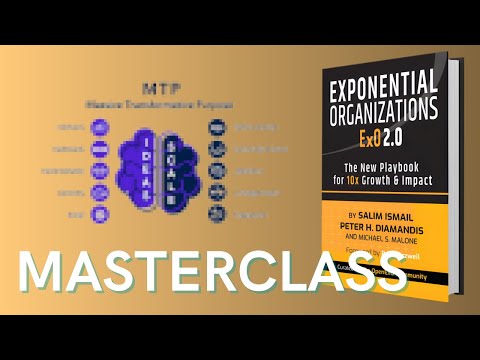
An exponential organization has the Massive Transformative Purpose (MTP) at its core, surrounded by five externalities (S-C-A-L-E: Staff on Demand, Community and Crowd, Algorithms, Leverage/shared Assets, Engagement) and five internal mechanisms (I-D-E-A-S: Interfaces, Dashboards, Experimentation, Autonomy, Social Technologies), with the brain diagram showing MTP in center as spiritual foundation and these characteristics enabling 10x performance.
“There's the massive transformative purpose. There's five externalities and the five internal mechanisms. So let's now get into the model of the characteristics of an exponential organization.”
Parenting shift from supply-side (become an engineer, doctor, lawyer) to demand-side (MTP): ask children what problem they want to solve, what excites them, and give them belief that tools are extraordinary and problems are solvable; this MTP-driven parenting creates more resilient, motivated children.
“I think there's a fundamental sea change. It's almost like linear to exponential or scarcity due to abundance. All of us grew up uh doing education and parenting on the supply side. So you were told become an engineer, become a doctor, become a lawyer, um become an accountant. So you trained in on the supply side on a set of skills and then you went to the job market to sell those skills. Right? Many of us uh I took be started engineering school because my dad was an engineer and I went to medical school because my dad was a doctor. Right? So we all all jobs came from the supply side. Now we're shifting over to the demand side which is the MTP. What excites you? What gets you most passionate? The best parenting we've seen is where you go what problem do you really want to solve young child or what really excites you and let them follow their passion and they'll figure it out and give them the belief that they can that the tools they have access to are extraordinary.”
New crops (PR23 rice in Asia) provide 8 yields per season with 60% labor reduction; genetic improvements combined with drones, robotics, and AI for monitoring/optimization are digitizing and automating agriculture.
“There's a new strain of uh of rice uh PR23 I believe it's called that is able to provide eight yields of crops reducing labor by like 60%.”
By the end of this next decade, every company, nonprofit, impact project, and government department will be structured as exponential organizations, not because of ideology but because it's simply better and data proves it, making the transition inevitable.
“I'm pretty clear that over this next decade every company every nonprofit every impact project every government department will be structured this way just because it's just that much better”
Pepsi scanned 200 million QR codes on chips/snacks for World Cup, dropping NFTs into users' web3 wallets; users took selfies which became part of a collective soccer ball mosaic, willingly providing first-party data and enabling direct brand-to-consumer communication—a model of engagement via NFT mechanics.
“Take a look at Pepsi for instance for the World Cup this year in uh Qatar. They actually printed 200 million QR codes on bags of potato chips, other snacks. When people scanned those potato chips, they didn't go to an app. Instead, they went to a web 3 wallet and in dropped a smart NFT, not for speculation, but for engagement. It said, 'Share, take a selfie and share.' And then your face became part of this massive soccer ball. The end result was an ongoing direct conduit of communication between the brand and the consumer. They had hundreds of thousands of people that willingly, happily gave first-party data.”
The Vega, the third-fastest electric car in the world (900 horsepower), is being designed, engineered, and built in Sri Lanka—a country with no automotive ecosystem, expertise, experience, or funding—proving that exo principles enable disruptive innovation from anywhere.
“The f the third fastest electric car in the world is called the Vega. Okay, it's 900 horsepower. You can go look it up um in your separate browser window that you've been browsing while we've been watching this webinar and and go check out the Vega. It's a car um 900 horsepower. It's being designed, engineered, and built in Sri Lanka. I've been to Sri Lanka twice. That hot bed of automotive innovation. Okay. If you can, they have no ecosystem, no expertise, no experience, no funding. uh and they've never done this before. I'm going to suggest to you that if you can build the third fastest electric car on an island of fishermen and farmers, you can do anything anywhere.”
Government departments are beginning to adopt exo structures; Nishi Degering, advisor to Mauritius Ministry of Oceans, designed the ministry as an exo with fishermen as a community (eyes and ears across 2M square kilometers of ocean), demonstrating exo applicability to public sector.
“the last one I'll talk about is that government departments uh over time I mentioned uh companies and impact projects but government departments are starting to become exos. Uh Nish Nishan Degaring who ran or advised the ministry of oceans in Maicius ping me and said hey I ran the we designed the whole ministry based on you. We're a small country. We have 2 million square kilometers of ocean to navigate. So they brought the fishermen into a giant community to act as eyes and eyes and ears etc etc.”
Elon Musk first-principles thinking: For Tesla, analyzed spot costs of battery metals (cobalt, nickel, lithium) per gram/ounce and reasoned that battery technology would reach target cost—nothing would stop it; for SpaceX, went to Russia to buy expendable boosters, found them ridiculously ancient (50 years old) and expensive, convinced himself that fully reusable first stage could fire repeatedly; demonstrates domain-independent methodology: identify physical/fundamental constraints, work backward from desired outcome.
“when he started Tesla... he made himself convinced that the battery technology would be viable when he looked at the spot cost of the metals involved of the cobalt of the nickel of the lithium and said okay here's the cost per ounce per gram and so I know I can get it down to this cost... when he started SpaceX... he went to Russia to buy expendable boosters and found them ridiculously ancient, 50 years and ridiculously expensive. And he came back and he got himself convinced that there's no reason you could not create a fully reusable first stage”