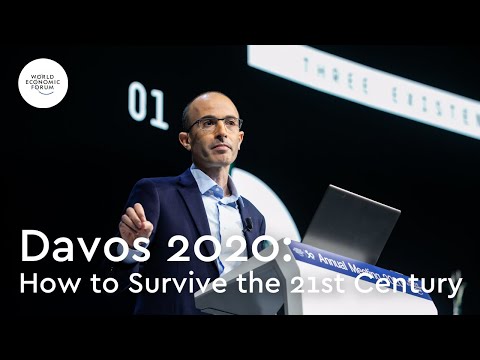
Yuval Noah Harari: How to Survive the 21st Century- Davos 2020
What this covers
Prof. Yuval Noah Harari takes to the Congress Hall stage at the World Economic Forum annual meeting to speak about how nuclear war, ecological collapse and technological disruption pose an existential threat to human civilization. Directly after, he explores the challenges of the 21st century and how to address them before it is too late with Dutch Prime Minister, Mark Rutte, moderated by Orit Gadiesh.
Full transcript available here: https://www.weforum.org/agenda/2020/01/yuval-hararis-warning-davos-speech-future-predications
Source description (no synthesized summary yet).
Humanity faces three existential challenges—nuclear war, ecological collapse, and technological disruption—that require immediate global cooperation and regulatory frameworks to prevent catastrophic outcomes, though strategic optimism about human capacity for coordination remains warranted.
- Technological disruption (AI + biotech) creates unprecedented risks of digital dictatorships, mass unemployment, and inequality that no single nation can solve alone
- Global cooperation mechanisms like the liberal international order have already accomplished the 'impossible' by reducing war; similar frameworks must extend to technology and climate
- Europe and democratic institutions offer counterbalances to US withdrawal and Chinese dominance, provided they act decisively on AI regulation and standards
This asset isn't compiled yet
You're seeing its claims, ranked. Compile it to build the argument threads, weight them, and check each claim against your library — the full view.
The logic of arms races means that an arms race in AI and bioengineering between nations is inherently destabilizing: each nation fears rivals will develop powerful technologies, so each must develop them first, but the actual winner of such an arms race is irrelevant because the loser is always humanity.
“almost every country will say hey we don't want to develop killer robots or to genetically engineer human babies will the good guys but we can't trust our rivals not to do it so we must do it first if we allow such an arms race to develop in fields like AI and bioengineering it doesn't really matter who wins the arms race the loser will be humanity”
Europe has unique technological advantages in telecommunications (5G): when mobile technology was developing, Europe agreed on a single standard and moved down the experience curve, while US companies took different directions and largely disappeared; Europe, China, and Korea now dominate 5G, which is crucial because those who control 5G infrastructure control the platforms for future AI applications.
“while the US and China have the big platforms that people talk about the technology companies Europe actually is quite unique of the United States it has 5g people who can still actually make 5g working now in America there isn't a single company that can do it today and the reason for that is because when mobile started the United States went a different direction Europe agreed on a single format and they went down the experience curve both cost wise and quality wise all the United States companies were sold to Europeans are disappeared Europeans are consolidated now there's now China Korea and Europe that is an opportunity for Europe in my mind to actually take stepping technology make a huge difference because when you think about the future those who control 5g or make 5g will actually control all the infrastructure in which the technology that we're talking about is gonna big as negative about America”
All three existential challenges (nuclear war, ecological collapse, technological disruption) are inherently global and cannot be solved by any single nation or bilateral negotiations; they require coordinated global solutions that transcend nationalist 'my country first' frameworks.
“to do something effective we need global cooperation all the three existential challenges we face our global problems that demand global solutions whenever any leader says something like my country first we should remind that leader that no nation can prevent nuclear war or stop ecological collapse by itself and no nation can regulate AI and bio engineering by itself”
Technology is not deterministic; in the 20th century the same industrial technology was used to build fascist dictatorships, communist regimes, and liberal democracies; in the 21st century, AI and biotech will also enable very different kinds of societies, so outcomes depend on human choices and global coordination.
“of course this is not a prophecy these are just possibilities technology is never deterministic in the 20th century people used industrial technology to build very different kinds of societies fascist dictatorships communist regimes liberal democracies the same thing will happen in the 21st century ai and biotech will certainly transform the world but we can use them to create very different kinds of societies”
The real line of concern about AI is not current data mining (based on clicks, purchases, etc.) but the future union of AI with ubiquitous biometrics: when biometric sensors become pervasive and data starts coming from inside the body (heart, brain), the ability to hack humans will become far more sophisticated and difficult to regulate.
“the AI revolution is barely an infant you know five years ago nobody talked about AI except first a few scientists and that what we submitted in the 2016 election with occasional attica that's nothing I mean we'll still haven't passed the crucial watershed the real watershed is the union of AI with biometrics at present still the vast majority of data being mined and people being hacked it's not based on by biological knowledge on my biological data it's based on where I click where I go what I buy and things like that it's still outside the body the real line in the sand is when biometric sensors become ubiquitous and it's happening and the data starts coming from within the body and they can access your heart your brain not just your credit card and it's not near its full capacity it's going to get much much more sophisticated so it's going to also to be much more difficult to regulate it”
Three existential challenges pose threats to human species survival: nuclear war, ecological collapse, and technological disruption; these three problems are global in nature and demand global solutions that transcend national borders.
“as we enter the third decade of the 21st century humanity faces so many issues and questions that it's really hard to know what to focus on so I would like to use the next 20 minutes to help us focus of all the different issues we face three problems pose existential challenges to our species these three existential challenges are nuclear war ecological collapse and technological disruption”
Requiring algorithms to disclose why they make decisions about individuals (e.g., why someone was rejected for a job) is legally important but practically ineffectual because algorithms make decisions based on thousands or tens of thousands of data points, each contributing small percentages; humans cannot comprehend such high-dimensional decisions, so disclosure becomes uninterpretable.
“even if like the European Union you have a law saying that if an algorithm makes a decision about me like not hiring me for a job I have the right to know why which is very crucial but to me it seems completely ineffectual because the way algorithms make decisions about us is based on enormous amount of data points when a human decides not to hire me for a job it's usually based on two three salient data points and I can understand why hey you're gay you're Jewish we don't want you a the discrimination you can do that that's easy but an algorithm with the big thing about big data in AI you take thousands tens of thousands of data points each contributing a very small percentage and that's how it makes decisions now you can have the right to get all these all the information so they'll give me a big book of a thousand pages with lots of numbers this is why the algorithm didn't hire for a job you wanna know why do I do with that so the thing is just the way the decisions are being made in the world is going to change algorithms make decisions in a different way than humans”
An AI arms race in the 21st century between leading nations (particularly China and the US) will replicate the pattern of the Industrial Revolution, where a few early industrializing countries (Britain, Japan) conquered and exploited the rest of the world; AI dominance will create unprecedented inequality both between nations and within them.
“The AI revolution might create unprecedented inequality not just between classes but also between cont in the 19th century a few countries like Britain and Japan industrialized first and they went on to conquer and exploit most of the world if we aren't careful the same thing will happen in the 21st century with AI we are already in the midst of an AI arms race with China in the USA leading the race in most countries being left far far behind”
Cheaper production of textiles and cars in California (via AI-driven automation) compared to Mexico will devastate developing economies, and when foreign actors have comprehensive data on a nation's politicians, judges, and journalists—including medical history and personal secrets—that nation loses independence and becomes a 'data colony'.
“just think what will happen to developing economies once it is cheaper to produce textiles or cars in California than in Mexico and what will happen to politics in your country in 20 years when somebody in San Francisco or in Beijing knows the entire medical and personal history of every politician every judge and every journalist in your country including all the sexual escapades all their mental weaknesses in all their corrupt dealings will it still be an independent country or will it become a data colony”
As AI systems make more decisions for humanity (where to work, whom to marry, whether to hire, whether to grant loans, whether to raise interest rates), authority shifts from humans to algorithms, and humans lose both control and understanding of public policy because the human brain lacks the biological knowledge, computing power, and data to comprehend algorithm decisions.
“Authority will shift from humans to algorithms and this is already already today billions of people trust the Facebook algorithm to tell us what is new the Google algorithm tells us what is true netflix tells us what watch and the Amazonian Alibaba algorithms tell us what to buy in the not so distant future similar algorithms might tell us where to work and whom to marry and also decide whether to hire us for a job whether to give us a loan and whether the central bank should raise the interest rate”
The EU and European countries should focus on transforming educational systems to adapt to AI developments, adopt a human-centric approach to AI development, and implement strong standards for data and privacy, positioning Europe as a regulatory and technological leader.
“in terms of artificial intelligence of course this crucial that we change the educational system it has to adapt to what is happening in the area of artificial intelligence we need to have the European human centric approach and leading us here that's a thing this is crucial and standards for example in the terms of data and privacy is very important here”
Automation driven by AI will eliminate millions of jobs in coming years; while new jobs will be created, older workers (e.g., a 50-year-old truck driver displaced by self-driving vehicles) cannot realistically retrain as software engineers or yoga instructors, and this job displacement will not be a single watershed event but a cascade of ever-larger disruptions.
“automation will soon eliminate millions upon millions of jobs and while new job will certainly be created it is unclear whether people will be able to learn the necessary new skills fast enough suppose you're 50 years old truck driver and you just lost your job to a self-driving vehicle now there are new jobs in designing software or in teaching yoga to engineers but how does a 50 years old truck driver reinvent himself or herself as a software engineer or as a yoga teacher”
The rule-based liberal global order is the first human organization to escape perpetual warfare; countries like France and Germany cannot plausibly go to war with each other, representing unprecedented stability that emerged in 'the last few decades.'
“there are many countries in the world which you simply cannot imagine going to war against each other next year like France and Germany”
Climate change creates both a mitigation imperative (reduce emissions) and an economic opportunity; new jobs are being created in the energy transition sector, as seen in the Netherlands where investments are growing due to climate action.
“but at the same time there is a huge economic possibility lots of new jobs being created I see this in my country where we see now growing investments because of the energy transition and climate change itself”
The Netherlands is actively building AI clusters and working with major tech companies worldwide to maintain its position as the fourth-most competitive economy globally and first in Europe; this is crucial for future economic competitiveness in the age of AI transformation.
“in the Netherlands we have this AR strategy we're working with all the big tech companies worldwide to build AI clusters in the Netherlands because we know that if we want to stay the fourth most competitive economy in the world and number one in Europe this is crucial because this is transformation transformational yet”
Media companies (newspapers, TV stations) are being starved of advertising revenue as digital platforms capture advertising dollars, threatening their ability to pay journalists and maintain investigative journalism, which is essential for explaining complex events to the public and distinguishing real information from manipulated content.
“I want to ask attention to the role of the Free Press there is a risk that with Facebook and all the other big companies were drawing all the advertising money into the internet now that it is running against the traditional newspapers and the traditional news outlets but he needs journalism to be able for example we have all seen this small clip with Obama saying very strange stuff which was a created clipper then you see it seems like it is really Barack Obama it mentioned that this clip will be aired on television one or two days before the election with some of the national politicians being in that small clip on on the internet or on television that might have a huge impact on election outcome so you need free press at these moments to be able to explain to the people what is really happening”
One-third of the Netherlands is below sea level, making the country particularly vulnerable to climate change and ecological risks; this geographic vulnerability motivates the Dutch to develop and showcase climate adaptation strategies to the world.
“when you have a established democracy because in an established democracy with no third party systems that in itself will create a tradition in your society of debating all the fair's issues and views etc and that is to the core of what we as human beings are we like to debate and you come from Israel Israel is one big debate in society and and most of our established democracies are thrive on debates rife on opposing views but that is also educating young people to be able to distinguish between the crazy stuff and the real stuff”
Effective governance of technology requires maintaining the liberal international world order, making changes to global institutions (UN, NATO, WTO) that are not functioning as they should, and combining acknowledgment of risks with acknowledgment of benefits to enable societal cooperation.
“I can agree with you on that point and that includes working on global standards that includes maintaining the liberal international World Order but then including making changes to the big global organization where this moment are in many cases not functioning as they should”
AI represents a bigger transformation than the invention of the internet itself, provided it is done right; it can enable precision farming with smaller carbon footprints, improve cancer research, support autonomous driving, and accelerate energy transitions.
“I believe the same is true for artificial intelligence possibilities this will present in terms for example of cancer research in terms of for example being able to have precision farming with a smaller co2 footprint and at the moment autonomous driving energy transition itself in all these areas we need interfacial tension I believe it is a more a bigger transformation than the invention of the internet itself if we do it right because things can go horribly wrong”
Established democracies with no third-party systems create traditions of debate and discussion on major societal issues, which educates young people to distinguish between reliable information and 'crazy stuff,' enabling people to form independent conclusions on policy questions.
“what will help me of course is when you have a established democracy because in an established democracy with no third party systems that in itself will create a tradition in your society of debating all the fair's issues and views etc and that is to the core of what we as human beings are we like to debate and you come from Israel Israel is one big debate in society and and most of our established democracies are thrive on debates rife on opposing views but that is also educating young people to be able to distinguish between the crazy stuff and the real stuff to be able to come to their own conclusions on big societal issues so an established democracy will be very helpful here”
The central issue in preventing AI domination is inequality: most developed nations (e.g., Netherlands) are not in serious danger, but developing nations (Venezuela, Brazil, India, Indonesia) face catastrophic risks if they are dominated by AI-advanced nations; this mirrors the Industrial Revolution pattern where early industrializers dominated the rest.
“the really central issue is is inequality I'm not so worried about a country like the Netherlands I think you'll be okay I'm much more worried about countries like Venezuela about Brazil about India about Indonesia what will they be in 30 50 years when I mentioned the analogy with the Industrial Revolution of the 19th century when a few countries dominated and exploited everybody else it could be much much worse in the 21st century if you have just a few countries that dominate the new divine powers of a iron biotechnology”
Technological disruption differs from nuclear war and ecological collapse in difficulty of coordination because some actors (corporations, governments) rationally believe they can win an AI arms race and thereby control the world economy and political system, making it harder to convince all parties that cooperation is in their interest.
“with nuclear war and ecological collapse it's relatively easy because it's obvious it's a threat to everybody nobody is going to win a nuclear war but with technological disruption it's much more difficult because there are a lot some people corporations and governments think and with some good reason that they can win an AI arms race and they can control the world economy or the world political system with that so it's much more difficult to convince them that everybody is on the same site”
Humanity has already accomplished the 'impossible' by escaping the law of the jungle (condition of omnipresent warfare) and building a rule-based liberal global order that created the most prosperous and peaceful era in human history; the meaning of peace has shifted from 'temporary absence of war' to 'implausibility of war' between many pairs of nations.
“the impossible well we have already accomplished the impossible we've already escaped the violent jungle in which we humans have lived throughout history for thousands of years humans lived under the law of the jungle in a condition of omnipresent war the law of the jungle said that for every two nearby countries there is a plausible scenario that they will go to war against each other next year”
AI governance requires both transparency standards (so individuals understand why they're rejected for jobs) and worldwide standards ensuring that algorithmic discrimination is not permitted; these standards must come from political systems informed by technological input but with political leaders making final decisions.
“you need that regulation including transparency and and how to have worldwide standards about transparency that at least you understand that because of the color of your skin or whatever you have been rejected for that job and that you don't have to go through out of the pages of digital data so you need that clearly discernible robot standards on on transparency that's crucial I mean it involvement of companies to help us to create it at the end is a political system which has to take the decision which you need a technological input but I'm very optimistic about European Europe country's being able to do this”
Current algorithmic decision-making is not as sophisticated as feared (e.g., Cambridge Analytica and Facebook's role in Brexit); however, risks of algorithmic manipulation do exist and require some regulation, though overly strong regulation creates the problem of asking 'who controls the regulator?'
“I think a reality it was not that sophisticated if he sometimes thing but of course these risks are there so you need some form of regulation but in the end let's not be too scary about it because if he startled regulators - happily then it will that email he post a question who is controlling the regulator because that man or a woman will have a lot of power”
Successful climate action requires society to be on board with the transition; the Netherlands achieved broad consensus through a 'big climate agreement' in June last year that is both affordable and achievable, creating the jobs necessary for the future.
“we in the best Dutch way had everybody on boards in this debate as you mentioned creates a big climate agreement in June last year which we now implementing which is affordable and achievable but this also creates the jobs necessary in the future”
Evidence that the liberal global order has reduced war: most countries with few exceptions (e.g., Russia) no longer fantasize about conquering or annexing neighbors; most countries spend only ~2% of GDP on defense and far more on education and healthcare, which was impossible under the law of the jungle.
“most countries with some notable exceptions like Russia don't even fantasize about conquering and annexing their neighbors which is why most countries can afford to spend maybe just about 2% of the GDP on defense while spending far far more on education and healthcare this is not a jungle”
The United States remains the leader of the free world despite its current president, and no major global issue can be solved without US involvement; however, the US is only ~1.5x larger than the EU in economy and China is ~3-4x smaller, so the AI competition is really about first vs. second place, not about dominance.
“I cannot envisage any big global issue being solved without involvement of the USA despite who's president not important at the ends that is still the case but at the same time the European Union is one 1/2 times bigger in its overall size of economy than the US and three or four times bigger than China so the question they are fighting each other the US and China this is not about first place is about second place”
The creation of a 'useless class'—people made economically irrelevant by automation—will be worse than historical exploitation because irrelevance offers no role in society and no narrative, whereas exploitation at least implies someone needs your labor.
“whereas in the past humans has had to struggle against exploitation in the 21st century the really big struggle will be against irrelevance and it's much worse to be irrelevant than to be exploited those who fail in the struggle against irrelevance would constitute a new useless class people who are useless not from the viewpoint of the friends and family of course but useless from the viewpoint of the economic and political system”
The foundational equation of 21st-century power is: Biological knowledge × Computing power × Data = Ability to hack humans. With sufficient understanding of biology, computing capacity, and personal data, actors can understand and manipulate individuals better than they understand themselves, predicting their emotions, decisions, and behavior.
“this danger can be stated in the form of a simple equation which I think might be the defining equation of life in the 21st century B times C times D equals R which means biological knowledge multiplied by computing power multiplied by data equals the ability to hack humans ah if you know enough biology and you have enough computing power and data you can hack my body and my brain and my life and you can understand me better than I understand myself”
Europe is not currently in the AI race (which is China vs. US); this represents a strategic vulnerability for Europe, and Europe should develop an independent technological path rather than relying on US or Chinese dominance.
“it is at least with AI it's really China versus the US and neither is a very good option as far as as far as we can tell I mean the u.s. at least until a few years ago at least said that it wants to be the leader of the world and to work for the benefit of everybody now it resigned its role of leader of the world and it openly says we don't care about anybody except ourselves and that's not a leader you don't follow a leader whose motto is me first so I think there is an opportunity here I think the opportunities is a wake-up call that's especially for Europe that you can't rely on the US anymore and you should be maybe a third independent way”
AI and biotechnology will give humanity godlike powers to re-engineer and create new life forms; governments, corporations, and militaries will likely use these powers to enhance traits valued for control (intelligence, discipline) while neglecting human capacities valued for flourishing (compassion, artistic sensitivity, spirituality), risking a race of humans who are powerful but spiritually diminished.
“in the coming decades AI and biotechnology will give us godlike abilities to re-engineer life and even to create completely new life-forms after four billion years of organic life shaped by natural selection we are about to enter a new era of inorganic life shaped by intelligent design our intelligent design is going to be the new driving force of the evolution of life”
Digital dictatorships enabled by ubiquitous biometric monitoring and AI will be worse than historical totalitarian regimes because they can monitor individual emotional states and micro-behaviors in real-time; even elites and wealthy people will not be safe, as demonstrated by Stalin's USSR where Communist Party members were monitored more closely than general populations.
“just imagine North Korea in 20 years when everybody has to wear a biometric bracelet which constantly monitors your blood pressure your heart rate your brain activity 24 hours a day you listen to his speech on the radio by the great leader and they know what you actually feel you can clap your hands and smile but if you're angry they know you'll be in the gulag tomorrow morning”
Humanity has become careless about preserving the fragile liberal global order; instead of strengthening it, countries are neglecting and deliberately undermining it. The global order is fragile—like a house everyone inhabits but nobody maintains—and can collapse if current patterns of undermining continue, returning humanity to the jungle.
“unfortunately we've gotten so used to this wonderful situation that we take it for granted and we are therefore becoming extremely careless instead of doing everything we can to strengthen the fragile global order countries neglected and even deliberately undermine it the global order is now like a house that everybody inhabits and nobody repairs it can hold on for a few more years but if we continue like this it will collapse”
The meaning of human life rests on decision-making; if algorithms make most decisions for humans, the meaning of human existence fundamentally changes, and philosophers lack conceptual models to understand what 'human life' would mean in such a condition.
“what will be the meaning of human life when most decisions are taken by algorithms we don't even have philosophical models to understand such an existence the usual bargain between philosophers and politicians is that philosophers have a lot of fanciful ideas and politicians patiently explain that they lacked the to implement these ideas now we are in an opposite situation we are facing philosophical bankruptcy”
Nationalism and globalism are not contradictory; rather, 21st-century good nationalism requires globalism because protecting citizens' safety and future requires cooperation with foreigners to address transnational threats like nuclear war, climate collapse, and AI arms races.
“there is no contradiction between nationalism and globalism because nationalism isn't about hating foreigners nationalism is about loving your compatriots and in the 21st century in order to protect the safety in the future of your compatriots you must cooperate with foreigners so in the 20th century the 21st century sorry good nationalists must be also globalists”
The crucial moment for global governance is now: countries and leaders must decide whether to cooperate on global rules for technology and climate or to compete in destructive arms races; history shows that empires and orders often collapse when decision-makers fail to act at critical junctures.
“I think we are at that moment I don't think oh yeah we talk about the things we work we talk about multilateralism but but there are countries who tell us that they don't actually want to cooperate on the standards of the world there are people who will tell us that I don't want to change the way I make profits and there is no regulator right now I'm doing that so this might be the moment in time where we needed to think just well we know that people start to cooperate when they face a common enemy and you know my question to both of you from slightly different points of view how do we how do we get a real or perceived common enemy out of those real challenges it faces”
Globalism does not require abandoning national traditions, establishing world government, or open borders; rather, globalism means commitment to global rules that regulate relations between nations while preserving national uniqueness, exemplified by the World Cup model where competition between nations coexists with shared rules.
“now globalism does it mean establishing a global government abandoning all national traditions or opening the border to unlimited immigration rather globalism means a commitment to some global rules rules that don't deny the uniqueness of each nation but only regulate relations between nations and a good model is the football World Cup the World Cup is a competition between nations and people often show fierce loyalty to their national team but at the same time the World Cup is also an amazing display of global harmony France can't play football against Croatia unless the French and creations agree on the same rules for the game and that's globalism in action”
Major technology and media companies should invest in supporting traditional news outlets through their advertising budgets to ensure journalists are paid sensible salaries and can continue investigative work, framing this as a business responsibility.
“so one of the police I have is big business here in Davos don't put all your money in the internet advertising make sure that our newspapers our news outlets also our TV stations also the future will be able to pay sensible and and real salaries to our journalists to be able to do this”
If humanity returns to the jungle (omnipresent warfare) equipped with 21st-century technologies (nuclear weapons, bioweapons, AI), the result will likely be self-annihilation; even if humanity disappears, something may survive (e.g., rats), but humans should hope to rely on leaders at Davos to prevent this rather than on rats rebuilding civilization.
“we will find ourselves back in the jungle of omnipresent war we've forgotten what it's like but believe me as a historian you don't want to go back there it's far far worse than you imagined yes our species has evolved in that jungle and lived and even prospered there for thousands of years but if we returned there now with the powerful new technologies of the 21st century our species will probably annihilate itself of course even if we disappear it will not be the end of the world something will survive us perhaps the rats will eventually take over and rebuild civilization perhaps then the rats will learn from our mistakes”
Yuval Noah Harari, a historian, published a book 18 years ago in which he gave civilization a 50/50 chance of surviving the 21st century, and has since published another work in which his concerns have only grown, citing technology and environmental catastrophe as reasons for increased concern.
“18 years ago marking Ries the britons astronomer royal published a book on the topic and he gave civilization a 50/50 chance of surviving the 21st century he published another book this year or actually last year and his concerns have only grown he cited technology and environmental catastrophe as reasons”
Despite risks and downsides of new technologies, the enormous amounts of good they can create (e.g., health improvements, cancer treatment) should be acknowledged, and societies should balance optimism about benefits with realism about risks rather than defaulting to pessimism.
“so yes we have to acknowledge the risks in the downsides of these new technologies but at the same time for the for our societies to come along let's also acknowledge the enormous amount of good this can create in terms of our health cancer is the many things I mentioned earlier because I'm extremely optimistic about what that can do”
Mark Rutte, Prime Minister of the Netherlands for 10 years, led a nation that was ranked 4th globally and 1st in Europe in the World Economic Forum's 2019 Competitiveness Report, indicating successful governance despite real challenges including geographic vulnerability.
“also with us is Mark Bruton also an historian he's been the prime minister of the Netherlands for 10 years in 2019 the World Economic Forum Competitiveness Report ranked the Netherlands and fourth globally and first in Europe”
Technology presents both enormous promises (innovation in healthcare, etc.) and serious dangers; the key is to mitigate risks while capturing benefits, and this requires strategy, societal engagement, and affordable/achievable implementation.
“I believe that is a strategic and also a societal and economic imperative let's say a urgency to make sure that B it's artificial intelligence or be it this big issue of climate change that we get a let's get a grip on it but I will also briefly address some of the big issues just being mentioned because of course they are rightly mentioned and we have to mitigate them”
The discussion involved perspectives from a philosopher (Harari) analyzing existential challenges and a political leader (Rutte) discussing governance responses, indicating that both philosophical conceptualization and political pragmatism are necessary to address 21st-century risks.
“I think we have participated and seeing a discussion between a philosopher and a political leader trying to conceptualize a little further what the 21st century might look like there was a little bit of pessimism a little bit of optimism I think a lot of realism”