What this covers
Introduction to the Old Testament (Hebrew Bible) (RLST 145) with Christine Hayes
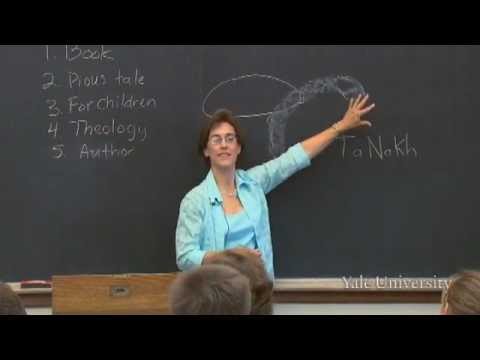
This lecture provides an introduction to the literature of the Hebrew Bible and its structure and contents. Common misconceptions about the Bible are dispelled: the Bible is a library of books from diverse times and places rather than a single, unified book; biblical narratives contain complex themes and realistic characters and are not "pious parables" about saintly persons; the Bible is a literarily sophisticated narrative not for children; the Bible is an account of the odyssey of a people rather than a book of theology; and finally, the Bible was written by many human contributors with diverse perspectives and viewpoints.
00:00 - Chapter 1. Introduction to the Hebrew Bible and Its Radical Ideas 16:10 - Chapter 2. Common Myths about the Bible 29:33 - Chapter 3. An Overview of the Structure of the Bible 40:17 - Chapter 4. Course Organization
This course was recorded in Fall 2006.
Source description (no synthesized summary yet).
The Hebrew Bible is not a uniform theological text but a complex anthology of diverse voices and literary forms that represents a revolutionary monotheistic and ethical worldview, best understood through historical, literary, and cultural analysis rather than through modern religious presumptions.
- The Bible's core innovation—a transcendent God outside nature known through history rather than natural forces—enabled ancient Israel's survival as a cultural-religious entity despite political collapse
- Biblical narratives are psychologically realistic literature about flawed humans in moral conflict, not pious parables about saints, requiring readers to abandon Sunday School interpretations
- The Hebrew Bible is an anthology assembled over centuries by multiple contributors with diverse political and religious motivations, not a unified book or systematic theology
This asset isn't compiled yet
You're seeing its claims, ranked. Compile it to build the argument threads, weight them, and check each claim against your library — the full view.
Unlike conquered peoples in antiquity who typically assimilated culturally and religiously to their conquerors and disappeared as distinctive entities, the Israelites of the southern kingdom (Judah) uniquely survived the destruction of their state in 586 BCE and produced a continuous community and culture traceable through history into the modern period.
“Conquest and exile were events that normally would spell the end of a particular ethnic national group, particularly in antiquity. Conquered peoples would trade their defeated god for the victorious god of their conquerors and eventually there would be a cultural and religious assimilation, intermarriage. That people would disappear as a distinctive entity, and in effect, that is what happened to the ten tribes of the northern kingdom to a large degree. They were lost to history. This did not happen to those members of the nation of Israel who lived in the southern kingdom, Judah.”
The radical innovation that enabled ancient Israelite survival was the conception of a single God who was transcendent—outside of and above nature, not identified with natural forces—and who was known through history, events, and a particular relationship with humankind rather than through natural phenomena.
“over the course of time, some ancient Israelites, not all at once and not unanimously, broke with this view and articulated a different view, that there was one divine power, one god. But much more important than number was the fact that this god was outside of and above nature. This god was not identified with nature. He transcended nature, and he wasn't known through nature or natural phenomena. He was known through history, events and a particular relationship with humankind.”
The Bible is not a book of theology, catechism, or systematic theology; there is nothing in it that corresponds to modern Western notions of religion, and there is no word for religion in biblical Hebrew.
“the Bible is not a book of theology, it's not a catechism or a book of systematic theology. It's not a manual of religion, despite the fact that at a much later time, very complex systems of theology are going to be spun from particular interpretations of biblical passages. You know, there's nothing in the Bible that really corresponds to prevailing modern western notions of religion, what we call religion, and indeed there's no word for religion in the language of biblical Hebrew.”
Despite differences between Dead Sea Scroll manuscripts and medieval biblical manuscripts, there is a remarkable degree of correspondence and high degree of continuity, suggesting a relatively stable textual tradition while still allowing for some fluidity in transmission.
“Suddenly, we have evidence, thirteen or fourteen hundred years earlier, that people were reading this stuff and, by and large, it's a pretty constant textual tradition. Sure there are differences, sure there are differences. We see that our manuscripts are not exactly like those fragments, but there is a remarkable degree, a high degree of correspondence so that we really can speak of a relatively stable textual tradition but still some fluidity.”
We do not have any original copies of the biblical texts as they came from the pens of the authors, and before the middle of the twentieth century, the oldest biblical manuscripts dated to the year 900, an enormous distance from the events they describe.
“We don't, of course, have any original copies of these materials as they came off the pen of whoever it was who was writing them, and in fact before the middle of the twentieth century, our oldest manuscripts and fragments of manuscripts of the Bible dated to the year 900. That's an awful long distance from the events they're talking about.”
In the Mesopotamian flood story (Sumerian story of Ziusudra), the gods act capriciously and arbitrarily, deciding to destroy humanity simply because people are noisy and prevent the gods from sleeping, with no moral scruple involved.
“In the Mesopotamian stories, for example, the gods act capriciously, the gods act on a whim. In fact, in one of the stories, the gods say, 'Oh, people, they're so noisy, I can't sleep, let's wipe them all out.' That's the rationale. There's no moral scruple.”
The Israelites were a small and relatively insignificant group for much of their history, establishing a kingdom in Canaan around 1000 BCE that divided into two smaller kingdoms around 922 BCE, with the northern kingdom destroyed by Assyrians in 722 BCE and the southern kingdom conquered by Babylonians in 586 BCE.
“the Israelites were a small, and I've actually overrepresented it here, I'm sure it should be much smaller, a small and relatively insignificant group for much of their history. They did manage to establish a kingdom in the land that was known in antiquity as Canaan around the year 1000. They probably succeeded in subduing some of their neighbors, collecting tribute--there's some controversy about that--but in about 922 this kingdom divided into two smaller and lesser kingdoms that fell in importance.”
Most cherished presuppositions about the Bible among modern readers are based on astonishing claims that others have made on behalf of the Bible, not claims that the Bible has made on behalf of itself.
“Most of our cherished presuppositions about the Bible are based on astonishing claims that others have made on behalf of the Bible, claims that the Bible has not made on behalf of itself.”
The term 'Old Testament' is a theologically loaded term that suggests the doctrine that the New Testament has fulfilled, surpassed, or antiquated the Hebrew Bible, so the instructor prefers to refer to the Bible as the 'Hebrew Bible' for accuracy.
“Because the term 'Old Testament' is a theologically loaded term, it sort of suggests the doctrine that the New Testament has somehow fulfilled or surpassed or antiquated the Bible of ancient Israel, you're going to hear me refer to the object of our study as the Hebrew Bible.”
Ancient peoples widely regarded various natural forces (earth, sky, water) as imbued with divine power—as divinities themselves—such that the gods were identical with or immanent in the forces of nature, with no single god being all-powerful.
“The conception of the universe that was widespread among ancient peoples is one that you're probably familiar with. People regarded the various natural forces as imbued with divine power, as in some sense divinities themselves. The earth was a divinity, the sky was a divinity, the water was a divinity, had divine power. In other words, the gods were identical with or imminent in the forces of nature. There were many gods. No one single god was therefore all powerful.”
The discovery of the Dead Sea Scrolls in the middle of the twentieth century brought about a dramatic change in the state of biblical manuscript evidence, providing texts dated to the fourth and third centuries BCE.
“what was so exciting in the middle of the twentieth century was the discovery of the Dead Sea Scrolls...They brought about a dramatic change in the state of our knowledge of our Hebrew manuscript evidence...we have this really great collection of scrolls...And some of them date back to the fourth and third century.”
Biblical narratives are not pious parables about saints, but psychologically real literature about very real or realistic people in life situations, with non-exemplary, sometimes scandalous, violent, rebellious, outrageous, lewd, and vicious behavior.
“biblical narratives are not pious parables about saints. Okay? Not pious tales. They're psychologically real literature about very real or realistic people and life situations. They're not stories about pious people whose actions are always exemplary and whose lives should be models for our own, despite what Sunday School curricula will often turn them into.”
The final editors of the Hebrew Bible had a decidedly monotheistic and ethical perspective, and they attempted to impose that perspective on their older source materials; though for the most part they succeeded, the result is often a deeply conflicted and ambiguous text.
“Those who were responsible for the final editing, the final forms of the texts, had a decidedly monotheistic perspective, ethical monotheistic perspective, and they attempted to impose that perspective on their older source materials; and for the most part they were successful. But at times the result of their effort is a deeply conflicted, deeply ambiguous text.”
The Bible represents or expresses a basic discontent with the larger cultural milieu in which it was produced, functioning as a revolutionary cultural critique rather than a conservative or traditional document.
“In many respects, the Bible represents or expresses a basic discontent with the larger cultural milieu in which it was produced, and that's interesting for us, because a lot of modern people have a tendency to think of the Bible as an emblem of conservatism.”
In biblical times and the Ancient Near East generally, religion was not a set of doctrines that people subscribed to; to become an Israelite, one simply joined the Israelite community, lived an Israelite life, obeyed Israelite law and custom, revered Israelite lore, and entered into the historical community by accepting that their fate and the community's fate should be the same.
“It's clear that in biblical times and in the Ancient Near East generally, religion wasn't a set of doctrines that you ascribed to. To become an Israelite, later on a Jew--the word 'Jew' isn't something we can really historically use until about this time, so most of our period we're going to be talking about the ancient Israelites--to become an Israelite, you simply joined the Israelite community, you lived an Israelite life, you died an Israelite death. You obeyed Israelite law and custom, you revered Israelite lore, you entered into the historical community of Israel by accepting that their fate and yours should be the same.”
The Bible is not a book but a library—an anthology of writings or books written and edited over an extensive period of time by people in very different situations responding to very different issues and stimuli (political, historical, philosophical, religious, moral).
“The Bible is not a book with all that that implies, that it has a uniform style and a message and a single author, the sorts of things we think of when we think in a conventional sense of the word 'book.' It's a library. It's an anthology of writings or books written and edited over an extensive period of time by people in very different situations responding to very different issues and stimuli, some political, some historical, some philosophical, some religious, some moral.”
Job, possibly the greatest book of the Bible, challenges conventional religious piety and arrives at the bittersweet conclusion that there is no justice in this world or any other, but that nonetheless we are not excused from the thankless and perhaps ultimately meaningless task of righteous living.
“Job, possibly the greatest book of the Bible, I won't give away my preferences there, challenges conventional religious piety and arrives at the bittersweet conclusion that there is no justice in this world or any other, but that nonetheless we're not excused from the thankless and perhaps ultimately meaningless task of righteous living.”
Section discussions are not primarily about discussing the lectures and readings, but are complementary to lectures and provide experience with close reading and textual exegesis that lectures cannot provide.
“In fact, it's really wrong to call them section discussions. It sounds like you're discussing the lectures and the readings and you're really not. The section discussions are a complement to the lectures...I want you to have the experience of actually sitting and reading chunks of text and struggling with that and understanding the history of interpretation of passages”
In this university course, the focus is on the demonstrably human component of the Bible—its formulation, editing, and transmission by human beings—rather than on questions of divine inspiration, which are matters of faith.
“Since this is a university course and not perhaps a theological course or within a theological setting, it's really only the latter, the demonstrably human component, that will concern us.”
It is inevitable that students will bring what they learn in this course into dialogue with their own personal religious beliefs, and this can be enriching and exciting, but it may also be difficult for some students.
“It is inevitable that you will bring what you learn in this course into dialogue with your own personal religious beliefs, and for some of you, I hope all of you, that will be enriching and exciting. For some of you it may be difficult.”
For Jewish communities that first compiled the Hebrew Bible in the pre-Christian era, the Bible was perhaps first and foremost a record of God's eternal covenant with the Jewish people.
“For the Jewish communities who first compiled these writings in the pre-Christian era, the Bible was perhaps first and foremost a record of God's eternal covenant with the Jewish people.”
The Apocrypha are writings composed around 200 BCE to 100 CE that were widely used by Jews of the period but were not considered to have the same status as the 24 books; they later became part of the canon of Catholic Christianity and their canonical status was confirmed for the Catholic Church in the sixteenth century.
“These are writings that were composed somewhere around here, sort of 200 BCE to 100 CE. They were widely used by Jews of the period. They simply weren't considered to be of the same status as the 24 books...But they did become part of the canon of Catholic Christianity and in the sixteenth century, their canonical status was confirmed for the Catholic Church.”
The Septuagint was a translation of the Hebrew Bible into Greek written for Greek-speaking Jews living in Alexandria, Egypt in the Hellenistic period around the third or second century BCE.
“One of the earliest translations of the Hebrew Bible was a translation into Greek known as the Septuagint. It was written for the benefit--it was translated for the benefit of Jews who lived in Alexandria--Greek-speaking Jews who lived in Alexandria, Egypt in the Hellenistic period somewhere around the third or second century BCE.”
The five books of Moses (Pentateuch: Genesis, Exodus, Leviticus, Numbers, Deuteronomy) nowhere claim to have been written in their entirety by Moses; tradition later ascribed them to him, but this ascription is not made by the texts themselves.
“the so-called five books of Moses--Genesis, Exodus, Leviticus, Numbers, Deuteronomy, the first five books we call the Pentateuch of Moses--nowhere claim to have been written in their entirety by Moses. That's not something they say themselves. Some laws in Exodus, you know, the Book of the Covenant, a few things--yes, it says Moses wrote those down, but not the whole five books that tradition later will ascribe to him.”
The Septuagint orders biblical books temporally: Genesis through Esther tell of things past, Job through Song of Songs contain wisdom applicable to the present, and Isaiah through Malachi tell of things future.
“The Septuagint's rationale for ordering the books is temporal. They've clustered books Genesis through Esther, which tell of things past; the books of Job through the Song of Songs or the Song of Solomon contain wisdom that applies to the present; and then the prophetic books, Isaiah to Malachi, contain or tell of things future.”
The early chapters of Genesis (chapters 1-11), known as the 'Primeval History,' are not best read or understood as history in the conventional sense, but owe a great deal to Ancient Near Eastern mythology and should be studied in that context.
“The early chapters of Genesis, Genesis 1 through 11--they're known as the 'Primeval History,' which is a very unfortunate name, because these chapters really are not best read or understood as history in the conventional sense--but these 11 chapters owe a great deal to Ancient Near Eastern mythology.”
The story of Noah and the flood (Genesis 6-9) is an Israelite version of an older Mesopotamian flood story, copies of which have been found in multiple sources including the Epic of Atrahasis and the Epic of Gilgamesh.
“The story of Noah and the flood, which occurs in Genesis 6 through 9 is simply an Israelite version of an older flood story that we have found copies of: a Mesopotamian story called the Epic of Atrahasis a flood story that we also have incorporated in the Epic of Gilgamesh.”
Readers alert to the textual layers in the Bible can listen to the cacophony of voices within the text, which reveals the ideological conflicts and multiple perspectives that constitute the Bible's richness rather than a flaw.
“that's going to be one of the most fun things for you as readers of this text, if you're alert to it, if you're ready to listen to the cacophony of voices that are within the text.”
The creation story in Genesis 1 draws upon the Babylonian epic known as Enuma Elish, demonstrating direct literary dependence on Mesopotamian sources.
“The creation story in Genesis 1 draws upon the Babylonian epic known as Enuma Elish. We'll be talking about that text in some depth.”
Genesis is concerned to account for the origin of things and wrestles with the existence of evil, idolatry, and suffering in a world created by a good God.
“Genesis is concerned to account for the origin of things and wrestles with the existence of evil, the existence of idolatry and suffering in a world that's created by a good god.”
The priestly texts in Leviticus and Numbers emphasize the sanctity of all life and the ideal of holiness and ethical and ritual purity.
“The priestly texts in Leviticus and Numbers emphasize the sanctity of all life and the ideal of holiness and ethical and ritual purity.”
The story of the first human pair in the Garden of Eden (Genesis 2-3) has clear affinities with the Epic of Gilgamesh, a Babylonian and Assyrian epic in which a hero embarks on an exhausting search for immortality.
“The story of the first human pair in the Garden of Eden, which is in Genesis 2 and 3 has clear affinities with the Epic of Gilgamesh, that's a Babylonian and Assyrian epic in which a hero embarks on this exhausting search for immortality.”
The Dead Sea Scrolls were found in caves in the Judean desert and contain an almost complete copy of the Book of Isaiah and partial copies or fragments of all biblical books except possibly Esther.
“The Dead Sea Scrolls were found in caves in the Judean desert...we have found an almost complete copy of every book of the Bible. Sorry--almost complete copy of the Book of Isaiah and then partial copies or fragments of all of the biblical books, except maybe Esther.”
The Septuagint has some divergences with the traditional Hebrew text of the Bible, including differences in the order of the books.
“The translation has some divergences with the traditional Hebrew text of the Bible as we now have it, including the order of the books, and some of these things are charted for you on the chart that I've handed out.”
The Bible is not suitable for children due to its adult subject matter, including episodes of treachery, incest, murder, and rape, and because it requires sophisticated reading skills to understand its structure, style, artistry, and subtle ironies.
“the subject matter in the Bible is very adult, particularly in the narrative texts. There are episodes of treachery and incest and murder and rape. And the Bible is not for naive optimists. It's hard-hitting stuff.”
If readers work too hard and too quickly to vindicate biblical characters simply because they are in the Bible, they miss the moral sophistication and deep psychological insights that have made these stories of such timeless interest.
“if we work too hard and too quickly to vindicate biblical characters just because they're in the Bible, then we miss all the good stuff. We miss all of the moral sophistication, the deep psychological insights that have made these stories of such timeless interest.”
Exegesis is a particular kind of skill that the teaching fellows will introduce students to, and it is not something most high school students would have acquired, and perhaps not even many college upperclassmen.
“The skills that you will need for that paper I am fairly certain are not things that you would've acquired in high school and, if we have some upperclassmen--I don't know, but maybe not even some upperclassmen will have acquired here yet. Exegesis is a very particular kind of skill and the teaching fellows will be introducing you to methods of exegesis.”
The Bible dates from approximately 1000 BCE down to the second century BCE, with the last book within the Hebrew Bible written in the 160s BCE, though some books contain narrative snippets or oral traditions that may date back further in time.
“the Bible is this assemblage of books and writings dating from approximately 1000 BCE--we're going to hear very diverse opinions about how far back this stuff dates--down to the second century: the last book within the Hebrew Bible was written in the 160s BCE. Some of these books which we think are roughly from a certain date, they will contain narrative snippets or legal materials or oral traditions that may even date back or stretch back further in time”
Ecclesiastes reads like an existentialist writing from the twentieth century, scoffing at the vanity of all things including wisdom, and espousing a kind of positive existentialism.
“Ecclesiastes reads like an existentialist writing from the twentieth century. It scoffs at the vanity of all things, including wisdom, and espouses a kind of positive existentialism.”
These biblical writings have had a profound and lasting impact on three world religions: Judaism, Christianity, and Islam.
“These writings have had a profound and lasting impact on three world religions: Judaism, Christianity and Islam.”
The great civilizations of the Ancient Near East—Egypt, Mesopotamia, and the Fertile Crescent—were long unknown to modern scholars until the nineteenth and twentieth centuries when archaeological discoveries unearthed their ruins, records, and previously forgotten languages.
“our knowledge of the earliest stages of human civilization was quite limited for many centuries. That is, until the great archaeological discoveries of the nineteenth and twentieth centuries, which unearthed for us the great civilizations of the Ancient Near East”
The terms BCE (Before Common Era) and CE (Common Era) correspond to BC (Before Christ) and AD (Anno Domini), and are used as a non-Christian-centric way of dating that appears frequently in secondary readings.
“I use BCE to refer to the period before 0 and CE to refer to the period after 0; the Common Era and Before the Common Era, and in a lot of your secondary readings and writings they'll be using the same thing. It corresponds to what you know as BC, Before Christ, and Anno Domini, AD, the year of our Lord. It's just a non-Christian-centric way of dating”
Sections are critically important to success in the course, and Hayes characterizes the attendance penalty as 'a favor' to students, suggesting that section participation is essential to doing well in the final paper.
“These sections are critically important in this course...And believe me, this is a favor to you. It is definitely a favor to you. These sections are critically important in this course.”
The Ketuvim (Writings) is a miscellany of works of various types and probably represents about 50% of the Hebrew content that students will encounter in the course.
“The final section of the Bible is referred to as Ketuvim in Hebrew, which simply means 'Writings,' and that's probably about 50% of the Hebrew you're going to get in the whole course, so please don't be scared. The Ketuvim...are really a miscellany. They contain works of various types”
Biblical traditions have roots stretching deep into earlier times and out into surrounding lands and traditions, and the parallels between biblical stories and Ancient Near Eastern stories have been the subject of intense scholarly study.
“Biblical traditions have roots that stretch deep into earlier times and out into surrounding lands and traditions, and the parallels between the biblical stories and Ancient Near Eastern stories that they parallel has been the subject of intense study.”
The Protestant Church denied canonical status to the books of the Apocrypha, considering them important for pious instruction but excluding them from the canon.
“Protestants, the Protestant church, denied canonical status to the books of the Apocrypha. They said they were important for pious instruction but excluded them from their canon.”
With the Renaissance and the Reformation, some Christians became interested in Hebrew versions of the Bible and wanted to examine the Hebrew rather than the Greek translation.
“With the Renaissance and the Reformation, some Christians became interested in Hebrew versions of the Bible. They wanted to look at the Hebrew and not the Greek translation from the Hebrew.”
The Nevi'im (Prophets) section is divided into two parts: the Former Prophets (narrative prose accounts of the history of Israel focusing on the activities of prophets) and the Latter Prophets (poetic and oracular writings ascribed to named prophets, including the three major prophets Isaiah, Jeremiah, and Ezekiel, and the twelve minor prophets).
“The section of the Prophets is divided really into two parts, because there are two types of writing in the prophetic section of the Bible. The first or former Prophets continues the kind of narrative prose account of the history of Israel, focusing on the activities of Israel's prophets. All right? So, the Former Prophets are narrative texts. The Latter Prophets are poetic and oracular writings that bear the name of the prophet to whom the writings are ascribed. You have the three major prophets, Isaiah, Jeremiah and Ezekiel, and then the twelve minor prophets, which in the Hebrew Bible get counted together as one book”
Jews refer to the Bible as the Tanakh, an acronym where the T stands for Torah (instruction or teaching), the N for Nevi'im (Prophets), and the KH for Ketuvim (Writings).
“Jews refer to the Bible as the Tanakh...which is really the letter 't', 'n' and 'kh'...the T stands for Torah, which is a word that means instruction or teaching...the second division of the Bible is referred to as Nevi'im, which is the Hebrew word for 'prophets'...The final section of the Bible is referred to as Ketuvim in Hebrew, which simply means 'Writings'”
The Jewish Study Bible is recommended for the course for its very good translation of the Tanakh and its wonderful scholarly articles in the back that provide great introductions to the individual books.
“I'm asking you to pick up the Jewish Study Bible not only for the translation of the Tanakh, which is a very good translation, but because it contains wonderful scholarly articles in the back...great introductions to the individual books of the Bible”
The Ancient Near East is a recommended paperback text for the first few weeks of the course.
“I also would like you to pick up this paperback, it's not terribly expensive. We're going to be using it in the first few weeks especially: The Ancient Near East.”
The Torah, Prophets, and Writings probably reached authoritative status in that order, with the Torah first and all three divisions probably organized by the end of the first century BCE.
“The Torah probably reached a fixed and authoritative status first, then the books of the Prophets and finally the Writings. And probably by the end of the first century, all of this was organized in some way.”
Secondary readings for the course are available online and will be made available at Allegra for students who prefer printed copies.
“Other readings, the secondary readings for the course, are all already online. I will be also making them available at Allegra for people who would like to just purchase them already printed out”
The syllabus contains both a schedule of lectures and a schedule of readings, with readings by Kaufman required for the next class.
“The syllabus...is divided into a schedule of lectures and then a schedule of readings...The assignment that you'll have for the weekend and for next week's lectures are the readings by Kaufman. I really, really need you to read that before the next class”
Section participation is worth 10 percent of the grade, but repeated unexcused absences will result in section participation being worth 20-25 percent of the grade as a negative deduction.
“section participation is worth ten percent of your grade. However, if there are repeated, unexcused absences, there will be an adjustment in the grade calculation, and it will be worth twenty to twenty-five percent of your grade, and it will be a negative grade also.”