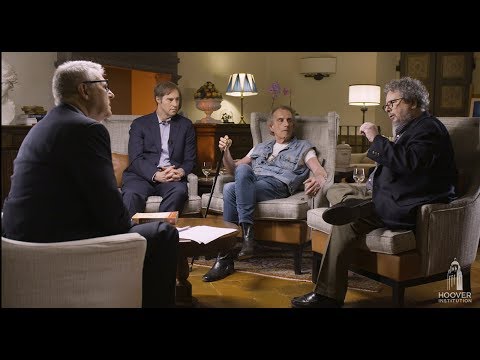
Mathematical Challenges to Darwin’s Theory of Evolution
What this covers
Recorded on June 6, 2019 in Italy.
To comment please go to https://www.hoover.org/research/mathematical-challenges-darwins-theory-evolution-david-berlinski-stephen-meyer-and-david
Based on new evidence and knowledge that functioning proteins are extremely rare, should Darwin’s theory of evolution be dismissed, dissected, developed or replaced with a theory of intelligent design?
Has Darwinism really failed? Peter Robinson discusses it with David Berlinski, David Gelernter, and Stephen Meyer, who have raised doubts about Darwin’s theory in their two books and essay, respectively The Deniable Darwin, Darwin’s Doubt, and “Giving Up Darwin” (published in the Claremont Review of Books).
Robinson asks them to convince him that the term “species” has not been defined by the authors to Darwin’s disadvantage. Gelernter replies to this and explains, as he expressed in his essay, that he sees Darwin’s theory as beautiful (which made it difficult for him to give it up): “Beauty is often a telltale sign of truth. Beauty is our guide to the intellectual universe—walking beside us through the uncharted wilderness, pointing us in the right direction, keeping us on track—most of the time.” Gelernter notes that there’s no reason to doubt that Darwin successfully explained the small adjustments by which an organism adapts to local circumstances: changes to fur density or wing style or beak shape. Yet there are many reasons to doubt whether Darwin can answer the hard questions and explain the big picture—not the fine-tuning of existing species but the emergence of new ones. Meyer explains Darwinism as a comprehensive synthesis, which gained popularity for its appeal. Meyer also mentions that one cannot disregard that Darwin’s book was based on the facts present in the 19th century.
For further information: https://www.hoover.org/publications/uncommon-knowledge
Interested in exclusive Uncommon Knowledge content? Check out Uncommon Knowledge on social media!
Facebook: https://www.facebook.com/UncKnowledge/ Twitter: https://www.twitter.com/UncKnowledge/ Instagram: https://instagram.com/uncommon_knowledge_show
Source description (no synthesized summary yet).
Darwin's theory of evolution by natural selection fails to explain the origin of new species and biological complexity because it cannot account for the Cambrian explosion, the rarity of functional proteins, or the origin of genetic information—suggesting instead that life shows evidence of intelligent design.
- The Cambrian explosion shows animal body plans arising abruptly in ~10 million years without intermediate ancestors, contradicting gradual Darwinian prediction
- Functional proteins are extraordinarily rare (1 in 10^77) compared to non-functional sequences, making random mutation search probabilistically impossible in Earth's history
- New biological forms require new genetic information (digital code-like DNA), and all known sources of information originate from minds, not undirected material processes
This asset isn't compiled yet
You're seeing its claims, ranked. Compile it to build the argument threads, weight them, and check each claim against your library — the full view.
The origins of life and origins of consciousness are the 'intellectual bookends' of modern science and philosophy; neither can be adequately characterized, and without being able to characterize what we wish to explain, we cannot properly explain how they emerged.
“the the question the origins of life and the origins of consciousness are the intellectual bookends of modern science and philosophy and we can't say much about either of them we can't characterize either of them and if we can't characterize them we're not really in a position to explain how they emerged that seems to me a prior commitment to be able to say what we wish to explain”
A 1960s MIT conference called 'Mathematical Challenges to Neo-Darwinism' was among the first to identify the mathematical problem with Darwinism, with computer scientists like Murray Eden recognizing that random search for meaningful DNA sequences would be extremely unlikely, though at the time they could not measure how rare functional proteins actually were.
“there was an extraordinary conference in the 1960s uh held by uh convened by a number of mit scientists some of whom david knew very well murray eden marchette and uh they were the first to see the mathematical problem with darwinism they called it their conference was called mathematical challenges to neo-darwinism but at the time they could compute the number of possible arrangements but they didn't know at the time how many of the arrangements would result in functional proteins that would do a job in the cell and so they didn't know they couldn't exactly measure how hard the search was would be on a random random basis the especially the computer scientists murray eden and others knew that based on computer science if this is functioning like a true linguistic system uh it's going to be it's like unlikely that you can do a random search and find a meaning a meaningful string of characters in dna that will produce a meaningful protein”
Gallarenter's criticism of intelligent design is that if there was an intelligent designer, his strategy is unclear—why did he design so many doomed organisms, waste energy on evolutionary dead-ends, and create a world where creatures are disease-prone and heartbreak-prone rather than optimizing design?
“if there was an intelligent designer what was his strategy how did he manage to back himself into so many corners wasting energy on so many doomed organisms what was his purpose and why did he do such a slip slip shot job why are we so disease prone heartbreak prone and so on”
Darwin successfully explained small adjustments by which organisms adapt to local circumstances such as changes to fur density, wing style, or beak shape, but he cannot explain the emergence of entirely new species and the big picture of biological complexity.
“there's no reason to doubt that darwin's successfully explained the small adjustments by which an organism adapts to local circumstances changes to fur density or wing style or beak shape yet there are many reasons to doubt whether he can explain the big picture not the fine-tuning of existing species but the emergence of new ones”
C.S. Lewis argued that if minds are wholly dependent on brains, brains on biochemistry, and biochemistry on meaningless atomic flux, then the thoughts of those minds have no more significance than the sound of wind in trees—making consciousness a fundamental problem for scientific materialism.
“if minds are wholly dependent on brains and brains on biochemistry and biochemistry on the meaningless flux of the atoms i cannot understand how the thought of those minds should have any more significance than the sound of the wind in the trees”
Newton's theoretical framework, unlike Darwin's, is extraordinarily predictive for a 'huge range' of physical phenomena (planets, stars, everyday experience) and fits 'flawlessly with 98 percent of human experience,' whereas Darwinian theory has failed to explain fundamental biological phenomena.
“there's a range of physical phenomena very big things planets stars newton isn't too good at that very tiny things quantum mechanics tiny particles we can't he's not too good at that but this huge range dart newton is perfectly predictive it fits it comports flawlessly with a with 98 of human experience that's true and darwin doesn't have to go farther than planets and stars oh i do yeah but you're right”
The fundamental issue with Darwin's theory is not that it is false in matters of local adaptation, but that it attempts to extrapolate from local, observable phenomena (beak shape, fur density) to explain the emergence of entirely new body plans and higher-order biological organization, which is a fundamentally different order of complexity.
“he entirely failed to explain what he thought he was explaining the emergence of biological complexity on the species level or higher order levels”
If Darwinian mechanisms were true, one would not expect to find creatures that are disease-prone, heartbreak-prone, fated to die without leaving value, or subject to suffering—these observations are evidence against the view that biological organisms are products of an optimizing evolutionary process.
“why are we so disease prone heartbreak prone and so on”
For a short protein of 150 amino acids, the experimental ratio of functional proteins to non-functional gibberish sequences is approximately 1 in 10 to the 77th power, meaning functional proteins are extraordinarily rare in the sequence space.
“for example just one result for a short protein 150 amino acids long the ratio is one uh protein that will fold into a a functional structure for compared to 10 to the 77th gibberish sequences so the ratio of functional to non-functional is one over 10 to the 77th power okay so functioning proteins are extremely rare”
The cell is an unbelievably and unfathomably complex bit of machinery; every time scientists look deeper, they discover additional layers of complexity, so the goal of explaining the emergence of cellular complexity is receding as the complexity keeps increasing with each new discovery.
“the cell is an unbelievably complex bit of machinery unfathomably complex and we haven't understood its complexity at all every time we look there seems to be an additional layer of revoltative complexity that needs to be factored into our theories don't forget the the eternal goal is to explain the emergence of this complexity yes and if we're continually behind the curve because the complexity is increasing every time we look that eternal goal is also receding from view not approaching it's receding”
Mutations that affect early development and body plan in organisms are almost universally fatal or non-functional, because early developmental decisions have cascading effects on all downstream structures, whereas mutations that arrive late in development cannot make a difference because the organism is already constructed.
“if i want to direct the assembly of an animal that i've got to get in there early before they've finished putting them together putting all the you know the hoofs on and getting the wool on i've if he's a sheep i like sheep i have to say you know i have to get in there early before they start building them so they don't accidentally build a mouse or or a leopard or a zebra i have to say look there's going to be a sheep get bones this high and we need a nose about this big and we need sheep ears and we need hooves if sheep have hooves i know they do we need wool you know get all this stuff together so i've got to act early now if i'm going to now if i'm going to create a new species i'm going to mutate and instead of building a sheep i'm going to build a little uh horse because horses come in cheap size what are they called well anyway they're called shetland polonies to do that there may be a mutation that that makes me order purple wool or or the wrong color hooves or stomachs that won't quite fit but a mutation that is going to recreate the creature in such a way that it's a different creature is biologists tell me and farmers tell me almost certainly likely to be fatal”
Whenever information is found and traced back to its ultimate source—whether in hieroglyphic inscriptions, books, radio signals, or computer code—it always originates from a mind, not a material process; therefore, the biological information in DNA suggests an intelligent source.
“what we know from experience is that information whether we find it in a hieroglyphic inscription or a paragraph in a book or information embedded in a radio signal or in a section of computer code whenever we find information and we trace it back to its ultimate source we always come to a mind not a material process and what i do in the book in darwin's doubt in my prior book signature in the cell showed that these undirected evolutionary mechanisms that have been proposed as an explanation for the origin of information fail for various reasons”
The intense opposition to Darwin skepticism is understandable when one recognizes that many scientists equate their worldview of scientific materialism with the practice of science itself; challenging one of the foundational thinkers supporting that worldview provokes an emotive rather than rational response.
“it's understandable when you realize that you actually it makes sense because you're challenging a fundamental plank in the world view of many of the scientists many scientists equate their world view of scientific materialism with the practice of science itself and when you challenge one of the thinkers that has that supports that worldview you're going to get a a very kind of emotive reaction and that's often what happens”
Darwin was asking invaluable questions about the origin of species and biological complexity, but he got the answer wrong; the problem lies with the Darwinian mechanism's bottom-up, undirected process approach rather than with the questions themselves.
“even you who bear the scars of abuse from darwinists say darwin may have been mistaken in his answers but he was asking invaluable questions he's asking invaluable questions but i think he got it wrong i think all darwinians in the broad sense get it wrong they're trying to explain something very very complex in terms of bottom-up undirected processes”
Darwin addressed the question of the origin of species prematurely as a 19th-century thinker without adequate knowledge of cellular complexity, molecular biology, or the mathematical constraints on evolutionary change; the problem of biological complexity remains unsolved and the question of species origin is still premature to address fully in the 21st century.
“i think what we have determined is that darwin created a 19th century local theory without looking at extreme cases that was reasonably successful for breeders for the explanation of local characteristics like beak size or the growth of wings but he entirely failed to explain what he thought he was explaining the emergence of biological complexity on the species level or higher order levels he wasn't it was a premature question to address an audience about the origin of species he couldn't say anything about what he did not know what he could not comprehend and the fact that he did not know or could not comprehend these things is simply a reflection of the fact that we do not know or cannot comprehend those things in the 21st century so the question was the question addressed was widely premature in the 19th century it's still premature we're just learning the structure of intellectual inquiry necessary to understand something like the biological cell and it's much harder a problem than we ever suspected much harder”
Virulent bacteria are invariably the result of loss of information through mutation rather than gain of information; this supports a theological perspective that evil or dysfunction results from privation (defect in good) rather than independent existence, and demonstrates that the mutational process produces degradation, not innovation.
“the problem of virulent bacteria you know nasty nasty bugs they are the they are invariably the result of a loss of information as a result of the mutational process so the very process that the darwinists have invoked to explain the origin of good design is actually i think responsible for the the evidence of decay so i think there is a this is the question in uh philosophy known as the theodicy you know the yes yes the problem and so i think there's ways of thinking about that but but for me the the evidence of design is powerful it's ubiquitous in in both in life and at the level of physics of things like the fine-tuning of the laws and constants of physics so i i see a very powerful signal of design but i don't deny the decay and the suffering in the world”
The problem of 'combinatorial inflation' describes how as the required length of a protein molecule grows, the number of possible combinations grows exponentially, so the odds of random search finding a functional protein drop precipitously.
“even mathematicians can understand has a memorable phrase to describe this mathematical problem he calls it the problem of combinatorial inflation yes as the length the required length of the protein molecule grows the numbers grow exponentially they inflate exponentially and so the the the odds of a random search finding the the the one that makes the pretty necklace to use right metaphor dropped precipitously”
Gallarenter predicts that whether biology can move beyond Darwin and construct a new theoretical framework is an important open question for 21st-century science, and the speed of this transition may be generational—requiring the old guard of Darwinians to pass away before new frameworks can emerge.
“darwin now poses a final challenge whether biology will rise to this last one as well as it did to the first when his theory upset every apple cart remains to be seen how cleanly and quickly can the field get over darwin and move on”
Life exhibits complex biological systems and information processing systems that bear the 'hallmark of mind' and suggest top-down rather than bottom-up causation; viewing life from the perspective of intelligent design rather than Darwinian bottom-up mechanisms is 'holding science back' and a new approach is needed.
“complex miniature machines complex information processing systems digital code these are things that bear the hallmark of mind and they suggest rather a top-down instead of a bottom-up approach so i'm sure people committed to a materialistic view of things will continue to to generate bottom-up explanations but i think we're in a new day we're looking at life in light of our own high-tech digital computing technologies and realizing it bears these systems bear all the hallmarks of design let's start to look at life differently and i think looking at it from a bottom-up darwinian approach is holding science back”
Academic resistance to Darwinian skepticism demonstrates anti-religious bigotry, which is one of the most important facts of the intellectual world in the United States and the West; this parallels the ideological capture that happened in English and history departments.
“it's an absolutely serious scientific argument in fact it's the first and most obvious and intuitive one that comes to mind it's got to be dealt with intellectually not not by the bigotry the anti-religious bigotry which is one of the most important facts of the intellectual world in the united states the west generally the case the case for intelligent design is not based on uh you know we can have a theological discussion as we had a bit here but the case for intelligent design isn't an interpretation or a deduction from the scriptural text right it's an inference from biological evidence and in that sense it's different”
Gallarenter has experienced hostile intellectual rejection from colleagues in academia for challenging Darwinism, with colleagues willing to 'destroy' him professionally if he challenged it; this demonstrates that Darwinism has passed beyond scientific argument into ideological and religious territory in universities.
“they will destroy you if you challenge it now i haven't been destroyed i'm not a biologist and you know i don't claim to be an authority on this topic but um and you know a book review is not the same as a book it's it's sort of a satellite around the book anyway it remains a case that i have nothing personally to charge my colleagues with but what i've seen in their behavior intellectually and at colleges across the west is nothing approaching free speech on this topic is a bitter rejection not just a a a sort of uh uh bitter fundamental uh angry outraged violent rejection which comes nowhere near scientific or intellectual discussion i've seen that happen again and again i'm a darwinism don't you say a word against it or will or i don't want to hear you period which proves that you're attacking their religion in effect i am attacking their religion”
Generating new forms of life requires generating new proteins, which means inventing new genes, because proteins are assembled according to genetic code in the DNA molecule—analogous to how a computer requires new code to perform a new function.
“life means new life new form of life means new protein means new gene well i'll explain it in terms that would be familiar to david if you want to give a computer a new function write a new program for it to accomplish a new function you've got to give it new code and the big discovery of 20th century biology following watson and crick and what's now called the molecular biological revolution is the same thing is true in life you want to invent a new form of life you've got to have you've got to have code in the form of the information inscribed along the spine of the dna molecule”
The Cambrian explosion shows a striking variety of new animal body plans arising suddenly in the fossil record over approximately 10 million years (with the date narrowing from the previously cited 70 million years) without discernible connection to earlier precursors in the pre-Cambrian record.
“in the cambrian is you get a huge number of what are called the uh animal body plans where a body plant is a unique configuration of body parts and tissues and they arrive very abruptly in the fossil record without discernible connection to earlier precursors or earlier ancestors in the pre-cambrian record”
Post-neo-Darwinian evolutionary theories are emerging that attempt to provide new mechanisms to account for things that the Darwinian mechanism cannot explain, suggesting that Darwinism has not provided a complete explanation but has created a research program that newer theories are trying to complete.
“what we're getting is post neo-darwinian theories of evolution that are trying to uh provide new mechanisms that will account for the the the things that the darwinian mechanism doesn't account for”
The DNA molecule encodes information in a roughly digital or alphabetic form, with chemical subunits called nucleotide bases functioning like characters in written text or zeros and ones in computer code, according to the sequence hypothesis discovered in 1957.
“the big discovery of the 1950s and 60s was that the dna molecule encodes information right in a roughly digital or alphabetic or typographic form this is why do you use the term digital well because in computer science we have characters you know zeros and ones this is this is correct 1957 is the sequence hypothesis you realize that the the information in dna or the the chemical subunits of dna called nucleotide bases were functioning like alphabetic characters in a written text or like the zeros and ones in a section of computer code that is to say it's not it wasn't their chemical properties that gave them their function but rather their specific arrangement in accord with an independent symbol convention which was later explicated in the form of what we call the genetic code”
Population genetics calculations show that the expected waiting times for the amount of evolutionary change evident in the Cambrian explosion would require hundreds of millions or billions of years, making 5-10 even 70 million years 'a blink of an eye' in terms of what mathematical theory predicts should be necessary.
“there is a mathematical branch of darwinian theory called population genetics that allows us to calculate how much time how much change evolutionary change we ought to expect in a given amount of time if we know things like the mutation rate the generation time the population sizes and 5 10 even 70 million years is a blink of an eye in terms of those the calculations that can be made for what are called waiting times and the expected waiting times for the amount of change that's evident in the cambrian blow out the time scale if you will there hundreds of millions or billions of years”
Historical calculations estimate approximately 10 to the 40th total organisms have lived on Earth; if mutations search a space of 10 to the 77th possible combinations, the total number of mutations in Earth's history can search only one ten trillion trillion trillionth of the possible combinations, making it overwhelmingly more likely that random mutations would fail to produce functional proteins.
“i read it here's a precise way of cashing out this probabilistic argument if you have 1 over 10 to the 77th power is your ratio but then you have all if every organism in the history of the planet we can estimate that about 10 to the 40th organisms so you define bacteria a little tiny thing everything every keto every bacterium yeah every time one of those replicates there's a possibility for a mutation that could search the space of possibilities so you've got 10 to the 40th possible mutations against a search space 10 to the 77th strong right so if you do your exponential math you end up with you can what it means is you can search one ten trillion trillionth one ten trillion trillion trillionth of the possible combinations so in that case are you more likely to succeed or fail you're overwhelmingly more likely to fail to find one of the functional combinations even taking into account every organism that's lived on earth”
Darwinism has transcended its status as a scientific theory and has become the basis of a worldview and 'emergency religion for the many troubled souls who need one,' functioning as a comprehensive materialistic explanation analogous to Marxism, Freudianism, and traditional religion.
“darwinism is no longer just a scientific theory but the basis of a world view and an emergency religion for the many troubled souls who need one”
Even accounting for all organisms that have ever lived on Earth and all possible mutations, the probability of randomly finding functional protein combinations is so low that the hypothesis of Darwinian evolution by random mutation is 'overwhelmingly more likely to be false than true.'
“the winning hypothesis is overwhelmingly more likely to be false than true it just didn't happen”
Marx, Darwin, and Freud are three great 19th and early 20th century materialistic thinkers whose theories answer comprehensive life questions—Marx on the future, Darwin on origins, Freud on psychology—and together they form the basis of a comprehensive materialistic worldview that has replaced traditional Judeo-Christian religion in providing meaning.
“you've talked about how darwinism david talked about how darwinism has become the foundation of a worldview and if you look at the questions that they address marx darwin tells us where we came from marx has a utopian vision of the future and freud tells us what to do about our guilt and between the three of these great materialistic thinkers of the 19th century and early 20th century they form the basis of a kind of comprehensive materialistic worldview they answer all the same questions that traditional judeo-christian religion has addressed”
Proteins are assembled from amino acids according to genetic code, with each position in a protein sequence occupied by one of 20 possible amino acids; the number of possible arrangements grows exponentially as the protein length increases, creating astronomical combinatorial possibilities.
“the mathematical element of this not of population genetics in in the uh complex sophisticated predictive sense that um c was referring to but just the simple issue of the code it is remarkable for young people to learn in high school is remarkable for me or in elementary school to learn that proteins molecules are assembled because there are codes there are codes in the nucleus of cells that spell them out character by character codon by codon this codon means this amino acid and the next one means that and the next one means that but the but the mathematics the mathematics underlying these codons is very simple and there's then darwin could perfectly well have understood if he had the facts each one of these positions has to be occupied by one of 20 amino acids”
The intelligent design argument is a purely scientific approach to explaining biological complexity and is not an attempt to bring theological arguments into science; it is based on inference from biological evidence, not on scriptural interpretation.
“the intelligent design parents have just one word that's definitely not steve's intention in in this book in intelligent design it's not a way to bring in a theological argument it is a scientific approach purely and absolutely valid scientifically and one can agree with it or disagree with it but one doesn't have to reject it insofar as theology making an illegal move because that's not what he's doing”
Intelligent design proponents have made successful predictions about the non-coding regions of the genome, predicting that 'junk DNA' previously identified as non-functional by neo-Darwinians would in fact be importantly functional, and this demonstrates that the design approach is scientifically productive.
“we're starting to make predictions based on intelligent design we were some some of our guys were the first people to predict that the non-coding regions of the genome previously identified as junk by the neo-darwinians have in fact are in fact importantly functional and so there's the looking at life as a design system is actually yielding insights into how life works it's a new day”
Thomas Nagel and others have become skeptical of neo-Darwinism because minds are real phenomena, and if one cannot give an account of where minds come from or what they do without self-refutation, the theory becomes incoherent.
“this is this is what bothered thomas nagel and what he's become a skeptic of neo-darwinism is that minds are real things and if you can't give an account of where they came from or what they do that isn't itself self-defeating then you end up uh in a in a really incoherent”
Berlinski responds skeptically to consciousness as a philosophical problem, saying that it is a 'fashionable' claim to be puzzled by it, and that the fact that he cannot experience others' sensations is not itself a philosophical problem—it is merely a fact of sensory privacy.
“someone says i'm deeply puzzled about consciousness everybody says that that's a very fashionable thing they say in teen vogue for heaven's sakes but i would like to have a better sense of what is prompting the puzzlement i don't have that i can't sit in your seat when you're sitting there so i can't experience your sensations when you're having them all right so what why is that intelligible from a scientific or a philosophical point of view as a pressing issue”
Berlinski predicts that while the Darwinian theory itself will eventually disappear, the name 'Darwin' and 'Darwinian' will persist as labels for whatever replaces it, just as Newton's name persists for phenomena even though Newtonian physics has been superseded; the commemorative and historical legacy will be eternal even as the theory fades.
“well i think darwin is eternal because eternal eternal the name is eternal the idea is eternal the belief the commitment they're all eternal the theory will disappear in good riddance to a bad theory but no matter what's a beautiful theory all right it's a beautiful theory whatever it is it will disappear but whatever replaces it will be called darwinian no doubt about that no matter what christian heresy emerges in the tides of time it's always called a christian heresy this will be a darwinian heresy but that legacy that commemorative legacy will never disappear it's part of the history of the subject just like newton will not disappear”
The persistence of Darwinism may be generational—young scholars have been 'brought up as little Darwinists' and are embedded in a Darwinian paradigm, making it unlikely the field will quickly overcome Darwin even if the theory is false.
“i think that would be a great outcome to have the old guard die and and but you know religion is imparted uh more than anything else by the parents to the children and and and the young people have been brought up as little darwinists i mean kids i see running around new haven are all darwinists anyway the children i mean the students in my class are all darwinists so i these guys know more about it than i do i'm not hopeful”
Berlinski observes that when he looks at the world, he sees a 'mess'—creatures fated to die without leaving value, disease, pain—and views it as more likely the result of random chance than of intelligence; he would rate the world a failing grade if he were grading creation.
“when i look at the world at large i see a mess when i look at the mind of man i see a worse mess i see a creature as likely to do bad as good or more likely um i see um many creatures who are who are fated to die out without leaving any contribution that we can associate with value not even becoming oil or something like that i don't look at i don't look at the world as we know it as more likely the result of intelligence than random playing around than just random taking your chances i think if you took your chances you you'd come up with a mess like the world”
Meyer observes both evidence of design and evidence of decay in nature; from a Judeo-Christian perspective, this duality is expected—original creation shows design, but entropy and the mutational process cause decay—and virulent bacteria are examples of loss of information rather than gain, consistent with a theology of original creation followed by degradation.
“i see two things when i look at nature i see evidence of design or aboriginal design and original meaning from the beginning you know in different different groups of organisms but you also see evidence of decay and that's also something that's consistent with what when designers make things then there's we this thing we call entropy and i think here a theological perspective does help because i think you from the judeo-christian perspective you would expect to see both evidence of of original creation or original design but you would also expect to see that something's gone wrong in nature as well and i think we see both”
Berlinski is skeptical that intelligent design as currently formulated constitutes a complete theory; he is 'warm but distant' toward it, viewing it more as a critique of materialism than as a positive explanatory framework.
“it doesn't really give us much it's not yet a theory i'm certainly prepared to say there's a lot of intelligence manifest in the world but at the same time i think that doesn't really it's a tautology to you it's not look at this it's information yes it's information”