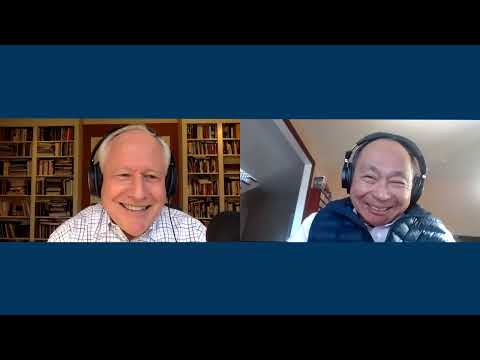
Francis Fukuyama on the War in Ukraine, Authoritarianism, and Liberal Democracy
What this covers
On the war in Ukraine, the weakness of strong states, and the resilience of liberal democracies. Click "Show more" to view all chapters. For more conversations, visit http://www.conversationswithbillkristol.org Chapter 1 (00:15 - 28:17): Where things stand in Ukraine Chapter 2 (28:17 - 56:43): Liberalism and Authoritarianism Eleven months into the war, where do things stand in Ukraine? What does the West need to do to help Ukraine win? What lessons can we draw from the war about the ambitions of authoritarians, the resolve of liberal democracies today, and the most pressing geopolitical challenges we face? To discuss these questions, we are joined by Francis Fukuyama, the Olivier Nomellini Senior Fellow at the Freeman Spogli Institute for International Studies at Stanford University, who has led important efforts in education and civil society in Ukraine over the last decade. According to Fukuyama, we are in the midst of a difficult moment in the war. Nonetheless, he argues, the fundamental dynamics remain unchanged: Ukraine can win if it receives adequate military and financial support from the West. Fukuyama argues that Ukraine’s impressive performance and Russia’s weakness should force us to confront and reassess the fashionable narrative of pessimism about liberal democracies. The war—as well as other recent developments—have revealed the reserves of strength and resilience in liberal democracies, while the weaknesses of “strong states” such as Russia and China have become more apparent. This assessment is not one of complacency. Rather, Fukuyama points to the high stakes of the war—and the importance of strengthening our resolve to defend free countries against authoritarian threats.
Source description (no synthesized summary yet).
Fukuyama argues that liberal democracies have demonstrated superior resilience and adaptive capacity compared to autocracies in the Ukraine crisis, and that this moment represents a potential generational turning point toward renewed Western commitment to democratic governance and alliance-building, though outcomes in 2023 remain uncertain and dependent on military success and sustained political will.
- Autocratic regimes like Russia suffer from centralized decision-making, poor information flows, and lack of institutional accountability, leading to catastrophic strategic failures despite apparent surface strength
- Democratic societies, particularly Ukraine and younger European leaders, demonstrate superior motivation, institutional adaptability, and legitimacy that outweighs authoritarian coercive capacity
- The Ukraine crisis has reactivated Western commitment to liberal democracy across generational lines, with implications for China policy and long-term geopolitical alignment
This asset isn't compiled yet
You're seeing its claims, ranked. Compile it to build the argument threads, weight them, and check each claim against your library — the full view.
Generational cycles operate in how people understand the world: people who lived through the depression, Reagan era, end of Cold War each developed lasting understandings of how the world works. If the Ukraine war leads to something that looks like a Western victory, this will create a lasting generational understanding of Western capability, not just temporary change.
“things do work in these generational cycles and so we've you know had several different Generations the one that lived through the depression then the one that lived through the Reagan Era then the end of the Cold War um that you know brought about very lasting understandings of how the world worked uh and I think this one if it does lead in fact to something that looks like a western Victory then I do think that it's not going to be just a temporary change but will um uh you know have this uh important uh kind of shift in in global attitudes”
Russia's fundamental weakness stems from reduced decision-making to a single individual (Putin) who lacks information, lives in an information cocoon, and failed to understand Ukrainian nationalism, deep corruption in his own military, and logistical realities, demonstrating how autocratic political systems produce very bad decisions.
“if you remember back to the early stages of the war you saw all those pictures of Putin sitting at a 30-foot table away from his defense minister a foreign minister because he was so afraid of covid and you know he obviously you know and it I think it gets to the heart of what's wrong with autocracy you basically reduce decision making to one single individual who's lacking in information living in his own uh information cocoon he didn't understand how Ukrainian nationalism had developed”
The pacifism that was inoculated into Japan and Germany through post-WWII settlement runs very deep in the generations that directly experienced the war and its aftermath, which accounts for the slowness of the current zeitenwende (change of era) that Scholtz has announced. The population, especially older parts, is still mired in old assumptions about dangers of German and Japanese militarism.
“it led to this gigantic cultural change in both countries where the people that directly experienced the war and its aftermath uh were kind of inoculated very very deeply you know pacifism runs very deep in that generation and I think that that's really that accounts for the slowness of the current you know zeiten Venda the the change of uh era that Schultz has talked about I mean you announced a change but you still have a population you know the older uh parts of which are still mired in these old assumptions about you know the dangers of German or Japanese militarism and you know destabilizing potential for that and not fully recognizing that the world has really changed”
Fukuyama was surprised at how well Ukraine came together and demonstrated extreme motivation and patriotism not just from middle-class elites but from the whole society including Russian speakers in the east who people thought would be loyal to Putin but turned out to be Ukrainian nationalist.
“I was actually surprised at the way the country came together and the extreme motivation and patriotism that was demonstrated not just by the kind of middle class Elites that I deal with but you know really by uh the whole society including a lot of Russian speakers you know in the East who people had thought would be loyal to Putin and Russia but turned out to be actually you know very uh Ukrainian nationalist”
Putin has ironically become the father of the Ukrainian nation in a way he never intended, because his invasion has crystallized Ukrainian national identity that transcends regional, linguistic, and class divisions.
“Putin ironically has become the father of you know the the Ukrainian nation in a way that I suspect he never intended to”
Ukrainians were much more effective than Russians at controlling the social media space after the invasion, while Russians were caught flat-footed and are continuing to make ridiculous assertions about denotification, whereas Ukrainians are building huge amounts of sympathy through better information management.
“one of the things that was a big surprise was how much more effective the ukrainians were at controlling that social media space after the invasion uh whereas the Russians seemed to be caught completely flat-footed you know they're continuing to make these ridiculous assertions about denotsification and uh you know this sort of thing and the ukrainians were actually building a huge amount of sympathy for themselves”
Ukraine's corruption problem was real and the country was dominated by six or seven oligarchs who controlled media and corrupted parliament, but the sociological thesis of Charles Tilly—'the state makes war and war makes the state'—is being demonstrated in Ukraine as incompetent leadership gets exposed through war and necessity forces meritocratic selection in government.
“there's no question that the country had a really big problem it was dominated by you know a group of about six or seven oligarchs that controlled the media that you know corrupted Parliament uh and so forth but you know there's this uh this thesis about war and State Building that's associated with the sociologist Charles Tilley you know who famously said that the state makes war and War makes the state and I think we're seeing a demonstration of this that you know in many respects uh you know you can you can hire your cousin to be uh you know the uh the chief of the general staff who's completely incompetent until you actually get into a real war”
Fukuyama's background as a Soviet military analyst at RAND Corporation for 10 years taught him that wars are won or lost by military logistics, and he observed that Russians don't pay attention to logistics, which led to their defeat around Kiev in early stages of war, setbacks in Kharkiv and Kherson, and will ultimately do them in in Crimea.
“I started my life as a analyst actually of the Soviet military when I worked at the Rand Corporation for the first 10 years of my career and you know the one thing I took away from that whole experience is that words are one or lost by military logistics it seemed to me that the Russians were in a very bad position with regard to that they don't pay attention to Logistics and sure enough you know that's what led to their defeat around Kiev in the early stages of the war that's what led to their setbacks and kharkiv and Carson and I think that's what's going to do them in ultimately in Crimea”
Democratic processes are slow and error-prone, but have superior capacity for self-correction when leaders screw up, allowing voters to change the people at top. This is an enduring strength of living in a liberal democracy.
“our Democratic processes it's true they take a lot of time they're slow we often make bad decisions but you at least have some Prospect of changing the people at the top uh if they really screw up and you know it certainly happened many times in American history so I think that's really one of the enduring strengths of living in a in a liberal democracy”
Abraham Lincoln's experience during the Civil War shows how military failure forces professionalization: he began the war with political generals who kept losing battles, then turned to professional military. Ukraine is experiencing this same process at a much faster scale because the emergency is deeper.
“Abraham Lincoln during the Civil War began the war having to appoint all of these uh political generals and they kept losing battles and that was the point at which they turned to a professional military and so we've seen this process play out at a much faster scale in Ukraine because the emergency was so much uh deeper”
States can appear strong through repressive capacity (controlling opposition, media, citizens) while being weak across other dimensions of state strength—particularly the ability to provide basic services to citizens. Russia can produce gazillions of tanks but cannot provide indoor toilets for 40 percent of its population, demonstrating this contradiction.
“there are different dimensions of State strength and when we look at countries like uh China and Russia we see one aspect of it which is their ability to repress political opposition to control the media to control the you know many aspects of the lives of their citizens but you know there are many asks other dimensions of of State strength that are also important um like the ability to actually provide decent services for their citizens you know one of the facts that's come out since the Russian invasion is something like 40 percent of the Russian population do not have access to indoor toilets”
The impact of the Ukraine invasion on Japan has been remarkable because many Japanese could not visually imagine an actual military operation, but when they saw tanks rolling across borders, cities being bombed, and refugees streaming from a European city, this changed minds and people realized the world has not actually changed—major conventional military conflicts are still possible in the modern world.
“the problem uh was simply that many people just could not visually imagine an actual military operation you know and then all of a sudden you saw these tanks rolling across the border and cities being bombed and you know refugees streaming out of you know a European city and this life went on and people's heads and said yeah actually the world has not changed it is possible to have a major conventional military conflict in our modern world and in we got to adjust to that”
It's not clear whether the 1947-49 Cold War decision to fight for 40 years was really as inevitable as it seems in history, though the current uncertainty about Ukraine commitment is a catch-22: if the US looks uncertain, it weakens those in Europe who want to look certain, and the same would be true of Japan.
“it's not as if they weren't opponents in 1947 48 49 to you know true I mean it's always a little dicier in in real time that it seems in history where you know of course we just decided to fight you know for 40 years to fight a cold before I don't know is that really as inevitable as it seemed and but but there's a little bit of a catch-22 problem if we look uncertain it's certainly weakened those in Europe who want to look certain and I assume the same would be true of Japan”
Fukuyama has been visiting US Indo-Pacific Command in Honolulu over the last decade, and over the last year or two (before the end of 2022), they have completely changed from thinking abstractly about Taiwan or South China Sea contingencies to being deadly serious about them, thinking through concrete military scenarios, with Japan rethinking their strategy in concrete terms about what forces they need.
“I've been going out to U.S indo-pack com in in Honolulu you know we've we've made several visits there over the last decade and I would say the last time I was there is maybe it was the year before covid and they were starting to think seriously about a Taiwan contingency or a South China Sea contingency that's completely changed now I mean they're deadly serious about that and they're trying to work through different kinds of military scenarios the Japanese are in the process of rethinking their whole strategy in very concrete terms you know what kind of troops would you need to defend the senkakus if you needed to you know range further out there they're talking about acquiring Counter-Strike capabilities which presumably would allow them to Target you know Targets in China itself so that's a really big you know that's a really big shift in mentality”
Zelensky has been extremely important because of his background, talents, abilities, and strength of character, particularly his decision not to flee at the war's opening and his daily speeches for nearly a year demonstrating fortitude and determination that keep up a sense of inspiration—something that doesn't exist in many other people.
“I think he's been extremely important uh you know we actually hosted a a rock star who is considering running for president uh at the in the same election that that led to zielinski's election and he's a very good you know guy I mean I like him a lot but I do think that zielinsky just from his background had certain talents and abilities and also kind of strength of character that I think was really uh critical you know this not wanting to run away at the opening of the war was just an unbelievably important decision”
The Ukraine invasion has probably been the single most covered war in history in terms of ability to see what's going on in minute detail, with virtually every Russian tank destroyed visible on the internet, and this modern communications capacity has had a big effect on many people's perceptions globally.
“this has probably been the single most covered War you know in terms of just your ability to see what's going on in a very minute you know virtually every Russian tank that's been destroyed as you've seen pictures of on the internet uh and so I do think that's had a big uh effect on many people”
Putin's legitimacy has been built on success on the battlefield in the context of the Ukraine war, but lacks a deeper reservoir of goodwill that would sustain him if defeated militarily. This contrasts with how autocratic legitimacy is fragile when performance claims fail.
“Putin has managed to I think rally a lot of support on the part of Russians because of the war so in that sense he's managed to create legitimacy but it's all dependent on the the success that he sees on the battlefield and if he is defeated you know he doesn't have a reservoir of Good Will that's going to last him”
China's Communist Party legitimacy was similarly built on a claim to competence and superior governance, with COVID handling as exhibit number one, but China has revealed huge weaknesses through inadequate intensive care beds and inadequate healthcare for rural citizens, undercutting its performance legitimacy claim.
“so much of the Chinese Communist party's legitimacy was built around this claim that they can actually get things done and their handling of covid was exhibit number one uh in how they were doing things better than Western liberal democracies and I think we've now seen that that is also uh you know wrong uh they they can do all this Mass testing but they don't have intensive care beds you know they don't have adequate Health Care especially for their rural citizens”
US allies across all parts of the world (NATO countries, Japan, South Korea, Israel) face a common set of challenges by being dependent on the US and look anxiously at American domestic politics because there's perpetual worry that US willingness to support them is weakening based on real changes in American politics.
“I think that all U.S allies in no matter what part of the world they're in uh you know face a common set of challenges by being dependent as they are so that's you know countries of NATO Japan South Korea Israel you know there's a lot of states that we've supported over the years and they look anxiously at our domestic politics because there's a Perpetual worry that our willingness to support them is you know is weakening based on some real changes going on in American politics”
Young German and Japanese people are experiencing a different generational moment where many have grown tired of being blamed for historical transgressions and are saying their countries should be more normal. This will lead to generational change similar to how younger Japanese are rejecting pacifist constraints.
“I mean a lot of German young people got really tired of being blamed for the Holocaust and you know said okay Germany should be a more normal country now and I think something similar to that is is you know going to happen in Japan”
Countries become more dangerous when they're in decline (Hal Brands argument), so if China has hit peak and is declining, starting something in foreign policy might be a way of distracting attention from internal decline. On the other hand, China might just focus on addressing a declining population and inadequate care for elderly rather than striking out on new foreign ventures.
“there's this Hal bronze kind of argument that actually countries become more dangerous when they're on the downside so if we've hit Peak China and they're now declining you know maybe starting something uh in foreign policy will be a way of distracting attention from that decline on the other hand it may just be Decline and they're going to realize that they've got a declining population that they haven't taken care of their old people and they need to focus on that rather than striking out on New foreign Ventures”
Ukrainian forward momentum observed at the end of summer 2022 has slowed down during winter, with Russians making marginal gains around Bakhmut while Germany has dragged its feet on providing Leopard tanks, but if the West continues to provide adequate weapons, Ukrainians will be able to break out of current positions by spring and put Russia's entire position in Crimea in danger by taking Mariupol and other southern cities necessary for Ukraine to be a viable state capable of exporting goods.
“we're in a kind of dispiriting phase because of the Ukrainian forward momentum that we saw at the end of the summer has slowed down uh they're in the middle of a you know a very cold winter the Russians have actually made a few very marginal gains”
Japan and Germany were aggressors in WWII, lost the war, had constraints imposed on their sovereignty by the US, and were embedded in the NATO alliance and US-Japan security treaty with pressure to become pacifists. The Japanese Constitution, written by Americans, even paid them to avoid having a military and conducting defensive operations.
“Japan and Germany were the aggressors in World War II they lost the war and we imposed uh basically big constraints on their sovereignty you know we embedded them in the NATO alliance in Germany's case U.S Japan security treaty in Japan's case but basically pushed them to become pacifists you know the Japanese Constitution that was written by a bunch of Americans for paid them to have a military and to conduct actually by some wording you know even defensive operations”
Democracy in Europe is largely pretty solid at the moment, Japan is solid, South Korea has problems but is doing okay, and new left-wing presidents in Latin America are too incompetent to accomplish their agenda because democracies still function as constraints on executive power, so the world is more stable and doing better than many people think.
“I think you know there are also reasons for seeing the resilience of democracy I mean democracy in Europe I think is largely pretty you know pretty solid uh at the moment uh and um solid in Japan uh South Korea's got its problems but you know it's it's doing okay I think this new crop of left-wing presidents in Latin America are by and large so incompetent that you know I'm going to go to Columbia next week uh I haven't been there in in probably a decade or so but you know this new left-wing president they have I don't think is going to be able to accomplish any of his agenda because these countries are still democracies and you know you can't just order uh you know a complete reversal of policy because you narrowly won an election”
The US has troops in Germany and Japan that were previously symbolic reassurance of US resolve, keeping both countries pacifist and reassuring other allies, but this is now being viewed differently—not as symbolic but as actual forces that might have to fight.
“we visited Okinawa and it was all fine we were strongly in favor of the US Japan Alliance and all that but it was sort of everyone took it to be symbolic in a sense you know that it was very reassuring to them it also kept them pacifist which is probably a good thing for the rest of Asia and certainly some other countries including other Ally countries like South Korea and we're happy about that so it was sort of sort of like the U.S troops in Germany after 89 which we left there it was not to stop anyone from evading but kind of a reassurance of U.S resolve but it feels to me that people are a little more considerably more serious about the fact that you know troops are there also because they might have to fight”
China is a much bigger player waiting in the wings than Ukraine/Russia, and if there's a war in the Far East, it would make Ukraine look pretty minor by comparison in terms of damage and risk. Whether the West would be willing to stop a Chinese attempt to conquer Taiwan is uncertain, but if China succeeds regardless of Ukraine outcome, that would be a huge demonstration of authoritarian power and Western weakness.
“there are many other complications though because the other big player waiting in the wings is China and you know in a way if there's actually a war in the Far East it would actually make Ukraine look pretty minor in comparison you know to first of all the amount of damage and risk that that would uh produce and the outcome is also very uncertain uh it's not clear you know whether we would be willing to stop a Chinese attempt to conquer Taiwan and if they did that regardless of what happens in Ukraine I think that's going to be a huge demonstration of authoritarian power and if we can't do anything to stop it or deter it it's going to be a big demonstration of Western uh Western weakness”
Internal Chinese dynamics, not external factors like US policy, are what's mostly driving the new era in the Far East, which may be even more important than Ukraine and Russia.
“that's mostly driven by internal Chinese Dynamics not by yes us I mean we can affect things uh you know that's really why we went on this trip is to judge Japanese willingness to stand up to China”
The Biden Administration has done pretty well with Ukraine, better than expected, though some think they could have been quicker and bigger on a couple of areas. If Trump wins in 2024, this would be concerning for European allies' commitment to Ukraine.
“I think the Biden Administration is pretty committed I myself would go wish they'd been a little quicker and a little you know bigger on a couple of areas but pretty I think there's no and there's pretty good support uh Sarah has been in Congress and uh one of them said what if Trump wins in in 2024 and I said well that's a fair point”
The US boosted LNG exports and diverted many from Asia to Europe instead, leading some conspiracy-minded Europeans to think this is a deliberate plot to make Europe dependent on American LNG, but it was actually the result of long-term policy with a lot of foresight.
“what we did was we really boosted LNG exports you know diverted a lot of them from that were going to Asia and sent them to uh to Europe instead and uh to the point where some conspiracy-minded Europeans think that this is all a deliberate plot you know to make them dependent on our LNG but but it was I think the result of a pretty you know uh uh for uh long-term policy that that had a lot of foresight in it”
Germany's response to the energy crisis proved more successful than expected: industries made big adjustments, they stored natural gas over summer, and a fairly mild winter allowed them to maintain higher gas supply levels than a year ago, meaning Putin's strategy of freezing Europeans to death has been a complete failure.
“it's a combination of luck and resourcefulness because they took a lot of measures to store natural gas over the summer the industries in Germany especially really did make big adjustments to deal with the energy shortage and they had luck because it's been a fairly mild winter and so they actually have higher levels of gas supplies now than they did a year ago so you know all together I think the strategy that Putin was trying to execute of freezing the Europeans to death and freezing them into submission you know has been a has been a complete failure”
On the American right (MAGA Republicans), there is openness to anything the Russians put out—any disparaging of Ukraine, claims about Nazis, various slanders that the Russians have put forward are repeated by Tucker Carlson and others on the right. Because they live in a completely parallel information universe and believe they're basing views on empirical information, the US remains divided and polarized by divergent information universes.
“one of the big problems that we have is that on the Maga right uh they basically are very open to you know anything that the Russians put out so anything you know disparaging of Ukraine I mean you know the existence of Nazis you know the uh you know these various Slanders that the Russians have put forward are repeated by Tucker Carlson and you know other people on the right and because they live in a completely parallel information universe they believe that you know they're basing their views on empirical information and so you know in that respect we're still living in a very you know divided and and polarized world that where the polarization has to be traced really back to the basic information the universes that you know we live in”
There is a clear generational divide in Europe where people in their 30s and 40s seem very much moved by and invested in Ukraine's success and understand it as a moment to shape the future around liberal democracy, while older people show caution, wariness, pacifism, and some have business ties to Russia.
“people in their 30s and 40s seem very much you know moved by invested in a sense the success of Ukraine and understood this was this was their moment to the sense this was there you know this was their the way they could the moment to shape the future uh they they talked a lot about the broader implications for Liberal democracy and autocracy I think people who were older and certainly you could see this I think in the chancellor there's a certain kind of you know we have to be very careful and some of them of course have business ties with Russia and others and history of that”
Oligarch Rinat Akhmetov, who controlled big iron, steel, and energy resources in eastern Ukraine, has had his properties relentlessly bombed by Russians. In a future Ukraine assuming victory, such oligarchs will be much less important and the democratic future looks better because of strong national identity.
“the chief one renat ahmiatov who controlled all of those big you know iron steel energy resources in eastern Ukraine it's his properties that have been relentlessly bombed by the Russians and I think in a you know a future Ukraine assuming that they do win the war uh you know those kinds of people are going to be much less important and uh you know the Democratic future of the country I think you know looks a lot better because there is such a strong sense of national identity now”
The critical unknown is whether Japan would be willing to give aid to the US and help protect Taiwan if China attacks Taiwan without directly attacking Japan. This is something Japan has not yet figured out, similar to Germany's debate over Leopard tanks.
“that's very uncertain I mean it's just like in in Germany you know there's a lot of resistance to actually the idea of Japanese military forces taking part in you know offensive office operations you know sinking Chinese ships and that sort of thing there may be a little bit more support for foreign assisting the United States so we got this very important air base on Okinawa kadena where the U.S Air Force operates out of we got Marines on hokey now and these would be forces that would be very important in a Taiwan contingency and Japan has to make a decision whether to allow us to use you know those bases to help Taiwan and that's something that they have not figured out yet”
Russia had invested a lot in internet shutdown capacity and people were worried about their ability to shut down Ukraine's internet, but they seem to have underperformed, or Ukrainians were much more effective in defending against them, or Elon Musk's Starlink system kept Ukraine's internet working under stressful conditions and has been a godsend for Ukraine.
“you're people thought Russia had invested a lot in this kind of thing and people were worried about their ability to shut down uh the internet and so forth it seems like they've underperformed there I don't know or maybe in maybe the ukrainians are much more effective in defending against them very early on I don't know”
There is still an undercurrent of anti-Americanism in Europe with people saying the US got Ukraine into this war to sell LNG and keep Europe under American domination, and some say this isn't Europe's business or isn't worth the commitment, but the Ukraine crisis has generally led to more solidary response than expected.
“there's still a undercurrent of anti-americanism these are the people that say you know the United States go to Ukraine into this war in order to be able to sell LNG to uh uh to Europe and and keep us under American domination and I think that you know there's a certain number that say well this simply isn't uh you know this isn't our business or it's not worth the degree of uh commitment um but I do think that um you know the populists have really taken a hit as a result of the war”
Emmanuel Macron said a few years ago that NATO was brain dead and completely irrelevant to the contemporary world, but the Western reaction to the Ukraine invasion demonstrates that's really not the case any longer.
“if you recall a few years ago uh the French President Emmanuel macron said that NATO was brain dead and completely irrelevant to the Contemporary world and I think that uh you know we've seen a demonstration of why that's really not uh not the case any longer”
Ukrainians need to make a breakthrough in southern Ukraine by summer 2023, and if they don't manage that with adequate Western support, all bets are off and Ukraine could be facing a frozen conflict with Western support disappearing.
“I think the ukrainians have to make a breakthrough in uh in the South uh by the summer and if they don't manage to do that and if we don't give them adequate support to do that then I think all bets are off and then you could be facing another Frozen conflict and you know a lot of that Western support is going to disappear so it's really really important what happens on the battlefield in the next I would say six months”
Fukuyama's confidence that liberal democracies would do better than autocracies, and his correct prediction of Ukrainian victory, provides some reassurance because his reasoning—that autocracies have hidden structural disadvantages—appears sound.
“the fact that you got the Ukraine Russia situation basically right is heartening not just because it's nice that you got it right but also because it the reason you got it right I think so far seems to have been a certain confidence that liberal democracies would do better and as you said the strong States autocracies in this case had disadvantages that people weren't you know fully aware of or cognizant of I mean that I think is is heartening”
Democratic pessimism about the future has been somewhat overdone, and while there have been real concerns about democratic recession, this needs to be put in broader historical perspective. Democracy shows resilience in Europe, Japan, South Korea, and even dysfunctional Latin American democracies constrain executive overreach.
“I do think that uh the Democratic pessimism small the Democratic pessimism that a lot of people have felt over the last few years has been a little bit uh overdone they don't like Holly Larry Diamond has been writing about the Democratic recession and you know he you know you can be very selective I mean there's still bad things going on you know all over the world uh but you know putting that in a broader historical perspective uh I think you know there are also reasons for seeing the resilience of democracy”
Fukuyama fears that people in the US are not sufficiently aware that a big war in Asia could actually happen fairly quickly and that the US is really not prepared for it.
“you know what I fear is that people here are not sufficiently aware that you could actually have a big war in Asia and that that could actually happen fairly quickly and that we're really really not prepared for it”
China's economic model is coming apart. Some Chinese economists believe growth has been negative over the last couple of quarters, which is remarkable because China hasn't had a recession since 1988 when they began reforms. There are huge vulnerabilities in buildup of provincial government debt.
“their economic model is coming apart uh you know some of our Chinese Economist friends in my Institute actually believe that their growth has been negative over the last couple of quarters which is really something because they haven't had a recession since 19 88 when they began their reform uh there are huge vulnerabilities in this buildup of debt on the part of provincial governments in China”
Fukuyama traveled four times to Europe in the fall of 2022 (Spain, Portugal, Czech Republic, Germany, Netherlands, Greece) and was amazed at the degree of enthusiastic support for Ukraine everywhere, though there remains a problem in Germany due to lingering pacifism, especially among older Germans with vivid memories of WWII.
“I have certainly been surprised at the overall Western reaction I mean I I traveled a lot I took four trips to Europe last fall Spain Portugal you know Czech Republic Germany Netherlands a lot of a lot of different places Greece and you know in every single one I was just amazed at the degree of you know enthusiastic support now obviously we got a problem in Germany because there still is this lingering pacifism that especially affects you know older Germans that kind of have a more vivid memory of you know the war and uh or at least the uh that the residue of World War II”
The most discouraging thing about the last few years is the number of Americans who could vote for Trump and buy into the Trump narrative. Fukuyama thought Americans could make a mistake but correct it, but the correction has taken much longer than expected. However, the November 8th election results were very heartening because election deniers didn't materialize in key roles where they could manipulate the 2024 election.
“the most discouraging thing about the last few years is just the number of Americans that could vote for Trump and buy into that whole uh you know Trump narrative I I had always sort of thought that the American people could make a mistake but then they correct it you know once they saw the mistake and the correction has taken much longer than I thought but I do think it is ultimately being corrected and I thought the results of the November 8th election were very very heartening you know this very specific threat that many of us were worried about that the Republicans would place these election deniers and these key roles where they could then manipulate the 24 election that just didn't materialize”
American responses to Ukraine depend heavily on whether Republican party reverts to Reaganism or Trumpism, with the split potentially being 70-30 one way or the other, which would make a big difference. The 2024 presidential campaign and which way Republican candidates have been quiet on foreign policy will be important in determining this.
“what chunk of the Republican party reverts to some form of reaganism and what Trump what chunk is goes to trumpism is I mean it makes a big difference I think in American politics if that's 70 30 one way or 70 30 the other way it's not going to be 100 zero you know I mean this trumpism isn't going away I don't think the Reagan's the Reagan strand is still somewhat alive and well among some people though so um but it makes a big difference if it's which has the majority of the 24 presidential campaign for Republicans would be important in that respect and which way people have been pretty quiet like DeSantis you know on foreign policy who want to sort of be the Trump Heir but don't maybe quite want to be fully Tucker carlsonesque on on things like Ukraine”
The consequence of China's provincial debt buildup will not be a Lehman Brothers type collapse but rather something like Japan's experience: instead of 6-7 percent annual growth, China will have 1 percent or zero percent growth for the next 20 years, which will fundamentally change their geopolitical model.
“the consequence of that is not going to be a Lehman Brothers type collapse of the economy it's just going to lead to something that looks like Japan where for the next 20 years instead of having you know even six seven percent annual growth you know they're going to give one percent or zero percent and under those circumstances you know their whole model is going to look different”
Populists in Europe (Salvini with Putin t-shirt, Marine Le Pen taking Russian loans, Meloni as Mussolini fan) have been put on their back foot by the war, with their prior Russian alignment now politically toxic, though they still represent a reservoir of support for Russian positions like MAGA Republicans.
“the populists have really taken a hit as a result of the war you know salvini had a Putin t-shirt you know and was very openly courting a Russian influence Marine Le Pen similarly had taken money loans from uh you know from Russia and all of those people have kind of had to backtrack you know very substantially Georgia Maloney this new prime minister of Italy uh you know is a big fan of Mussolini but she's been actually very good on Ukraine”
A letter by Ro Khanna and J.D. Vance calling for Ukraine settlement was pulled back very quickly because they saw which way the wind was blowing, which is a hopeful sign that dovish sentiment on the left may not prevail. However, voices like Jeffrey Sachs and John Mearsheimer keep arguing that Ukraine can never win and therefore settlement is necessary, and this argument can come back when Ukrainians slow down.
“that letter that promula Jai Paul uh put forth over the summer I got pulled back very very quickly because they saw which way the wind was blowing so that's uh you know that's a hopeful sign but you know on on the left you still have uh you know the Jeffrey saxes and John beersheimers and so forth that are you know I mean it really does follow this cycle that every time the ukrainians look like they're slowing down and and they're kind of stuck uh militarily you know those voices get louder and say Well they're never going to win and therefore we have to have a settlement”
The year 2023 represents an unusual moment with the widest range of possible outcomes since 1989, with multiple unresolved questions: Ukraine war outcome, American political direction (Reaganism vs Trumpism), European and Japanese strategic reorientation, and Chinese internal dynamics all uncertain.
“it does feel like an unusual moment in our since maybe the most unusual since the most I don't know the widest range of possible outcomes maybe since 89 is that right it's great for pundits you know or bad if you get it all rise and much much greater chance of getting it raw”
The ATACMS (long-range missile system) that the West has been refusing to give Ukraine would be so useful for targeting Russian bases in Crimea and southern Ukraine, but for some reason the US hasn't done this despite it being within its power.
“these eight hackens uh that we've been refusing to give them would be so useful they could Target all of these Russian bases in Crimea you know in southern Ukraine why we have not done this it's just beyond me”
Trump coming back seems pretty unlikely to Fukuyama because the guy has 'gone crazy' sitting in Mar-a-Lago, and people figured out what he represents in 2016 when he was new and offering something different, but it's not going to attract new support now.
“a trump comeback just seems to me pretty unlikely yeah I mean the guy has really gone crazy you know sitting there in Mar-A-Lago uh uh and it's very hard to see that a lot of people are going to see him as any kind of uh you know what was attractive in 2016 was he was new he was offering something different and I think people at this point kind of figured out what he represents and it's you know it's not something that's going to attract a lot of new support”
Fukuyama believes House Republicans pursuing Hunter Biden's laptop investigation will make themselves look ridiculous and is betting that voters won't be as interested in that as the Republicans hope, making him more optimistic about the next two years.
“I just think that the Antics now of the House Republicans I just think they're going to make themselves look kind of ridiculous maybe this is wish casting but uh I just don't believe that Hunter Biden's laptop is going to be of such consuming interest you know to American voters going forward so um so in that sense I guess I'm I'm more optimistic than uh than I was before November”