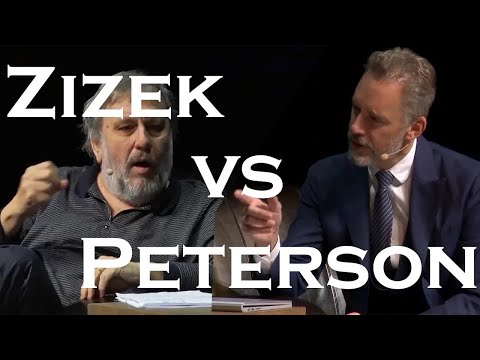
Slavoj Zizek debates Jordan Peterson [HD, Clean Audio, Full]
What this covers
Slavoj Zizek and Jordan Peterson debate on the concept of Happiness: Capitalism vs Marxism. The event was billed as “the debate of the century”, “The Rumble in the Realm of the Mind”, and it did have the feel of a heavyweight boxing match: Jordan Peterson, local boy, against the slapdash Slovenian Slavoj Žižek in Toronto.
Check out these Peterson and Zizek books on Amazon! Zizek's "The Sublime Object of Ideology": https://amzn.to/4hFPOrm Zizek's "The Relevance of the Communist Manifesto": https://amzn.to/4iZBnQ2 Peterson's "Maps of Meaning: The Architecture of Belief": https://amzn.to/4hSu7EI Peterson's "12 Rules for Life: An Antidote to Chaos": https://amzn.to/4c3IKna
Join us on Patreon! https://www.patreon.com/ManufacturingIntellect
Get Two Books FREE with a Free Audible Trial: https://amzn.to/313yfLe
Checking out the affiliate links above helps me bring even more high quality videos by earning me a small commission! And if you have any suggestions for future content, make sure to subscribe on the Patreon page. Thank you for your support!
Source description (no synthesized summary yet).
Peterson argues the Communist Manifesto is fundamentally flawed in its axioms about class struggle and the dictatorship of the proletariat, while Žižek contends that capitalism contains unresolved antagonisms (ecological, technological, spatial) requiring collective action beyond market solutions, though both agree happiness is a byproduct of meaningful engagement with responsibility rather than a direct pursuit.
- Peterson identifies ten axiomatic errors in Marxist thought, particularly the binary class model and assumption of proletarian moral superiority, which historical communist experiments proved catastrophic
- Žižek argues modern capitalism's internal contradictions (environmental collapse, digital control, global inequality) cannot be solved by markets alone and require new forms of international cooperation
- Both speakers reject happiness as a goal in itself, instead locating human flourishing in the assumption of responsibility and meaningful struggle against suffering and ignorance
This asset isn't compiled yet
You're seeing its claims, ranked. Compile it to build the argument threads, weight them, and check each claim against your library — the full view.
The binary class division between proletariat and bourgeoisie proposed by Marx is unreliable because people can be divided into multiple overlapping identities (based on education, wealth, family background, profession), and this ambiguity about who counts as 'oppressor' versus 'oppressed' was a central driver of the Red Terror and collectivization deaths.
“Marx also assumes that you can think about history as a binary class struggle with clear divisions between say the proletariat proletariat and the burrs huazi and that's actually a problem because it's not so easy to make a firm division between whose exploiter and whose exploit”
Almost all ideas are probably wrong, and the job of a critical thinker is to assume first that one's own ideas are wrong and then assault them with everything in one's arsenal to see if they can survive.
“almost all ideas are wrong and so if you and it doesn't matter if they're your ideas or someone else's ideas they're probably wrong and even if they strike you with the force of brilliance your job is to assume first of all that they're probably wrong and then to assault them with everything you have in your arsenal and see if they can survive”
Happiness and misery are mediated by different psychobiological systems and should not be conflated; happiness scales measure absence of misery rather than presence of positive states.
“it's not exactly obvious whether the happiness measures are measures of happiness or whether they're measures of the absence of misery and my sense is as a psychometrician who's looked at these scales that people are more concerned with not being miserable than they are with being happy those are all actually separate emotional states mediated by different psycho biological systems it's a technical point but it's important one”
Modernity requires that we bear the burden of freedom ourselves, taking responsibility for our burdens without relying on unquestionable external authority, and we cannot return to traditional authority because any such return is a 'postmodern fake'.
“since we live in a modern era we cannot simply refer to an unquestionable authority to confer a mission or task on us modernity means that yes we should carry the burden but the main burden is freedom itself we are responsible for our burdens not only are we not allowed cheap excuses for not doing our duty duty itself should not serve as an excuse we are never trust instrument of some higher cause once traditional Authority loses its substantial power it is not possible to return to it all such returns are today a postmodern fake”
Political power and expertise should be kept apart, as ancient Greece understood (even combining popular vote with lottery to prevent expert rule); communism's fatal error was not keeping them apart, which is why it failed and then became tyranny.
“political power and competence or expertise should be kept apart in Stalinism precisely they were not kept apart while already in ancient Greece they knew that they have to be kept apart which is why the popular weight was even combined with lottery often”
Traditional communism promised that removing class structure would lead to happiness through material security; this teleological structure is dangerous because it encourages self-instrumentalization—viewing oneself as an agent of history with justified certainty about future outcomes.
“the danger in Marxism is for me this teleological structure we are at the zero point but there is a unique chance of a reversal into a new emancipated society and so on and the danger here is that of self instrumentalization Praetorian communist party is a an agent of history which knows the laws of history to put it follows them”
The concept of 'dictatorship of the proletariat' is both conceptually and practically flawed because: (1) it assumes a minority of proletariat can be chosen without specification of how they'll be selected, (2) it assumes this group won't be corrupted by sudden access to power despite being drawn from the same population as the 'evil capitalists', and (3) it assumes this minority can make centrally the impossibly complicated computations required to run a market economy.
“how they're going to be chosen isn't exactly clear in the communist manifesto but none of the people who are from the proletariat class are going to be corrupted by that sudden access to power because they're well by definition good so so then you have the good people who are running the world and you also have them centralized so that they can make decision decisions that are insanely complicated to make in fact impossibly complicated to make and so that's a failure conceptually on both dimensions because first of all all the proletariat aren't going to be good and when you give put people in the same position as the evil capitalists especially if you believe that social pressure is one of the determining factors of human character which the Marxist certainly believed then why wouldn't you assume that the proletariat would immediately become as or more corrupt than the capitalist which is of course I would say exactly what happened every time this experiment was run”
Ideological belief operates at a level deeper than conscious thoughts: we can consciously disavow belief (like Niels Bohr about the horseshoe) but still structure our behavior around it, which means ideology cannot be overcome through intellectual argument alone.
“the idea is it works even if you don't believe in it now that's ideology today that ideology today fundamental I want to solicit from you patellar Joe I don't you see I think I think that people are are possessed by ideas that aren't theirs”
Christianity introduced an unprecedented idea: that a divine spark dwells equally in everyone, and this enables the creation of a community where familial and hierarchic values are at least partly abolished—a vision that democracy extends to the political sphere.
“the change enacted by Christianity it's not just that in spite of all our natural and cultural differences the same divine spark dwells in everyone but this divine spark enables us to create what Christians call holy ghost or holy spirit a community which hierarchic family values are at some level at least abolished remember Paul's works from Galatians there is no longer true or Greek there is no longer male and female in Christ a democracy extend this logic to the political space”
Modern global capitalism contains three unresolved antagonisms that threaten its indefinite reproduction: (1) the ecological commons threatened by pollution and climate change, (2) the biological commons threatened by new biogenetic technologies that could alter human nature, and (3) the political commons of global humanity's interconnected but divided world.
“the question is does today's global capitalism contain strong enough antagonisms which prevent its indefinite reproduction I think there are such antagonisms the threat of the collage achill catastrophe the consequence of new technical difficult specialty environ ethics and new forms of apartheid all these antagonisms concern what Marx called Commons the sharp substance of our social being”
Modern neoliberalism is not a weakening of state power but an active transformation of state power to serve capital; the state plays a larger role than ever, but in the service of capital accumulation rather than the common good.
“just think about in what way global market already functions today I always thought that neoliberalism is a vague term if you look closely you will see that state plays today more important role than ever precisely in the richest capitalist economies”
Proposed solutions like solar radiation management (continuous dispersal of aerosols to reflect sunlight and cool the planet) exemplify the dangers of geoengineering—they could trigger unpredictable catastrophes while trying to solve ecological crises.
“the idea which is floating around of solar radiation management the continuous massive dispersal of aerosols into our atmosphere to reflect and absorb sunlight and thus cool the planet can be even imagine how the fragile balance of our earth function and in what unpredictable ways geoengineering can disturb it”
The state plays a more important role than ever in the richest capitalist economies; the market is already limited, but not in the right ways—showing that the problem is not market limitation per se but what it is limited for.
“I always thought that neoliberalism is a vague term if you look closely you will see that state plays today more important role than ever precisely in the richest capitalist economies so you know the market is already limited but not in the right way”
Human hierarchies are not fundamentally predicated on power; reliable authority in human society is achieved primarily through competence and trustworthiness, not through exploitation, which is a very unstable means of obtaining power.
“human hierarchies are not fundamentally predicated on power and I would say that biological anthropological data on that or crystal clear you don't rise to a position of authority that's reliable in a human society primarily by exploiting other people it's a very unstable means of obtaining power”
Happiness as a direct goal is problematic because humans are very creative in sabotaging their own pursuit of happiness; we pretend to desire things we don't really desire, and the worst thing that can happen is actually getting what we officially desire.
“happiness as a goal of our life is a very problematic notion if we learned anything from psychoanalysis it is that we humans are very creative in sabotaging our pursuit of happiness happiness is a confused notion basically it relies on the subjects inability or unread enos to fully confront the consequences of his/her their desire in our daily lives we pretend to desire things which we do not really desire so that ultimately the worst thing that can happen is for us to get what we officially desire”
Democracy's wager is that ultimate decision-making should remain with all people despite differences in competence, precisely because political power and competence should be kept separate to prevent rule by 'fake experts' who claim to know what's best.
“in spite of all differences in competence the ultimate decision should stay with all of us the wager of democracy is that we should not give all power to competent experts it was precisely communist in power who legitimize the rule by posing as fake experts”
Not lying and avoiding deceit is a primary pathway toward spiritual and intellectual integrity because lies reinforce possession by unconscious ideologies; stopping oneself from lying requires confronting what one actually believes and desires.
“one of the ways of escaping from that possession by the kind of ideology that you're describing which is liken it's like an unconscious of unidentified axioms it's something like that even though they take personified form they're like personalities is to stop saying things you know not to be true it's a nice pathway forward”
Marx did not advocate for egalitarianism as commonly understood; he explicitly dismissed equality as a 'bourgeois category' in his critique of the Gotha program, seeing communism as transcending equality rather than realizing it.
“another point nonetheless where well at one point I'm ready to play where did you find this these ghosts maybe for today's politically correct drugs and so on that this egalitarianism there is one passage in his late critic of Goethe program where Marx directly accesses the problem of equality and he dismisses it as a strict bourgeois category explicitly explicitly for him communism is not a Galit arianism”
The primary problem with the Chinese political system is that organizing trade unions and independent workers' movements is dangerous, despite the economic freedom, showing that capitalism without political democratization creates new forms of control.
“the Communist Party is the best manager of capitalism and protector against workers the truly dangerous thing in China today is not to flirt with Western ideas is to organize trade unions to you know like this is what worries me”
Equality should be defined as equality of opportunity—creating the space for many individuals to develop their different potentials—rather than equality of outcome, and this is actually threatened more by capitalism than enabled by it.
“the quality I advocate creating the space for as many as possible individuals to develop their different potentials it is that my paradoxical claim it is today's capitalism that equalizes us to mark and causes the loss of many talents so what about the balance between equality and hierarchy did we really move too much in the direction of equality is there in today's United States really too much equality I think a simple overview of the situation point in the opposite direction”
Free universal healthcare and education should be understood as enabling rather than restricting creative freedom; they create the space for people to focus on meaningful creative issues rather than survival needs.
“I see no threat in to free creativity in this program on the contrary I see health care and education and so on as enabling me to focus my life on more important creative issues I see equality this basic equality of trench's as a space for creating differences”
Foucault, despite being post-modernist, was not primarily anti-modern or revolutionary; his real target was Marxism, and his politics involved celebrating marginal positions rather than seeking central power.
“so strange that you mentioned for example somebody like Foucault who for me that his main target was Marxism okay for him represented in energy and his game was never a radical change but and this is what I don't like in this what you call postmodern let's not call the Marxist but revolutionary it's this enjoying your own self marginalization the good thing is to be on the margin you know like not in the centre and so on and so on it almost made me nostalgic for old communiques to at least get the honesty to say no we don't enjoy our margin position we want to do something central power”
Hedonic pleasure-seeking is not the primary human danger; the more serious danger comes from those who sacrifice pleasure for an ideological cause, showing that asceticism and self-denial can be more destructive than hedonism.
“I would not say why the choice there ok so well so first of all I have to point out that it's you have unfairly tasked me with three very difficult questions and so I'm hoping that I can this life that's like if you said life is the challenge in Soho so so I'm going to I'm hoping that I have the mental wherewithal to keep them in track and answer them in order but you can help me if I stray I was very interested in your comments about the above Christ's atheism on on the cross that final moment of atheism that that's something I'd I'd never thought about in that way”
Hierarchies are necessary to solve complicated social problems and are a very efficient way of distributing resources, but the problem is that they also dispossess people at the bottom—this is the fundamental existential problem of inequality, not something unique to capitalism.
“hierarchical structures are actually necessary to solve complicated social problems we have to organize ourselves in some manner and you have to give the devil is due and so it is the case that hierarchies dispossessed people and that's a big problem that's the fundamental problem of inequality but it's also the case that hierarchies happen to be a very efficient way of distributing resources”
Marxism assumes that once the bourgeoisie are eliminated and their private property removed, the remaining proletariat dictatorship will mysteriously become hyper-productive without any theory of how or why this would occur, and this hyper-productivity is logically necessary for the utopian stage to work.
“marks and angles also assume that this dictatorship of the proletariat which involves absurd centralization the overwhelming probability of corruption and impossible computation as the proletariat now try to rationally compute the manner in which an entire market economy could run which cannot be done because it's far too complicated for anybody to think through the next theory is that somehow the proletariat dictatorship would become magically hyper productive and there's actually no theory at all about how that's going to happen and so I had to infer the theory”
The Marxist utopia assumes that if you give people material security and freedom from economic want, they will spontaneously engage in meaningful creative labor, but this ignores Dostoyevsky's insight that people are built for trouble and if handed everything on a silver platter, they would engage in creative destruction just to have adventure.
“Dostoyevsky's idea was that you know we were built for trouble and if we were ever handed everything we were we needed on a silver platter the first thing we would do is engage in some form of creative destruction just so something unexpected could happen just so we could have the adventure of our lives and I think there's something well there's something to be said for that”
Social power and political authority cannot be directly grounded in competence; authority is something 'mysterious even irrational' and requires a gap between the ruler and the ruled that competence cannot establish.
“I think that social power and authority cannot be directly grounded in competence in our human universe power in the sense of exerting Authority is something much more mysterious even irrational Kierkegaard my and everybody's favorite geologist wrote if a child says he will obey his father because his father is a competent and good guy this is an affront to father's authority”
Capitalism's managers are not motivated by evil but by the internal logic of capitalism itself, which does not account for environmental consequences in decision-making—this is not a moral critique but an analysis of structural incentives.
“there is a problem with capitalism here for the simple reason that its managers not because of their evil nature but that's the logic of capitalism care to explain self reproduction and environmental consequences are simply not part of the game this is again not a moral reproach”
Performing casual moral actions often leads immediately to justification of less moral actions because the person has symbolically elevated themselves morally, which is psychologically documented and reflects people performing the moral action specifically to enable themselves to commit the less moral one.
“if they perform a casual moral action they immediately justify committing a less moral action because they've put themselves in a higher moral place and you might if you were real pessimist you'd say well that's why they performed the action to begin with I think that's often true that's associated with that shallow moralizing”
Marx himself admits in the Communist Manifesto that capitalism is the most effective system at producing material commodities in excess compared to any system in history, yet he still advocates revolution instead of allowing the system to play itself out toward material security for all.
“marks it agree admits and angles admit repeatedly in the Communist Manifesto that there has never been a system of production in the history of the world that was as effective at producing material commodities in excess than capitalism like that's that's extensively documented in the Communist Manifesto and so if your proposition is look we got to get as much material security for everyone as we as possible as fast as we can and capitalism already seems to be doing that at a rate that's unparalleled in human history wouldn't the logical thing be just to let the damn system play itself out”
New biogenetic technologies, especially neural links directly connecting brains to digital machines, represent a genuine game-changer that could enable unprecedented forms of control and surveillance without individuals' knowledge or consent.
“the digitalization of our brain opens up unheard of new possibilities of control directly sharing your experience with your beloved may appear attractive but what about sharing them with an agency without you either knowing kit”
Today's fundamental inequality documented by Piketty cannot be justified on the basis of differential competencies; market success is not an innocent or neutral regulator of social recognition of competence.
“I find it very hard to ground today's inequalities as they are documented for example by Piketty in his book on to ground today's inequalities in different competencies competencies for what in totalitarian states competencies are determined politically but market success is also not innocent in neutral as a regulator of the social recognition of competences”
Human sexuality, while biologically conditioned, is 'trans-functionalized' through culture and psychology into complex forms that bear little resemblance to reproductive instinct—humans have extended sexuality beyond mating season and developed perversions, courtly love, and metaphysical passion as uniquely human elaborations.
“our sexuality works sexual instincts are of course biologically determined but look what we humans made out of them they are not limited to the mating season they can develop in a permanent up into a permanent obsession sustained by obstacles that demand to be overcome in short into a properly metaphysical passion that perturbs the biological ritum with twists like endlessly prolonging satisfaction in courtly love engaging in different perversions and so on and so on so it still yes biologically conditioned sexuality but it is if I may use this term trans functionalized it becomes a moment of a different cultural however you call it logic”
The social justice identity politics that Peterson critiques are a logical derivation from Marxism's fundamental oppression narrative, smuggling Marxist analytical categories into contemporary discourse under a different name.
“it also seemed to me that the social justice group identity processes that dr. Dusek was decrying are to me a logical derivation from the oppression narrative that's a fundamental presupposition of Marxism so there I never heard a defense of Marxism in that part of his argument as well”
It is crucial to reject the simple opposition between postmodern political correctness and alt-right movements; reasonable alternatives exist that neither embrace PC moralism nor alt-right nationalism, and people should think rather than immediately label disagreement as fascism.
“I hope sincerely that we made at least some people to think and to reject this simple opposition there are quite reasonable but the only alternative to all try it is not political correctness and so on and I now I'm speaking not for you but for me please if you are a leftist don't feel obliged to be politically correct think please don't be afraid don't be afraid to think”
Functioning at the edge of one's competence (where you're stretching your abilities) is when meaning emerges and happiness descends as a consequence, because this indicates you're in the right place at the right time doing what you should be doing while expanding your future capacity.
“your you're acting in a manner that is in accordance with what you believe to be right but you're doing it in a manner that simultaneously expands your ability to do it which means that you cannot stay safely ensconced within the confines of your current ethical beliefs you have to stand on the edge of what you know and encounter continually the consequences of your ignorance to expand your domain of knowledge and ability”
History should not be understood primarily through an economic lens of class struggle because human beings have many other motivations beyond economics, including cooperation, and because hierarchical struggle is rooted in biology and predates capitalism by hundreds of thousands of years.
“the first of all is there the proposition there is that history is primarily to be viewed through an economic lens and I think that's a debatable proposition because there are many other motivations that drive human beings than economics”
Most modern free-market states already implement significant social redistribution and government intervention at varying levels, experimenting with the right balance; we don't know exactly how much intervention is necessary to prevent hierarchies from becoming completely tilted.
“I heard an argument for a modified social distribution of wealth but that's already part and parcel of most modern free-market states with a wide variation and an appropriate variation of government intervention all of which constitute their own experiment we don't know how much social intervention is necessary to flatten the tendency of hierarchies to become tilted so terribly that only the people at the top have everything and all of the people at the bottom have nothing it's a very difficult battle to fight against that profound tendency much deeper than the tendency of capitalism itself and we don't exactly know what to do about it so we run experiments”
The famous bet between Julian Simon and Paul Ehrlich (author of 'The Population Bomb') ended with commodity prices declining rather than increasing between 1980 and 2000, suggesting that warnings of resource depletion are not empirically grounded.
“a famous bet between Julian Simon and the biologist ed at Stanford who wrote Paul Ehrlich who wrote the Population Bomb they bet air like who thought we were gonna be overpopulated by the year 2000 bet Simon that by the year 2000 commodity prices would have increased dramatically as a consequence of evidence that we were running out of material resources they made a famous bet over a 25 year period and err like paid off Simon in the year 2000 because commodity prices went down and not up”
There is a well-documented relationship between absolute level of income and self-reported psychological well-being or absence of misery, and this relationship is roughly linear up to a decent working-class income level, after which additional wealth adds nothing to well-being.
“there is by the way a relationship this is something I didn't point out before there is a relationship between wealth and happiness it's quite well defined in the psychological literature now it's not exactly obvious whether the happiness measures are measures of happiness or whether they're measures of the absence of misery and my sense is as a psychometrician who's looked at these scales that people are more concerned with not being miserable than they are with being happy those are all actually separate emotional states mediated by different psycho biological systems it's a technical point but it's important one the there is a relationship between absolute level of income and self-reported lack of misery or happiness and it's pretty linear until you hit I would say something approximating decent working-class income and so what seems to happen is that wealth makes you happy as long as it keeps the bill collectors at bay”
Happiness is a form of grace—something that comes upon you unpredictably—and therefore cannot be willed or pursued directly; it is better understood as a byproduct of meaningful action and responsibility.
“I don't I don't first of all there's something you said five minutes ago or so I think you were still at the podium that I agree with profoundly which is that happiness is a side effect it's not it's not a thing in itself it's something that comes upon you it's like an act of grace in some sense”
China in the last decade has achieved the greatest economic success story in human history by raising hundreds of millions from poverty to middle-class existence, combining strong authoritarian state power with wild capitalist dynamics.
“China in the last decade is arguably the greatest economic success story in human history hundreds of millions raised from poverty into middle-class existence how did China achieve it the 20th century left was defined by its opposition to the two fundamental tendencies of modernity the reign of capital with its aggressive market competition the authoritarian bureaucratic state power today's China combines these two features in its extreme forum strong authoritarian state state wild capitalist dynamics”
The eternal marriage between capitalism and democracy is slowly disappearing; while capitalism previously needed periodic dictatorship (in South Korea, Taiwan) to establish itself before democracy returned, this pattern may no longer hold.
“I'm a pessimist here no they found a perfect formula of how and that's the paradox of China today the Communist Party is the best manager of capitalism and protector against workers the truly dangerous thing in China today is not to flirt with Western ideas is to organize trade unions to you know like this is what worries me this perfect combination between unleashing capitalism and still the authoritarian rule or to put it in another way my worry is dead today all around the world this eternal marriage between capitalism and democracy is slowly disappearing till now I admit it capitalism needed from time to time some 10 20 years of dictatorship when things started to improve democracy returned Hill South Korea and so on I wonder if we are still at debt now”
From 1800 to 2017, real income growth adjusted for inflation grew by 40 times for the general population, 16 times for production workers, and 12 times for unskilled labor, while GDP rose by a factor of about 0.5 from 1800 to 1880 but then exploded in the last 217 years.
“from 1800 to 2017 income growth adjusted for inflation grew by 40 times but for production workers in 16 times for unskilled labor well GDP fact GDP rose by a factor of about 0.5 from 180 to 1800 so from 180 to 1880 it was like nothing flat and then all of a sudden in the last two hundred and seventeen years there's been this unbelievably upward movement of wealth”
It is capitalism itself, not some external cultural Marxist conspiracy, that causes the commodification of culture and the erosion of traditional moral values, as Daniel Bell documented in 'The Cultural Contradictions of Capitalism'.
“I would like to refer to a classic Daniel well cultural contradictions of capitalism written back in 1976 where the author argues that the unbounded drive of modern capitalism undermines the moral foundations of the original Protestant ethic”
South Africa after apartheid's end saw the old white ruling class join with a new black ruling class in a 'smart system,' creating inequality where both groups benefit at the expense of the poor, who blame this on colonialism while the actual problem is structural integration of old and new elites.
“I the same time so many explosive tangents for example do you know about South Africa it's a terrifying situation on the edge of the civil war to be very brutal the only thing that in simplified it that really happened with end of apartheid is that the old ruling class a simplified ingrate a smart system was joined by a new black ruling class which is not doing a good job so they are trying to play the race card it's still the consequence of white colonialism and so on and so on but but tendrils are terrifying”
Marx's assumption that profit is inherently theft is wrong; profit can be legitimate when capitalists add value through abstract labor (thought, management, competition, product development, efficient treatment of workers), and profit provides necessary security and enables growth for enterprises.
“what it means in part at least if the capitalist is adding value to the corporation then there's some utility and some fairness in him or her extracting the value of their abstract labor their thought there are abstract abilities their ability to manage the company and to engage in proper competition and product development and efficiency and the proper treatment of their workers and all of that and then if they can create a profit well then they have a little bit of security for times that aren't so good and that seems absolutely bloody necessary as far as I'm concerned”
The poor are getting richer under capitalism by a large margin, which means if one's goal is truly to lift the poorest people above starvation levels, the evidence suggests the best approach is implementing something approximating a free-market economy.
“so the rich may be getting richer but the poor are getting richer too and that's that's not the look I'll leave it at that because I'm out of time but one of the I'll leave it with this the poor are not getting poor under capitalism the poor are getting richer under capitalism by a large margin and I'll leave you with one statistic which is that now in in Africa the child mortality rate in Africa now is the same as the child mortality rate was in Europe in 1952”
Marx did not have a good theory of how social power works after class structure disappears; his idea seems to become a technocratic dream where expert social engineers manage society as a perfect machine, though he was aware of this problem (which is why he was enthusiastic about the Paris Commune).
“Marx didn't have for example a good theory of how social power exists his idea was simply with disappearance of class structure it secretly although he wouldn't have accepted it a technocratic dream like by expert social life will be around as a perfect machine although he was at least aware of the problem which is why he was so enthusiastic marks about Paris Commune you know which was precisely not centralized power”
Ecological and climate projections are deeply uncertain and will only become certain when too late; however, scientific data is abundant enough to warrant large-scale collective action even though we do not know precisely what forms that action should take.
“I am well aware how uncertain analysis and projections are in this domain it will be certain only when it will be too late and I am well aware of the temptation to engage in precipitous extrapolations”
Capitalism, despite its problems (shallow materialism, corruption, inequality), is the worst form of economic organization except for all the others that have been tried, and it is superior to communism specifically with regard to human happiness and material security.
“capitalism in the free market well that's the worst form of social organization possible as I said except for all the others there is a positive relationship between economics measured by income and happiness or psychological well-being”
Religion can make good people do bad things more readily than godlessness; Steve Weinberg's claim that 'without religion, good people would do good and bad people bad, but it takes religion to make good people do evil' better explains terrorism than Dostoyevsky's concern about godless moral nihilism.
“it is often claimed that true or not religion makes some otherwise bad people do good things from today's experience I think we should rather stick to Steve Weinberg's claim that while without religion good people would have been doing good things and bad people bad things only something like religion can make good people do bad things”
The tragedy of Syriza in Greece demonstrates that even when the left wins democratically, once in power as managers of a capitalist economy, they become executors of austerity programs and cannot implement alternatives; this shows the trap of working within capitalism's structural logic.
“the mega tragedy is for me for example what happened to syriza they were elected for claims whatever and they become and I'm not blaming them they become the perfect executives of of austerity program”
Zen Buddhism's justification of Japanese militarism in the 1930s (e.g., D.T. Suzuki's argument that enlightened action requires detachment from ego-illusion, allowing killing to become 'cosmic dance') shows how even the most spiritually advanced traditions can serve terrible causes.
“Zen at war it's a shocking book especially horrible for many so called anti Eurocentric who claim our monotheism is guilty of everything we need oriental ever dead book is about the apart from a couple of exceptions the behavior of Zen Buddhist community in Japan in the thirties early forties not only they totally supported Japanese expansion into into China they even provided properly Zen Buddhist justification for it”
Congo warlords ruling provinces and dealing with Western companies for minerals extraction exemplifies how Western prosperity depends on exploitation; without cobalt from Congo there would be no computers, demonstrating complicity in the creation of refugee crises.
“take what is perhaps the ultimate rogue state Congo warlord who rule provinces there are always dealing with Western companies selling them minerals where would our computers be without Colton from Congo”
Tradition itself is not a static essence but a living dialogue with the past; as T.S. Eliot argued, new works of art alter our understanding of all preceding works, and the past is continuously reshaped by the present.
“tradition TS Eliot the great conservative wrote quote what happens when a new work of art is created is something that happens simultaneously to all the work of art which preceded it the past should be altered by the present as much as the present is directed by the past end of quote”
Ideologies function by identifying an external enemy/scapegoat to explain internal social antagonisms; just as anti-Semitism projected internal tensions onto Jews, modern anti-immigrant populism and the alt-right obsession with 'cultural Marxism' project the real contradictions of capitalism onto external causes.
“the owner of Minerva takes off in the evening when there is dusk so philosophy can grass grasp a social order when it's already in its decay philosophy cannot see into the future its radical openness we need this openness today the tragedy today may be we agree here is that we really don't have to a basic how do they call it cognitive mapping I don't think we have here a clear insight into where we stand where we are moving and so on and so on so I'm much more again sincerely of a pessimist”
Global capitalism creates refugees and forces migration through military interventions and resource exploitation, yet the standard response is either protective self-enclosure (building walls) or symptomatic treatment (humanitarian aid) rather than addressing the root cause of global inequality.
“take what is perhaps the ultimate rogue state Congo warlord who rule provinces there are always dealing with Western companies selling them minerals where would our computers be without Colton from Congo and what about foreign interventions in Iraq and Syria or by our proxies like Saudi Arabia in Yemen here refugees are created”
Christianity's unique theological achievement is the moment on the cross when Christ says 'My God, why have you abandoned me?'—a moment when God himself becomes atheist, where the distance between God and creation is inscribed into God's own being.
“in that moment of alien Lamas about God Father why have you abandoned me for a brief moment symbolically God Himself becomes an 80s in the sense of you know you get a gap there and that is something shows absolutely unique”
Business managers who exploit their workers are 'bloody fools' from a purely economic perspective because greedy extraction of maximum labor reduces productivity; successful business requires treating workers reasonably and extracting fair value through efficiency rather than exploitation.
“if you're running a business and and it's a successful business first of all you're a bloody fool to exploit and exploit your workers because even if you're greedy is sin because you're not going to extract the maximum amount of labour out of them by doing that”
If GDP per capita reaches about $5,000 per year per person, people start to become concerned about environmental degradation and take actions to prevent it, suggesting that if enough people are brought to this wealth level, collective action on environmental problems becomes possible.
“there's some evidence for example that if you can get GDP up to about $5,000 per person per year oh that's GDP that people start to become concerned about environmental degradation and start to take actions to prevent it”
The true opposite of egotism is not altruism but rather envy and resentment, which motivate people to act against their own interests; this makes evil more deeply spiritual than goodness, and egalitarianism can mask resentment rather than genuine concern for others.
“one should stop blaming hedonist egotism for our walls the true opposite of egotist self love is not altruism a concern for the common good but Envy resentment which makes me act against my own interest this is why as many perspicuous philosophers clearly saw evil is profoundly spiritual in some sense more spiritual than goodness”
The UN Millennium Development Goals aimed to reduce absolute poverty (defined as $1.90/day) by 50 percent between 2000 and 2015, but this target was achieved in 2012 (three years ahead of schedule), and the same trajectory holds at higher poverty thresholds ($3.80/day and $7.60/day).
“the UN Millennium of the UN Millennium Goals to was to reduce the the rate of absolute poverty in the world by 50 percent between 2000 and 2015 and they defined that as a dollar ninety a day pretty low you know but you have to start somewhere um we hit that at 2012 three years ahead of schedule and you might be cynical about that and say well it's kind of an arbitrary number but the curves are exactly the same at three dollars and eighty three dollars and eighty cents a day and seven dollars and sixty cents a day not as many people have hit that but the rate of increase towards that is the same”
Adding several billion more well-nourished brains to the planet through population growth might help generate enough problem-solvers to stay ahead of ecological catastrophe as population peaks around 9 billion.
“there is some utility and considering that the addition of several billion more brains to the planet especially if they were well nourished brains as the increasing they are might help us generate enough problem-solvers so that we can stay ahead of the looming ecological catastrophe as our population balloons outwards now we're going to peak at 9 billion”
Child mortality rates in Africa have declined to match what European child mortality rates were in 1952, a change that occurred within a single human lifetime due to capitalist wealth production and distribution.
“now in in Africa the child mortality rate in Africa now is the same as the child mortality rate was in Europe in 1952 and so that's happened within the span of one lifetime”
There is more forest in the northern hemisphere now than there was 100 years ago, and the ecological news is less dismal than catastrophists suggest, though there are real problems (like ocean degradation) that require attention.
“jejak pointed out for example that there are more forests and Europe in now than there were a hundred years ago there's actually more forests in the entire northern hemisphere than there were a hundred years ago and the news on the ecological front is not as dismal as the people who put out the most dismal news would have you think”
Hegel's concept of the fall as 'felix culpa' (happy fault) suggests that the fall is constitutive of goodness—we only perceive goodness as something that drags us out of the fall, creating a dialectical paradox where the fall reactively creates what we fell from.
“would you then agree because this is how Hegel reads the story of the fall that fall really is Felix culpa in the sense that for Hegel before the fall we are simply animals it's true the fall that you perceive goodness as what will drag you out of the fall so in this sense fall is constitutive of the very you know it's not you fall from goodness you fall and there's the dialectical paradox your fall Rico actively creates what you fell from”
Ideology is fundamentally a lie where the truth lives outside, in what we do; we tell ourselves stories about ourselves to acquire meaningful experience of our lives, but the story we tell ourselves is not the truth but rather how we account for what we are doing.
“the experience that we have of our lives from within the story we tell ourselves about our cell in order to account for what we are doing is and this is what I call ideology fundamentally a lie the truth lives outside in what we do”
Profit functions as a useful constraint on labor that prevents stupidity and waste; it forces enterprises to ensure their ideas are actually implementable and customers are satisfied, making it an effective disciplinary mechanism even in non-commercial pursuits like psychological health interventions.
“and then the other issue with profit and you know this if you've ever run a business is it it's really useful constraint you know like it's not enough to have a good idea it's not a good enough to have a good idea and the sales and marketing plant and then to implement that and all of that that's bloody difficult like it's not easy to have a good idea and it's not easy to come up with a good sales and marketing plan and it's not easy to find customers and satisfy them and so if you allow profit to to constitute a limitation on what it is that you might reasonably attempt it provides a good constraint on on wasted labour”
The Marxist idea that all good can be attributed to the proletariat and all evil to the bourgeoisie is 'classic group identity thinking' and is naive beyond comprehension because it is foolish to assume one can identify someone's moral worth with their economic standing.
“it's also bad in this way and that and this is a real sleight of hand that Marx office you have a binary class division proletariat brew Swasey and you have an implicit idea that all of the good is on the side of the proletariat and all of the evil is on the side of the bourgeoisie and that's classic group identity thinking you know it's one of the reasons I don't like identity politics is because once you divide people into groups and pit them against one another it's very easy to assume that all the evil in the world can be attributed to one group the hypothetical oppressors and all the good to the other and that well that's that's that's naive that's naive beyond comprehension because it's absolutely foolish to make the presumption that you can identify someone's moral worth with their economic standing”
Mark's analysis in 'Capital' is a tremendous achievement in describing the dynamics of capitalist society; Marx is much more nuanced and ambiguous in his serious economic work than in the revolutionary polemic of the Communist Manifesto.
“I still think that his so-called critique of political economy capital and so on is a tremendous achievement as a description of the dynamics of capitalist society and if you read it closely Marx is much more ambiguous and open there”
Catastrophic ecological collapse is likely despite ongoing protests and resistance movements, because the underlying incentive structure of capitalism remains unchanged; we will probably continue to slide toward apocalypse until large-scale catastrophes force change.
“a pessimist conclusion what will happen in spite of protests here and there we will probably continue to slide toward some kind of apocalypse awaiting large catastrophes to awaken us”
Political correctness and its excesses, while often moralistic and counterproductive, represent a genuine reaction to real injustices and should be understood as an important (if flawed) response rather than dismissed entirely.
“what appears as its excesses its regulatory zeal is I think an important reaction to that masks the reality of a defeat my hero is here a black lady tirana Burke who created the mid-to campaign more than a decade ago”
Contemporary thinking requires stepping back to interpret the world rather than rushing to change it, inverting Marx's famous thesis 11; we need cognitive mapping before action.
“Marx is famous thesis 11 in that in our new century we should say that maybe in the last century we tried all too fast to change the world the time has come to step back and interpret it”
Political correctness as it appears today should be understood not as a genuine attempt at social transformation but as a hyper-moralization that masks the failure of leftist movements to achieve structural change; it is an 'impotent moralization' rather than genuine political power.
“what appears as its excesses its regulatory zeal is I think an important reaction to that masks the reality of a defeat my hero is here a black lady tirana Burke who created the mid-to campaign”
Nature is not a stable hierarchical system but full of improvisations and develops like French cuisine, where 'failures' become successes through unexpected discovery and reframing; this demonstrates how sexuality and tradition similarly transfunctionalize biological givens into cultural logic.
“nature I think we should never forget this is not a stable hierarchical system but full of improvisations it develops like French cuisine a French guy gave me this idea that French the origin of many famous French dishes or drinks is that when they wanted to produce a standard piece of food or drink something went wrong but then they realized that this failure can be resolved as success”
People who claim to focus on genuine resistance to oppression but actually enjoy their marginal status represent a degradation from the honesty of communists who at least claimed to want state power.
“it almost made me nostalgic for old communiques to at least get the honesty to say no we don't enjoy our margin position we want to do something central power”
The advantage of working on personal problems is that one is immediately punished for mistakes, providing direct feedback and the possibility of learning, whereas large-scale social experiments can fail with devastating consequences for others.
“if I do broad scale social experiments and they fail it's like well tough luck for the people for whom they failed but if I'm experimenting on myself within the confines of my own relationship and I make a mistake I'm going to feel the pain and then I and that's good that's just but it also gives me the possibility of learning”
Happiness in Czechoslovakia during Soviet rule was paradoxically enabled by authoritarianism reducing responsibility, an unachievable paradise (West Germany) providing desire, and periodic deprivation reminding people of their relative good fortune.
“we came to the crazy result after the Soviet intervention Czechoslovakia in 1970s and 80s why for happiness first you don't have you should not have too much democracy because this brings the burden of responsibility happiness means there is another guy out there you can put all the blame on him and as the globe went in Czechoslovakia if there is bad weather a storm or this communist screwed it up again that's one condition of happiness the other condition much more subtle ones is and this was done in Czechoslovakia those dark times after the life was evilly moderately good but not perfect like there was meat all the time maybe once a month there was not meat in the sauce it was very good to remind you how happy you are the other time another thing they had a paradise which should be the proper distance West Germany affluence it was not true far but not directly accessible”
Donald Trump is not a defender of traditional values but rather the ultimate postmodern politician, a 'gigantic ego trip' who mixes references to traditional values with open obscenities and performance, making him more postmodern than conservative.
“does Donald Trump stand for traditional values no his conservativism is the postmodern performance a gigantic ego trip in this sense of play with traditional values of mixing references to them with open obscenities Trump is the ultimate postmodern president”
The Communist Manifesto contains more conceptual errors per sentence than almost any text Peterson has read, making it seriously flawed in virtually every way it could be flawed.
“I have to tell you and I'm not trying to be flippant here that I have rarely read a tract now I read it when I was 18 it was a long time ago right that's 40 years ago but I've rarely read a tract that made as many errors per sentence conceptual errors per sentence as the Communist Manifesto”
Žižek's position cannot be characterized as support for traditional Marxism, communism, or revolution; rather it is a plea for coordinated international action to limit capitalism in three domains (ecology, biotechnology, global inequality) through new forms of cooperation.
“I know it's provocative to call this a plea for communism I do it a little bit to provoke things but what is needed is none delayed in all these spheres I claim ecology digital control unity of the world capitalist market which does great things I admit it has to be somehow limited regulated and so on”
Peterson did not defend unbridled capitalism as an isolated structure but rather defended it in comparison to communism, and he does not believe capitalism alone solves all problems—the proper pathway forward involves individual moral responsibility aimed at the highest good rooted in Judeo-Christian tradition.
“he said well what's the problems with capitalism well the commodification of cultural life all life fair enough there's something that isn't exactly right about reducing everything to economic competition and capitalism certainly pushes in that direction advertising culture pushes in that direction sales and marketing culture pushes in that direction and there's reasons for that and I have a certain amount of admiration for the necessity of advertisers and salesmen and marketers but that doesn't mean that the transformation of all elements of life into element into commodities in a capitalist sense is the best way forward I don't think it is the best way forward”
Proper action requires balancing what is good for you individually, what is good for your family, and what is good for society—these are not separate domains but should be integrated through an 'elaborated iterated game' of cooperation.
“a balance between what's good for you as an individual and what's good for your family in keeping with what's good for you as an individual and then what's good for society in the larger frame such that it's also good for you and your family and that's a form of an well an elaborated iterated game a form of elaborated cooperation”
Liberal critics of Trump obsess over his personal failings as if he is the cause of social problems, when in fact Trump is a 'fetish'—the last thing liberals see before confronting the actual social tensions created by liberal capitalism itself.
“liberal critics of Trump and outright never seriously asked how our liberal society he could give birth to Trump in this sense the image of Donald Trump is also a fetish the last thing liberal sees before confronting actual social tensions Hegel's motto evil resides in the gaze which is evil everywhere fully applies here the very liberal gaze which dominates Trump is also evil because it ignores how its own failures open up the space for Trump's type of patriotic populism”
Individual moral responsibility and action on personal problems is the foundational pathway forward, and solving personal and family-level problems will simultaneously address broader social problems through a cascading effect.
“the proper pathway forward is one of individual moral responsibility aimed at the highest good and something for me that's rooted in our underlying judeo-christian tradition that insists that each person is a what is is sovereign in their own right and a locus of ultimate value”