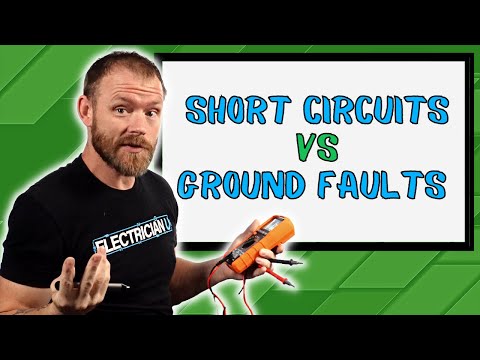
What is the Difference Between a Short Circuit and a Ground Fault?
What this covers
Troubleshooting can be one of the most daunting tasks an electrician can face. There are usually just so many variables to consider when trying to figure out what went wrong or when something isn’t working. In todays episode of Electrician U, Dustin answers a follower’s question regarding the difference between Short Circuits & Ground Faults and the values you should see on your multimeter when testing for them.
🤘⚡️EU Learning System⚡️🤘 For Individuals --- https://electricianu.com/learning-system-for-individuals/ For Businesses --- https://electricianu.com/learning-system-for-businesses/ -Video courses on every side of the electrical trade (theory, code, safety, wiring, install, troubleshooting, leadership, and more) -Practice exams for 2017, 2020, 2023 code -YouTube videos categorized and searchable -Audio lessons -Forum -Business version has admin portal and ability to assign learning to technicians and monitor progress -Any business size from 2 techs to 2,000!
🎓💡CONTINUING EDUCATION💡🎓 Sign up here --- https://electricianu.com/continuing-education/ -State Approved -Video Based
✍📝PRACTICE EXAMS📝✍ Get them here --- https://www.electricianu.com/electrician-u-membership/ -2017, 2020, and 2023 NEC versions -Online Residential Wireman Exam -Online Journeyman Exam -Online Master Exam -300 Question Online Code Cannon (not license specific, all code) -Take as many times as you want -All of the above come with printable PDFs
🎤🎧PODCAST🎧🎤 Spotify: https://open.spotify.com/show/7ldCwdxhWnT0R3nne96XjC?si=a42a98b83c3549fc&nd=1 Apple Podcast: https://podcasts.apple.com/us/podcast/electrician-u/id1583270265
📱👍SOCIALS👍📱 TikTok - https://www.tiktok.com/@electricianu Instagram - https://www.instagram.com/electrician_u/ Facebook - https://www.facebook.com/TheElectricianU/ Reddit - https://www.reddit.com/r/ElectricianU/ Rumble - https://rumble.com/c/ElectricianU Discord - https://www.discord.gg/electricianu
🎧🎹Music, Editing, and Videography by Drake Descant and Rob LeBlanc🎹🎧
#electrician #electrical #electricity
While the terms Short Circuit and Ground Fault seem to be used frequently and interchangeably, they are in fact quite different from one another. Think of a Short Circuit as a Short Cut, removing the load from the equation, and providing a path for the circuit to make its completed loop to the source of power. By doing this, it generates more amperage than the breaker is rated for, and the breaker trips. A ground fault is simply where a hot conductor has come into contact with something that is specifically grounded (maybe the grounding conductor itself or the case of a piece of equipment that is grounded, or a box/conduit that are grounded) and providing a return pathway to source. Either way, both of these scenarios happen BEFORE the load and in doing so, result in much higher amperage than the breaker is designed to withstand so it trips. A great way to diagnose your power issues is to use your multimeter. There are two functions of said multimeter that would be helpful in this situation. You could use the OHM setting to check for resistance in the circuit. However, if you did not know the EXACT wiring of the circuitry, this would not be the most helpful of the functions. If you were to check between a hot and a neutral, you would most likely get the same values as checking from hot to ground. This happens as the grounding conductor AND the neutral conductor are run in the same conduit and have roughly the same length. A better choice would be to use the continuity function of the multimeter. If you are measuring before the load, you should not have continuity between the hot and either ground, neutral, or another hot. Once you figure out which two wires are completing the circuit, then you have found your problem! Another great journeyman’s tip when troubleshooting is to gather as much information as you can about the situation and find out as many KNOWNS as you can. How much amperage is it supposed to draw? Has it done anything like this before? What exactly happened when it faulted (was there a shower of sparks, or a loud boom, etc.). A great one to ask is “did anyone perform any work on it recently? And if they did, are those folks available to speak? If something used to function, someone performed some type of work on the system, and now it doesn’t work, usually means the malfunction is either located within the work they did or is a direct result of the work they did. So, be a detective of sorts and gather as much information as possible. Use those KNOWNS to mark off the UNKNOWNS and it will narrow down the areas you will be looking in. It is also helpful to pull back and get a higher altitude look at the situation, then dive down into the details. Doing this in multiple areas of the whole system will help you eliminate possibilities, so you aren’t chasing demons throughout the entire system!
Source description (no synthesized summary yet).
Dustin demonstrates that continuity testing, not resistance measurement, is the practical method for distinguishing between short circuits and ground faults in the field, because both faults produce identical resistance values but can be isolated through systematic continuity checks and circuit topology analysis.
- Resistance measurement alone cannot distinguish shorts from ground faults because conductors of equal length have identical resistance regardless of which wires are involved
- Continuity testing reveals which specific conductors are connected, allowing technicians to isolate whether the fault is between two hots, between hot and neutral, or between hot and ground
- Systematic troubleshooting by gathering 'knowns' through multiple test points (panel, junction boxes, load) narrows the problem location without requiring deep circuit knowledge
This asset isn't compiled yet
You're seeing its claims, ranked. Compile it to build the argument threads, weight them, and check each claim against your library — the full view.
Continuity testing (using a multimeter's continuity mode) is a more practical field method than resistance measurement because it reveals whether a complete circuit loop exists between two points, directly showing which conductors are shorted together without requiring calculation of conductor length or resistance values.
“what I do is I take my multimeter and I put it on the continuity setting because that's more important I don't care how many ohms of resistance there is on any specific circuit”
When both grounds and neutrals are bonded together at the service panel and both run back to the utility pole, they are functionally equivalent at the surface level in terms of test values, even though grounds and neutrals are not the same thing electrically.
“every ground that's run out to something is running back to the neutral up at the pole not at your panel made well if it's a service panel yeah they're going to be touching we always Bond our neutrals and grounds together out at the service and then up at the pole we want to be able to clear a fault or a short circuit we want to be able to trip a breaker so essentially these grounds and these neutrals at this surface level are kind of like the same”
Testing at multiple points in a circuit—panel, junction boxes, load—using continuity testing allows a technician to systematically narrow down the exact location of a short or ground fault without opening or dismantling appliance components.
“if you're over at the motor itself you could do the same thing if there's continuity there if there's a junction box in between somewhere don't take the wire nuts apart just stick your leads down in the wire nuts and if you have continuity there shouldn't be continuity so you know oh that is where my problem is”
Resistance measurement cannot distinguish between a short circuit and a ground fault when the ground wire, neutral wire, and hot wires are the same length, because all conductors have identical resistance per unit length and thus yield the same ohm reading regardless of which wires are shorted together.
“if we have a breaker and we you run a black a white and a green out from a breaker all the way out to a load well there's just as much copper on the black as there is on the white and as there is on the green or the bare conductor so you're really going to get the same values whether you test either way”
Experienced electricians can recognize subtle differences in breaker trip behavior (delay time, aggressiveness) based on fault type and circuit characteristics, such as whether a short is direct (two conductors touching) versus indirect (current flowing through a long convoluted path of neutral wires before returning).
“you might be able to like tell through years of being able to see things trip which if something is a is tripping because it's like an arc fault trip there's usually like a little bit of a delay in the trip um if something is like a direct short it might act differently if like the neutrals are tied into other neutrals and it's like a really really long convoluted way for this thing to trip versus just two straight conductors”
When troubleshooting a circuit failure, the first information to gather should include the current being drawn (using a clamp ammeter), the presence of control devices (photocells, time clocks, lighting control systems), and whether internal components have been opened or modified.
“first thing you're going to do is start asking you questions like what's what's the current you know like when you put your clamp on ammeter on what values are you getting is there some kind of photocell somewhere is there time clock somewhere is there lighting control system somewhere did you take this apart”
Resistance measurement could be useful for distinguishing shorts from ground faults only if the technician knew the specific circuit characteristics (e.g., that the ground wire is much shorter than the neutral wire), allowing them to identify the longer wire by its higher resistance value.
“if I knew the characteristics of the circuit and what all the wires were doing and everything if I knew hey I've got this really short ground wire but this incredibly long convoluted neutral wire then yeah you're going to get different resistance values and that is going to be of some value because then you can identify oh the one that has a whole crapload of resistance on it is the long Crazy Wire the one that has a very short resistance value is the the short one”
In a properly functioning appliance circuit with the load off, there should be no continuity between ground and neutral, even though they are bonded at the service, because the testing loop needs to be completed through the load.
“you're probably going to get continuity between your white and your green so don't be surprised by that if you start testing that because again look they're all connected back at the end so they're using a completed Loop you know to complete your your continuity test”
A ground fault is specifically a short circuit where a hot conductor is touching a ground wire or conductive metal, distinguishing it from other short-circuit types and directing troubleshooting focus to the ground conductor.
“a ground fault can be a short circuit but we call a ground fault a ground fault and it's specifically because we're talking about a hot conductor that is grounded out that it's touching a ground wire it's touching a piece of metal”
When testing for continuity in a de-energized appliance circuit, there should be no continuity between hot and neutral, between the two hots (in a 240-volt circuit), or between hot and ground, because the load (motor, heating element, etc.) is not yet energized and thus not providing a closed path.
“you shouldn't have continuity before that because the load is off the machine's shut off so if there's still continuity in the circuit you should be able to test anywhere you could test back at the panel too”
If a continuity test shows a complete circuit between a hot conductor and the ground wire, the fault is a ground fault; this can be confirmed by testing from the hot to the green/bare ground conductor rather than measuring resistance.
“if there's continuity between hot and ground there shouldn't be that means that this whole entire thing is the green wire right essentially when you hook up an appliance or a light fixture or anything to the green wire it makes the green wire the whole Appliance everything metal”
Multimeters have multiple measurement modes (voltage, amperage, resistance, continuity) because circuits present many different types of information, and gathering data across multiple modes provides a more complete understanding than any single measurement.
“there's a reason reason there's this many damn dials on these things because there's this much information that you can try to find in a circuit and the more things that you actually know about the circuit and what's happening even if you got to write it all down the better you're going to be able to diagnose”
Once a load is energized, a complete circuit is formed through the load (motor coil, heating element, etc.), and there will be continuity between the appropriate conductors because the load itself provides the continuous path.
“once you energize a load this whole element here or this coil of wire connects to both of these and that's what allows the motor to start working so in that moment while it is working you do have a complete circuit and there is going to be continuity”
Dustin maintains that understanding how a multimeter works and what happens when conducting various tests is essential to effective troubleshooting and diagnosis.
“there's a lot of different ways to do things in this trade and once you start understanding how a multimeter works and what's going to happen when you do things it's really going to help your troubleshooting a lot”
A short circuit is a condition where power does not take its intended path through the load but instead finds a shortcut, bypassing the load entirely before returning to the source.
“when we say a short circuit what we mean is that there's a shortcut in the circuit the power is not coming from the source going through the load like it's supposed to and getting back to the source it's somehow found a shortcut or a short before the load”
If a continuity test shows a complete circuit between two hot conductors (black and red on a 240-volt circuit), the fault is a 240-volt short circuit, which is typically accompanied by visible signs such as sparks at the breaker panel due to higher current levels.
“if there's continuity on these two that means you're going to have a 220 short but you can probably tell it's a 220 short because that's like a boom like a lot of times you'll see Sparks Fly Through of panel cover with a 220 short”
The 'knowns' principle—systematically gathering as much factual information as possible about a circuit problem before attempting diagnosis—is more effective than jumping to conclusions, because each known fact eliminates potential causes and narrows the problem space.
“always find the knowns when you're troubleshooting anything you need to find the knowns as many knowns as you can get even if it's an extraneous amount of knowns that seem like it's not even important find as many knowns so that way when you're sitting there in front of a problem you can knock off silly questions basically because you've already checked certain things”
Apprentice electricians often fail at troubleshooting because they focus too narrowly on immediate details without maintaining a broader 30,000-foot view of the entire circuit, and alternating between zoomed-out and zoomed-in perspectives is essential for effective diagnosis.
“especially once you can kind of look at a circuit and understand it from like a 30 000 foot View and then zoom in that's one thing I tell a lot of apprentices when you're troubleshooting like you can't just be so focused in all the time and only seeing what's in front of you without thinking about everything else or else you're going you're going to be missing a lot of information”
Dustin was taught by an experienced electrician named Johnny to always prioritize finding knowns when troubleshooting, which became his core troubleshooting philosophy.
“a really good method that I was taught by this old school dude Johnny thank God I worked with you for a lot of years uh he said always find the knowns when you're troubleshooting anything”