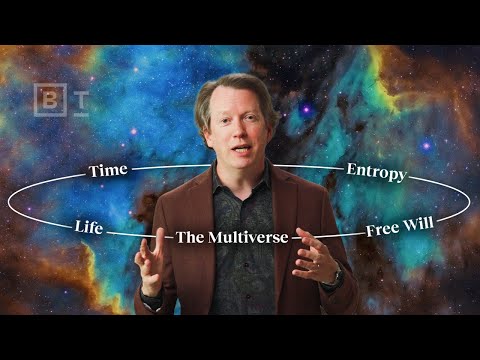
The Universe in 90 minutes: Time, free will, God, & more | Sean Carroll
What this covers
Everything you ever wanted to know about parallel universes, time, entropy, free will and more, explained by physicist Sean Carroll.
Subscribe to Big Think on YouTube ► https://www.youtube.com/channel/UCvQECJukTDE2i6aCoMnS-Vg?sub_confirmation=1 Up next, Michio Kaku: The Universe in a nutshell (Full Presentation) ► https://youtu.be/0NbBjNiw4tk
Do you have free will? Is our Universe the only one, or do we live in one of many? And what does Einstein’s theory of relativity really say about the nature of reality?
These are some of the big questions that theoretical physicist Sean Carroll tackles in this Big Think video.
In 2022, Carroll published The Biggest Ideas in the Universe: Space, Time, and Motion, a book that achieves that rare feat of detailing the inner workings of scientific concepts in a way that’s accessible but not overly simplistic.
THE MULTIVERSE 0:00 Sean Carroll, Johns Hopkins physicist 0:18 What is the Multiverse and what does it mean to us? 2:38 What is the physicist’s version of the Multiverse? 6:43 Is every possible world real? 9:22 Why should we trust the many worlds of quantum mechanics? 12:24 How many worlds are there? 14:47 How does personal identity in the Multiverse work? 16:43 Do our decisions create different universes? 20:25 Why are we drawn to the Multiverse and how does technology propel it?
TIME 26:33 What is time? (And entropy?) 35:52 What is the past hypothesis? (The laws of thermodynamics)
ENTROPY 41:32 Why is entropy essential to living? 44:33 Why are there complex structures in the Universe? 46:11 Do complex structures require design? 47:55 What is the effect of increasing entropy? 50:03 What is the difference between entropy and complexity? 52:52 What is emergence?
PHYSICS: GALILEO'S LEGACY 55:08 Why is physics such a difficult field to study?
ORIGINS OF LIFE 58:14 Is life a struggle against entropy? 1:00:36 What are the origins of life here on Earth? 1:04:52 How many things had to “go right” for us to exist? 1:07:33 If this isn’t God’s design we’re seeing, what is it?
FREE WILL 1:11:22 What is Laplace's demon and do we have human agency? 1:16:30 What are the different viewpoints on free will? 1:23:44 How do our feelings fit into the molecular world? 1:26:24 Are there objections to the compatibilist worldview?
Read the video transcript ► https://bigthink.com/series/the-big-think-interview/biggest-ideas-in-the-Universe
----------------------------------------------------------------------------------
About Sean Carroll: Dr. Sean Carroll is Homewood Professor of Natural Philosophy — in effect, a joint appointment between physics and philosophy — at Johns Hopkins University in Baltimore, and fractal faculty at the Santa Fe Institute. Most of his career has been spent doing research on cosmology, field theory, and gravitation, looking at topics such as dark matter and dark energy, modified gravity, topological defects, extra dimensions, and violations of fundamental symmetries. These days, his focus has shifted to more foundational questions, both in quantum mechanics (origin of probability, emergence of space and time) and statistical mechanics (entropy and the arrow of time, emergence and causation, dynamics of complexity), bringing a more philosophical dimension to his work.
----------------------------------------------------------------------------------
About Big Think | Smarter Faster™ ► Big Think The leading source of expert-driven, educational content. With thousands of videos, featuring experts ranging from Bill Clinton to Bill Nye, Big Think helps you get smarter, faster by exploring the big ideas and core skills that define knowledge in the 21st century. ► Big Think+ Make your business smarter, faster: https://bigthink.com/plus/
----------------------------------------------------------------------------------
Want more Big Think? ► Daily editorial features: https://bigthink.com/popular/ ► Get the best of Big Think right to your inbox: https://bigthink.com/st/newsletter ► Facebook: https://bigth.ink/facebook ► Instagram: https://bigth.ink/Instagram ► Twitter: https://bigth.ink/twitter
Source description (no synthesized summary yet).
Carroll argues that the multiverse, entropy, and personal agency are not mystical or contradictory concepts but natural consequences of physics and emergence; understanding these reveals that we can meaningfully make choices despite being physical systems, and that complexity arises necessarily from the universe's low-entropy beginning.
- Physicists are 'dragged kicking and screaming' to multiverse theories by the data, not by preference; both quantum and cosmological multiverses emerge from equations, not speculation
- The arrow of time and our sense of free will derive entirely from entropy increasing since the Big Bang, not from fundamental physics breaking time-symmetry
- Compatibilist free will is coherent: we can be physical systems obeying laws and still meaningfully talk about ourselves as agents making choices, because emergence allows multiple valid descriptions of reality at different scales
This asset isn't compiled yet
You're seeing its claims, ranked. Compile it to build the argument threads, weight them, and check each claim against your library — the full view.
The multiverse concepts used in Hollywood—where characters interact with alternate versions of themselves who made different choices—are more aligned with philosophical ideas of possible worlds than with actual scientific multiverse theories from cosmology and quantum mechanics.
“in retrospect the kind of Multiverse that is being used in Hollywood is more like the philosophical idea of the set of all possible worlds that you can imagine literally anything else happening and the differences of course that Hollywood lends itself the ability to talk between the multiverses so that you can go and interact or even fight with a version of yourself”
The brain operates as a prediction and updating machine: it stores predictions about what will happen, receives new information from the world, compares predictions to actual outcomes, and updates its internal models—all processes that have intrinsic directionality in time.
“the brain... is reaching out to other moments of time... it's carrying inside itself a version of what it thought happened a little bit ago and what it predicts will happen a moment next the human brain... are trying to understand and predict their environment”
The second law of thermodynamics (entropy increases) is not a fundamental law of physics in the same way Newton's or Einstein's equations are; it is a statistical law that emerges from the time-symmetric microscopic laws when applied to systems with many particles and incomplete information.
“the second law of Thermodynamics a very important feature of the macroscopic world but it's not there in the fundamental laws of physics it's just there in the macro world”
The reason entropy was lower in the past than today is not because time is asymmetric or physics forbids it; it is simply a boundary condition: the Big Bang was in an extraordinarily low-entropy state, and entropy has been increasing ever since. This is called the 'past hypothesis.'
“the only and the correct answer is because it was even lower entropy the day before yesterday and why was the universe even lower entropy the day before yesterday because even lower entropy the day before that and this chain of reasoning goes back 14 billion years to the Big Bang to the origin of our observable universe in a hot dense state which looks kind of disorganized but if you run the numbers it's actually a very special very delicate very unusual State for the universe to begin in a very low entropy State and the universe has been increasing an entropy ever since”
Life, specifically metabolism, is a process of taking in low-entropy energy (e.g., sunlight converted to chemical energy in glucose), using it, and expelling it as higher-entropy energy (heat radiated to space). For every photon we absorb from the sun, we eventually radiate roughly 20 photons back into space at lower energy, each contributing to entropy increase.
“the important part is we get sunlight and most of it is in the visible wavelengths of light right so we get a certain set of photons with certain energies and then we absorb them and what do we do we convert them into higher entropy forms of energy the Earth radiates into space more or less exactly the same amount of energy as it gets from the Sun but it radiates it in a much higher entropy form for every one Photon of energy we get from the sun we radiate 20 photons of light back into the universe with on average one twentieth of the energy each but the total has 20 times the entropy”
Humans are trained by evolution to make fast judgments based on vastly incomplete information about the world, not to perform perfectly rational calculations. This explains our expertise in pattern recognition, intuition, and holistic reasoning, and also our cognitive biases and errors.
“we human beings through our biology are not trained to add numbers together or play chess but we're trained to get a picture of the world very quickly and react to it in this kind of holistic way with vastly incomplete sets of information compared to a perfect Reasoner or a perfect Observer of the world”
Libertarian free will—the idea that humans are somehow exempt from the laws of physics—is held by few modern scientists, and the real philosophical debate is between hard determinists (who deny agency despite physicalism) and compatibilists (who affirm it).
“libertarian Free Will is that somehow I am not beholden to the laws of nature I as a human being I am a law unto myself... so libertarian Free Will is truly an ability to make choices and do things in the world that cannot even in principle in any way be explained by stuff obeying the laws of physics”
Different cultures conceptualize time orientation differently (past-oriented, present-oriented, future-oriented people), and each orientation has distinctive biases: past-oriented people ruminate; present-oriented people neglect future consequences; future-oriented people miss present enjoyment.
“psychologists talk about different orientations that people have vis-a-vis time... some people are just intrinsically right about now like the present moment... some people are past oriented... some people are... future oriented”
The emergence of complex structures at intermediate entropy levels is a scientific question we are actively researching: how exactly does the path from low entropy to high entropy lead to structured complexity like galaxies, stars, and life?
“this is a very fun active scientific research area why did complex structures like living beings come into existence in exactly the way we did what is the role of information what is the down to earth chemistry that is going on here what is the geology that is going on here”
The many-worlds interpretation of quantum mechanics is the simplest explanation for quantum phenomena because it requires no additional machinery beyond the Schrödinger equation; all other interpretations must add ad-hoc rules to explain why other measurement outcomes don't occur.
“the reason to accept it is it's just what the equations say every other version of quantum mechanics has to say the worlds would have been there but we're going to remove them somehow and it's awkward you don't know how to do it and there's no special reason to do it so I think it's just simplest to accept that the other worlds are probably there”
The ability to reason counterfactually—to imagine different possible futures and choose among them—may be unique or special to humans and may not exist in the same way in other animals. Artificial intelligences are becoming good at imitating human behavior but are not yet truly conscious or genuinely understanding the world, and it's unclear if or when that threshold will be crossed.
“we have an ability to reason counterfactually to think not about just what will happen but of various things that could happen and then pick the one that we think is a good one... we can write a computer program that mimics human behavior and AI has become really really good at mimicking human behavior it has not become conscious when you try to show that the AI is just mimicking and not truly understanding the world it's not that hard all of the modern AI programs are very easy to see they don't truly have understanding of the world but how long will that last I don't know”
Compatibilism is the view that we can meaningfully talk about humans as agents making choices and bearing responsibility for their actions, even though we are made of atoms obeying the laws of physics. This is compatible because emergence allows multiple valid descriptions of reality at different scales.
“compatibilism says that we can still talk about human beings as agents making choices while also agreeing that we don't violate the laws of physics and to say well how are those two things compatible that's perfectly fair question and the answer is emergence the answer is layers of reality the answer is there are different ways of talking about the world that are compatible with each other but very very different”
Pendulums and planetary orbits show no arrow of time—if you play a movie of them in reverse, you cannot tell the direction—because these few-body systems are time-symmetric. But if you throw a rock in a pond and play the movie in reverse, you immediately know it's reversed because rocks do not spontaneously jump out of ponds.
“if I make a movie of a pendulum swinging back and forth and I play it to you backwards you don't know that it's going back and forth it's still going back and forth you don't know that I played it backwards there's no directionality there to time but if I throw a rock into a pond and I make a movie of that if I play that backwards you know it's obviously reversed because rocks do not get thrown out of Pawns randomly”
The fundamental laws of physics appear to be fine-tuned to permit complex structures like atoms, molecules, and life; we do not yet have an explanation for why the mass of the electron, the proton, and the neutron have the specific values they do, or why the strengths of forces allow for stability and complexity.
“we seem to live in a universe where the very delicate laws of physics that give you the mass of the electron and the proton and the neutron and the strength of all the forces that let them interact are such that they allow for the existence of complex structures is that easy is that surprising is that something that requires an explanation I think that naively as of right now it does seem to require an explanation and we don't have one”
The likelihood of life forming is not accurately calculated by treating it as a random search through possible configurations (like a random letter generator producing Shakespeare); instead, the correct calculation must account for starting from a low-entropy Big Bang and asking which paths from that initial state lead through complex structures.
“you should be asking it's not in all of the possible Arrangements of stuff which of them would have looked like life it's in all the different paths you could take from the low entropy beginning of the universe to the high entropy future which of them would pass through something as complicated as a living being I don't know how to do that calculation either but I know that it's much more likely to get complex structures that way than just to have a random number generator spitting things out”
Life is not a struggle *against* entropy; that is a misconception. Life depends fundamentally on entropy increasing; without increasing entropy, there would be no memory, causality, or ability to affect the future. Life rides the wave of entropy increase from the Big Bang toward heat death.
“a lot of times you'll hear people talk about life as a struggle against increasing entropy that's crazy that's like saying my life is a struggle against eating food I think that eating food is really important in fact it literally is a transfer of low entropy into high entropy... the important part is we get sunlight and most of it is in the visible wavelengths of light right so we get a certain set of photons with certain energies and then we absorb them and what do we do we convert them into higher entropy forms of energy... we are riding a wave from low entropy to high entropy and you shouldn't just because the wave will eventually crash upon the shore you shouldn't say ah we're fighting against the wave no no we're riding the wave that is what lets us exist”
Entropy is defined quantitatively as the number of ways atoms and molecules can be rearranged while the system looks the same macroscopically; this explains why systems naturally evolve toward high entropy—there are simply more high-entropy configurations than low-entropy ones.
“entropy is what physicists talk about when they talk about how messy how disorganized how random a system is when things are nice and neat and tidy they are low entropy when they're all messy and all over the place they are high entropy... later in the 1800s they realized if you understand atoms and the fundamental constituents of the things around us you can quantify what we mean by entropy it's the number of ways you can rearrange the constituents of a system so that it looks the same macroscopically”
Causal influence flows only toward the future; choices made now affect the future but cannot undo the past, and this asymmetry is both a physical truth and a psychologically important principle for avoiding rumination.
“the causal influence I have on the world only extends toward the future the choices I can make right now will have an impact that I will feel down the road but I cannot make a choice right now that undoes what happened in the past”
Different versions of yourself in the multiverse should be thought of as separate people, much like identical twins who share a past but diverge into distinct identities—they have a relationship but are not the same person, so one cannot be killed because 'another version' exists.
“I think the clear answer here is there's a relationship but they're a different person it's very much like identical twins you have one fertilized egg that's at one point in time a single cell that is one identity right one entity there in the universe but it splits into two different people and no one is tempted to say that two identical twins are two versions of the same person no one is tempted to say well I can kill one identical twin because the other one is still around right they're separate people with their own existence their own dignity”
Time is not fundamentally a mystical or difficult concept; operationally, time is just a label on different events in the universe that helps us tell moments apart. The puzzle is not 'what is time' but rather why time has apparent properties like direction, why we have memories of the past but not the future, and why we can affect the future but not the past.
“the question of what time is I think is easier than sometimes people make it out to be... I think about how we use time when we actually talk about it if you say meet me at 7 pm no one panics no one says like oh my God what are you talking about with these esoteric Concepts about 7 PM you know we all know what to do operationally and time in some sense is just a label on different events in the universe the universe happens over and over again at different things we call moments and time helps us tell the difference between one moment and another so what time is I don't think is the problem”
The reason we have memories of the past but not the future is because our brains are physical systems embedded in a universe with increasing entropy, and information (low-entropy patterns) only flows into the brain from the past, not from the future.
“all of the photographs all the memories we have are of the past that gives us an imbalance to how we flow through time”
Laplace's demon—a hypothetical intellect that knows every particle's position and velocity and can therefore predict the entire future deterministically—is often used to argue that free will is impossible. But this thought experiment is irrelevant to human agency because humans are not Laplace's demons; we have finite information and computational power.
“the answer is you are not laplace's demon LaPlace knew perfectly well that we're not going to come close to being laplace's demon if you take the amount of information in a grain of sand you would need I forget the exact number but it's something like a million billion laptop computers to contain the information contained in the atoms and the molecules in that grain of sand it's never going to happen”
The miracle of human existence is that we can make reliable predictions and take effective action in the world using vastly incomplete information—we cannot know the exact state of every atom in our body, yet we can predict the tides accurately and navigate our lives meaningfully.
“the miracle of the world is that the incomplete information we can get about it still gives us a handle on what's going on how to react to it we can predict the future a little bit we can predict the tides very accurately the weather not quite so much the stock market not very well at all but those different levels of accuracy are important”
The inflationary theory of cosmology predicts that inflation does not stop everywhere simultaneously; it continues in some regions, creating new universes with different physical laws and properties—a prediction made before such multiverses were observed.
“the problem or the benefit depending on how you look at it is that inflation keeps on happening elsewhere creating more different kinds of universe so that's a version of a Multiverse that is utterly different than the quantum mechanical one”
Technology (dating apps, house-hunting websites like Zillow, social media) is increasing our ability to vividly imagine alternate realities and different life paths, which changes our psychology by making counterfactual thinking more concrete and accessible than it was historically.
“we're increased increasing of how things could have been different and technology is helping us along the way we're sort of peeking into alternate realities that didn't come true... apparently there's a whole genre of Zillow porn which is not actually pornography it's just getting kicks out of looking at houses you can't afford on Zillow and imagining what it would be like to live there and this is something again that we just couldn't do in the same way technology is letting us see what we're Miss missing”
In the many-worlds interpretation, when a quantum system is measured, both possible outcomes become true, but each in a different universe; the universe literally splits into versions where the electron spins clockwise and versions where it spins counterclockwise, with human observers entering superposition themselves.
“whenever you measure it in a particular way you can get different possible measurement outcomes this is something we've understood for a hundred years now the question is what happens to the alternative measurement outcomes that you didn't observe... The idea of the many worlds of quantum mechanics is they're out there every possible measurement outcome of a Quantum system becomes true just in a different Universe”
The origin of life likely involved both replication (genetic information) and metabolism (energy flow), and it's not clear which came first. The 'metabolism first' view is plausible because metabolic processes naturally arise from purely physical chemistry without requiring information: if chemical conditions allow energy release through a pathway, that pathway will be taken, eventually leading to organized cycles.
“there is a replication first camp in the origin of Life studies literature that says look clearly the genetic information is necessary to call it life that must have come first and it must have hooked up to an energy source but there's also a metabolism first camp that says look it doesn't matter if you have information sitting there if it's not going someplace if it's not doing anything if it's not moving around and metabolizing you can't call it life”
Physicists never start out wanting a multiverse; they are always 'dragged kicking and screaming' to it because they are trying to explain what we actually observe, meaning the multiverse is a consequence of simple, elegant theories like inflation and many-worlds quantum mechanics, not an arbitrary addition.
“some theories some very very simple very easy to write down theories like the inflationary theory of cosmology or the many worlds theory of quantum mechanics they both explain what we see in our universe and unambiguously predict the existence of other universes”
The multiverse idea, especially in pop culture, serves as a coping mechanism: when people experience regret or disappointment, imagining an alternate reality where things went better provides psychological comfort, though this can become unhealthy if taken too far and prevents acceptance of unchangeable past decisions.
“in some sense the Multiverse is a coping mechanism right we see terrible things happening around us we think of ways that things could have been better right if an election had gone a different way if our team had gone a different way if we had not gotten hurt if we had asked that person out to for a date and this sort of makes us think well maybe we're in the wrong Universe we're in the wrong timeline”
Removing God from our worldview (as science implies we should) creates a genuine philosophical problem: what gives our lives meaning or purpose? But this is not a reason to believe in God; rather, it means we must actively create our own meaning, which is what humans have been doing all along—God was just a roundabout way of giving ourselves purpose.
“when you take God out of the story we have a lot of work to do to decide is there a purpose to our lives how should we lead them if there's not a reason for our existence given to us from the outside is it possible for us to create that purpose I think the answer is yes in fact I think that's what we do all the time since we human beings invented God that was just a roundabout way of giving ourselves purpose I think we're still now doing the same thing that human beings have always done we're doing it in a slightly more open-eyed way in a way that is much more compatible with the fundamental nature of reality”
Human intelligence is not best measured by performance on tasks designed for computers (like chess or Go), because these tasks are fundamentally different from how humans think. Humans think holistically and adaptively, transferring knowledge across domains; computers excel at brute-force search in well-defined spaces. The difference is not that one is better; they're just different modes of cognition.
“human beings don't think in the same way a human grand master at chess does not think about the chessboard in the same way that an AI does a grand master will think about big configurations in a holistic way if you suddenly told a chess Grandmaster we're going to play chess except that every other move the Rook will move diagonally instead of horizontally and vertically the Chess Master would you know think about it and probably make some Elementary mistakes but still be able to play a pretty good game a computer would have no clue what to do”
Physics as a discipline makes progress by simplifying the world, ignoring complications, and putting them back later. This approach (inherited from Galileo) works well for physics and cosmology, but breaks down in fields like psychology and sociology where interactions and emergent properties are crucial to the phenomena.
“physics really makes progress by simplifying the world right I mean maybe all the way down to Elementary particles but even when we think about the universe as a whole the modern cosmologist simplifies the universe enormously... the good news is it works you can get very very far by making that simplification thinking about what it means and then putting in the complications later this is a legacy that we were handed by Galileo... but when it comes to biology when it comes to Sociology or psychology when it comes to the emergence of higher levels out of the simple microscopic world that methodology doesn't always work anymore”
The relationship between simple and complex, and between orderly and disorderly, are two independent axes. A system can be simple-and-ordered (all molecules in one corner), simple-and-disordered (molecules evenly distributed), or complex-and-partially-disordered (intermediate entropy state with intricate structures).
“one of the issues with really feeling through the implications of the second law of Thermodynamics is that people tend to mix up simple versus complex and orderly versus disorderly the truth is these are two different axes... when you're very very low entropy when you're as orderly as you can be things will tend to be simple... likewise a high entropy configuration tends to be simple once again there are many ways for the individual atoms to be organized so they're spread evenly throughout the room but it's still very simple... in order for complexity to Arise at all it seemingly insists that we have a medium entropy configuration”
William Paley's design argument is logically sound (complex things exhibit purposeful arrangement of parts, so they require a designer) but is weakened by observational facts: the universe is not organized around human comfort (we're not at its center, it's vast and mostly hostile), which is what we'd expect from a design perspective. A naturalistic universe fits better with observations.
“to me there's a lot more that fits well that fits nicely that is explicable in a universe that just obeys the laws of physics... we know better now we live on a planet surrounding a star which is one of several hundred billion stars in our galaxy and there are hundreds of billions of galaxies in the observable universe we human beings are not that important”
Hydrothermal vents at the ocean floor were predicted by origin-of-life researchers before their discovery, based on theoretical reasoning about the conditions needed for life to emerge (specific chemical balances, temperature gradients, energy sources). These vents were later discovered by submersibles, providing evidence that the metabolism-first hypothesis has merit.
“they thought about what kind of conditions would they be and they thought that it might be a warm hydrothermal vent under the oceans right with certain chemical balances and I'm a physicist I don't know the details and I shouldn't say anything but the point is these kinds of hydrothermal vents were not known at the time they had not yet been discovered but a prediction was made these must exist in order for life to have come into existence and after the prediction was made we found them famously the lost city formation at the bottom of the Atlantic Ocean was found by submersibles going down near the bottom of the ocean floor they found exactly the kind of geochemical conditions that had been hypothesized as possible places where life could have formed”
The history of science shows a pattern: seemingly inexplicable features of the world are explained over time by discovering natural mechanisms. The apparent design of living beings was explained by evolution and natural selection, not God; we should expect the same for other apparent fine-tuning (like fundamental constants), rather than concluding it requires a designer.
“to me the history of science is a series of discoveries that make these seemingly inexplicable things make a lot more sense now that we know there's genetic information it mutates we can explain by a natural selection the existence of all these different biological species that that part has been explained we have the next bigger picture question about why the universe allows for these kinds of processes we don't know the answer to that yet but my feeling is it will be explained”