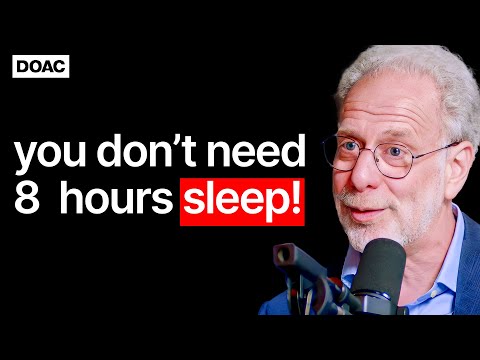
Harvard Professor: REVEALING The 7 Big LIES About Exercise, Sleep, Running, Cancer & Sugar!!!
What this covers
In this new episode Steven sits down with the world renowned expert on the evolution of human physical activity, Dr Daniel E. Lieberman.
0:00 Intro 02:38 Why do you do this research? 03:35 Where has your work taken you? 04:34 Has your research shifted your perspective on exercise? 05:55 The biggest exercise myths 12:00 The importance of weight training 16:12 Why always moving your body is so important 19:47 Genetics vs lifestyle 24:20 Have we evolved to be lazy? 25:46 We should be preventing diseases, not medicating them 28:13 Do hunter-gatherers get the same diseases as us? 31:32 The truth about sugar 37:30 How would you redesign our society? 42:18 Should organisations force people to exercise? 48:25 What did you learn from these tribes? 50:03 Why you should do strength training on your feet 56:38 Is too much muscle bad? 01:01:46 Running myths 01:06:58 The best cardio workout 01:09:21 The best exercise for weight loss 01:15:59 Why we need more compassion around exercise 01:20:46 What is it that actually gets people exercising? 01:24:59 The last guest's question
You can purchase Dr Lieberman’s newest book, ‘Exercised: The Science of Physical Activity, Rest and Health’, here: https://amzn.to/49udz2v
My new book! 'The 33 Laws Of Business & Life' per order link: https://smarturl.it/DOACbook
Join this channel to get access to perks: https://bit.ly/3Dpmgx5
Follow me: Instagram: http://bit.ly/3nIkGAZ Twitter: http://bit.ly/3ztHuHm Linkedin: https://bit.ly/41Fl95Q Telegram: http://bit.ly/3nJYxST
Sponsors: Huel: https://g2ul0.app.link/G4RjcdKNKsb Airbnb: http://bit.ly/40TcyNr
Source description (no synthesized summary yet).
Lieberman argues that modern sedentary lifestyles represent a profound mismatch with human evolutionary adaptation, and that physical activity—understood not as exercise but as necessary or rewarding movement—is the primary lever for preventing most chronic diseases and maintaining health across the lifespan.
- Humans evolved to be physically active; 75% of modern diseases are preventable through physical activity and lifestyle changes, yet we spend only 3% of medical budgets on prevention
- The problem is not inactivity per se but the combination of comfort-optimized environments, lack of social motivation, and absence of reward systems that made movement necessary in ancestral contexts
- Physical activity slows senescence across all body systems; the effect grows stronger with age, making exercise more—not less—important as we age
This asset isn't compiled yet
You're seeing its claims, ranked. Compile it to build the argument threads, weight them, and check each claim against your library — the full view.
Humans evolved to live about 20 years after reproducing (to be grandparents), which is unique except for killer whales. This extended lifespan coevolved with active roles: ancestral grandparents worked in fields, hunted, gathered, and provided childcare, staying physically active until death. Modern retirement is a recent Western invention with no precedent in evolutionary history.
“We evolved to be grandparents. But grandparents in the old days weren't, you know, retiring to Florida or I don't know what they what they do in England or whatever, go to Mallorca or whatever and you know, kick up their heels and play golf or whatever with carts. Grandparents in the in the olden days, right? Or in in many cultures still today, are working, right? They're working in the fields, they're hunting, they're gathering, they're getting food for their children and their grandchildren, they're helping with child care.”
A Harvard study by Ralph Paffenbarger tracked alumni for 25-30 years and found that the effect of physical activity on health outcomes increased with age: alumni in their 20s-40s exercising 4-5 times weekly had 20% lower death rates, while alumni 60-70 who exercised had 50% lower death rates.
“he realized that uh places like Harvard are fantastic for studying aging because um Harvard, like other private universities, never lets go of their alumni... he got the alumni association... to let him follow a series of Harvard alumni... and keep asking them in questions about their physical activity levels”
Society confuses diseases that are more common with aging with age being the cause of those diseases. Most age-related diseases (Alzheimer's, heart disease, cancer) are not inevitable consequences of aging but rather consequences of lifestyle mismatch that accumulates over decades.
“We've confused diseases that are more common with aging with age being a cause of those diseases in the first place. And they're not inevitable inevitable diseases. Um and many of them are preventable.”
Play is a form of physical activity that humans and few other species engage in as adults; it's a way to learn cooperation and build community while moving bodies, making it an underutilized lever for promoting exercise.
“play is what is another thing we evolved to do, right? What kids play and we're one of the few species that plays as adults, right? And what is play? Play is a way in which you you you learn cooperation, you you you build community, um but you also move your body, right?”
The Tarahumara's long-distance running has a spiritual dimension—it's a form of prayer and a metaphor for life—not a competitive or athletic practice. This spiritual element was once universal among Native American populations. Most populations globally have endurance traditions, but the spiritual/social meaning is often lost in modern framing of 'exercise.'
“for them, physical activity is spiritual. Um you know, there's this book Born to Run that uh that describes their their running and calls them a hidden tribe of super super athletes. They're not hidden and they're not super athletes. Um and um and the one thing that the book missed was that the the main impetus for the for the for the running they do these famous long-distance races is that it's a form of prayer. Um it's really very beautiful. Um and um and it's it's a metaphor for for life... this actually used to be almost universal among Native American populations, right? Native American tribes. Everybody had long-distance races and ball games and and all they were all had a spiritual element.”
The 10,000 steps per day target was picked arbitrarily by a Japanese pedometer company in the 1960s based on what 'sounded auspicious,' not on scientific evidence. Epidemiological data shows that health benefits plateau around 7,000–8,000 steps per day; hunter-gatherers average 10,000–18,000 steps depending on sex, suggesting the metric is reasonable but not optimal.
“that started because of a Japanese pedometer pedometer. Um so but right before the the Olympics were in Tokyo in the in the '60s, uh they had invented the pedometer and they were in sitting in a boardroom and they were discussing what to call the pedometer and they picked out of just out of the blue they picked 10,000 steps because that's apparently an auspicious number. And it sounded about right. There was no science behind it.”
75% of disease that people walk into a doctor's office with is preventable, yet the US medical system spends only 3% of its budget on prevention rather than treatment.
“We spend approximately 3% of our budget our medical budget on prevention. And yet when people walk into a doctor's office, 75% of the time the disease is according to the Center for Disease Control a preventable disease.”
The myth that 'sitting is the new smoking' is misguided. Hunter-gatherers sit as much as Westerners; the key difference is not sitting duration but sitting interruption—people who get up every 10–15 minutes have much better health outcomes than those who sit uninterrupted for 40+ minutes, because getting up activates cellular mechanisms, lowers blood sugar, and activates genes.
“all animals sit, right? My dog sits, um cows sit, chickens sit, every animal sits. And hunter-gatherers also sit. In fact, if you uh some of my students actually put sensors on hunter-gatherers, and uh when when we're doing some research in farmers as well. But they sit just as much as Westerners.”
Plantar fasciitis is a 'mismatch disease'—more common or severe because modern bodies are inadequately adapted to modern environments. The disease results from weak foot muscles, which atrophy due to stiff-soled, arch-supported shoes. Insoles treat symptoms but perpetuate the problem; the solution is strengthening foot muscles through minimal shoes or barefoot activity.
“plantar fasciitis is what I would call a mismatch disease, right? A disease that's more common or more severe because our bodies are inadequately adapted to modern environments... you have a weak foot... your your foot has four layers of muscles... And those muscles are supporting your arch... the problem with the plantar fascia is that if it stretches too much, it like anything else, right? It gets inflamed... To prevent plantar plantar fasciitis, the best way to preventing it is having a strong foot.”
Barefoot running is not recommended as sole practice, but learning to run with a midfoot/forefoot strike (as people naturally do barefoot) reduces impact forces on knees. Modern cushioned heels enable heel-striking, which increases collision force. Forefoot striking is gentler on knees but harder on ankles and calves, so transition must be gradual.
“today shoes have these cushioned heels that enable you to essentially run the way you walk, right? You land on your heel. And everybody who's barefoot sometimes lands on their heel, but people who are barefoot often more often than not land on the ball of their foot and then they'll let their heel down. It's called a forefoot strike or a midfoot strike. And when you do that we worked out the biomechanics of that and published a paper on the cover of nature showing that when you do that you actually prevent your foot from crashing into the ground causing a what's called an impact peak collisional force.”
Hunter-gatherers are not physically impressive (not 'buff, built, and bulked'). They have enough muscle to do what they need but no more. Muscle is expensive tissue (1/3 of body mass, 1/5+ of calorie expenditure at rest). Natural selection doesn't favor excess muscle in food-insecure contexts. Modern 'Liver King' physiques are artifacts of gym access and protein shakes, not ancestral reality.
“if you look at the data um from hunter-gatherers, and people have done that. They've done grip strength tests, etc., and all kinds of other fun things with it... People are reasonably strong, but they're not super strong. And they're not they're not buff and built and bulked and all that sort of stuff. They've got enough muscle to do what they need to do, but no more... Muscle is really expensive, right? It's actually a super expensive tissue. Uh about a third of our body is muscle, and it's using up about about you know, a fifth or more of the calories that we're expending”
Physical activity makes things rewarding through dopamine signaling. Fit people get dopamine hits from exercise; unfit people don't. This creates a motivation barrier: to get the reward, you must first endure months/years without it. Overweight people carry extra weight while exercising, making it harder. Society should be compassionate toward this barrier, not shame people struggling to exercise.
“when I run Central Park tomorrow, I'm going to get a big dopamine hit. I'm going to my body is going to produce all this dopamine, which is the molecule that says, do that again, right? It's a reward... But if I were unfit and overweight, I wouldn't get that dopamine hit... it takes months if not years before you actually get that reward... just like being overweight um causes you to become insensitive to insulin, you become insensitive insensitive to all kinds of other hormones and neurotransmitters and dopamine is one of them.”
The fundamental instinct to 'take it easy' when possible is adaptive, not a personality flaw. Modern environments optimize for convenience and ease, requiring people to overcome this basic instinct to be active. Exercise is fundamentally about overcoming this instinct, not about motivation or laziness.
“we are evolved to take it easy, to to rest whenever possible, right? So, we've now got ourselves into a bit of a comfort crisis here because everything has in our lives is optimizing us for convenience and ease... so and and furthermore, if you're out of if you're unfit and you're not really, you know, exercising isn't any fun, right? It's it's it's it's unpleasant... and it's not that rewarding uh until you get fit. And so uh people hate it, right? Um and and then we blame them for being lazy. But they're actually just being they're just being normal.”
Sarcopenia—age-related muscle loss—creates a vicious cycle: as people age, they lose muscle, become frail, lose functional capacity, become less physically active, and then experience accelerating muscle wasting. This is preventable through strength training, especially as people age.
“as people get older, they tend to lose muscle and when you do that, you become frail and you lose functional capacity and then that starts off a vicious cycle, right? Once that happens, then you're less likely to be physically active and then of course when you're less physically active, your muscles begin to waste away more”
Interrupted sitting activates cellular mechanisms including lowering blood sugar levels and activating genes, similar to turning on a car engine briefly
“when you do that, you actually it's like turning on the engine of your car. You don't even drive it around the block. You're you're you're you're um you're turning on all kinds of cellular mechanisms. You lower blood sugar levels. You You all kinds of genes get activated.”
The primary way people become and stay physically active in modern environments is through social mechanisms: accountability, group participation, running partners who motivate continuation even on bad days. Social reward is more powerful than individual willpower. The most effective interventions for exercise adoption likely involve social dimensions.
“the more I study it, the more I think it's social. The more I think that um again, I think people are physically active I in our modern world exercise for two reasons. One, it's necessary or rewarding. And what makes it rewarding for most people is the social aspect... I often you know meet meet friends for early morning runs and I can tell you that the evening before it seems like a great idea to meet Aaron at 6:00 a.m. on the corner of Mass Ave and Linnaean. The next morning at 6:00 a.m. I want to stay in bed with my wife... But I I agreed to meet him and out I go, right?”
Use it or lose it is an adaptation: muscles increase when needed, decrease when not used, to avoid wasting energy on unnecessary tissue
“And that's an adaptation, right? Because you don't want to spend extra energy on muscles you're not using, right? So, you want enough but not too much. You want to be economical with muscle mass, right?”
Women who get 150 minutes of physical activity a week have a 30 to 50% lower breast cancer risk compared to sedentary women.
“women who get 150 minutes of physical activity a week have a 30 to 50% lower breast cancer risks”
Genes load the gun, environment pulls the trigger. Some people have genetic predisposition to diabetes, heart disease, and other conditions, but their great-great-great-grandparents in different environments didn't get these diseases at high frequencies. Environment is far more important than genetics for disease risk, and people have some control over their environment.
“we have this expression in my field, which is that genes load the gun and environment pulls the trigger, right? Some of us have genetic predispositions towards being, you know, more likely to get diabetes or heart disease or this or that or the other. But our great, great, great grandparents in different environments weren't getting these diseases or they were getting them at much, much, much lower frequencies.”
Insulin is an anabolic hormone whose job is to store energy (glucose and fat). When insulin levels go up (from eating sugar/high-glycemic foods), cells get more energy. When you exercise, insulin levels go down because energy is being used. Cells with more energy are more prone to going out of control—a mechanism linking high insulin to cancer risk.
“insulin insulin, the basic function of insulin is is is it's it's what we call an anab- anabolic hormone. It's its job is to is to store energy. Glucose. Glucose, but also fat... when you eat food, insulin levels go up because its job is to store that energy. And when you exercise, insulin levels go down because because you want to then use that energy, right? So so uh so when cells get more energy, they're more prone to going out of control, basically.”
Inflammation is caused by storing so much fat that fat cells swell, rupture, and get damaged, attracting the immune system. This systemic inflammation is like 'a slow burn' causing widespread damage. Physical activity turns down inflammation by producing interleukin-6 (IL-6) at high levels, which is anti-inflammatory, counteracting the inflammation from excess body fat and sugar.
“inflammation is caused by basically by getting you store so much fat in your cells that those fat cells start to swell. And when those start to swell, like anything, right? They start to rupture. They get damaged. And that damage attracts the immune system and the immune system gets turned on and that causes inflammation.”
Physical activity benefits follow a curve that flattens well before hunter-gatherer activity levels. Small amounts of daily physical activity produce large benefits, but the curve flattens; you don't need to exercise at hunter-gatherer levels to gain most benefits. Any little physical activity is better than none.
“any any physical activity is better than none, right? And if you look at the kind of any curve of any output, any health health health health outcome like how many years you live or whether you're likely to get cancer or heart disease or whatever, you know, any little physical activity, your curve starts to fall quickly, right?... But eventually that curve flattens out, right? And it flattens out well before the hunter-gatherer level.”
Most universities used to require physical education; this standard has slipped globally since the 1970s. When asked, most students think mandatory physical education is 'actually a pretty good idea.' Habits formed in youth persist into adulthood, making early requirement beneficial.
“every university in the world used to require and every school, right? Supposedly requires exercise, right? I'm sure you had physical exercise you know, physical some kind of phys ed required in your school. Those standards are slipping around the world and more and more kids are doing less and less in school... universities were are no exception. It used to be that all universities required some degree of physical education... since basically the 1970s, that's basically disappeared. Although most students, if you ask them, they think, Yeah, it's actually a pretty good idea.”
Exercise can help with weight loss, but not as a primary mechanism. At 150 minutes/week (WHO standard), people burn ~50 calories/day via walking (~1 mile), negligible compared to dietary intake. Higher doses (300+ min/week) have modest weight loss effects. Exercise's primary benefit for weight is preventing gain or regain after dieting, not achieving loss.
“the pretty much every major health organization in the world recommends that you get 150 minutes per week of physical activity... when you walk 150 minutes a week, which is what? 20 minutes a day of walking, which is about a mile, a mile a day, you're not going to lose much weight. You're basically burning about 50 calories a day doing that, right? That's a piddling amount of calories compared to drinking a glass of orange juice... However, plenty of rigorous controlled studies that look at higher doses of physical activity, 300 minutes a week or more, find that they are effective in losing for helping people lose weight, but not fast and not large quantities.”
It is hard to separate diet and exercise effects in large studies because they covary—people who eat better also exercise more. Both are markers of privilege in modern society; people with money for gyms can afford healthy food. However, randomized controlled trials can isolate diet and exercise effects, revealing they have independent and interactive effects.
“it's almost impossible to separate diet and exercise because people who tend to eat better also tend to exercise more. They're both in our modern upside-down, topsy-turvy world, they're both markers of privilege. People who have money to go to the gym also have money to buy healthy foods... However, if you're studying a particular component of a system in a randomized controlled trial in a lab, you can separate them out. And so, we know that they have independent and also interactive effects.”
Physical activity is vital for mental health, not just physical health. Loss of physical activity contributes to depression and anxiety. The covariation of mental and physical health improvements from exercise suggests activity is a fundamental lever for wellbeing.
“physical activity is important not just for physical health, but also vital for mental health. And um I think a lot of the problems that uh a lot of mental health issues we have today, depression, anxiety, uh some of them, you know, to some extent, uh we can attribute that to loss to less physical activity.”
Modern advertising and design prioritize comfort over health at every level. Comfort appears beneficial in the short term ('hyperbolic discounting'), but we often value immediate comfort over long-term health. This explains why people prefer elevators, comfortable shoes, and sedentary options, even though these choices have long-term costs.
“comfort's nice, right? Who prefers shoes that are uncomfortable, right? We we we, you know, comfort's comfort's, you know, we we love comfort, right? But since when is comfort necessarily better for you, right? I mean, are comfortable shoes actually better for you than going barefoot or the comfortable chair is better for you than or taking the the lift better for you than taking the stairs? the short term or at least it appears to be today. Right. Yes, because we often value the short-term benefit over the long-term cost, right? Um that's, you know, hyperbolic discounting is the technical term for that.”
The advice to 'sleep 8 hours' and 'sit less' are contradictory: you can't simultaneously sleep more and sit less, yet both are commonly prescribed. This contradiction reveals that much popular health advice lacks scientific grounding and may reflect cultural norms rather than biological reality.
“if you if you think about those two different myths uh why is it that we're constantly told to sleep more and to sit less? Actually, it kind of seems a little contradictory to me, right?”
Medical school teaches that high blood pressure is an inevitable consequence of aging. In reality, high blood pressure only increases with age in inactive populations eating poor diets; many people maintain normal blood pressure throughout life through activity. Age does not cause high blood pressure.
“If you go to medical school today you're taught that as people get older, their blood pressure goes up. I can tell you that's just not true. It's in the Western world where people are physically inactive and eat crap diets that their blood pressure tends to go up. But there are plenty of people I'm actually one of them, right? Who don't have high blood pressure as they age.”
Depression and grief from losing a partner produce physiological harm: cortisol rises, immune function declines, causing real physical damage. Psychosocial stress has serious physiological consequences, making mental health and social connection central to physical health.
“when you lose a partner, I mean, grief and depression, your cortisol levels go up, your immune system goes down. I mean, you know, it's it's it's really tough on your body. I mean, psychosocial stress plays a serious physiological toll.”
There is no single 'optimal dose' of exercise. The dose-response relationship depends on individual factors: baseline fitness, prior injuries, health conditions, and what disease outcome one is trying to prevent. Medicalized attempts to prescribe exercise like a drug ('take this many mg per week') fail because humans are too variable.
“Exercise it doesn't work that way. There is no there is no optimal dose. Everybody's different. Depends on are you more worried about heart disease or Alzheimer's or diabetes or depression or you know are you previously injured? Are you fit? Are you unfit? There is it's impossible to prescribe exercise in this kind of medicalized way. It doesn't work.”
Cancer rates are much higher in wealthy Western populations than in non-Western populations; this is best explained as a 'disease of energy' correlated with wealth, sedentariness, and high caloric intake
“There's a strong association between cancer and wealth. And that's because cancer is basically a disease of energy, right? When your cells cuz cancer is basically natural selection gone awry in the body.”
One of the biggest myths about exercise is that you need 8 hours of sleep a night. In reality, sensors placed on people without modern technology (no electricity, TV, phones) show they sleep 6–7 hours and don't nap; epidemiological data reveals a U-shaped curve where 7 hours is optimal for most people, and oversleeping is associated with worse health outcomes.
“when you put sensors on people who don't have any electricity, they don't have TVs, and they don't have phones... they sleep like 6 to 7 hours a night. Um and um they uh they don't nap. Um so, this idea that natural human beings sleep 8 hours a night is just is just nonsense.”
Running doesn't cause knee arthritis or cartilage damage. The myth arose from confusing correlation with causation. Cartilage benefits from use—physical activity promotes repair mechanisms in cartilage just as in other tissues. Running has high injury rates, but injury is different from arthritis causation.
“it's absolutely definitively not true that running increases rates of knee cartilage damage and arthritis. So arthritis is caused by cartilage wearing away in a joint... it's a myth that that running actually increases cartilage damage. If you have arthritis running is excruciating and problematic, but if you don't have it running actually if anything may be slightly preventive um because cartilage joints like everything else benefits from being used, right? And so physical activity actually helps promote strong and healthy joints.”
Boston police officers who dieted plus exercised lost slightly more weight than those who dieted alone, but when tracked afterward, those who kept exercising maintained weight loss while those who stopped exercising regained rapidly.
“they got a bunch of policemen on a diet, a really severe diet. The policemen all lost weight, but some of the policemen were were had to diet and exercise, some just dieted alone. And as you might imagine, the ones who dieted plus exercise lost a little bit more weight, not a lot, just a little. But and then they tracked them for months afterwards because most people after a diet, their weight comes just crashing back, right?”
Natural selection selects on reproductive success (having children who survive and reproduce), not on being strong, healthy, or loved; attractiveness to mates is only relevant insofar as it increases reproduction
“Remember, the only thing that natural selection cares about is how many offspring you have who survive and reproduce. Doesn't care if you're strong or healthy or nice or loved or, you know, fun or whatever. It only cares about whether you have grandchildren. That's it, right? That's the cold calculus of selection.”
Sugar availability today is unprecedented; we pay premium prices for low-sugar foods while high-sugar foods are cheapest, inverting the historical relationship where sweetness was rare and valuable
“We never lived in a I mean, it's astonishing. You you pay more money for foods today that have less sugar added. Right? I mean, that's just ridiculous, right? Cuz it's so cheap. And sugar is you know, we love everybody loves sugar.”
Only 50% of Americans ever exercise, and only 20% meet minimal World Health Organization physical activity standards; the rest of the world is following the American pattern.
“only 50% of Americans ever exercise. And the rest of the world is headed our way”
The Biggest Loser TV show: one contestant maintained weight loss long-term while most regained; the one who kept weight off was the one who continued exercising
“Another good example would be the Have you ever seen the TV show The Biggest Loser? Uh, yes, where they where people go and lose weight. Yeah, so that so this crazy show, right? These people, you know, this is like totally unhealthy. They were confined to a ranch in Malibu and these guy these people lost ridiculous amounts of weight. Guy named um Kevin Hall at the National Institute of Health studied them for for for years afterwards and looked at and most of them regained a lot of the weight that they lost. And there was one person on the show who did not. And that was the person who kept exercising, right?”
If given a blank canvas to redesign modern society for health, one would ban white bread and elevators (except for accessibility), making people walk stairs and eat whole grains. While this would improve long-term health and happiness, liberty and choice must be respected. Better approaches: tax sugar, advertise healthy foods as heavily as unhealthy foods, make healthy food cheap as unhealthy food, sponsor community dancing.
“if you banned white bread and you banned elevators other than for those people that need it for accessibility reasons, etc. They would do better. Over the long term, they would be healthier and happier... I would do more to nudge people, right? Um I would instead of banning sugar, I would tax it more. Um instead of um uh pushing uh all kinds of foods on people, I would push I mean, why don't we why don't we advertise healthy foods the way we advertise unhealthy foods”
Physical activity slows senescence (bodily degradation) across all systems—not aging itself (the clock ticking), which is unavoidable—and this effect becomes more pronounced with age. Endurance activities and resistance activities slow different aspects of senescence, and all are important.
“aging is just the clock ticking on, right? There's nothing we can do about age, but senescence is the way the way our bodies degrade as we get older. And what physical activity does, perhaps maybe the most important thing about physical activity, is that it slows senescence, especially for certain organs and systems. And there are different kinds of physical activities... And all of them are important.”
The concept of 'training' does not exist in Tarahumara language; when asked how they train, a 70-year-old Tarahumara runner's response indicated incomprehension at why anyone would run if they didn't have to, revealing that exercise as intentional practice is a modern Western invention.
“there's no word for training in in that language. The concept of training doesn't exist. So, so so she was trying to explain to this guy what my question was. Um and I could even with a translator, I could figure out just from his tone of voice, he was like, why would anybody run if you didn't have to?”
Commitment contracts with financial penalties for non-compliance (like stick.com) can create accountability that drives behavior change. Example: a woman paying $50 to the NRA if she doesn't walk daily has been highly effective. High-stakes emotional penalties create motivation that individual willpower often cannot.
“she signed up for a a program. It's this company called stick.com. I don't know if you've run across it where it's a commitment contract where you send like $1,000 to them... you set up a referee and and you agree that I'm going to not smoke or this or that or the other or in this case exercise and if you don't do it and your husband is her referee... her husband will will tell her and and or tell the website and it'll send $50 to the NRA that week. Oh my god. And she hates the NRA with a burning passion... if she doesn't exercise she sorry, she doesn't do it then then then money goes to this organization that she hates. So if there ever was a stick if there ever was one... she says oh no, the NRA isn't getting a penny. Right?”
You cannot lose large amounts of weight quickly through exercise because a cheeseburger has 800-900 calories requiring 15km of running to burn off, and hunger compensation causes you to regain calories afterward.
“a cheeseburger has what, you know, 800, 900 calories. You have to run, you know, 15 km to lose that to to burn the same number of calories. You're going to be hungry afterwards, too. So, you're going to make some of that back. You have compensation.”
Humans never evolved alternative mechanisms to regulate inflammation other than physical activity. We never lived with current sugar levels, and we never evolved to be sedentary except when dying. When physically inactive, there is no evolutionary mechanism to regulate inflammation, making modern inactivity pathological.
“we never evolved to regulate inflammation because in this way because we never evolved to be physically inactive. Until recently, nobody was physically inactive until they unless they were dying, right? So, so we never evolved an alternative mechanism to regulate inflammation other than physical activity. And we didn't live in a world with this much sugar.”
Hunter-gatherers consume honey, a paleolithic equivalent of eating candy all day, but their activity level—about 15 km (9 miles) of walking and running per day over 2–3 hours—allows them to metabolize it without health consequences. The activity level is the key mitigating factor.
“I've gone hunting with um hunter-gatherers, you know, you know, foraging hunter-gatherers. And um and I can tell you that they're honey addicts, right... they'll go from hive to hive to hive get smoke, burn out the bees and just gorge themselves on more honey than I could possibly imagine to eat. Except these are lean physically active hunter-gatherers and they they handle it just fine. Um but it's you know, it's the it's the Paleolithic equivalent of, you know, eating Mars bars all day long. But they've been out doing physical activity for how long? Yeah, I mean, the average day is about 15 km of of walking with some running, you know. So, so so they're you know, they can they can they can cope with it.”
The Björn Borg sports company in Sweden requires all employees—regardless of rank—to exercise during 'sports hour' every Friday at 11 AM. Some employees left when this policy was implemented, but those who stayed report it as positive. This shows how companies can make exercise necessary rather than optional.
“the Björn Borg sports company in Sweden where the CEO of the company is this crazy sort of exercise addict and he um he requires every member of the company to to exercise. They have sports hour every Friday at 11:00 o'clock... apparently, some people quit. Um but um but pretty much everybody else said, you know, it's actually a pretty damn good thing.”
People should not be shamed for taking elevators; they should understand it's an instinct to conserve energy when possible, not a moral failing; anything is better than nothing
“And we make people feel bad for taking the elevator, right? Um they shouldn't feel bad. It's an instinct. And so, I think we have to figure out ways to help people without shaming them and without blaming them and without without bragging and whatever, make you know, you know, talking about, you know, the marathon they ran or this, that, or the other. Make them feel um less uncomfortable about the topic and realize that you don't have to swim the English Channel or run a marathon or, you know, join your WhatsApp group and do crazy hit workouts every day.”
Overweight runners carrying extra body weight experience proportionally increased mechanical load; someone carrying weights while running uphill approximates the experience of an overweight person running easily
“Now I don't I think that might be a little on the extreme side and I wouldn't actually recommend that to everybody. But but she's accountable, right? She's made herself accountable in some ways and I think um people can find ways to make themselves accountable to a friend a loved one, a parent, you know priest, who knows what, right? Um you might um or or hire trainer. That's I mean that's kind of what a trainer does, makes you accountable, right? And I think so so those are again social ways to help people be more physically active. So I think there are multiple ways of doing that and I suspect that is going to be the most effective sort of set of tools that will help people. One thing I actually do is the on the screen saver of my phone, it has something that really inspires me. So I see it every day and it's that reminder for me which reinforces my my why across my life. It's actually my my home screen on my iPhone is actually a bit of a mood board for me. We have a closing tradition on this podcast where the last guest leaves a question for the next guest not knowing who they're going to leave it for. And I don't get to see it until I open the book. Um the question is what is one aspect or feature of your life that causes you the most friction /discomfort and how can you change or fix it? I would say um it's my tendency to compare myself to others. Um uh I you know you know life is short, life is precious. We're all experiments of one and uh when I think about when I when I when I engage in that oh so-and-so has such and such um that's um that's a really bad habit. That's a really bad trait. It never leads anywhere good. It only leads towards either either I think about how I have more of something than somebody else that leads to um uh I think uh unhealthy um feelings of pride or feelings of jealousy um you know so-and-so has this award or such and such and and uh that's um that's kind of pernicious. So I think that's a bad habit that I uh I work hard to to overcome. Because it changes your expectations of yourself and that change takes steals happiness. It steals happiness, yeah. It steals happiness.”
The Drive company enables and facilitates employee fitness clubs (women's football, men's football) and reading clubs; paying for kits and uniforms, recognizing connection/community drives retention
“So, we have a fitness channel in the company um Slack channel, the communication channel that we use. And in that channel um and we did this at my previous company as well where we would enable and facilitate. So, we we someone started a women's football team. So, we enabled it and promoted it. Someone started a men's football team, so we enabled it and promoted it. And this this also applies to non-physical sort of exercise related clubs like someone starts a reading club and we enabled it and promoted it. Um and we also paid for it. If they need to if they need new kits, for example, when the women's football team needed wanted to have their own uniforms, we paid for it because we saw a huge value in terms of staff retention, connection, community and all those things that actually lead up to staff retention if we could have more social clubs outside of the office.”
When the host stops exercising regularly, diet quality declines in tandem. When exercise motivation returns, diet quality improves simultaneously. Exercise and diet are not isolated behaviors but deeply linked through motivation and identity.
“when I exercise, when I go through the the moments of my life where I'm most committed to exercise, I'm also most committed to my diet... when I go to the gym, I will not then leave the gym and have a donut or a pizza. Absolutely not. It seems like wasting the effort... I noticed there was a couple of months ago, had a bit of a motivation slump... my motivation in the gym had gone down and my diet had gone down. The minute I managed to get in the gym and do a big workout, the same day my diet came back.”
Lieberman's comparison of the tendency to compare oneself to others as a 'really bad habit' that leads to jealousy or pride, and steals happiness. Instead of benchmarking against others, focus on intrinsic values and personal progress.
“it's my tendency to compare myself to others. Um uh I you know you know life is short, life is precious. We're all experiments of one and uh when I think about when I when I when I engage in that oh so-and-so has such and such um that's um that's a really bad habit. That's a really bad trait. It never leads anywhere good. It only leads towards either I think about how I have more of something than somebody else that leads to um uh I think uh unhealthy um feelings of pride or feelings of jealousy um you know so-and-so has this award or such and such and and uh that's um that's kind of pernicious. So I think that's a bad habit that I uh I work hard to to overcome.”
Even Lieberman personally wants to take elevators and eat chocolate cake; he takes stairs only from social pressure, not inherent preference, illustrating how difficult it is to overcome evolved preferences for ease and comfort
“if you put a you know, if you put a chocolate cake and an apple in front of me here, I would want to eat the chocolate cake. And I would I might eat the apple only because you're there. But if you weren't there, I would eat the chocolate cake, right? And and and when I'm in the in the in my building at in at Harvard, my office is on the fifth floor of this old Victorian building. Every single day I want to take the elevator. And the only reason I take the stairs is that if anybody catches me in the elevator, I'll be a hypocrite.”
People worry mandatory exercise requirements are organizational overreach, but society requires reading, mental development, and book recommendations without objection; exercise is treated differently only through cultural bias
“We kind of see it as overreaching, don't we? I was thinking about if I was to announce one of my companies that everyone is now required to exercise, it would seem like like tremendous overreach. If I announced that everyone is required to read a certain book, they'd do it and it'd be fine. And it might be seen as a positive thing, right? Might be a representation of our values that we are learners and we're innovators and we keep, you know, nourishing our brains. But if you turned around to your team and said, "Listen, we're all required to you're all required to go for a run every day or something." People would it just feels personal. Like that's not the responsibility of an organization to tell me to go exercise.”
Dancing is a form of physical activity that is social, fun, and engaging. Communities worldwide have dancing traditions. Why don't towns sponsor weekly community dances? This would improve physical and mental health at population scale, yet it's absent from public health policy.
“who doesn't like to dance, right? Every culture in the world has dancing, right? Dancing is a form of of of physical activity. It's social, it's fun, it's engaging. Why don't we have uh have Why doesn't every every town in America sponsor dancing? Right?... it would probably do an enormous amount for people's physical health and their mental health.”
In remote work era, pubs and churches declining, schools declining, work becomes one of few remaining institutions for social bonding; CEOs underestimate importance of in-person community building for retention
“in a world where screens are on the rise and pubs are on the decline and social activities and churches are on the decline, there's less sort of uh institutions that connect us socially, work has a big opportunity to do to do that. So, one of my big things that's always in my head is like how can I get the team members of my companies to hang out more and and a multiplier to that is how can I get them to hang out more and move their bodies more cuz then they'll feel better.”
The host practices HIT (high-intensity interval training) almost daily, tracking compliance in a 10-person group with monthly raffles for new members and eviction of the least-active member. This social accountability structure has maintained compliance for 3.5 years despite difficult workouts.
“We track it with a group of friends we have. There's 10 of us in the WhatsApp group. Whoever's last whoever does the least workouts every month is evicted and there's a raffle so there was a raffle yesterday on the 1st... And we do that every month and we've done it for 3 and 1/2 years. That's great. I've been in there I was the first ever member so I've been in there for 3 and 1/2 years.”
The host struggled with exercise motivation for years, despite multiple attempts and announcements. In 2017, he announced he'd work out daily but quit after 6 months. Only in 2020 did sustained exercise (6 days/week, 82% of days since then) stick. The change wasn't gradual; something fundamental shifted at a specific moment.
“Those folks that are struggling and I was one of those folks that were struggling for many many years. I would say to myself every year um pretty much all of my adult life that this was going to be the year that I'd get fit. I tried all of these various different you know fad exercise things... I announced in 2017 that I was going to work out every single day. And that lasted for 6 months and then I yo-yoed back out of that. It never stuck with me until 2020 and that's I've been exercising 6 days a week since 2020, 82% of days.”
The host, after listening to Lieberman's arguments, realizes that going from sedentary to active now feels like a choice rather than genetics—he will be able to descend stairs at 60 because of physical activity choices, not despite genetic predisposition.
“But having heard you say that, it's really feels much more like a choice than it is genetics.”
Insulin functions like calling an Uber: it signals cells to bring glucose in, not directly transporting glucose itself
“So, insulin for example binds to other cells that are the actual taxis. So, it's like it's like calling the Uber, I would say maybe, right?”
Lieberman calls his book 'Exercised' because modern culture makes people feel badly about exercise ('exercised' = stressed/uncomfortable), when instead the goal should be to reduce shame and stigma
“the reason I entitled the book Exercised is that people we make people feel exercised about exercise. We make them feel uncomfortable and un- confident and shamed”