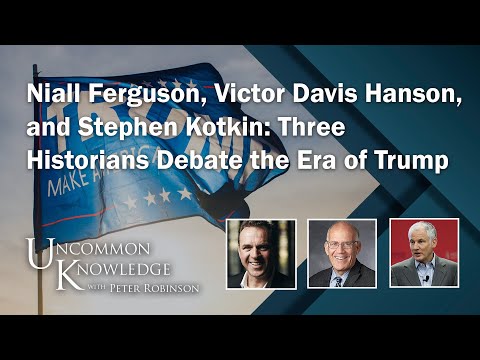
Niall Ferguson, Victor Davis Hanson and Stephen Kotkin: Three Historians Debate The Era of Trump
What this covers
Niall Ferguson, Victor Davis Hanson, and Stephen Kotkin are all senior fellows at the Hoover Institution, and this is the first time they have appeared together in a public discussion. The topic: Is the United States in decline or on the verge of renewal?
Exploring topics including Donald Trump’s second term and the transformation of the Republican Party, relations between China and Taiwan, America’s fiscal crisis, the current state of universities, and the upcoming 250th anniversary of the signing of the Declaration of Independence, this wide-ranging and often passionate conversation dives deep into history, politics, and the fate of Western civilization.
Subscribe to Uncommon Knowledge to stay notified for the next episode: https://www.hoover.org/publications/uncommon-knowledge?utm_source=youtube&utm_medium=description&utm_campaign=uk_description
__________ The opinions expressed are those of the authors and do not necessarily reflect the opinions of the Hoover Institution or Stanford University.
© 2025 by the Board of Trustees of Leland Stanford Junior University.
🔔 Subscribe for more discussions: @HooverInstitution 👍 Like and share this video!
🌐 Follow us on social media: • Facebook: https://www.facebook.com/HooverInstStanford • LinkedIn: https://www.linkedin.com/company/hoover-institution-at-stanford-university • Instagram: https://instagram.com/hooverinstitution • TikTok: https://www.tiktok.com/@hooverinstitution • X: https://www.twitter.com/HooverInst
Source description (no synthesized summary yet).
Trump represents a consequential but incomplete transformation of American politics and foreign policy—economically nationalist and disruptively reformist domestically, but fiscally unsustainable and dependent on military deterrence against revisionist powers (China, Russia, Iran) without a coherent long-term strategy.
- Trump has durably transformed the Republican Party from establishment conservatism to nationalist populism and challenged liberal institutional orthodoxy, but without fiscal reform or institutional process to implement coherent policy
- His foreign policy combines Nixonian realpolitik (deterrence, no nation-building) with unpredictability that deters adversaries psychologically, but leaves Taiwan and US-China competition unresolved
- Universities and federal bureaucracies show signs of reform only under Trump's disruptive pressure, but solutions must come from institutions themselves; America's fiscal trajectory remains unsustainable regardless of who governs
This asset isn't compiled yet
You're seeing its claims, ranked. Compile it to build the argument threads, weight them, and check each claim against your library — the full view.
Trump has been the dominant figure of American politics for over a decade because he never went away despite cancellation efforts in 2021, and he is only the second president ever (after Grover Cleveland) to win a non-consecutive second term.
“This is only the second time that a president's won a non-consecutive second term. Only Grover Cleveland previously did that. And that means we've had Trump for more uh than 5 years because he never went away. Despite every effort to cancel him in 2021, he did not go away. And in that sense, I think he's been the dominant figure of American politics for over a decade.”
Civilizations don't die from external enemies but by suicide, as Toynbee said, and America might be suiciding through fiscal irresponsibility rather than Chinese threat, suggesting internal problems are more dangerous than external ones.
“Civilizations, as Toynbee said don't die from external enemies, however significant that is. And so, it's it's more than worrying.”
Civilizations do not die from external enemies but from internal suicide, as Toynbee noted; if the US cannot reform fiscal structure and relies instead on a 'Hail Mary 100-yard pass with time running out where nobody can catch the ball,' this represents civilizational decline rather than renewal, making consequentiality moot.
“And so if you don't have the political will to write the fiscal problem, if you have a kind of Hail Mary 100-yard pass with time running out where nobody actually can catch the ball, that's sort of what I heard you say the strategy was. I don't know how this is a consequential presidency except for taking things down in turn You know, things die by suicide. Civilizations, as Toynbee said don't die from external enemies, however significant that is. And so it's it's more than worrying.”
The US is the largest natural gas producer, largest oil producer, and fourth in coal; it's the largest atomic energy producer even in decline; however, China has increased electricity generation dramatically, particularly through renewables investment (though heavily in coal), and this electricity generation capacity matters enormously for the AI race, which is extremely electricity-hungry.
“when you look at the basics of a civilization, energy, United States is the largest natural gas producer, the largest natural oil producer, and it's fourth in coal. It's the largest producer of atomic energy even in its nadir. But, here's where it gets tricky. Because in in in in so far that's all true, the problem is that China's increased its electricity generation by an extraordinary amount, investing in solar particularly, but renewables more broadly...The real miracle that we're seeing in China's economy is an incredible increase in the amount of electricity generated from all sources. This is going to matter in the AI race because the AI race is a a very electricity-hungry one.”
In the 1970s-80s, Reagan presided over growing deficits but was reviled by the left and ultimately won the Cold War, suggesting that fiscal discipline and domestic consensus are less important than foreign policy victory.
“He built the military. Started under Carter and he re- Look at the military that when you were writing those speeches, where is that on the horizon?”
Trump was the first to identify China as a major economic and strategic challenge during 2015-16 campaign, ending the bipartisan consensus that China's rise was 'win-win'; he replaced this with a national security strategy (with H.R. McMaster) identifying China and Russia as strategic rivals, representing a massive achievement that became bipartisan consensus.
“that Donald Trump asked on the campaign trail in 2015-16. He was the first person to say China is posing a major economic as well as strategic challenge to the United States. He was the one who tore up the old national security strategy of successive governments saying that the rise of China was a win-win and replaced it. Our colleague H.R. McMaster did much of the work with a national security strategy that identified China as well as to a lesser extent Russia as strategic rivals. Now, I think...That China yes. And that was because there was process, not just two thumbs. Now we have no process on purpose because Trump believes that process inhibits him from doing things.”
Trump has never intended to stabilize public finances; he explicitly refuses to touch Social Security, Medicare, or Medicaid for political expediency, which makes addressing the fiscal crisis impossible since entitlements cannot be reformed, creating a structural constraint on his presidency regardless of other accomplishments.
“The shadow side is that the president has never had any intention of stabilizing our public finances. This has always been the problem for political expediency because it's extremely hard to do these things as Mitt Romney and Paul Ryan discovered when they tried to make it clear that there needed to be entitlement reform. They were completely transed politically by Barack Obama...Donald Trump replies, 'Oh, no, no, no, no. I've been clear throughout my political career. I'm not touching Social Security, Medicare or Medicaid.'”
President Trump told John Bolton in the first administration: 'Taiwan is a Sharpie, China is the Resolute Desk. I'm not sending the US Navy to fight over a Sharpie,' indicating Trump's fundamental belief that Taiwan is not worth military commitment and that Taiwan is 'in play' in any negotiation with China.
“Remember what he told John Bolton in the first administration when Bolton was briefly on unhappily as national security advisor. He told him sitting in the Oval Office, 'In a Taiwan is a Sharpie, China's the Resolute Desk. I'm not sending the US Navy to fight over a Sharpie.' So, the Chinese know that with with Trump, Taiwan's in play.”
Trump is the first Republican president in 20 years (since 2004) to win the popular vote, achieving both popular and electoral vote victory while the Republican Party now controls the House, Senate, Supreme Court, and executive branch—a rare concentration of power across all branches of government.
“he was the first American Republican president in um since 2004, in 20 years, to win the popular vote. No one Nobody else had done that. McCain didn't do it. Romney didn't do it. Trump didn't do it the first time. He did that. He won the popular and the electoral vote. He now controls, whether you like it or not or whatever margin...There is a conservative majority in the House, the Senate, the Supreme Court, and the executive branch.”
The average US tariff rate has returned to levels not seen since the 1930s; the US has been 25% of global GDP continuously since 1870, independent of whether tariffs or income taxes were present, suggesting tariff levels do not determine great power status.
“The average tariff rate of the United States today has not been as high as this since the 1930s. The US is 25% of global GDP since 1870. And that's with tariffs and without tariffs. With income tax and without income tax.”
Trump has transformed the Republican Party from a traditional conservative establishment party into a nationalist populist party, fundamentally altering its ideology and voter coalition, which represents an enduring transformation at least for a generation.
“He radically changed the Republican Party. It's completely different. It's a nationalist populist party.”
Elite university classics departments have dropped Greek as a required language in the curriculum, accelerating the decline of classical studies as a discipline.
“And if you look at most of classics departments today in the United States, not most, but they what they're turning out, and they're not even requiring at some of the best universities Greek as a required language in classics.”
On fundamental civilization questions, the United States has recovered from similar crises before (1861, 1932, 1939) and possesses inherent renewal capacity—military manufacturing capacity expanded enormously in WWII from the 17th largest army to the largest navy and air force with GDP surpassing all belligerents combined—suggesting renewal is possible today if Americans maintain citizenship engagement.
“I think we're in a deer, and we're climbing out of it. We've had this in 1861, we had it in 1932, we had it in 1939. I mean, when we The war started, we had the 17th largest military army. Portugal was larger than ours. And when we finished 5 years later, we had a larger navy and air force than every belligerent put together, and a GDP that was bigger than all of theirs.”
Trump was the first president to fully understand how radically the internet and social media transformed the public sphere and to exploit that transformation effectively, whereas his rivals (Hillary Clinton, Kamala Harris) could not match his social media competence, though Obama was first to use social media effectively as the 'Google president' while Trump became the 'Twitter president.'
“Trump was the first president fully to understand how radically that altered the public sphere in the United States and to exploit that transformation. Virtually none of his rivals could match that. Hillary Clinton certainly couldn't. Kamala Harris was a fail on social media...Obama was the Google Obama was the Google president. He started But, Trump was the Twitter president. You can see that if you look at the data.”
Cutting federal scientific funding while trying to reform universities is contradictory, as universities conduct fundamental science that requires sustained high-level funding, and reduced funding will weaken American scientific capacity relative to China.
“When you cut American scientific funding, you are not engaging in China policy properly...Fundamental science is very, very expensive...And that expense does not come from private sector alone...If Hillsdale had 15 300 million dollar science labs, it would not be able to self-fund. And so, you want to do big science because you want to be a serious country, and anyway, you have to compete...with China. You need to have big money in science run properly.”
Trump was the first president to fully understand and exploit the radical transformation of the public sphere caused by the internet and social media, whereas his rivals could not match this understanding or capability.
“Trump was the first president fully to understand how radically that altered the public sphere in the United States and to exploit that transformation. Virtually none of his rivals could match that. Hillary Clinton certainly couldn't. Kamala Harris was a fail on social media.”
The American experiment has recovered from crises multiple times in its history: in 1861 (Civil War), 1932 (Depression), and 1939 (eve of WWII when US had 17th largest military, smaller than Portugal); within 5 years during WWII, US built a larger navy and air force than every belligerent combined with larger GDP, proving American renewal capacity.
“I think we're in a deer, and we're climbing out of it. We've had this in 1861, we had it in 1932, we had it in 1939. I mean, when we The war started, we had the 17th largest military army. Portugal was larger than ours. And when we finished 5 years later, we had a larger navy and air force than every belligerent put together, and a GDP that was bigger than all of theirs.”
Tariff revenue is much lower than initially expected—only in the tens of billions annually, not hundreds or the promised trillion—and will likely decay over time as international economy adjusts to tariffs.
“The problem is it's likely to decay over time as the international economy adjusts to the tariffs.”
Trump won record support from Hispanic voters (49%) and Mexican-American voters (55%), as well as 23% of African-American male voters, winning on key issues (border, illegal immigration, crime, energy, foreign policy) where polls showed 60/40 or 30/70 partisan splits in his favor, despite being outspent 3-to-1 and facing 93 indictments and removal attempts in 25 states.
“He radically changed the Republican Party...And he got a record number of Hispanics, 49%. He won 55% of the Mexican-American vote. He won 23% of the African-American male vote. On most of the key issues, on the border, illegal immigration, crime, energy, foreign policy, they were 60/40, 30/70 issues that he won on all of those issues. He was outspent uh three to one in the campaign, and he still overcame that. And he was indicted 93 times.”
Trump administration's first defense budget in real terms is slightly smaller than Biden's last defense budget, despite inheriting a $1.9 trillion annual deficit, $37 trillion national debt, and $1.1 trillion trade deficit, imposing real fiscal constraints on military spending.
“the Trump administration's first defense budget is actually in real terms a little bit smaller than Biden's last defense budget. All, over to you on foreign policy. He inherited a $1.9 trillion annual deficit, $37 trillion national debt, $1.1 trillion trade deficit. So, there is constraints on him.”
Trump has only 36 positions staffed in the National Security Council (compared to 400 under Biden and Obama), deliberately designed to prevent interagency process that Trump believes 'inhibits' him; this lack of process means announcements come from Trump personally but implementation is unclear and ad-hoc.
“And so there are 36 positions staffed in the National Security Council. 36. That's it. On purpose...You announce things with your thumbs and then who implements? Who follows up? Who makes the phone calls? Who actually implements whatever it is that you're thumbing out into the world? And the answer is nobody...There are two thumbs. And then there is waiting to see what might happen or not happen. In the first administration, we had McMaster. We had Pompeo. We had Matt Pottinger. We had interagency process...And so, we turned around this gigantic ship on China...Another massive achievement. Might even say consequential. That China yes. And that was because there was process, not just two thumbs. Now we have no process on purpose because Trump believes that process inhibits him from doing things.”
There have been three or four major government shutdowns over healthcare (Gingrich shutdowns, Obama shutdown, Biden shutdown) which demonstrates that healthcare is a political third rail that prevents fiscal discipline.
“Gingrich shut the government down over health care. Uh there was a shutdown of the government, a second one over health care. This is the third of four shutdowns, significant shutdowns, over health care. The fourth one was over the border wall, as you'll recall.”
Universities have the lowest popularity in history at 26% public confidence, with 70-80% A grades and employers like those in Silicon Valley questioning whether graduates from elite universities like Stanford are better than Georgia Tech or Southern schools in certain technical fields.
“We have the lowest popularity in history. 26% of the public have confidence in higher education. It's true. And we have 70 to 80% A's now, and people in Silicon Valley question, among other employers, whether the the graduates, say from Stanford, are better than Georgia Tech or Southern”
The 2024 election choice was between 'fiscal insanity or fiscal insanity,' with Democrats continuing their fiscal excess versus Republicans continuing Trump's fiscal excess, meaning neither party offers genuine fiscal reform—it was a choice of which type of unsustainable path to accept.
“When I had to go to the voting booth in 2024 I had certain cultural issues in play...But what I had in play from a structural long-term perspective was fiscal insanity or fiscal insanity. Which one did I want? And I I was going to get one from the Democratic side, which would have been a continuation of their fiscal insanity, or I was going to get fiscal insanity from the Republican side.”
Fundamental science is very expensive and cannot be self-funded by private sector or tuition alone; universities need big government funding to compete internationally, which Trump's budget cuts threaten.
“Fundamental science is very, very expensive. Okay. And that expense does not come from private sector alone, and it doesn't come from tuition money. If Hillsdale had 15 300 million dollar science labs, it would not be able to self-fund. And so, you want to do big science because you want to be a serious country, and anyway, you have to compete not just with China. You need to have big money in science run properly.”
In Trump's first term, there was an interagency process with McMaster, Pompeo, and Pottinger that turned around US China policy from 'rise of China is a win-win' to 'China is a strategic rival,' which became bipartisan consensus and was a massive achievement.
“In the first administration, we had McMaster. We had Pompeo. We had Matt Pottinger. We had interagency process. And so, we turned around this gigantic ship on China that was going the wrong way. It was a massive achievement. And it became a bipartisan consensus. Another massive achievement.”
Trump's foreign policy approach resembles Richard Nixon's strategy more than Jacksonianism: Trump views American allies as free riders, has told Europeans 'You're on your own' for Ukraine security, is pursuing peace in the Middle East (not isolation), and is imposing tariffs reminiscent of Nixon's 1971 unilateral economic actions (severing gold-dollar link, imposing 10% tariffs), representing a 'Nixonian' reshaping of the international order rather than isolationism.
“What I'm struck by is the resemblance to a more recent president, Richard Nixon. Uh it seems to me that President Trump has many Nixonian traits. One of them is to feel that America's allies are free riders. Uh and his response to this has been to tell the Europeans 'It's no longer possible for you to outsource your national security to the United States.' And that's a very Nixonian thing to have done...he's not isolationism and it's not Jacksonianism. Look at his involvement in the Middle East...And lastly, I think that what Trump's doing in the international economy very closely reminds me of 1971, where if you remember, Nixon announced...that he was severing the link between the dollar and gold and imposing a 10% tariff on all American imports.”
China has announced its intention to take Taiwan and collapse American power in East Asia; this represents a 'border of defeat' for China (like Ukraine for Russia and the Israel-Arab frontier), and China's revanchism is about more than Taiwan—it includes revenge for alleged Japanese WWII atrocities, eviction of US bases from South Korea and Philippines, pushing America back from the first island chain to the second, and potentially beyond; China's appetite grows with success, so Taiwan's fall opens a cascading sequence of further territorial ambitions.
“China has announced that it is going to be able to do this if it wants. Take Taiwan. And not only take Taiwan, collapse American power in East Asia...Taiwan, borders of defeat for China...revisionism...to overcome borders of defeat. That's not something you negotiate...China...wants to roll back American power in East Asia...The goal is not just to take Taiwan. That's important. It's clearly a high priority...Taiwan is going to capitulate...Or they're going to fight for it...But that's just the beginning of the story. They're then going to revenge against Japan. Japan's atrocities against China in World War II, that's on the agenda...And they're going to hit Japan back...They're also going to evict American military bases from South Korea, from the Philippines...and push America back to the second island chain...and maybe beyond...And remember the appetite grows in the eating.”
Harvard and other elite universities are wholly-owned Democratic Party affiliates with overwhelming Democratic or progressive faculty and support; they are corrupted by DEI like the federal bureaucracy.
“Like Harvard, the federal government is a wholly-owned affiliate of the Democratic Party. Look at the Look at the opinion surveys at an institution like Stanford or Harvard. The tiny number of professors who are Republicans. The overwhelming support for Democratic or progressive policies.”
Putin invaded Ukraine only when he perceived he could do so safely—he did not invade during Trump's first four years, but invaded during Bush's Georgia intervention (Ossetia), Obama's Crimea and Donbas interventions, and attempted Kiev takeover during Biden; therefore, perceived unpredictability and deterrence capacity (psychological and material) are what prevent revisionist aggression, not accommodation.
“The reason that Putin went in to Ukraine was because he thought that he could. And he could. And he didn't go in during Trump's four years, but he did go in during George W. Bush and the Ossetian Georgia. He did go in during Obama to Crimea. And the Donbas, and he did go in to try to take Kiev during...And so, they feel, they, the foreign policy antagonists in the United States, feel that he's unpredictable. And he's capable of doing anything at any time to anybody, anywhere.”
The average U.S. tariff rate under Trump is now as high as it has been since the 1930s, yet the U.S. maintained 25% of global GDP in 1870 both with and without tariffs, suggesting tariff policy doesn't determine economic standing.
“The average tariff rate of the United States today has not been as high as this since the 1930s. The US is 25% of global GDP since 1870. And that's with tariffs and without tariffs.”
The only significant piece of legislation Trump has passed is a continuation of fiscal insanity; executive orders are not permanent legislation and can be reversed, making them poor foundations for lasting policy impact or legacy.
“You know, executive orders are not legislation. They're not permanent. You want to talk about impact and legacy and consequence? Executive orders can be reversed...One piece of legislation which was a continuation of fiscal insanity.”
When hiring nine classics professors over 21 years, Hanson requested they translate a page of Caesar and Lysias (the easiest Greek and Latin), and the final candidate refused, saying any such request constituted harassment and they would complain to the American Philological Association—indicating hiring standards have collapsed.
“I hired nine classics professors over 21 years. I finally asked them, 'Could you please, when you come, translate a page from Caesar and a page from Lysias, which are the easiest Greek and Latin?' These were from the elite universities...And the final candidate...he says, 'If you ask me to do that, I'm going to complain to the American Philological Association that you're harassing me.' And they could not read it.”
Strategic ambiguity toward Taiwan served U.S. interests for half a century and should be restored rather than moving toward either explicit defense commitments or diplomatic capitulation.
“Surely it's preferable to re- reset us to 1972 or 1979, the strategic ambiguity that served us well for half a century. We don't want to fight a war over Taiwan.”
University overhead costs exploded from 15-20% to 30-60% or more, with federal government being gouged; Supreme Court ruled in 2023 that universities cannot use race in admissions, yet they created theme houses and continued racial segregation.
“we're going to live within 15 to 20% overhead. And you know, the Supreme Court said, you know, in 2023, we can't use race, and we've been breaking that law. We have racial graduations. We have We call them theme houses, but they're segregated dorms.”
Universities' instinctive tendency is to continue racial discrimination in admissions and trash meritocracy; without shock therapy, institutions like Harvard would never voluntarily reform from within.
“the instinctive tendency with the in these institutions is not to change. It's to carry on engaging in racial discrimination in admissions. It's to trash meritocracy. It's to That's the reality. So, you may not like the methods, but I'm struggling to imagine what else would get through to a place like Harvard for 12 years.”
Trump disavowed traditional organizations seen as corrupt (International Criminal Court, World Health Organization) by simply withdrawing without nation-building pretensions, and this set a precedent for breaking with international institutional consensus.
“Same thing with the these, you know, International Criminal Court, World Health Organization. Everybody knew that these groups were completely corrupt. And he comes along and says, "We're done." And they say, "You can't do that." This is the UN spin-off. He says, "We're done." And everybody says, "Wow." They were done, weren't they? They were kind of corrupt.”
The Israeli and Iranian failures in predictability and complacency contributed to October 7th: Israelis thought they had acculturated Hamas and made their fence defensible while Iran's leaders were seen as paper tigers, but both assumptions collapsed.
“The last two years before 2000 Um, when they would talk about well, Hamas Yes, they would say things like 20,000 people work here. And when they get injured, we take them to the ER room. And look at our fence. It's not very defensible. It looked pathetic. But, they thought that they were playing it off They thought that they could acculturate. And same thing. So, nobody would ever predicted that. Right. Nobody ever said... Nobody ever predicted October 7th. Yes. They said it was incomprehensible.”
American universities remain among the greatest assets any power has ever possessed, with 1.1 million foreign students and 300,000+ Chinese nationals studying in the U.S., suggesting that reforming universities is essential but destruction would be catastrophic.
“America's universities are some of our absolute biggest assets. Why are 300,000 Chinese here? Because American universities are a waste of time? Why are there 1.1 million foreign students here? Because American universities are a waste of time? No, because they're some of the biggest assets that any power has ever seen in history. I want reform, not destruction.”
China has worse fiscal and demographic problems than the U.S.: its deficit is even larger (when counting local government debt), and its population will likely halve by century's end due to demographic collapse, constraining its long-term power.
“Let me tell you about China's fiscal problems. You know what? The deficit is even larger in China if you look at local government debt. The economic problems of China are compounded by far worse demographic trends. Their population likely halves uh between now and the end of the century.”
The 1980s Reagan victory over Soviet Union was achieved despite growing deficits, showing that consequentialism is determined by outcome not by fiscal prudence during the contest; if Trump wins Cold War II against China, he will be judged consequential despite fiscal problems.
“But if, as happened in the 1980s, a president reviled by the left who presided over uh a growing deficit nevertheless emerges as the winner of the Cold War Then you're a good consequential president. He built the military. Started under Carter and he re-”
Trump won the 2024 presidential election with 77 million votes, making him the first Republican president in 20 years to win the popular vote, and he won all swing states and 93% of counties despite being indicted 93 times, having his home raided, and being taken off ballots in 25 states.
“He won the popular and the electoral vote. Trump won 77 million votes, which is a big number. Harris won 75 million...he won all the swing states and 93% of the counties in the in the country”
The American experiment can renew if Americans maintain citizenship engagement and constitutional vigilance—as long as people worry whether the republic can hold and the Constitution's separation of powers continues to function, America will likely survive existential crises.
“America has more than enough potential for renewal, but renewal is not an automatic thing that's going to happen. It's a matter of citizenship...As long as we have that worry and keep asking ourselves, 'Can we keep the republic?' And as long as the Constitution continues to function with its separation of powers...we'll be fine.”
Trump's willingness to use direct psychological deterrence (confronting leaders, signaling strength, making credible threats of military action) is effective in preventing adversary adventurism, as demonstrated by the absence of major Russian military actions during his first term compared to three separate invasions under Bush, Obama, and Biden.
“It's psychological and material. So, when you look at psycho There's no way in the world Donald Trump would have had his national security advisor and secretary of state go to Anchorage, Alaska and be dressed down and humiliated in the way that Blinken and Sullivan were...He would have shot it down. He would have blown it up.”
Neil Ferguson's law (citing a Scottish ancestor) states that any great power spending more on debt service than defense will not long remain great; the US debt was 30% of GDP when Reagan left office and is now 120% of GDP and growing; unless entitlement spending (at least 2/3 of federal budget) is reformed, the US cannot remain solvent.
“Niall Ferguson quote citing Ferguson's law, some distant ancestor of yours. Scottish? Scottish, of course, Ferguson. that any great power that spends more on debt service than it does on defense will not long remain a great power. We are now in that territory ourselves. When Ronald Reagan left office, everyone said, 'Oh, good presidency, happy about it, but the way he increased the deficit which was then 30% of GDP.' debt debt, excuse me. Sorry. The debt was 30% of GDP and now we're at 120% of GDP. and growing...unless we take on the entitlement spending, which now represents at least 2/3 of the federal budget unless we take that on the United States simply cannot remain solvent.”
As long as Americans continue to worry about whether the republic can hold and the Constitution continues to function with its separation of powers, the nation will be fine; the Constitution's separation of powers is a 'stroke of genius' that has been the key to American success.
“The great thing about this country is for 249 years, people have been worrying that the republic can't hold, that we're Rome. And that's the right worry to have. As long as we have that worry and keep asking ourselves, 'Can we keep the republic?' And as long as the Constitution continues to function with its separation of powers, the stroke of genius at the heart of its success, we'll be fine.”
Trump's administration has a fiscal plan, but it is based on unrealistic assumptions: expecting $10-15 trillion in foreign investment that never materializes, believing the US can 'energy out' everyone by selling natural gas and oil that exceeds actual productive capacity, expecting $400 billion to $1 trillion from tariffs (now tracking tens of billions), and assuming $7-8 billion in revenue from AI and crypto without touching entitlements—an approach Kotkin calls 'hope is not a strategy.'
“They think they're going to get 10 to 15 trillion dollars in foreign investment. All these people come over here and they promise 5 trillion and nobody ever ever calls them up a month later and says, 'Where's the check?'”
Grover Cleveland was the only president before Trump to win a non-consecutive second term, making Trump's persistence as a political figure for over a decade (never going away despite 2021 cancellation efforts) uniquely significant in American presidential history.
“This is only the second time that a president's won a non-consecutive second term. Only Grover Cleveland previously did that. And that means we've had Trump for more uh than 5 years because he never went away. Despite every effort to cancel him in 2021, he did not go away. And in that sense, I think he's been the dominant figure of American politics for over a decade.”
Executive orders are not legislation and are therefore not permanent; they can be reversed within days by subsequent administrations, so Trump's executive orders lack the lasting impact of actual legislation, and the Trump administration has passed only one piece of legislation (continuing fiscal insanity) in its tenure so far.
“You know, executive orders are not legislation. They're not permanent. You want to talk about impact and legacy and consequence? Executive orders can be reversed. We saw the idiotic executive orders from that previous guy, whatever his name was, and where are they now? They're in the trash heap of history.”
The Treasury Secretary projected 3% GDP growth and 3% deficit-to-GDP ratio targets, but both are highly unlikely to be met; growth is trending down as the administration speaks, the labor market is showing weakness, and large deficits keep long-term interest rates high even when Fed cuts short-term rates, making mortgages expensive and housing markets fragile.
“Scott Bessent said he was going to deliver uh 3% growth 3% of GDP deficit uh and uh and I think both of those targets are highly unlikely to be met. And I suspect he knows it. Indeed the growth rate is trending down as we speak. The labor market is showing signs of weakening. And remember, the problem with having a very large deficit and a large debt is that long-term interest rates tend to remain high even if the Fed is cutting short-term rates. That's bad news for people with mortgages...That's exactly where we are now. And the housing situation is is another cause for concern.”
When Trump administration came into office, the Army had a 45,000 soldier shortfall that was said to be permanent due to recruiting issues (obesity, drug use, gang involvement, lack of willingness to serve); within 9 months of the Trump administration, every branch of the military met all recruitment quotas for the first time in over a decade, suggesting administration's approach to military priorities is effective.
“When he came into office, we were told that we have 45,000 shortfall was going to be permanent because people are fat now. 45,000 shortfall in the army...And all of a sudden we've had record Every branch of the military has met all of their quotas in 9 months. It's the first time the army's made its quota in over a decade.”
Tariff revenue is much lower than expected—in the tens of billions rather than hundreds or the promised trillion dollars—and is likely to decay over time as the international economy adjusts to the tariffs.
“The tariff revenue now is much lower than expected. It's only in the tens of billions. No, no it's It's been It's probably going to come at annually as opposed to uh certainly hundreds. The The problem is it's likely to decay over time as the international economy adjusts to the tariffs.”
China faces three simultaneous challenges: a projected population decline that will halve between now and the end of the century, compounded local government debt that exceeds the US deficit, and an economic trajectory dependent on avoiding the AI race losing to the United States—making China's strategic position less strong than it appears.
“China has its own problems. You know what? The deficit is even larger in China if you look at local government debt. The economic problems of China are compounded by far worse demographic trends. Their population likely halves between now and the end of the century.”
China has massively increased its electricity generation from all sources, investing heavily in renewables, and this electricity increase will matter in the AI race because AI is very electricity-hungry and China is winning on infrastructure.
“China's increased its electricity generation by an extraordinary amount, investing in solar particularly, but renewables more broadly. Mostly in coal. And And well, it No, it's actually done the investment heavily in renewables. It's grown its coal, but it's it The real miracle that we're seeing in China's economy is an incredible increase in the amount of electricity generated from all sources.”
Trump's tariffs have caused China's share of global manufacturing value added to decline since 2021 while America's share has grown, indicating something significant is happening in the economic competition with China, though re-industrialization is extremely difficult.
“if you look at China's share of global manufacturing value added, it actually declined since 2021 and America's share has grown. So, something important is happening. I think it's difficult. It's really hard to re-industrialize the United States, but it is an economic competition between the United States and China.”
China will not be able to execute its geopolitical ambitions if it loses the AI race; there is a decent chance it will lose because it has not caught up with the best large language models built by US tech companies, making the AI race a decisive economic and technological competition.
“China will not be able to do the things that you're describing if it loses the AI race. There's a decent chance that it will. It's certainly not caught up with the best of the large language models that the US tech companies are building. So, I think from Trump's vantage point, the key issue is an economic one.”
Ferguson predicted Xi will move on Taiwan in some form during Trump's second term—not necessarily invasion but possibly quarantine, disruption of trade, or diplomatic moves extracting U.S. opposition to Taiwanese independence.
“There are different ways it can be done. I don't think an invasion's ever been very likely, nor even a blockade. But, you can imagine a quarantine, a loose disruption of Taiwan's trade. Or, you can imagine a diplomatic move...The Chinese have already signaled that one of the things they want out of that is for the United States explicitly to oppose their idea of Taiwanese independence.”
The French Thermidor reaction (the 1793-94 reversal of the Jacobin Terror) was the dominant force in real time but is not the dominant culture and politics of France in the fullness of history, suggesting Trump's cultural counterrevolution may prove similarly temporary.
“Where is the Thermidor reaction today? I mean, the original Thermidor reaction, how lasting was the Thermidor reaction?...the Thermidor reaction...looked like the biggest thing when it happened in real time...Is the Thermidor reaction today the dominant culture and politics of France?”
The government shutdown over budget negotiations demonstrates Democratic irresponsibility, as they shut down the government over a marginal cut to the Affordable Care Act that was much smaller than when the ACA was 20% larger under Trump's first term.
“We're talking right now when the government of the United States has been shut down by the left because the Affordable Care Act, which they had approved earlier, is now under the Trump budget questioning or suspending this tax incentive. And it's a mild mild cut. And if you look at the Affordable Act where it was with Trump before he left office the first time, it's about 20% more larger than it was.”
In artificial intelligence, genetic engineering, robotics, and cryptocurrency, it is not clear that China is ahead of the United States, and the US is drawing in talent globally, so the key technological race is winnable if universities reform.
“in key areas like AI, like genetic engineering, like robotics, like cryptocurrency, it's not clear that China's ahead. And the United States is drawing in all sorts of people now. And I think this reform of the university to be a a disinterested open empirical place again will In the short term, it's going to hurt it, but in the long term, it's going to be very positive.”
Russia and Iran face even greater problems than China, with Russia's difficulties being greater than China's, and Iran's regime on the brink of collapse, suggesting the US faces multiple adversaries with serious structural vulnerabilities.
“And Russia's problems are even greater. Iran, the regime is on the brink of collapse. North Korea, it's kind of a running error.”
Kamala Harris would have been a catastrophic alternative to Trump, and viewers should counterfactually imagine how bad conditions would be under her to appreciate that Trump was the only viable choice despite his failures.
“suicidal Harris had somehow won the 2024 election. It's just if you if you need, viewers, to just to kind of get a reality check, just run the counterfactual in your mind. How would the United States be doing today if Kamala Harris were commander in chief, the president of the United States?”
The US faces an unsustainable fiscal crisis: national debt is 120% of GDP (up from 30% when Reagan left office), annual deficit is $1.9 trillion, debt service now exceeds defense spending, and entitlements represent 2/3 of the federal budget—and neither party is willing to reform entitlements due to political cost, making fiscal stabilization nearly impossible.
“The debt was 30% of GDP and now we're at 120% of GDP and growing considerably”
High long-term interest rates remain high even when the Fed cuts short-term rates, and this harms homebuyers—the current US housing situation represents a serious concern alongside the broader fiscal crisis.
“The problem with having a very large deficit and a large debt is that long-term interest rates tend to remain high even if the Fed is cutting short-term rates. That's bad news for people with mortgages...That's exactly where we are now. And the housing situation is is another cause for concern.”
Trump's approach to universities is identification of real problems (DEI overreach, meritocratic collapse, racial discrimination in admissions, segregated 'theme houses,' low public confidence at 26%, grade inflation to 70-80% A's) but his methods amount to extortion and blackmail using federal funding leverage, which creates tit-for-tat escalation rather than sustainable reform from university leadership itself.
“The threat to American universities is leadership at American universities. Victor is 100% correct. That doesn't justify Trump's approach of extortion, blackmail, misuse of federal power. He's very good at identifying problems, but I need solutions. The problems are real, but where are the solutions?...Victor is right, they have to come from the universities themselves. Absolutely. And they haven't come from the universities themselves, and so Trump is identifying a very real problem that universities must address, cuz Trump, again, it doesn't intend to fix these things and is not going to fix them.”
Victor Davis Hanson experienced grade inflation and DEI pressure directly at Cal State Fresno: he went from assigning 10 authors in introductory humanities course to only 2 (because students couldn't finish reading), was told he gave too many C's (should be D's and F's), and when failing students, received pressure from DEI centers not to 'ruin their lives,' demonstrating how DEI infrastructure actively undermines academic standards.
“And I taught 21 years. When I came in '84, I had 10 authors in introduction to Western Humanities assigned. In 2004, I was down to two...And I was told that I was giving too many um I was giving too many C's. They should have been D's and F's...And then when I would give particular students an F, I would get a call from a person, I won't mention the name, but they came from a center for or a program for, and you name DEI, it was a prototype, saying to me, 'This person was a very nice person. This person is the first person in their family. This person And if you do this, you'll ruin a life.'”
When Nancy Pelosi visited Taiwan, it appeared to encourage Taiwanese independence elements and was extraordinarily dangerous, pushing China toward action; Biden-Harris administration came close to causing Taiwan issue to flare up, whereas détente (not appeasement) with China is the proper goal to avoid a colossal war.
“The Biden-Harris administration came very close to to causing the Taiwan issue to flare up. It was extraordinarily dangerous when Nancy Pelosi made that reckless visit to Taiwan and appeared to be encouraging those elements that favor Taiwanese independence. So I think détente is the right term, not appeasement. It'll be appeasement if they hand Taiwan over for nothing, but I don't think that's the plan...Surely it's preferable to re- reset us to 1972 or 1979, the strategic ambiguity that served us well for half a century. We don't want to fight a war over Taiwan. That would be a colossal war.”
Biden administration suffered a complete foreign policy disaster compared to Trump's more successful Middle East approach (despite Trump's 'two thumbs' governing style); comparing Biden-Harris institutional process-heavy approach with Trump's results-oriented approach shows Trump is better at actual execution, making process arguments less relevant than results.
“you get the feeling that in the Trump administration Taiwan is in play. Victor? In play in the sense that He's going to give it away if he gets something else for it in his mind...Which administration is a point of comparison? Listen to the disaster the national security advisor made. The national security advisor completely missed The national security advisor completely missed what happened on October 7th to the point that an article appeared in Foreign Affairs celebrating the peace that the Biden administration Jake Sullivan said it was the most quiet part of his life. So in other words, this was a good thing because of Biden...judge a president by results, not whether he abides by the interagency process. Look at the results in the Middle East. Compare the Biden-Harris administration with its bureaucracy and this administration, which as you describe it has two thumbs and no process. Which was more successful in the Middle East? We had an utter disaster 2 years ago.”
Despite DEI era, the Federalist Society (conservative legal community) and Harvard/elite medical schools are still producing excellent doctors and lawyers; therefore, even flawed institutions continue producing excellence and shouldn't be destroyed, only reformed, suggesting that institutional problems are real but solvable without demolition.
“No, I had cancer. Yeah. And I had three different cancers, and I'm alive today. Why? Because my doctors had MDs from Trump University or because my doctors had MDs from Harvard? All during the DEI era. Those Federalist Society uh members are conservative attorneys, judges, professors of law. Do they have JDs from Trump University or do they have JDs from Harvard University? They have them from Harvard University.”
Trump's initial trade war against China involved tariffs so high they amounted to a trade embargo, which failed because China retaliated with tariff-for-tariff responses and restrictions on rare earth exports, creating problems for US manufacturers and forcing a 'major climb down' by the Trump administration.
“One of the things that President Trump did even before April 2nd was essentially to impose a trade embargo on China. He imposed such high tariffs at one point that it amounted to a trade embargo. This failed, and it revealed the strength that China has. And it failed because China retaliated tit-for-tat, tariff-for-tariff, and then imposed restrictions on rare earth exports...That led to a major climb down by the Trump administration in its trade war with China.”
The Biden-Harris administration nearly triggered a Taiwan crisis through Nancy Pelosi's visit to Taiwan, which appeared to encourage Taiwanese independence advocates, and this reckless diplomatic signaling came close to causing the exact conflict Trump's détente approach aims to avoid.
“The Biden-Harris administration came very close to to causing the Taiwan issue to flare up. It was extraordinarily dangerous when Nancy Pelosi made that reckless visit to Taiwan and appeared to be encouraging those elements that favor Taiwanese independence.”
Trump shot down a Chinese surveillance balloon that the Biden administration allowed to traverse the continental United States for months, demonstrating Trump's willingness to enforce American sovereignty even symbolically, whereas Biden's tolerance of the balloon represented a psychological failure of deterrence.
“There's no way in the world Donald Trump would have had his national security advisor and secretary of state go to Anchorage, Alaska and be dressed down and humiliated in the way that Blinken and Sullivan were in two months into the administration. There's no way he would let a balloon traverse from China across half of the continental United States.”
Putin invaded Georgia (2008), Crimea and Donbas (2014), and attempted to take Kyiv (2022) because he believed he could do so without US military response, suggesting that adversaries will act whenever they perceive the US lacks the will or capacity to respond effectively.
“The reason that Putin went in to Ukraine was because he thought that he could. And he could. And he didn't go in during Trump's four years, but he did go in during George W. Bush and the Ossetian Georgia. He did go in during Obama to Crimea. And the Donbas, and he did go in to try to take Kiev during [Biden].”
If Kamala Harris had won the 2024 election, university reform would not be happening anywhere in the US, and federal pressure would have moved in the opposite direction—toward expanding rather than constraining DEI and progressive institutional capture.
“If Kamala Harris had been elected, none of this would be happening. On the contrary...If it weren't for the pressure that President Trump has exerted on these institutions...Not here, not at Harvard, if it weren't for the pressure that President Trump has exerted.”
Israel's Gaza policy before October 7th was based on the assumption that it could manage Hamas through low-level accommodation (providing employment, managing border traffic) without facing existential threat, and this predictable deterrence failed catastrophically when Hamas launched October 7th, demonstrating that enemies will act when they believe they can succeed.
“When I would go over to Israel and they'd talk about Hamas and Gaza, it was frightening. The last two years before 2000 Um, when they would talk about well, Hamas Yes, they would say things like 20,000 people work here. And when they get injured, we take them to the ER room. And look at our fence. It's not very defensible. It looked pathetic. But, they thought that they were playing it off They thought that they could acculturate.”
Institutions like the International Criminal Court and World Health Organization were 'completely corrupt,' and Trump's withdrawal from them was justified because they had become ineffective or compromised; his approach is to identify rotted institutions and simply exit them rather than attempt reform.
“Everybody knew that these groups were completely corrupt. And he comes along and says, 'We're done.' And they say, 'You can't do that.' This is the UN spin-off. He says, 'We're done.' And everybody says, 'Wow.' They were done, weren't they? They were kind of corrupt. It was like he he kicked in a rotten corpse or something.”
American universities have become thoroughly captured by progressive ideology and administrative bloat (70-80% grade inflation, DEI enforcement over merit, race-based admissions despite Supreme Court ruling, racial theme houses, 15-60% overhead costs on federal grants), and this corruption is now starting to reverse only because of Trump's disruptive pressure—not because university leadership chose reform voluntarily.
“I observe that although we could use reform in the universities, and the leadership has to come from it is only now happening because of one reason...If Kamala Harris had been elected, none of this would be happening.”
Stephen Kotkin argues that China, Russia, and Iran are engaged in a revisionist anti-Western entente—not a formal alliance but coordinated cooperation—to roll back American power, and Taiwan is not merely China's ultimate goal but the beginning of a sequence of territorial revisionism that includes revenge against Japan and eviction of US bases from South Korea and the Philippines.
“China, Russia wants to roll back American power in Europe. Iran wants to roll back American power in the Middle East. And China wants to roll back American power in East Asia. And they have a kind of entente cooperation, not a formal alliance, engaged in this anti-Western project.”
They have not addressed liberal norms but hard left norms in American institutions; these are not moderate progressive ideas but genuinely leftist ideology that Trump is reacting against.
“And they were not liberal norms. They were hard left norms. They were very hard left norms. They were hard left norms.”
Charles Murray argues that the American experiment was unique in 1789 due to geography, self-selected population, and Scottish Enlightenment influence, and that the last 60 years represent not a reversible setback but an inevitable downward spiral.
“American 1789 was unique geographically in the characteristics of its self-selected population and position at the apogee of Scottish Enlightenment. The creation of a limited government was a one-time event never to be repeated. What we have seen over the last 60 years is not a setback from which the American experiment can recover, but a downward spiral that was inevitable.”
Independents represent 40% of the US electorate, with Democrats and Republicans each at roughly 30%, and Trump's methods remain underwater with independents even though the specific policies (border security, fighting crime) have 60%+ support, indicating a gap between policy popularity and tactical approval.
“We're a 30/30/40 country. 30 for each party and 40 neither party. Trump won 77 million votes...Independents dominate the country...Trump is underwater even on most of his signature issues. With independents...he was the 56% were in favor of deportations despite all the ice cream...Trump's methods are underwater even though the policy of border security and fighting crime”
Comparatively, Trump's defense budget in real terms is slightly smaller than Biden's final defense budget, representing a constraint imposed by the fiscal crisis ($1.9 trillion deficit, $37 trillion debt, $1.1 trillion trade deficit inherited).
“The Trump administration's first defense budget is actually in real terms a little bit smaller than Biden's last defense budget. All, over to you on foreign policy. He inherited a $1.9 trillion annual deficit, $37 trillion national debt, $1.1 trillion trade deficit.”
During the Biden administration, there were 300,000+ Chinese nationals studying in American universities, part of 1.1 million foreign students total, and Trump is now using student visa policy as leverage with China to either increase or decrease international enrollment based on geopolitical considerations.
“Some 300 Actually, I think it's a little more than 300,000 Chinese nationals now studying in American universities...1.1 million foreign students in in general. And Trump is using that to either increase or decrease as leverage with them.”
The Scott Bessent Treasury is handling much of the Chinese trade negotiations, not just generic thumb-signaling from Trump, meaning there is some institutional coordination on China policy despite Kotkin's critique of overall thinness.
“The answer is Scott Bessent in the case of China policy...Treasury exists. Treasury is handling much of the Chinese negotiations.”
Trump's military recruitment success is evident in the fact that all branches of the military met their enlistment quotas within 9 months of his administration, the first time the Army has achieved quota in over a decade, despite having faced a 45,000-person shortfall previously attributed to obesity, drug use, and lack of recruitment interest.
“When he came into office, we were told that we have 45,000 shortfall was going to be permanent because people are fat now...And they are and the military...All of a sudden we've had record Every branch of the military has met all of their quotas in 9 months. It's the first time the army's made its quota in over a decade.”
Defense technology innovators wanted Trump as president over Kamala Harris; many Silicon Valley figures switched from Democrat to Republican because they saw Biden administration AI regulation as 'a disaster waiting to happen,' indicating technology community preference for Trump's approach over Democratic regulatory stance.
“ask the people who are at the cutting edge of defense technology, who did they want to be president, Kamala Harris or Donald Trump? That is a short conversation. In fact, one of the major reasons, and you know this, Steve, that people in this part of the world in Silicon Valley switched from Democrat to to Republican was because they saw where the Biden administration was going with AI regulation, and they realized it was a disaster waiting to happen.”
Scott Bessent (Treasury Secretary) is not coordinating China policy through normal interagency process; instead, 'whoever can get through on the phone' serves as de facto interagency process, though Bessent appears more involved than others in China negotiations.
“the answer is the answer is Scott Bessent in the case of China policy. Treasury exists. Treasury is handling much of the Chinese negotiations...What Nick is more involved in Bessent in a lot of these questions. And what Nick, I'm sorry to say, is certifiable...whoever can get through on the phone, that's interagency process.”
China views Trump's diplomatic overtures as 'potential capitulation,' not détente; Chinese propaganda and statements indicate they believe they are winning and that the opportunity for territorial gains has opened, demonstrating asymmetric perception of the relationship.
“You've got to ask the Chinese who run that regime what they think is going on, not ask what the blogosphere thinks is going on here in the United States. The Chinese don't think that this is détente, okay? They think that this is potential capitulation. You can look at the stuff that they're putting out and they're really happy with the way things are going.”
Trump failed to implement TikTok policy by preventing Chinese TikTok from being the main source of news in America as required by law, instead allowing a self-dealing appeasement deal with China.
“He failed to implement the law on TikTok now for quite some time...the law says he's got to do things to prevent the Chinese TikTok from being the main source of news in America, and he's not done that...if there's a deal on TikTok, it will be a smelly deal...a self-dealing, disgusting appeasement of China deal.”
If Kamala Harris had been elected, DEI and progressive policies would continue unchallenged; Trump's disruptive pressure on universities, while distasteful to some, is the only mechanism that has induced reform (reinstatement of SATs, elimination of diversity statements), proving external disruption was necessary because internal reform would never occur.
“It's all diagnosis and not enough solutions for me...Only now happening. Because of one reason. has been crude and blunderbuss, and now we get him the alumni of Yale, the Harvard alumni, they're also an important pressure group. Yes, but only now What I'm saying, Steve, is that this could magically happen by itself. But the reality is that if Kamala Harris had been elected, none of this would be happening. On the contrary...Not here, not at Harvard, if it weren't for the pressure that President Trump has exerted on these institutions...the federal government is a wholly-owned affiliate of the Democratic Party.”
Trump's foreign policy lacks coherent institutional process and coordinated strategy because he has deliberately staffed only 36 National Security Council positions (compared to 250-400 previously), believing process inhibits rather than empowers him; this creates chaos where announcements are made ('thumbs out') but no one implements or follows up systematically.
“There are 36 positions staffed in the National Security Council. 36. That's it. On purpose...And so there are 36 positions staffed in the National Security Council. 36. That's it. On purpose because Trump believes that process inhibits him from doing things.”
The Democratic Party has destroyed itself, and while Trump contributed to its immolation, Democrats had a 'bigger hand' in their own demise through ideological capture and poor strategic choices.
“He destroyed the Democratic Party as we know it. It's not the same Democratic Party...I think the Democrats had a bigger hand than Trump in that suicide, but I'll give you that he contributed to their immolation, which we are still witnessing.”
The Trump administration's Middle East policy has been more successful than Biden's, which suffered from unpreparedness for October 7th and failure to maintain deterrence, as evidenced by the national security advisor's claim that the period was 'the most quiet part of his life'.
“The national security advisor completely missed what happened on October 7th to the point that an article appeared in Foreign Affairs celebrating the peace that the Biden administration Jake Sullivan said it was the most quiet part of his life.”
Trump is likely moving toward détente with China rather than confrontation, as evidenced by his expressed interest in Beijing visits, his stated reluctance to defend Taiwan militarily ('Taiwan is a Sharpie, China's the Resolute Desk'), and his administration's failure to enforce the TikTok law—signaling capitulation rather than strategic competition.
“I think that we're seeing in China policy is a recognition that China is a formidable poses a formidable threat, that a war over Taiwan would be extremely risky for the United States, and therefore I think we're seeing President Trump moving in the direction of detente with China...I think that's what he would like to do...the big beautiful deal.”
China's share of global manufacturing value added has declined since 2021 while America's share has grown, suggesting Trump's trade and tariff policies have begun to reshape manufacturing patterns, although he acknowledges re-industrialization is difficult and not yet complete.
“If you look at China's share of global manufacturing value added, it actually declined since 2021 and America's share has grown. So, something important is happening. I think it's difficult. It's really hard to re-industrialize the United States, but it is an economic competition between the United States and China.”
Silicon Valley tech leaders switched from supporting Democrats to Republicans largely because they feared Biden administration AI regulation would be catastrophic to US technological development, representing a major ideological shift in a key economic sector.
“One of the major reasons, and you know this, Steve, that people in this part of the world in Silicon Valley switched from Democrat to to Republican was because they saw where the Biden administration was going with AI regulation, and they realized it was a disaster waiting to happen.”
Three borders of defeat define the modern great power system: Taiwan (China's strategic vulnerability forcing revisionism), Ukraine (Russia's vulnerability forcing revisionism), and Israel's borders (Iran and Arab neighbors' vulnerability forcing revisionism); these cannot be negotiated or subject to détente because they represent existential grievances, unlike the Soviet borders which were borders of victory and thus stabilizable.
“You have three borders of defeat in the world today where America is vulnerable. With the Soviet Union, you had borders of victory...Ukraine, borders of defeat for Russia. Israel, borders of defeat for Arabs in the neighborhood and for Iran. Taiwan, borders of defeat for China. So, there are revisionisms going on to overcome borders of defeat. That's not something you negotiate. That's not something you reach detente on.”
Trump failed to implement the law on TikTok requiring action to prevent Chinese TikTok from being the main source of news in America, and any deal on TikTok will be a self-dealing, disgusting appeasement of China.
“He failed to implement the law on TikTok now for quite some time. I think that's not appeasement. That's enrichment. So, but but the law says he's got to do things to prevent the Chinese TikTok from being the main source of news in America, and he's not done that. And he has no constitutional authority to do that. And if there's a deal on TikTok, it will be a smelly deal. Sure. It will be a self-dealing, disgusting appeasement of China deal.”
The Federalist Society members (conservative attorneys, judges, and law professors) who oppose liberal overreach graduated from Harvard University during the DEI era, demonstrating that elite universities remain capable of producing exceptional talent despite their ideological capture—meaning destruction is not necessary, only reform.
“Federalist Society uh members are conservative attorneys, judges, professors of law. Do they have JDs from Trump University or do they have JDs from Harvard University? They have them from Harvard University.”
American renewal depends on citizenship and understanding of American agency; it is not automatic but rather a matter of whether citizens actively engage in renewal or passively watch decline; the distinction between active renewal and passive decline hinges on civic understanding.
“I sign on to what Victor just said, and I'm proud to be his colleague, and I think that America has more than enough potential for renewal, but renewal is not an automatic thing that's going to happen. It's a matter of citizenship, as Victor has written very eloquently. We are America. So, it renews either because we help renew it or we watch it go down because we don't understand and appreciate our own citizenship and agency.”
Trump's foreign policy resembles Richard Nixon's approach more than Andrew Jackson's or isolationism—it involves telling allies they must provide their own defense while the US pursues diplomatic peace initiatives in the Middle East and recalibrates economic policy globally, similar to Nixon's 1971 severing of the gold-dollar link and 10% tariff imposition.
“I'm struck by the resemblance to a more recent president, Richard Nixon. President Trump has many Nixonian traits. One of them is to feel that America's allies are free riders...it's not isolationism and it's not Jacksonianism...President Trump, like Nixon, wants to be remembered as a peacemaker.”
Universities' overhead costs on federal research grants have historically been in the 30-60% range, and Trump's position is that federal-grant-receiving universities must comply with executive branch conditions regarding speech and non-discrimination; universities that reject federal funding (like Hillsdale) retain independence.
“We have the lowest popularity in history. 26% of the public have confidence in higher education...30, 40, 50, 60, which is what they were...we could live within 15 to 20% overhead...And so, Trump is saying, 'If you take a federal dollar, unlike Hillsdale College, then I can tell you how to spend it. If you want to tell me F U, then go do what Hillsdale does.'”
When Hanson was a classics professor at Cal State Fresno over 21 years, he went from assigning 10 authors in Introduction to Western Humanities to only 2 because students could not complete the work, was criticized for giving C grades instead of D's, and candidates for classics positions from elite universities could not translate basic Caesar or Lysias without claiming harassment allegations.
“When I came in '84, I had 10 authors in introduction to Western Humanities assigned. In 2004, I was down to two. Two. Meaning I couldn't assign three because they couldn't finish the work.”
The US remains the world's largest natural gas producer, largest oil producer, and fourth in coal production, and maintains the largest atomic energy capacity even during economic decline, giving the US fundamental energy advantages over China despite China's massive renewable investment.
“When you look at the basics of a civilization, energy, United States is the largest natural gas producer, the largest national natural oil producer, and it's fourth in coal. It's the largest producer of atomic energy even in its nadir.”
Democratic Party is a completely different party post-Trump era, effectively destroyed from within due to its own failures, with Trump merely contributing to what was already self-immolation.
“He destroyed the Democratic Party as we know it. It's not the same Democratic Party...I think the Democrats had a bigger hand than Trump in that suicide, but I'll give you that he contributed to their immolation, which we are still witnessing.”
Russia's problems are even greater than China's, and Iran's regime is on the brink of collapse, while North Korea is a 'running error,' making the geopolitical landscape more favorable to U.S. competition than pessimists assume.
“Russia's problems are even greater. Iran, the regime is on the brink of collapse. North Korea, it's kind of a running error.”
Trump views his first term as incomplete and naive, having appointed bipartisans like Barr and Bolton, whereas his second term is disruptive and reactionary—motivated by both his vision of 360-degree counterrevolution and by his experience in the wilderness years.
“It's not just the the reaction to the election, but he looks back at his first term as incomplete and he was naive and he played the bipartisan. He pointed a lot of people from the Bill Barr, John Bolton. This time it's disruptive and it's a reaction to his first term and it's reaction to the wilderness years of which he He says he's not on a revenge tour. But that's a motivation.”
Cynthia Ozick, a 97-year-old novelist who lived through the Depression, WWII, and Holocaust, recently stated 'This is a good country. It's a great country. And now it's disintegrating.'
“Cynthia Ozick, the 97-year-old novelist, this is a woman who lived through the Depression, the Second World War, who saw the horrors of the Holocaust as the newsreels came in. And here she says, "This is a good This is a recent interview. This is a good country. It's a great country. And now it's disintegrating."”
Kotkin voted for Trump in 2024 despite reservations because the choice was between fiscal insanity from Republicans vs. fiscal insanity from Democrats, and the Republican version while bad was preferable to the Democratic continuation.
“When I had to go to the voting booth in 2024 I had certain cultural issues in play that Victor has enumerated quite well. But what I had in play from a structural long-term perspective was fiscal insanity or fiscal insanity. Which one did I want? And I I was going to get one from the Democratic side...or I was going to get fiscal insanity from the Republican side, which was a continuation interrupted by the Democratic continuation of fiscal insanity.”
Trump's only significant achievement in foreign policy will be judged on China policy, as that is the only 'world historical consequential issue' for foreign policy; other regional issues like Sudan or Gaza, while emotionally significant, are not decisive for American power going forward.
“Trump will be judged on China policy because that is the only significant world historical consequential issue for foreign policy today. There are issues that are enormous for the people involved. What's happening in Sudan is colossal for the people in Sudan. It's not colossal for world order. What's happening in Gaza is of great moment...What happens with China or not with China is decisive for American power in the world going forward. That's where Trump will be judged.”
Trump refuses to touch entitlements (Social Security, Medicare, Medicaid) because doing so would destroy a Republican administration politically and because these programs are central to the new nationalist-populist party's base of middle-class deindustrialized America.
“The plan is that you cannot touch entitlements because it'll destroy a Republican administration because they'll demagogue at the left and it's just taboo. And it's also the center of the new national populist party of middle class deindustrialized America. They depend on these entitlements.”
Classics PhD candidates from elite universities cannot read Caesar or Lysias (basic Greek and Latin texts) and one threatened to report Victor to the American Philological Association for harassment when asked to translate a page, demonstrating the collapse of disciplinary standards.
“In an esoteric field like classics, I would hire I hired nine classics professors over 21 years. I finally asked them, 'Could you please, when you come, translate a page from Caesar and a page from Lysias, which are the easiest Greek and Latin?' These were from the elite universities. And the final candidate that put me over the edge, he says, 'If you ask me to do that, I'm going to complain to the American Philological Association that you're harassing me.' And they could not read it.”
Taiwan only spends 2-3% of GDP on defense while Israel spends over 5%, which raises the question of why the US should fight for Taiwan if Taiwan won't fight for itself, reflecting Trump's transactional approach to alliances.
“What does it tell us that Israel, another small country in a difficult neighborhood, spends upwards of 5% of its GDP on defense? And while Taiwan spends 2 and 1/2 Yeah. It's it's three under 3% on defense.”
Trump will be judged on China policy because it is the only significant world-historical consequential issue for foreign policy today; other major crises like Sudan and Gaza, while important to people involved, are not decisive for world order.
“Trump will be judged on China policy because that is the only significant world historical consequential issue for foreign policy today. There are issues that are enormous for the people involved. What's happening in Sudan is colossal for the people in Sudan. It's not colossal for world order. What's happening in Gaza is of great moment for all the people who are emotionally connected there as well as the people there, as well as the state of Israel and is Israel's supporters around the world. What happens in with China or not with China is decisive for American power in the world going forward.”
Treasury Secretary Scott Bessent promised 3% growth and a 3% deficit-to-GDP ratio, targets that both speakers assess as 'highly unlikely to be met,' and growth is currently trending downward while the labor market weakens.
“Scott Bessent said he was going to deliver uh 3% growth 3% of GDP deficit uh and uh and I think both of those targets are highly unlikely to be met. And I suspect he knows it. Indeed the growth rate is trending down as we speak. The labor market is showing signs of weakening.”
Trump conducted a '360-degree counterrevolution' against progressive institutions (like the Thermidor reaction against the Jacobins), targeting not just politics but culture, sociology, and economics across the Smithsonian, Kennedy Center, architecture, DEI, transgender sports policy, and working to undo the progressive project in every aspect of American life simultaneously.
“He's waging a 360° counterrevolution. It's sort of like the Thermidor reaction to the Jacobins. Because he's not just doing pol- politics. He's doing culture, sociology, economics. It's everything from the Smithsonian to uh the Kennedy Gallery to architecture to DEI to transgendered sports. It's He's trying to flood the zone in every aspect of our lives and undo the progressive pop project single-handedly, basically.”
Taiwan spends only 2-3% of GDP on defense while Israel spends 5%+; if Taiwan would emulate Israeli commitment and ally with Japan, South Korea, Australia, and Philippines, Trump would support it, but if Taiwan remains passive and assumes Chinese inevitability, he will abandon it.
“Taiwan spends 2 and 1/2...under 3% on defense...What does it tell us that Israel, another small country in a difficult neighborhood, spends upwards of 5% of its GDP on defense?...If Taiwan tomorrow would say we're going to emulate...5% and they're going to ally themselves with the Japanese and the South Koreans and the Australians and the Philippines and we're going to resist this, then he's going to be there. If they say...we have a lot of investment, we're all Chinese, it's going to be inevitable, then he's going to say go to it.”
Only Trump has generated a specific and non-negotiable exit strategy in Middle East military operations (unlike his predecessors in Vietnam or Iraq), allowing him to strike targets and withdraw without nation-building commitment.
“He's the first president that has what Colin Powell [would want] an exit strategy...he goes in and takes out in 30 minutes the Iranian nuclear project...And then he says Fine. It's over...He did the same thing when he killed Soleimani...no pretensions about nation-building, changing the world.”
There was a clear 'vibe shift' between 2020 and 2024: the 2020 election atmosphere was tense and contested, but the 2024 result, while arithmetically close, felt decisively in Trump's favor to observers, suggesting a psychological shift in perceived momentum and inevitability.
“I remember calling it a vibe shift. Uh it was in marked contrast a marked contrast uh to the atmosphere 4 years before or 4 years before that. Uh those were close elections. I don't think the 2024 election was close by comparison with the previous two elections.”
Trump would not have allowed his national security advisor and secretary of state to be dressed down in Anchorage or a Chinese spy balloon to traverse the continental U.S., as Biden did, because maintaining psychological deterrence requires demonstrating strength at such moments.
“There's no way in the world Donald Trump would have had his national security advisor and secretary of state go to Anchorage, Alaska and be dressed down and humiliated in the way that Blinken and Sullivan were in two months into the administration. There's no way he would let a balloon traverse from China across half of the continental United States.”
Trump is not on a 'revenge tour' despite his desire to prosecute perceived enemies, but rather is motivated by viewing his first term as incomplete and naive, particularly regarding his appointments of Bill Barr and John Bolton, whose betrayals he now sees as requiring correction through more decisive second-term action.
“He looks back at his first term as incomplete and he was naive and he played the bipartisan. He pointed a lot of people from the Bill Barr, John Bolton. This time it's disruptive and it's a reaction to his first term and it's reaction to the wilderness years of which he He says he's not on a revenge tour. But that's a motivation.”
Trump's 360-degree counterrevolution encompasses not just politics but culture, sociology, and economics—targeting DEI, the Smithsonian, the Kennedy Gallery, architecture, transgender sports, and the progressive project across every institutional domain—and no other Republican would have attempted such a comprehensive dismantling.
“He's waging a 360° counterrevolution. It's sort of like the Thermidor reaction to the Jacobins. Because he's not just doing pol- politics. He's doing culture, sociology, economics. It's everything from the Smithsonian to uh the Kennedy Gallery to architecture to DEI to transgendered sports.”
Trump's consequentiality will only be clear when the outcome of 'Cold War II' is known; if China wins, Trump will be remembered as the president who failed to address the strategic threat he himself identified; if the U.S. wins (as it did in the 1980s), he will be remembered as consequential despite presiding over growing deficits.
“The consequential nature of this presidency, here I agree with you, will only be clear when we know the outcome of Cold War II. When we know who wins. If China wins, then we'll look back and say President Trump, for all his flair on social media, had no solution to the strategic threat that he himself identified. But if, as happened in the 1980s, a president reviled by the left who presided over uh a growing deficit nevertheless emerges as the winner of the Cold War Then you're a good consequential president.”
The Trump administration's plan to address fiscal crisis is to rely on: (1) $10-15 trillion in foreign investment (which never materializes when checked), (2) $200 trillion in monetizable federal assets (natural gas, oil, coal leases) to generate massive energy export revenue, (3) tariff revenue (originally projected at $1 trillion, now down to $400 billion or tens of billions annually), (4) AI and crypto and robotics creating $10 trillion, and (5) federal workforce cuts without touching entitlements—hoping to generate $7-8 billion in revenue without structural reform.
“They think they're going to get 10 to 15 trillion dollars in foreign investment. All these people come over here and they promise 5 trillion and nobody ever ever calls them up a month later and says, 'Where's the check?' They think they're going to I think I really like the Secretary of the Interior Doug Burgum, but Yes, he says we're worth uh 200 trillion dollars in assets of federal properties and leases and coal and natural gas and we could be doing, you know, 25 million barrels all this. So they're going to energy out energy everybody and sell it all over the world...they think we're going to get soon half a trillion dollars here from tariffs...we're going to get AI and all crypto and robo all these new technologies we're going to get this 10 trillion dollars in foreign investment, we're going to get all this energy and we're going to have 7 8 billion dollars in revenue and we're going to cut the federal workforce, but we won't touch entitlements and therefore it'll work.”
At the Notre-Dame Cathedral and other international events, Trump commands psychological presence such that other leaders immediately imitate his choices (suit color, demeanor), demonstrating his influence through non-coercive behavioral modeling, comparable to Caesar 'stride over us like a Colossus.'
“He's at the Notre Dame Cathedral and Macron's Let me get near him...He has a blue suit on. They say, 'You can't wear a blue suit.' They all All of a sudden you look back there's three or four people wearing a blue suit.”
Trump's approach to defense contracting has recalibrated procurement toward smaller companies and off-the-shelf solutions rather than exclusive reliance on major defense contractors (Lockheed, General Dynamics, Northrop, Raytheon), suggesting a shift toward distributed and potentially more efficient defense innovation.
“All of a sudden we're told you cannot question Lockheed, General Dynamics, Northrop, Raytheon. They're the big suppliers and all of a sudden it's all this And all these small people with off-the-shelf stuff and they're really recalibrating.”
Kamala Harris published an atrocious memoir that revealed many defects as a human being, making the Trump-Harris choice obvious in retrospect.
“She has obliged us by publishing absolutely atrocious memoir to remind us of her many defects as a human being. So, let's just be relieved. You can criticize Trump, and I have on this show. He has not addressed the fiscal problem.”