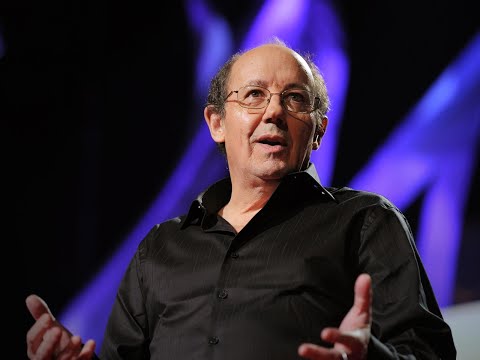
The history of our world in 18 minutes | David Christian | TED
What this covers
Visit http://TED.com to get our entire library of TED Talks, transcripts, translations, personalized talk recommendations and more.
Backed by stunning illustrations, David Christian narrates a complete history of the universe, from the Big Bang to the Internet, in a riveting 18 minutes. This is "Big History": an enlightening, wide-angle look at complexity, life and humanity, set against our slim share of the cosmic timeline. The TED Talks channel features the best talks and performances from the TED Conference, where the world's leading thinkers and doers give the talk of their lives in 18 minutes (or less). Look for talks on Technology, Entertainment and Design -- plus science, business, global issues, the arts and more. You're welcome to link to or embed these videos, forward them to others and share these ideas with people you know.
Follow TED on Twitter: http://twitter.com/TEDTalks Like TED on Facebook: http://facebook.com/TED Subscribe to our channel: http://youtube.com/TED
TED's videos may be used for non-commercial purposes under a Creative Commons License, Attribution–Non Commercial–No Derivatives (or the CC BY – NC – ND 4.0 International) and in accordance with our TED Talks Usage Policy https://www.ted.com/about/our-organization/our-policies-terms/ted-talks-usage-policy. For more information on using TED for commercial purposes (e.g. employee learning, in a film or online course), please submit a Media Request at https://media-requests.ted.com
Source description (no synthesized summary yet).
The universe generates complexity despite the second law of thermodynamics through the appearance of 'Goldilocks conditions' in specific pockets, creating nested thresholds of increasing complexity from the Big Bang through human civilization, but this complexity remains fragile and vulnerable.
- Entropy should drive the universe toward disorder, yet we observe staggering complexity around us
- Complexity emerges in discrete threshold moments when conditions are just right for new forms to appear
- Each threshold makes subsequent complexity possible but also more fragile and dependent on specific conditions
This asset isn't compiled yet
You're seeing its claims, ranked. Compile it to build the argument threads, weight them, and check each claim against your library — the full view.
What makes humans different is human language—a system of communication so powerful and precise that we can share what we've learned with such precision it can accumulate in collective memory, outlast individuals, and accumulate from generation to generation, making humans creative and powerful with a history.
“Now what makes humans different is human language. We are blessed with a language, a system of communication, so powerful and so precise that we can share what we've learned with such precision that it can accumulate in the collective memory. And that means it can outlast the individuals who learned that information, and it can accumulate from generation to generation. And that's why, as a species, we're so creative and so powerful, and that's why we have a history.”
Humans appear to be the only species in four billion years to possess the gift of collective learning, which is the ability to accumulate knowledge across generations through language and cultural transmission.
“We seem to be the only species in four billion years to have this gift. I call this ability collective learning. It's what makes us different.”
Early human migration into diverse environments (deserts, jungles, Siberian tundra, Americas, Australasia) involved learning new ways of exploiting the environment and dealing with their surroundings, demonstrating collective learning at work.
“We see it at work in the earliest stages of human history. We evolved as a species in the savanna lands of Africa, but then you see humans migrating into new environments, into desert lands, into jungles, into the Ice Age tundra of Siberia -- tough, tough environment -- into the Americas, into Australasia. Each migration involved learning -- learning new ways of exploiting the environment, new ways of dealing with their surroundings.”
Ten thousand years ago, humans exploited a sudden change in global climate at the end of the last ice age and learned to farm, which was an energy bonanza that caused human populations to multiply and human societies to become larger, denser, and more interconnected.
“Then 10,000 years ago, exploiting a sudden change in global climate with the end of the last ice age, humans learned to farm. Farming was an energy bonanza. And exploiting that energy, human populations multiplied. Human societies got larger, denser, more interconnected.”
We are burning fossil fuels at a rate that undermines the Goldilocks conditions that made it possible for human civilizations to flourish over the last 10,000 years, creating another trap alongside nuclear weapons.
“If we avoid that trap, others are waiting for us. We're burning fossil fuels at such a rate that we seem to be undermining the Goldilocks conditions that made it possible for human civilizations to flourish over the last 10,000 years.”
Life introduces an entirely new trick: instead of stabilizing individual complex molecules, it stabilizes the template (the thing that carries information) and allows the template to copy itself, with DNA being the beautiful molecule that contains this information in its double helix structure.
“How do you stabilize those huge molecules that seem to be viable? Well, it's here that life introduces an entirely new trick. You don't stabilize the individual; you stabilize the template, the thing that carries information, and you allow the template to copy itself. And DNA, of course, is the beautiful molecule that contains that information. You'll be familiar with the double helix of DNA. Each rung contains information.”
Sixty-five million years ago, an asteroid landed on Earth near the Yucatan Peninsula, creating conditions equivalent to nuclear war and wiping out the dinosaurs, but this was terrible news for dinosaurs but great news for mammalian ancestors who flourished in the niches left empty by dinosaur extinction.
“Occasionally, there are disasters. Sixty-five million years ago, an asteroid landed on Earth near the Yucatan Peninsula, creating conditions equivalent to those of a nuclear war, and the dinosaurs were wiped out. Terrible news for the dinosaurs, but great news for our mammalian ancestors, who flourished in the niches left empty by the dinosaurs.”
The Cuban Missile Crisis demonstrated that the entire biosphere seemed to be on the verge of destruction from nuclear weapons, and while that specific crisis passed, the same weapons remain armed and present an ongoing existential threat.
“I remember very vividly as a child growing up in England, living through the Cuban Missile Crisis. For a few days, the entire biosphere seemed to be on the verge of destruction. And the same weapons are still here, and they are still armed.”
A gold ring was forged in a supernova explosion, illustrating that the heavy elements comprising objects in our world originate from stellar nucleosynthesis.
“If, like me, you're wearing a gold ring, it was forged in a supernova explosion.”
Stars create Goldilocks conditions for crossing new thresholds by creating the temperatures necessary for proton fusion in exotic combinations to form all elements of the periodic table, enriching the universe chemically.
“Stars will create the Goldilocks conditions for crossing two new thresholds. When very large stars die, they create temperatures so high that protons begin to fuse in all sorts of exotic combinations, to form all the elements of the periodic table.”
The Goldilocks conditions for chemistry require moderate energy (not too much as in stars, not too little as in intergalactic space), great diversity of chemical elements, and liquids such as water, with planets being ideal because they are close to stars but not too close.
“Well, first, you need energy, but not too much. In the center of a star, there's so much energy that any atoms that combine will just get busted apart again. But not too little. In intergalactic space, there's so little energy that atoms can't combine. What you want is just the right amount, and planets, it turns out, are just right, because they're close to stars, but not too close.”
Early Earth was almost perfect for chemistry, being at just the right distance from the Sun to contain huge oceans of liquid water, and with deep oceanic vents at cracks in the crust providing internal heat and diverse chemical elements where fantastic chemistry began to happen.
“Well, planets are great, and our early Earth was almost perfect. It was just the right distance from its star to contain huge oceans of liquid water. And deep beneath those oceans, at cracks in the Earth's crust, you've got heat seeping up from inside the Earth, and you've got a great diversity of elements. So at those deep oceanic vents, fantastic chemistry began to happen, and atoms combined in all sorts of exotic combinations.”
The real beauty of DNA lies in its imperfections: as it copies itself, approximately once per every billion rungs there is an error, meaning DNA is in effect learning by accumulating new ways of making living organisms because some errors work, and this learning builds greater diversity and complexity.
“The real beauty of DNA though is in its imperfections. As it copies itself, once in every billion rungs, there tends to be an error. And what that means is that DNA is, in effect, learning. It's accumulating new ways of making living organisms because some of those errors work. So DNA's learning and it's building greater diversity and greater complexity.”
Gravity is more powerful where there's more stuff, so slightly denser areas cause gravity to compact clouds of hydrogen and helium atoms, breaking the early universe into about a billion clouds where density increases, temperature rises at the center, and when temperature crosses 10 million degrees, protons fuse to create stars.
“Gravity is more powerful where there's more stuff. So where you get slightly denser areas, gravity starts compacting clouds of hydrogen and helium atoms. So we can imagine the early universe breaking up into a billion clouds. And each cloud is compacted, gravity gets more powerful as density increases, the temperature begins to rise at the center of each cloud, and then, at the center, the temperature crosses the threshold temperature of 10 million degrees, protons start to fuse, there's a huge release of energy, and -- bam! We have our first stars.”
Simple atoms of hydrogen and helium appeared 380,000 years after the Big Bang, forming huge clouds with no structure that represented a cosmic mush, despite tiny temperature variations detected by satellites such as WMAP that were sufficient for the universe to move to the next stage of building complexity.
“Now we move forward 380,000 years. And now simple atoms appear of hydrogen and helium. It consisted of huge clouds of hydrogen and helium atoms, and they have no structure. They're really a sort of cosmic mush.”
Collective learning is a very powerful force, but it is not clear that humans are in charge of it, raising the question of whether we control our own trajectory as a species.
“Collective learning is a very, very powerful force, and it's not clear that we humans are in charge of it.”
Threshold moments are magical moments where something utterly new appears almost out of nowhere in the universe, and at each threshold, the going gets tougher because complex things become more fragile and vulnerable, and Goldilocks conditions become more stringent.
“Each stage is magical because it creates the impression of something utterly new appearing almost out of nowhere in the universe. We refer in big history to these moments as threshold moments. And at each threshold, the going gets tougher. The complex things get more fragile, more vulnerable; the Goldilocks conditions get more stringent, and it's more difficult to create complexity.”
The universe can create complexity, but with great difficulty, and complexity appears in pockets where 'Goldilocks conditions' exist—conditions that are not too hot, not too cold, but just right for the creation of complexity.
“the answer seems to be, the universe can create complexity, but with great difficulty. In pockets, there appear what my colleague, Fred Spier, calls "Goldilocks conditions" -- not too hot, not too cold, just right for the creation of complexity.”
Slightly more complex things enable the creation of slightly more complex things, allowing complexity to build stage by stage through threshold moments.
“And where you have slightly more complex things, you can get slightly more complex things. And in this way, complexity builds stage by stage.”
DNA learns slowly through random errors that happen to work, accumulating information over vast timescales, but DNA had generated a faster way of learning: it produced organisms with brains that can learn in real time and accumulate information, though when they die the information dies with them.
“We've seen that DNA learns in a sense, it accumulates information. But it is so slow. DNA accumulates information through random errors, some of which just happen to work. But DNA had actually generated a faster way of learning: it had produced organisms with brains, and those organisms can learn in real time. They accumulate information, they learn. The sad thing is, when they die, the information dies with them.”
In New York City alone, there are approximately 10 billion SKUs (distinct commodities) being traded, which is hundreds of times as many species as exist on Earth.
“Eric Beinhocker estimates that in New York City alone, there are some 10 billion SKUs, or distinct commodities, being traded. That's hundreds of times as many species as there are on Earth.”
As extremely complex creatures, humans desperately need to understand how the universe creates complexity despite the second law of thermodynamics and why complexity means vulnerability and fragility.
“we, as extremely complex creatures, desperately need to know this story of how the universe creates complexity despite the second law, and why complexity means vulnerability and fragility.”
Humans are part of a creative evolutionary pulse that began 65 million years ago with the asteroid landing, and humans appeared approximately 200,000 years ago, counting as a threshold moment in the big history story.
“And we human beings are part of that creative evolutionary pulse that began 65 million years ago with the landing of an asteroid. Humans appeared about 200,000 years ago. And I believe we count as a threshold in this great story.”
In the last 200 years, humans have stumbled on another energy bonanza in fossil fuels, which combined with collective learning explains the staggering complexity we see around us.
“And in the last 200 years, something else has happened. We've stumbled on another energy bonanza in fossil fuels. So fossil fuels and collective learning together explain the staggering complexity we see around us.”
Living organisms represent a significant threshold moment introducing entities that are significantly more fragile and vulnerable but also much more creative and capable of generating further complexity compared to non-living physical systems.
“Now, the going gets tougher. The next stage introduces entities that are significantly more fragile, significantly more vulnerable, but they're also much more creative and much more capable of generating further complexity. I'm talking, of course, about living organisms.”
A group is building a free online syllabus in big history for high-school students throughout the world, based on the belief that big history will be a vital intellectual tool for the next generation as they face the huge challenges and opportunities ahead at this threshold moment in human history.
“And that's why a group of us are building a free, online syllabus in big history for high-school students throughout the world. We believe that big history will be a vital intellectual tool for them, as Daniel and his generation face the huge challenges and also the huge opportunities ahead of them at this threshold moment in the history of our beautiful planet.”
Big history can show humans the nature of our complexity and fragility and the dangers we face, but it can also show us our power through collective learning, providing both warning and hope.
“So what big history can do is show us the nature of our complexity and fragility and the dangers that face us, but it can also show us our power with collective learning.”
Rocky planets like Earth are significantly more complex than stars because they contain a much greater diversity of materials, representing the fourth threshold of complexity.
“Rocky planets like our Earth are significantly more complex than stars because they contain a much greater diversity of materials. So we've crossed a fourth threshold of complexity.”
From about 500 years ago, humans began to link up globally through shipping, trains, telegraph, and the Internet, until now we seem to form a single global brain of almost seven billion individuals that is learning at warp speed.
“And then from about 500 years ago, humans began to link up globally through shipping, through trains, through telegraph, through the Internet, until now we seem to form a single global brain of almost seven billion individuals. And that brain is learning at warp speed.”
The second law of thermodynamics states that the general tendency of the universe is to move from order and structure to lack of order, lack of structure—toward mush.
“the second law of thermodynamics, or the law of entropy. What that says basically is that the general tendency of the universe is to move from order and structure to lack of order, lack of structure -- in fact, to mush.”
Living organisms are created by chemistry, and chemistry is dominated by the electromagnetic force, which operates over smaller scales than gravity, explaining why living organisms are smaller than stars or planets.
“Living organisms are created by chemistry. We are huge packages of chemicals. So, chemistry is dominated by the electromagnetic force. That operates over smaller scales than gravity, which explains why you and I are smaller than stars or planets.”
DNA contains information about how to make living organisms and copies itself, scattering templates through the ocean so that information spreads throughout the biological world.
“DNA contains information about how to make living organisms. And DNA also copies itself. So, it copies itself and scatters the templates through the ocean. So the information spreads.”
Stars began to appear throughout the universe approximately 200 million years after the Big Bang, making the universe significantly more interesting and complex.
“From about 200 million years after the Big Bang, stars begin to appear all through the universe, billions of them. And the universe is now significantly more interesting and more complex.”
Over the last four billion years, we can observe DNA learning in action: for most of that time, living organisms were relatively simple single cells with great internal diversity and complexity, then from 600-800 million years ago, multi-celled organisms appeared including fungi, fish, plants, amphibia, and reptiles.
“We can see this happening over the last four billion years. For most of that time of life on Earth, living organisms have been relatively simple -- single cells. But they had great diversity, and, inside, great complexity. Then from about 600 to 800 million years ago, multi-celled organisms appear. You get fungi, you get fish, you get plants, you get amphibia, you get reptiles, and then, of course, you get the dinosaurs.”
The Big Bang occurred approximately 13.7 billion years ago, creating an entire universe that was initially smaller than an atom, incredibly hot, and expanding at incredible speed, with distinct forces and matter emerging within the first second.
“Let's begin by winding the timeline back 13.7 billion years, to the beginning of time. Around us, there's nothing. There's not even time or space. And then suddenly, bang! A universe appears, an entire universe. The universe is tiny; it's smaller than an atom. It's incredibly hot. It contains everything that's in today's universe, and it's expanding at incredible speed.”
Nearly seven billion individuals are linked by trade, travel, and the Internet into a global system of stupendous complexity.
“they're being traded by a species of almost seven billion individuals, who are linked by trade, travel, and the Internet into a global system of stupendous complexity.”