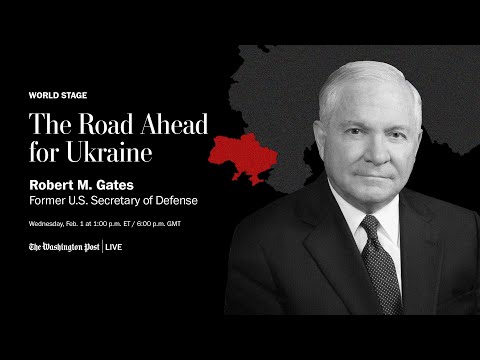
Robert M. Gates on Ukraine, China and the international order (Full Stream 2/1)
What this covers
Robert M. Gates has served eight U.S. presidents in various capacities throughout his career, including as secretary of defense, director of the CIA and a member of the National Security Council. On Wednesday, Feb. 1 at 1:00 p.m. ET, Gates joins Washington Post foreign affairs columnist David Ignatius to discuss the path forward in Ukraine nearly one year after Russia’s invasion, the international order and the geopolitical dynamics of the U.S.-China relationship.
Washington Post Live is the newsroom’s live journalism platform, featuring interviews with top-level government officials, business leaders, cultural influencers and emerging voices on the most pressing issues driving the news cycle nationally and across the globe. From one-on-one, newsmaker interviews to in-depth multi-segment programs, Washington Post Live brings The Post’s newsroom to life on stage. Subscribe to The Washington Post on YouTube: https://wapo.st/2QOdcqK
Follow us: Twitter: https://twitter.com/washingtonpost Instagram: https://www.instagram.com/washingtonpost/ Facebook: https://www.facebook.com/washingtonpost/
Source description (no synthesized summary yet).
Gates argues that the U.S. and West must accelerate military support to Ukraine before Russian mobilization creates a stalemate, and that deterring future Russian aggression requires making Ukraine militarily powerful through security arrangements rather than NATO membership, while managing escalation risks carefully within defined limits.
- Time is not on Ukraine's side due to competing Russian and Ukrainian mobilization timelines; Western equipment must be delivered urgently via airlift, not in months-long timescales
- Ukraine has demonstrated tactical and strategic superiority that Western observers consistently underestimated, so providing defensive equipment and armor is low-risk escalation as long as Ukraine cannot strike Russian territory
- A militarily invulnerable Ukraine deterred Russia for 8 years after Crimea; post-war security arrangements must replicate this deterrence without requiring NATO membership or direct U.S. combat commitment
This asset isn't compiled yet
You're seeing its claims, ranked. Compile it to build the argument threads, weight them, and check each claim against your library — the full view.
Fragmentation of Russia in the current context would be the worst possible outcome because the U.S. needs a coherent Russian state with a strong central government to maintain control of nuclear weapons, making it in the Western interest to NOT want Russian fragmentation.
“the last thing we need is Russia fragmenting and and the fate of all of those nuclear weapons being uncertain. So the last thing we should want is the fragmentation of Russia. We we need a r a coherent Russian state and we need a strong government in Moscow to maintain control of all those weapons.”
The Ukrainian military benefits from eight years of NATO and U.S. training from 2014 to 2022, transforming it from a Soviet-style army (with centralized decision-making and limited tactical flexibility) into a NATO-style army with independence for small units, decisionmaking authority at company level, and strategic and tactical flexibility that Russian forces lack.
“one of the things the Ukrainian military is benefiting from is eight years of training from 2014 to 2022 by NATO and by the United States. So you now have a Ukrainian army that for a long time was essentially a Soviet kind of army. Now a NATO kind of army which gives a lot of independence to small units, a lot of decisionmaking to company level officers. Gives them a strategic and tactical flexibility that the Russians just don't have.”
In 1989, Gates (as deputy national security adviser) obtained President Bush's authority to form a small, secret contingency planning group to plan for the Soviet Union's collapse, which took place 2.5 years later, chaired by Condoleezza Rice. The main conclusion was that maintaining a strong central government in Russia and control over 40,000 nuclear weapons after the Soviet collapse was critically important.
“back in 1989 when we were getting a lot of information uh about how the Soviet Union was falling apart, I got pre I was deputy national security adviser and I got President Bush, first President Bush's authority to form a very small, very secret contingency planning group uh to plan for the collapse of the Soviet Union. That was that was two and a half years before the Soviet Union collapsed. And that little group was chaired by the NSC person on Russia who happened to be Condisa rights. And the conclusions of that group, the main conclusion was it was critically important after the Soviet Union collapsed that we do everything we could to maintain a strong central government in Russia in order to maintain control over what were then 40,000 nuclear weapons.”
Russia has historically overcome military disadvantages through overwhelming mass of barely trained, barely equipped conscripts thrown into the front lines with total disregard for casualties, expecting that numerical superiority will bring victory, though this strategy worked in World War II but no longer has behind it any tactical or strategic genius.
“that is well we'll just overcome it by overall mass which is basically how Russia's fought most of it wars uh with barely trained barely equipped co uh conscripts who are thrown into the front lines and with a total disregard for the number of casualties that you take and that that just ultimately over overwhelming numbers will will bring victory. You know, it it has worked in the past uh certainly in World War II. U but there's not sort of a a tactical genius or a strategic genius behind all of this.”
A fundamental flaw in the Soviet way of warfare is its lack of decentralized tactical authority given to lower-level officers and noncommissioned officers (NCOs), with the Russian military having essentially no NCO cadre like NATO armies do, which prevents the adaptive tactical flexibility that Ukrainian forces demonstrate.
“a big part of the problem, frankly, is is um a lack of battle experience. Soviet the use of Soviet this is a Soviet army and as I was saying earlier this is not an army that devolves authority to lower level officers and NCOs's. It has basically no NCO uh cadre like we do and many of NATO's armies do. Uh and and so there there's kind of a deep flaw in in the the Soviet way of battle”
Two competing clocks constrain the Ukraine war outcome: Russia is mobilizing 300,000 men (mobilized last fall) plus another 120,000 from annual conscription with talk of further mobilization, and the question is how fast Russia can equip and train these soldiers and deploy them for spring offensives; Ukraine's clock is how fast Western equipment can be delivered and integrated with trained personnel. Russia may launch an offensive as early as February 24th, the anniversary of the invasion.
“I think there are two clocks at work right now, David. One is on the Russian clock, which is they've mobilized 300,000 men last fall. They just went through their annual conscription that will add another 120,000 men. They're talking about mobilizing even more in Russia. And the question is, how fast can Russia get those hundreds of thousands of uh new soldiers uh equipped and trained and get them into the front lines uh in Ukraine in time uh for spring offensives. Then there's the Ukrainian clock, which is how fast can this new western equipment that will be critical to taking on the Russian offensives?”
Hundreds of thousands of young Russians have fled the country, many of them in tech and entrepreneurial sectors who don't want to fight and die in Ukraine, representing a massive loss of human capital and productive capacity for Russia's future.
“The hundreds of thousands of young men who have fled the country, many of them uh in tech, many of them entrepreneurial, not wanting to fight and be killed in Ukraine. Um that's a that's a loss of a huge resource for Russia.”
The political benefit of the Russia-China partnership is that their narratives support each other in opposition to the West and democracy, with Russian spoiler behavior globally supporting the Chinese narrative of offering an alternative form of governance and economics to other countries.
“The political benefit of the partnership between them is that their narratives support each other in terms of opposition to the west, opposition to democracy and offering an alternative. The Russians are basically spoilers around the world. But that their narrative helps the Chinese narrative of offering an alternative form of governance and economics to other countries.”
When Gates was Defense Secretary, he had occasion to call in senior officers and 'chastise' them for making geopolitical comments outside their purview.
“when I was secretary, I had the opportunity on more than one occasion to call in a senior officer and um shall we say chastise him for uh making comments about geostrategic and geopolitical matters that were not really his purview.”
Western companies that had invested in Russia and employed Russian staff have pulled out and won't be returning anytime soon, particularly as long as Putin remains in power, significantly arresting the modernization of the Russian economy that had been underway.
“the withdrawal of Western companies. You know, these companies that have invested in Russia, had Russian employees and so on, and have pulled back and and just pulled out of Russia. They're not going back anytime soon. Uh and particularly as long as Putin is in the chair. Uh so so you know, they they have improved or significantly expanded their economic relationship with China during the course of this. uh they've expanded their economic relationships with the Central Asians and so on, but the western investment, the modernization of the of the Russian economy and so on, the direction that they had been headed some years ago has has been arrested”
Ukrainian NATO membership faces significant opposition in Europe from countries like Germany and France, and would also face opposition in the U.S. Senate, because NATO is fundamentally a military alliance requiring populations and governments to be willing to send their own sons and daughters to fight for Ukraine.
“when the issue of of Ukrainian and I might add Georgian membership in NATO came up in 2008 when I was secretary under President Bush. I was deeply skeptical it would work simply because the Germans and the French were so opposed to it. I think there remains significant opposition in Europe to Ukraine joining NATO and I suspect there would be in the United States Senate uh as well because people need to remember at root NATO is a military alliance and the question is are these governments and their populations prepared to send their own sons and daughters to fight in Ukraine for Ukraine and I think particularly the answer in Europe is probably not.”
The United States and Europe have promised and are delivering significant armor and military equipment to Ukraine including Abrams tanks, Leopard tanks, Bradley fighting vehicles, and mine-resistant ambush-protected vehicles used in Iraq and Afghanistan, but the critical issue is the speed of delivery, not the total amount of equipment.
“the provision of the tanks uh is important, actually critical and and and the fact is that both the United States and the Europeans have promised a lot of other armor. They're sending uh armored vehicles. They're sending Bradley's from the United States. They're sending the mine resist and ambush protected vehicles that we used in Iraq and Afghanistan”
The only public criticism allowed in Russia has come from the right (hawks), claiming Putin isn't doing enough or that generals are incompetent, which means only hawkish pressure is tolerated.
“The only criticism, public criticism that has been allowed in Russia has actually been coming from the right, from the hawks, saying he isn't doing enough or that the generals are screwing this up, that the generals don't know what they're doing”
Sanctions have not had dramatic short-term impact on Russia, but their long-term impact is significant for Russia's economic trajectory.
“while the sanctions have not had the dramatic short-term impact that I think a lot of people hope, their long-term impact on Russia, I think is significant.”
Russians are now the junior partner in their relationship with China, with China as the dominant partner.
“there's no doubt about the fact that the Russians at this point are the junior partner uh in the relationship.”
Sweden and Finland joining NATO is a fundamental change in the security balance in Europe and demonstrates how badly Putin miscalculated, as it represents the opposite of his goal of containing NATO.
“the prospect of Sweden and Finland joining NATO... shows just how badly Putin miscalculated and is a fundamental change in the security balance in Europe”
Xi's counterpart, the vice chairman of the Central Military Commission, was due to be executed for corruption but died of cancer before execution could occur, showing the severity of corruption in the Chinese military.
“My counterpart, the vice chairman of the Central Military Commission, um who was my host in China, was due to be executed for corruption. He just died of cancer before they could execute him.”
Eight years passed between the invasion of Crimea (2014) and the invasion of eastern Ukraine (2022), during which Russia built up forces, requiring Ukraine to maintain sufficient military power to deter renewed Russian invasion years into the future.
“it was 8 years between the uh in invasion of Crimea and and the invasion of eastern Ukraine u in uh 2022. and the Russians are prepared to wait and sort of we can't have a situation in which the Russians sort of hover with huge forces on the eastern borders or in the eastern part of Ukraine just waiting to re-equip uh retrain resustain themselves and then launch another attack several years from now on Ukraine.”
A Russian general (later identified as wanting to withdraw from Kherson) was prevented from doing so by 'the powers to be Putin in Moscow,' demonstrating Putin's direct interference in operational decisions and his reluctance to accept military advice from field commanders.
“one of one of the things we heard was that uh the Russian general in charge wanted to withdraw from Hersan a couple of months before they actually did to more defensible positions, but the powers to be Putin in Moscow wouldn't let them.”
Gates would support providing Ukraine with longer-range strike missiles (ATACMs) that could reach into Russian territory in principle, conditional on reaching agreement with Ukraine on target types and locations near the Ukrainian border (such as logistics hubs, ammunition dumps, railroad hubs serving logistics) rather than deep strikes into Russia.
“I am troubled by the notion of the Russians uh first of all invading Ukraine and then having the area close to the Ukrainian border but in Russia be a sanctuary uh for supporting Russian logistics and and and so on. Uh, so I think I think it bears very careful consideration and I think I think I would be willing to ex to support it in principle if we could reach agreement with the Ukrainians on the kinds of targets and the locations that we would be comfortable well or would be would be acceptable to us uh in terms of support for the actual ground fight that's going on in the east. So if you had logistics hubs, ammunition dumps and so on just across the border fairly close to the Ukrainian border or or railroad hubs that are serving as logistics uh places for logistics support. I think those are worth considering.”
China is benefiting economically from the Ukraine war by selling goods (like semiconductors) that Russia cannot obtain from the West and by receiving discounted oil and gas from Russia, as are the Indians.
“the Chinese are benefiting economically from this. They've got a lot they're selling a lot of stuff uh to the Russians that the Russians can't get from the west now. Not weapons but but things like semiconductors and so on. uh they've obvious they're obviously getting a lot of discounted oil and gas as are the Indians.”
It is unrealistic to think Ukraine can retake Crimea in the near term, though it may be able to retake most or all of the territory the Russians seized in eastern Ukraine in the Donbas; Crimea is 'critically important for Putin' because of its strategic value and the Russian naval base located there.
“I think I think Crimea is a different and more challenging problem. Uh I think Crimea is critically important for Putin uh for no in no small part because of its strategic importance. The big Russian naval base in Crimea.”
Putin was very isolated during the first months of the war due to emerging from COVID and meeting with very few officials, as evidenced by an extraordinary photograph of Putin seated opposite his general staff chief (Gerasimov) and defense minister at opposite ends of a 40-foot table, symbolizing his isolation.
“particularly in the first uh months of this war he was very isolated and because of coming out of COVID and and so on and and meeting with just very few officials. I think the most extraordinary one of the most extraordinary photographs was the meeting that he had with the head of the Russian general staff, General Dazimoff and and his defense minister and they were seated at opposite ends of a 40ft table. Um I think that was symbolically evidence of of of his isolation.”
China has been very careful to remain within the boundaries of sanctions placed on Russia and to avoid secondary sanctions, with Chinese financial institutions abiding by sanctions almost entirely.
“the Chinese have been very careful to remain within the boundaries of of the uh sanctions that have been placed on Russia. They don't want secondary sanctions. So uh the Chinese financial institutions uh have have been very careful. So they've abided by the sanctions uh almost entirely.”
President Xi has twice (once with German Chancellor Schultz and once with President Biden) indicated that the use of nuclear weapons in Ukraine would be 'a really bad idea,' suggesting China has drawn red lines in its relationship with Russia.
“you've had uh President Xi now twice once with uh German Chancellor Schultz and once with President Biden basically say the use of nuclear weapons in Ukraine would be a really bad idea.”
Gerasimov faces fundamental problems with the Russian military including slow decision-making, top-heavy command structure, shortages of new armor, ammunition shortages, and lack of precision-guided munitions.
“Grazmoff has a has a real problem in terms of just the tactical flexibility of his adversary in the Ukrainians and and the flexibility that they have to take advantage of opportunities that crop up at the last minute. They're they're very slow uh in the Russian military decision making. they're they're very topheavy in terms of those decisions being made only at the top.”
The so-called 'unlimited partnership' between Russia and China has been quite limited, with no evidence that China has provided military equipment to Russia, forcing Russia to turn to North Korea and Iran for military help.
“the so-called unlimited partnership is. We have no evidence that the Chinese have provided any military equipment to um to to Russia. Uh I mean it is telling that they're having to turn to the North Koreans and to the Iranians for help.”
General Michael Minahan, head of the Air Mobility Command, said publicly 'my gut tells me we will fight,' meaning the U.S. will fight China over Taiwan in 2025, which was inappropriate commentary for a senior military officer to make about war and peace between the U.S. and China.
“We just recently had an extraordinary comment from General Michael Minahan, who's head of the Air Mobility Command, who said publicly, "My gut tells me we will fight," meaning the US fighting China over Taiwan in 2025.”
Alternative bilateral and multilateral agreements outside of NATO could provide sufficient sophisticated weapons and military capabilities to Ukraine to make it militarily powerful and invulnerable, deterring Russian invasion without absolute commitment to send NATO forces.
“there may be bilateral arrangements there may be some multilateral agreements outside of NATO uh that do not represent absolute commitments to send our own forces but provides a sufficient level of very sophisticated weapons and capabilities to Ukraine that make it so militarily powerful and so militarily uh invulnerable that the Russians are deterred from from ever invading again.”
The West has consistently underestimated what Ukrainians could accomplish and endure throughout the first year of the war, suggesting that pessimistic Western assessments about Ukrainian capabilities should be viewed skeptically.
“if there's one consistent theme in the West uh over the past year, particularly the first few months of the war, it has been uh consistently underestimating what the Ukrainians could accomplish and what they could endure.”
Putin has significantly weakened Russia probably for a generation to come as a result of the war.
“I think Putin has significantly weakened Russia probably for a generation to come.”
Russian drone and missile attacks on Ukraine are aimed at terrorizing the Ukrainian people and breaking their will to fight, not achieving military objectives in the ground war where the actual outcome will be determined, and these attacks have failed in their terror objective.
“the attacks the Russians are making with their drones and their missiles are not militarily significant. those attacks are aimed at terrorizing the Ukrainian people and breaking their will. Uh I think we've already seen that that's not going to happen. But but they have not played a significant role in in the in the ground war that we're seeing and where the outcome of this war will be determined.”
The determination and courage with which Taiwanese fought the Chinese in Gates's analysis might match the Ukrainian example, raising the question 'What if the Taiwanese fought the Chinese like that?' as a cautionary consideration for Xi regarding Taiwan military adventure.
“And then third, just the the the determination of the Ukrainians to fight and their courage in fighting. What if the Taiwanese fought the Chinese like that?”
Putin's closest advisers are more hawkish than he is, and if Putin were to depart the scene tomorrow, he would be replaced by a more hawkish person rather than someone seeking a negotiated solution in Ukraine, making hopes for his replacement by a dovish figure 'a vain hope.'
“the adviserss that are closest to him at this point are actually more hawkish than he is. if he were to uh depart the scene tomorrow, he I believe he would be replaced by a more hawkish person rather than somebody looking for u a a solution or a negotiation in Ukraine. I think whether it's Pgoanian the head of who runs the Gagner group or Patrev and national security official or others the hawks are the ones that are pushing him the most.”
As long as Western material provided to Ukraine does not allow Ukraine to attack targets inside Russian territory, Putin has been 'pretty reluctant' to escalate in any significant way, suggesting that restrictions on Ukrainian strike range provide a de facto escalation limit that Putin respects.
“as long as as we are providing uh material that does not allow u Ukraine to attack targets inside Russia. Putin has been pretty uh reluctant to to uh escalate in any significant way.”
The key question is whether the West and United States can sustain public support for providing military and economic support to Ukraine at current levels; Gates believes this can be sustained through the rest of 2023 and that Europeans and the administration remain committed, but the question is whether marginal voices could become more central if the war remains a protracted slog with neither side gaining significant advantage.
“this goes to the point that we've made about time being on not being on Ukraine's side mainly because can can the West and the United States sustain public support for providing the kind of material and support to both the Russian the Ukrainian economy and the Ukrainian military that we've done so far. My own view is we can sustain that through the rest of this year. I think the Europeans will remain strong. I think we will remain strong. The administration is totally committed to this. But the question is, do the voices who are now kind of on the margins become more central if this war is is basically a slog a year from now with neither side gaining a significant advantage?”
The timing of negotiation opportunities depends entirely on developments on the battlefield and how long the conflict continues.
“I think the question of when you might have an opportunity for negotiations first of all will depend entirely on the developments on the battlefield. But I think it also depends on how long this conflict continues.”
The Ukraine war has given Xi at least a few lessons about Western and democratic alignment: first, the speed and severity with which the West came together on sanctions, which surprised both Xi and Putin who believed in the narrative of Western decline; second, the performance of the Russian military, which should make Xi wonder whether his own generals and weapons are as good as he's been told.
“the war in Ukraine she has to have taken at least a few lessons from that. The first was the speed with which the west came together and the severity of the sanctions. you know, she and Putin have both bought into this narrative of the decline of the West and the decline of the democracies and so on. And boom, all of a sudden, they've got all of the West and including other democracies like Japan and Australia and so on, all aligned on these sanctions against Russia and and the speed and the unity that came out of that I think was extraordinary and really must have gotten she's attention. The second is the performance of the Russian the Russian military. you know, she's been fighting corruption in the Chinese military uh for a long time.”
It is unclear what specific further escalation Russia could realistically undertake beyond its current actions like mobilizing hundreds of thousands of troops, given that using weapons of mass destruction would be so self-destructive for Russia that it has very low probability.
“what does escalation mean? Does escalation mean mobilizing a another half million troops, which he is basically on the road to doing uh or is escalation meaning using weapons of mass destruction? I think that's so self-destructive for Russia uh that that's not in the cards, at least a very low probability. Uh so I I you know what what kind of escalation are we expecting or do we think is possible on the part of the Russians that they have not already done?”
Neither Russia nor Ukraine is currently in any mood to negotiate, with Putin believing he can outlast the West and mobilizing the Russian economy for the first time since the war started in support of military operations.
“neither country, neither government uh is in any mood to negotiate. the Russians. I think I think Putin believes at this point he can outlast the West. He he thinks with all this mobilization, he's in the process of mobilizing the Russian economy for the first time since the war started in terms of support for the military operation.”
The administration has been 'kind of a half a step behind the Congress' on providing weapons to Ukraine, with many members of both parties pushing for more aggressive provision of weapons, though the administration has done the right things but could have done them more quickly.
“the administration's been kind of a half a step behind the Congress actually, which had many members, both Republicans and Democrats, have pressed for a somewhat more aggressive approach in terms of the weapons that we've been providing. I think the administration has done the right things along the way, but I think they could have done some of them more quickly.”
Putin appears to be receiving more accurate information about the challenges the Russian military is facing now than he did early in the war, evidenced by changes in his messaging to the Russian people.
“whether he's getting more accurate reports of the problems that the military is facing. I kind of have the sense that he is getting more accurate information of the challenges they're facing. I think this has come through in some of his messaging uh to the Russian people.”
Ukrainian air defense systems have achieved 'extraordinary success' in knocking down Russian missiles and drones, which may make F-16 fighters unnecessary for Ukrainian defense.
“the extraordinary success they've had in knocking down both missiles and drones uh I think I think u may may make the the qu the need for F-16s moot.”
Putin is a rational decision maker, as evidenced by his reluctance to take some of the escalatory steps he might have taken, despite being ill-informed and having made huge strategic miscalculations and mistakes.
“I think he's a rational decision maker. I think he has I think the fact that he has not taken some of the escalatory steps that that he might have is is evidence of that. I think he's been u he's he's been illinformed. He's made huge strategic miscalculations and mistakes, but but I think he is a rational decision maker.”
Russia has not been able to establish air superiority over Ukraine or even over the battlefield in eastern Ukraine, which raises questions about how important aircraft like F-16s would be to the actual fight, making the provision of F-16s potentially moot given Ukraine's significant air defenses.
“the fact that the Russians have not been able to establish air superiority over Ukraine or even over the battlefield in eastern Ukraine uh raises the question of just how important such aircraft are or would be in the in the fight to come. Uh I I think that the significant air defenses that have put in been put in place in Ukraine and the extraordinary success they've had in knocking down both missiles and drones uh I think I think u may may make the the qu the need for F-16s moot.”
Gates wrote his doctoral dissertation on the Sino-Soviet split and whether it could be detected in official media, demonstrating his historical interest in understanding Chinese-Russian relations.
“You wrote your doctoral dissertation, if I remember, on the Sino Soviet split”
General Gerasimov, if taking command of Ukrainian operations, would likely view it as 'second prize' or an undesirable assignment given the disastrous situation Russia faces, reflecting the challenge of salvaging a failing military campaign.
“if I were in Garasimov's shoes, I would be saying as with respect to being given command in Ukraine, kind of what second prize, what else could I what else could I do?”