What this covers
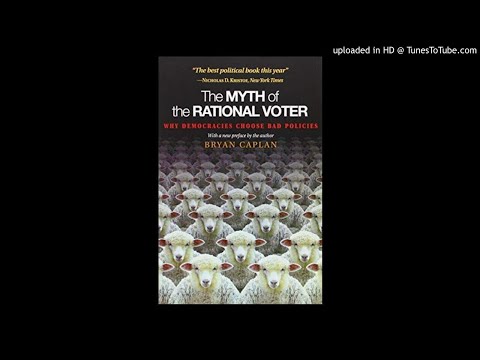
Bryan Caplan, an economist at George Mason University, joins Russ Roberts to examine why democracies persistently adopt economically damaging policies—not through the hidden machinations of special interests, but through the ordinary operation of voting when voters hold systematically mistaken beliefs about economics. Caplan argues that voters face essentially zero personal incentive to form accurate economic views, since an individual ballot almost never determines an election outcome. This rational apathy permits biased beliefs to flourish without correction, much as a single driver's emissions barely harm Cairo's air quality, yet millions of such choices produce collective pollution. The interview moves through the core mechanisms: voters harbor predictable economic biases—skepticism toward markets and foreigners, a tendency to judge prosperity by employment rather than production—and these biases are not random errors but systematic distortions that recur across centuries and countries, suggesting evolutionary or psychological roots rather than mere ignorance.
The conversation explores why these biases persist despite exposure to counterargument. Caplan distinguishes between questions where being wrong carries personal cost (a surgeon who misjudges his own competence will quickly fail) and those where belief costs nothing—like how trade or monetary policy affect national welfare. On costless questions, people indulge comforting views and gain social belonging by holding them, making economic arguments feel like attacks on community rather than factual claims. The discussion confronts popular policies directly: steel tariffs and farm subsidies are not elite conspiracies but genuinely popular with the general electorate, including those who don't benefit. Caplan also addresses the charge that economists are themselves biased, presenting evidence that controlling for income, gender, and politics explains only a small fraction of why economists' views diverge so sharply from public opinion. The net implication unsettles both left and right: the problem lies not in special pleading or media manipulation, but in the foundational structure of democratic incentives.
Caplan argues that bad democratic policies persist not because special interests sneak them past voters, but because voters hold systematically biased economic beliefs and have no incentive to correct them, since a single vote almost never changes outcomes—so politicians rationally deliver the popular-but-wrong policies voters demand.
- Bad policies like steel tariffs and farm subsidies are broadly popular, not hidden from voters
- Voters hold systematic economic biases (anti-market, anti-foreign, make-work, pessimistic) rather than random errors
- Because individual votes are not decisive, irrationality is 'free' to the voter—political pollution analogous to an externality
This asset isn't compiled yet
You're seeing its claims, ranked. Compile it to build the argument threads, weight them, and check each claim against your library — the full view.
Voter irrationality functions as political pollution—a negative externality: one person's biased vote barely shifts the election, but when millions vote on their biases, society gets bad policy 'by popular demand,' with each individual gaining a private psychological benefit while imposing small costs on hundreds of millions of others.
“irrationality is basically political pollution ... it does just ever so slightly tilt the scales in that direction and if millions and millions of people think that way the result is going to be that a policy that's bad for everyone wins by popular demand”
People exert more intellectual discipline and stay open-minded on questions where being wrong is personally costly (a drunk surgeon who believes he operates well will quickly ruin his career), but on questions where their belief has no personal cost—like how voting affects national policy—they indulge comforting irrationality.
“on questions where there's a high cost to being wrong people generally are going to be more open-minded they'll exert some more intellectual discipline”
Anti-market bias is the public's tendency to infer that because market participants have self-interested (greedy) intentions, the social consequences must be bad—whereas economists argue that competition and the freedom of customers to go elsewhere channel self-interest into serving others.
“people look at the intentions of people in the market and see hey they're out to make money they're greedy ... just because their aim is actually to make money does not mean the social consequences will not be very good”
Make-work bias is judging the economy by employment rather than production; by the employment standard 19th-century America (with grueling all-day labor) would rank above the modern economy, yet living standards were miserable—so trade and technology that reduce employment can still make society wealthier.
“make work biased is seeing the economy in terms of employment rather than production now the problem is by this standard 19th century America was a better economy than the 21st century”
The two common theories of why economists are biased—self-serving bias (they are rich, white, male, tenured) and ideological bias (they are conservative Republicans)—both fail empirically: controlling for income, job security, gender, race and income growth closes only ~18% of the belief gap (often with signs in the wrong direction), and the typical economist is actually a moderate Democrat who nonetheless thinks downsizing helps the economy and supply-and-demand sets prices.
“throwing in the whole kitchen sink of self-serving variables reduces the belief gap between economists and the public by about 18 percent on average”
Most of the improvement in the living standards of the poorest members of society over a century or two comes from the growth and broad availability of production, not from forced redistribution; even equally dividing the entire output of the 19th-century economy (assuming no incentive effects) would leave everyone poor by modern standards.
“if you were to have redistributed the production of the 19th century economy equally with no effect ... still we would all be tremendously poor by modern standards”
The standard public-choice explanation for bad policies—that concentrated special interests hijack the political process while diffuse losers stay rationally ignorant—is largely wrong, because policies like steel tariffs are extremely popular with the general public, not snuck past them.
“I used to believe that public choice story quite well myself but then I started looking at public opinion data and I discovered something that few economists seem to realize which is that policies like the steel tariffs are extremely popular”
Because the two strongest predictors of voter turnout are age and education, and education is the single strongest predictor of thinking like an economist, the actual electorate is more economically reasonable than the general population—one reason policy isn't worse than expected.
“there are basically two big predictors of voter turnout one is age the others education ... education is actually the single strongest predictor ... of whether or not a person will think like an economist”
The same economic biases recur across centuries and countries (visible in Bastiat in 1840s France, Adam Smith in 1700s England, and Böhm-Bawerk on ancient Israelite attitudes toward interest), which suggests a biological or evolutionary-psychological origin rather than mere local culture.
“you can read Bastiat writing in the 1840s in France or Adam Smith writing in the 1800's or excuse me 1700s in England ... the attitudes that economists are to have been trying to beat out of their students ... are really quite stable across places over time”
Anti-foreign bias has an evolutionary basis: in ancestral small-tribe conditions encountering another tribe was often genuinely zero-sum (competing over fixed game) or dangerous (violence), so wariness of foreigners was adaptive—but this instinct now misfires onto harmless modern trade (e.g. the Toyota dealership).
“if you go back to living on the savanna you're a small tribe of 20 people and another tribe shows up ... you are just competing over a fixed pool of animals so it really is a zero-sum game ... the problem is it seems like we transferred this fear to the toyota dealership”
Betting (prediction) markets would aggregate dispersed knowledge far better than surveys for questions like how much living standards have improved, because the uninformed self-select out and well-informed participants stake large sums whenever the odds drift from the truth.
“betting markets I think would give us a very accurate picture ... people who don't know very much about economics would just stay out of the betting market ... there would be a decent number of people who actually know the answer who would put up an enormous amount of money”
Complexity of the world cannot by itself explain persistent biased beliefs, because complexity should rationally produce agnosticism (suspended judgment); instead people who haven't studied economics hold confident, vehement views that gravitate precisely toward the answers textbooks say are wrong.
“if the problem were simply the complexity of the world it wouldn't make a lot of sense to just dogmatically support whatever we have it would make much more sense to be agnostic”
Voters often treat the mere passage of legislation as a 'result' rather than the actual outcome (e.g. counting passing a gun-control bill as success regardless of whether the murder rate falls), so political accountability for genuine outcomes is weaker than it appears.
“to an economist a result would be a reduction in the murder rate ... but to the public it appears that merely getting legislation passed equals a result”
The 'market fundamentalist' charge against economists is unfair because economists themselves invented most market-failure arguments and actively seek counterexamples to their own views; meanwhile 'democratic fundamentalism'—the dogmatic faith that the cure for any democratic problem is more democracy, treating democracy as judge in its own case—gets a free pass.
“most market failure arguments were created by economists ... it is quite common for people to say things like the solution to any problem of democracies is more democracy”
Sustaining faith in democracy after a lifetime of observing its dysfunction (as journalist William Greider does) is irrational in the same way as a doomsday cult that grows more confident after its prediction fails—a failed track record should diminish, not confirm, confidence in the institution.
“it's very similar to cults that predict the end of the world the end of the world doesn't happen and say I'm even more convinced now”
An individual vote is almost never decisive—with a hundred million voters the chance your vote breaks a tie is like being struck by lightning—so the personal incentive to vote wisely is essentially zero, just as a single Cairo driver's emissions barely affect air quality.
“with a hundred million people it really is like being struck by lightning ... the votes is not decisive”
People will physically migrate to a country with better institutions for a few thousand dollars, yet will not vote for those same institutions in their home country, because emigrating yields a large personal payoff while voting for the better policy yields only a tiny chance of changing outcomes—so they tolerate the psychological cost of one but not the other.
“in the case of moving you're gonna get a ton of money ... in the case of voting on the other hand the odds that your votes gonna change the outcome it's really quite small so there's just not much incentive”
People resist economic arguments not because of lack of exposure but because holding mainstream beliefs provides psychological benefits—comfort, social belonging—so challenging a shared worldview is painful, illustrated by an economist whose picnic companions physically edged away after he questioned the minimum wage.
“people generally get some psychological benefits out of believing the world is the way they'd like to see it ... to fit in with the rest society if they believe the same thing that other people”
When audiences of educated people (congressional staffers, journalists, law professors) are asked how much living standards rose since 1900, the median answer is about 50% and 10-20% think it has fallen, whereas a defensible estimate is at least 5-10 times higher—demonstrating that public misperception is systematically downward-biased, not random noise.
“the median answer is a 50% increase ... and there's usually 10 to 20% of the audience thinks we have a lower material standard of living today than we had a hundred years ago”
Because voters partly evaluate politicians on the policies they favor (not just on results), the more competitive the political race, the more reliably politicians deliver the policies voters want—so persistently mistaken voter beliefs persistently produce bad policies, since favoring those policies is what it takes to get elected.
“if voters are very persistently convinced that bad policies are actually good then you're very persistently going to get politicians delivering bad policies because that is what it takes to get elected”
Democracy works surprisingly well in that politicians genuinely deliver what voters want; the problem is that what voters want is often detrimental to their own welfare.
“the good news is democracy works surprisingly well politicians give voters what they want ... the bad news is what they want is really often not very good and is detrimental to their health”
Farm subsidies enjoy roughly equal support in farm states and non-farm states, contradicting the self-interest explanation, because non-farmers believe subsidies are necessary to ensure a stable food supply.
“farm subsidies enjoy virtually equal support in farm states and non-firm states and you made an economist again are baffled how could that be why would none farmers support farm subsidies”
When experts and laymen disagree, the rational default presumption is that the expert is probably right—a presumption we rely on for mechanics, doctors, and historians—though it is only a starting point that can be overridden by a specific, testable account of expert bias.
“when experts and laymen disagree the experts are probably right you cannot get through life without this presumption”
The belief that farm subsidies are needed to guarantee food supply is refuted by the observation that unsubsidized goods like shirts and most foods remain plentiful and stable or falling in price, while subsidized goods like milk show little technological or price improvement.
“there are a lot of things that aren't subsidized that seem to be plentiful we don't have a shirt subsidy program and shorts are plentiful available ... whereas the things that are often subsidized such as milk don't see a lot of technological or price improvements”
Economists' biggest weakness is communication: they over-qualify with 'on the one hand, on the other hand' even when one side carries 95% of the weight, which fails to persuade in a world where you have only a minute or two; effective persuasion requires being a 'one-handed economist,' clearly flagging the disagreement, explaining why, and making it fun and emotionally engaging.
“a lot of economists just don't feel comfortable pairing their message down ... they like to say on the one hand on the other hand and even if one hand has 95 percent of the weight ... that just is not a way of communicating effectively”
Politicians must balance popular policies against actual results: simply enacting whatever voters demand can backfire, because if the resulting economic outcome is bad (as with Nixon's wage-price controls or Gray Davis), voters may turn on them—so discretion sometimes leads politicians toward better policy than pure pandering.
“if you're a politician wants to get elected you need to strike a balance between doing what's popular and doing what works”
Given how bad public economic beliefs are, the surprising puzzle is not why policy is bad but why it isn't far worse; the glass is half-full, and the US economy works reasonably well by historical standards despite extensive regulation.
“after you go and take a look at public opinion you're more likely to say wow I can't believe that we're not in the Stone Age”
The right question is not 'democracy versus dictatorship' but the proper scope of centralized, top-down coercive policy versus decentralized voluntary arrangements; one can criticize and limit democracy (as the First Amendment removes speech and religion from majority control) without favoring its diametric opposite.
“what should be the scope for centralized top-down coercive policies that are determined by the electorate versus decentralized voluntary arrangements that we all choose on our own”
Politics functions as the religion of modernity: the passion and dogmatism once reserved for religion are now transferred to political beliefs, so questioning someone's key political views provokes hostility rather than curiosity—and treating contrary evidence as an enemy ('killing the messenger') is a poor route to truth.
“politics is the religion of modernity ... the same kind of passion and dogmatism that you see in religion has been transferred over to politics”
Pessimistic bias is the public's tendency to underestimate how well the economy is doing and overestimate decline relative to economists; this bias has good US data but, unlike the other three, is less clearly cross-cultural or stable over time.
“people tend to underestimate how well the economy is doing ... it's relatively speaking that the public is pessimistic sees things in decline”
Reading an introductory economics textbook carefully and calmly is the single most convincing way to resolve the dispute between economists and the public, because an open-minded reader will conclude much of what they believed was simply false—though this requires a large time investment that distrustful people won't make.
“any reasonably open-minded intelligent person who ... cracks open an economics textbook and just gives it a decent patient read ... will come away thinking a lot of what I thought coming into this ... was just simply not true”
Democracies often pursue bad policies.
“democracies often pursue some pretty bad policies”