What this covers
Howard Marks, co-founder of Oaktree Capital, sits down with the hosts of My First Million to discuss his framework for thinking about investment risk and timing. The conversation covers his core thesis: that market risk originates not from companies or securities themselves, but from human behavior and crowd psychology. Marks walks through how superior returns come from clinically assessing where the market sits in its emotional cycle—carefree and overpriced, or terrified and underpriced—and acting against the prevailing mood. He draws on three decades of his own investing decisions, including Oaktree's timing of major capital deployments before the 2008 crisis and its distressed-debt strategy after Lehman's collapse.
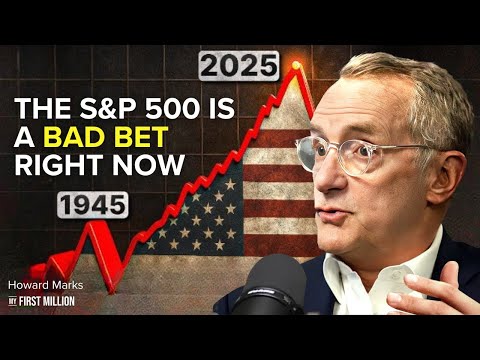
The discussion moves across several practical territories. Marks lays out the three biggest investor mistakes: overestimating predictability of the future, assuming trends will continue unchanged, and letting emotions override discipline. He addresses the current valuation environment directly, citing S&P P/E ratios near 23–24, which historically have preceded roughly zero annualized returns over the following decade. He distinguishes between active risk-taking and what he calls "avoiding losers"—arguing that a portfolio consistently in the second quartile, year after year, compounds into top-tier long-term results. The episode also covers how to recognize overheated or depressed markets through behavioral signals (whether investing is celebrated or shunned at social gatherings), why raising capital during a crisis is nearly impossible, and why most simple investing wisdom—Buffett's included—is easy to state but hard to execute. Throughout, Marks emphasizes that investors cannot know the future, only assess where they stand in the cycle and adjust their posture accordingly.
Howard Marks argues that investment risk comes primarily from human behavior and crowd psychology rather than from companies or securities, so superior returns come from clinically reading where the market sits in its emotional cycle and acting contrarily, while accepting that consistent above-average results beat heroic risk-taking.
- Risk in markets comes from people's behavior, not from companies or securities
- Current S&P P/E of ~23-24 historically implies near-zero 10-year annualized returns
- Avoiding losers and being consistently above-average compounds into top-tier results
This asset isn't compiled yet
You're seeing its claims, ranked. Compile it to build the argument threads, weight them, and check each claim against your library — the full view.
Oaktree decided to deploy its $7B distressed fund after Lehman's bankruptcy based on pure logic rather than analysis: if you invest and the world melts down it doesn't matter what you did, but if you don't invest and the world doesn't melt down you failed your job—and historically the world usually doesn't melt down.
“If we invest it and the world melts down, it doesn't matter what we did. But if I don't invest it and the world doesn't melt down, then we didn't do our job. QED. You have to move forward.”
Being too far ahead of your time is indistinguishable from being wrong; bubble.com succeeded because it was both right and right fast, with the tech bubble collapsing within about six months of the January 2000 memo.
“being too far ahead of your time is indistinguishable from being wrong. So, the the answer is I was not too far ahead.”
You cannot raise money in a crisis because the same factors that frighten the world frighten your prospective investors, who put their hands in their pockets; therefore Oaktree raised its opportunistic capital before the 2008 crisis hit, going to clients on the first day of 2007 to build the fund that would deploy when the crisis arrived.
“You can't raise money in a crisis... Because the same factors that influence the world influence the people you talk to and everybody else stick their hands in their pockets”
The three biggest mistakes investors make are: (1) believing they understand and can accurately know what the future holds; (2) assuming the world will remain as it is—that current trends continue and no new trends emerge; and (3) letting emotions rise and fall and dictate actions instead of doing what they should.
“the biggest single mistake that investors make is that they think the world will remain the way it is. That the things that are working today will continue to work... and that there won't be any new trends.”
A portfolio that ranks consistently in the second quartile every year (e.g., between the 27th and 47th percentile for 14 years, as General Mills' equity fund did) can finish in the top few percent for the whole period—because avoiding bad years compounds favorably—which is why pursuing consistency and avoiding self-inflicted losses beats swinging for the top.
“in 14 years the the equities General Mills equity portfolio was never above the 27th percentile or below the 47th percentile... where do you think it was for the whole period?... The answer is fourth.”
The riskiest place is where there appears to be no risk, because market risk does not come from companies, securities, or exchanges but from the behavior of people: when others are carefree their behavior raises prices and makes them precarious, and when others are terrified their behavior suppresses prices to giveaway levels.
“the riskiest thing in the world is the place that there's no risk. The risk in the markets does not come from the companies, the securities, or the institutions like the exchanges. The risk in the markets comes from the behavior of people.”
Buffett and similar investors give away their 'secrets' without fear of being caught up to, because telling people what to do is easy but doing it is hard—the things great investors must do are simple but not easy.
“we can tell them all day long what what you should do but it's hard to do... I think the things we have to do are simple. They're just not easy to do.”
For someone with a surplus of money beyond what they need, the first purpose of that money should be to make them comfortable; it makes no sense to risk what you have and need to get what you don't have and don't need.
“if you have more money than you need to eat, the first purpose of your money should be to make you comfortable”
Portfolio management should not be framed as binary 'buy or sell' or 'risk on or risk off'; instead investors should think of a continuum from aggressive to defensive (like a 0-100 pedometer), identify their appropriate normal posture, and try to stay there most of the time, adjusting the mix rather than going all-or-nothing.
“the the operative continuum to think about is the continuum that runs from aggressive to defensive. And I think about it as a pedometer in the car. So, zero is no risk, 100 is max risk.”
Good contrarian investing requires acting like a battlefield hero—not someone who is unafraid, but someone who does the right thing anyway despite feeling the same fear-inducing environment everyone else feels.
“a battlefield hero is not somebody who's unafraid. It's somebody who does it anyway. And that's that's the way you have to be.”
Although the S&P 500 has averaged about 10% per year over 100 years, the annual return is almost never between 8% and 12%; the norm is not the average, so individual years tend to be extreme rather than near the mean.
“on average, it has returned 10% a year for 100 years. But, do you know that the annual return is almost never between eight and 12?”
It is impossible to know or analyze the future because it does not yet exist; the only way to get a handle on the future is to study the past, look for the repetition of patterns, and judge whether they apply today—because human nature causes themes to rhyme from cycle to cycle.
“there is no such thing as knowing something about the future... the only thing you can do to get a handle on the future is look at the past. And uh look for the repetition of patterns, as Twain said, and try to figure out if they apply today.”
Because you cannot predict the future, active investing in the efficient-market sense doesn't reliably work; rather than trying to hit winners like an aggressive tennis player, you should try to avoid hitting losers and keep the ball in play—'fewer winners, fewer losers' rather than 'more winners.'
“rather than try to hit winners like the tennis player, you should try to avoid hitting losers and keep the ball in play. And that has always defined my investing style.”
We never know where we're going, but we can know where we are; understanding where you stand in the market cycle determines what probably will happen and how likely it is, which improves your odds without making you a sure winner.
“we never know where we're going, but we sure as hell would have know where we are”
Companies' fortunes and outlooks don't change much; what changes is how people think about what's going on and about the future, which changes the relationship of price to value—when people love assets too much expect prices to fall (bubble), and when they hate them too much expect prices to rise (crash).
“the fortunes of companies and the outlook for companies doesn't change much. What... changes is how people think about what's going on and think about the future. And so what changes is the relationship of price to what I'll call value.”
You can assess whether a market is overheated or too shunned by observing behavioral indicators—whether investing TV shows are popular, whether investors are mobbed or shunned at cocktail parties, and whether deals get done easily or are left begging—if you observe methodically and clinically.
“Are the TV shows about investing popular or unpopular? If an investor goes to a cocktail party is he mobbed or shunned?... you can figure out from that checklist whether the market is overheated and too popular or frigid”
The Fed's actions at the start of 2009—cutting interest rates to zero for the first time in history and introducing quantitative easing—saved the economy and prevented the feared meltdown, resulting in relatively few bankruptcies outside the financial sector, which made Oaktree's crisis investments good but not a 'barn burner.'
“the Fed mobilized uh very astutely cutting interest rates to zero for the first time in history at the beginning of '09 and introducing QE. And those two things saved the economy.”
A conservative non-active investor worried about high S&P valuations can rebalance into high-yield (low-grade credit) bonds, which currently yield 7-8% and are backed by contractual obligations enforceable through bankruptcy, giving them much less uncertainty and downside than equities though with annual taxation on the income.
“today, you can buy high-yield bonds, whether it be the US or Europe or variations on that theme, what we call low grade uh credit. And you can buy buy it to get yields of seven to eight.”
There is a negative correlation between the S&P 500's P/E ratio at purchase and the annualized return over the following 10 years; historically, buying when the P/E was 23 produced annualized 10-year returns of between +2% and -2% in every case with no exceptions, and the S&P's P/E is currently around 23-24.
“if you bought the S&P when the P/E ratio was 23, in every case, there were no exceptions. In every case, your annualized return over the next 10 years was between two and minus two.”
Marks's worst lifelong mistake was being too conservative—a result of being raised by parents traumatized as adults by the Depression—meaning he would have made more money in less conservative asset classes over 56 years, though his caution also let him pioneer high-yield bonds (1978) and distressed debt (1988) without scaring off clients.
“My worst mistake is that I have always been too conservative. My parents were traumatized by the Depression.”
Investing is a lot like life, and an investor's approach to investing is a way of testing whether their way of living is true.
“investing is a lot like life.”
Howard Marks was born unemotional and did not develop his investing equanimity through any intentional mindset shift or practice; his longtime partner Bruce Karsh is similarly unemotional, making it easy.
“these things are not intentional on my part... I was born unemotional.”