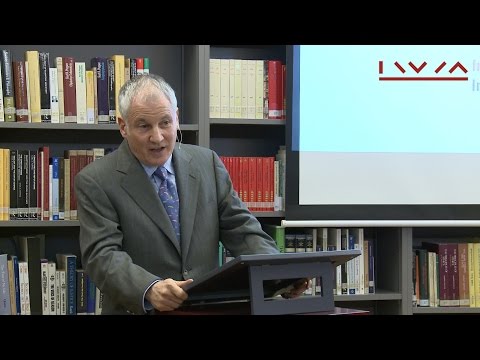
Stephen Kotkin: Sphere of Influence I - The Gift of Geopolitics: How Worlds are Made, and Unmade
What this covers
This lecture was recorded on 5 April 2017 at the IWM Library.
A History of the Present
The liberal, rules-based international order did not take shape predominantly as a consequence of highmindedness, but as a sphere of influence. That, moreover, was to a great extent inspired, and sustained, by a comprehensive cold war with the Soviet Union (or Second World, as it was once called). The sphere of influence known as the West played a significant part in European integration, spurred phenomenal global investments in science and research, gave additional impetus to desegregation and civil rights in the U.S, and more. Above all, the formation, consolidation, and maintenance of a sphere of influence disciplined American power. It even made possible an American grand strategy. Is any of that possible anymore? Will we now see the successful construct of enduring alternative spheres of influence, alongside a permanent decline of the Western one? Or are we overreacting to a misunderstood historical conjuncture?
Lecture I: The Gift of Geopolitics: How Worlds are Made, and Unmade
Americans and Europeans long tended to think of geopolitics as a kind of primitivism to be transcended. The “escape from geopolitics” has both a right wing and a left wing incarnation: the former rooted in a fantasy of universal democracy and benign US-led hegemony, the latter, in a world order governed by supranational institutions and pooled sovereignty. What both share is a conviction that the rivalry of states, with conflicting interests and worldviews, produces conflict, insecurity and impoverishment. Hence the “return” of geopolitics today is lamented. But should it be? Interstate rivalry can unleash cataclysm, of course, but the wealthy, democratic West arose not in spite of geopolitics but as a result of it. The question therefore is not whether geopolitics is escapable or bad, but how the inevitable interstate frictions can be harnessed to push the major powers security and prosperity.
Further information: https://www.iwm.at/
Source description (no synthesized summary yet).
Codkin argues that the West's greatest success—the rise of global prosperity and the end of Cold War competition—has paradoxically undermined Western cohesion because the West was unprepared for success and failed to defend its sphere of influence as geopolitical rivals (China, Russia, Iran) have grown stronger and more assertive.
- The post-1970s dramatic reduction in global poverty and expansion of the Western liberal order represent genuine success, yet Western publics and elites are dissatisfied and disengaging
- The West treated geopolitics as something to transcend rather than harness, leaving it unprepared to defend its sphere when rising powers asserted their own
- China, Russia, and Iran are now pursuing explicit sphere-of-influence strategies while the West has lost the will and grand strategy to compete
This asset isn't compiled yet
You're seeing its claims, ranked. Compile it to build the argument threads, weight them, and check each claim against your library — the full view.
Terrorism and non-state violent actors are not new phenomena but are perceived as new because of 24/7 cable news; similar violence and terrorism occurred in Tsarist Russia where terrorists killed 3,000 officials, and in the Austro-Hungarian Empire's secret societies.
“We think of them as having somehow miraculously appeared and proliferated recently... There was a year in Russia where terrorists killed 3,000 officials... Terrorism was a fact of life in modern Russia... We're forget about... it was always the same phenomenon before”
The CIA spent decades conducting covert operations and funding broadcasts like Radio Free Europe to try to bring down the Soviet Union with almost no effect, whereas Gorbachev dismantled the Soviet system himself by relaxing censorship, allowing Western information to flood in, introducing market mechanisms, deliberately sabotaging centralized Communist Party rule, forcing multicandidate competitive elections, and declaring satellite states in Eastern Europe free to go.
“The CIA fantasized for decades to bring down the Soviet Union. It did all manner of covert operations... and achieved almost no effects bringing down the Soviet Union. Then all of a sudden someone begins to say the system the Soviet system is rotten. He decides to relax the censorship... He decides to introduce market mechanisms and unhinges the planned economy... He forces the introduction of multicandidate elections with secret ballot... He declares that the satellite states of Eastern Europe can go free.”
The past 250 years have witnessed the most spectacular increase in human well-being in history: 1.3 billion people have been lifted out of poverty, life expectancy has soared globally, child mortality has collapsed, and this is the safest period in recorded history.
“The past 250 years have witnessed the most spectacular increase in human well-being in history. The economies of China and India accounting for one-third of the world's population have seen growth rates that are unparalleled... Life expectancy in most parts of the world has soared... A child born in subsaharan Africa today is more likely to live to the age of five than a child born in the UK at the beginning of the 20th century... Strange as it might seem, life now is better than at any time in recorded history.”
Russian hacking is different from Chinese hacking: Chinese hacking does a million attacks all at once hoping one gets in, while Russian hacking does pinpoint attacks to exactly where they want, gets in, and doesn't turn the malware on—they just stay in case they need it later, for example staying in JP Morgan and Goldman Sachs to potentially shut Wall Street down.
“Russian hacking is different from Chinese hacking. Chinese hacking is they do a million attacks all at once and if one gets in, it gets in. The Russians do pinpoint attacks. They go exactly where they want. They get in and they don't turn the malware on. They just stay because they may need it later. So they're in JP Morgan and they're in Goldman Sachs just in case they want to shut Wall Street down.”
You cannot measure happiness or popularity in authoritarian regimes accurately because citizens cannot give honest answers (they have no alternative, they cannot exit, they cannot compare); and when alternatives are introduced, popularity may remain or may change, so present happiness in authoritarian regimes tells us little about underlying sentiment.
“with these authoritarian regimes, you know, Putin is popular, Xi Jinping is popular, but they're only popular in the absence of alternatives... What you discover in an authoritarian regime is when an alternative is introduced, they might still be popular or they might not, right?... to understand the opinion the mood the sentiment in the authoritarian regimes is more difficult than in the in the open societies.”
Russia's military doctrine is that if it's losing a conventional war, it will use nuclear weapons to avert defeat, meaning Russia cannot be defeated in a war because it has approximately 7,700 nuclear weapons that work.
“Russia, 7,700 approximately, right? That includes some in storage... Russia's uh military doctrine is that if they're losing a conventional war, they will use nuclear weapons to avert defeat. So, they cannot be defeated in a war because they have the nuclear weapons to use... their nuclear weapons work unlike some of these other nuclear weapon we don't know right”
The 'clash of civilizations' narrative is not a real geopolitical phenomenon but rather a panic that sets in when poorer and darker parts of the world begin to gain power and a say in the international system; what people call 'dangerous instability' is simply that they now have television 24 hours a day, 7 days a week with 600 channels.
“A third misconception, I'll only do three, is the so-called clash of civilizations. This is my favorite one because this is the panic that sets in when poorer and darker parts of the world begin to gain a little bit of power and say in the international system. That's known as a clash of civilizations. I just don't think that's true... What people are saying when they say the contemporary world, our world now, is quote dangerously unstable. What they're saying is that they have now television 24 hours a day, 7 days a week with 600 channels.”
The current fantasy of Russia, Iran, and China is that someone from within would discredit and destroy the American system by claiming it is corrupt, that elections are rigged, courts are biased, civil servants are saboteurs, the media are enemies, and the government kills people like Russia's does; sabotaging the State Department, blocking appointments, having family members run government, appointing generals to civilian posts, and using political power for personal enrichment—exactly what is now happening with Trump.
“The new fantasy is not the CIA fantasy. It is a kind of combination Russia, Iran, China fantasy... that someone comes along and discredits and maybe even destroys the American system. What would that someone do? that someone would say that the whole system is completely corrupt, that there are millions and millions of illegal voters, that the elections are rigged, that the courts are packed with completely biased judges...”
British dominance of the world after 1815 created a world market economy that was not fair, equal, or friendly to small and powerless countries, but it created a world economy nonetheless and this British-dominated world was increasingly British-dominated over time.
“Great Britain beat the French in a hundred years war once Napoleon abdicated for the second time. It was a decisive victory for the British... And then we began to live in a British dominated world. The British created a world market economy. Now, did they create a fair world market economy? Did they create an equal world market economy? Did they create a world market economy that was friendly towards small and powerless countries? No, that's not what they did. Not at all. But nonetheless, they created a world economy and the British dominated world.”
Russia has three current spheres of influence (Transnistria, Abkhazia, South Ossetia, Crimea, and Eastern Ukraine), but Russia's actual sphere of influence in the post-Soviet space doesn't really exist because those countries are suspicious of Russia and recognize it could annex them.
“Transnistria, which is a Boris Yeltsin era, right? 1992 confection. Then of course there's the abcazia southia dismembering of Georgia, eastern Ukraine and Crimea... Russia exercises influence only in the territories it directly controls. It does not exercise influence in the postsviet space... Russia doesn't really have the sphere of influence it's pining for in the postsviet space because it doesn't really have soft power and because those countries are suspicious of Russia”
China claims 95% of the South China Sea as a 'core interest,' which is the same language used for Taiwan, indicating China will 'go to the wall' for the South China Sea just as it would for Taiwan.
“They claim 95% of the child South China Sea and they call it a core interest, which is the same language used for Taiwan. That tells you that they're going to go to the wall for the South China Sea. You should have no illusions when they say something is a core interest. They mean it. Absolutely.”
China has built seven artificial islands in the South China Sea, several of which are military bases including Fiery Cross Reef which is larger than Pearl Harbor and was built in just two years (2014-2016) with a 10,000 foot runway.
“we now have seven artificial islands. Several are military bases, right? We have Subie Reef, larger than Pearl Harbor. Right. There was nothing there before. Now it's larger than Pearl Harbor... Fiery Cross... he have a 10,000 foot runway... So here is Fiery Cross Reef. You see the coral 2014 2015 2016. That's what the Chinese can do... they just seized it violate international law and they just militarized it and they built this base and they have a 10,000 foot runway on Fiery Cross Reef. Two years.”
Scarborough Shoal, which is not yet built up by China, is only 140 miles from Manila, indicating how close Chinese military expansion is to Philippine territory and demonstrating China's encroachment on neighboring countries' maritime space.
“Rocky Outcrop Scarboro Shaw. They haven't built it yet. They just seized it so far. But it's coming. Anybody has any doubts it's coming. Okay. So this scar bro show which is not built up yet is 140 miles from Manila.”
The idea that Trump voters have much to lose under Trump is incorrect; they were already experiencing 100% failure under previous administrations; many elites imagine rather than understand Trump voters' lives and imagine they were fooled rather than understanding their rational calculation that Trump offered possibility where previous alternatives offered none.
“The problem uh is is that we we we imagine what these people's lives are like. We imagine that they were fooled by Trump. We imagine that they have all these things to lose, right?... This is not a defense of him. This is a discussion of what it looks like to some of and many of the 63 million people who are out there, right? It's very different looking to them... somebody came along and said the whole system in Washington is corrupt”
Non-state violent actors like al-Qaeda and ISIS feel there is injustice and have stories about creating positive visions (like a caliphate), but they cause mischief; they are not a new phenomenon but a long-standing form of violence that mutates with financing (oil revenues, diamond revenues); when compared to the stakes of managing China's rise, non-state actors represent much lower-order existential risk.
“non-state actors, we think of them as having somehow miraculously appeared and proliferated recently. And the answer to that is once again a television which is on 24 hours a day, 7 days a week and in 600 channels... things can rise and fall like a sule depending on financing, right? oil revenues, diamond revenues can finance a lot of stuff... We're not talking about 3,000 deaths or 10,000 deaths or 250,000 deaths. We're talking about the incineration of all your portfolios... That's what we're talking about. That situation doesn't have to end badly.”
Eastern Europe is fundamentally a 'strip of land lying between German power and Russian power' and is romantic but unrealistic to view it otherwise; its fate depends on the character and orientation of German and Russian power, not on Eastern European agency.
“Eastern Europe is a strip of land lying between German power and Russian power. That's all it is. We romanticize it... There's tremendous romanticism about Eastern Europe, but all it is is a strip of land between German power and Russian power.”
The Cold War was not an era of predictability, stability, and relative peace as commonly believed; it had constant crises, risk of Armageddon multiple times, and more than 100 wars around the world with 1 million Vietnamese deaths and 1 million Afghan deaths.
“One misconception is that the Cold War was an era of predictability, stability, and relative peace. You know that misconception. I can tell you the cold war was totally unpredictable. There were crises all the time. There was risk of Armageddon several times and not just during the Cuban missile crisis, the famous one. There were more than a hundred wars around the world during the Cold War. Many more wars than since the Cold War ended. 1 million Vietnamese died. 1 million Afghanis died. That wasn't exactly predictable, stable, and relative peace, was it?”
The current moment is not one of profound instability and war; there is actually less war now than during the Cold War and more predictability, despite 24/7 cable news coverage making it seem worse.
“The second misconception I would point to is that the current moment is one of profound instability, profound unpredictability, and war. I got to tell you, that's just not true. There is a lot less war now than there was during the Cold War. and there's a lot more predictability than there was during the Cold War.”
Bismarck's unification of Germany and the Meiji Restoration in Japan created new dynamic powers that disrupted the British-dominated international system, and the US, already the largest economy in 1880-1900, was looming over the system even though it was not yet fully integrated into it because trade was only 5% of US GDP.
“One eruption was on the European continent when Bismar unified Germany. That was a big head spinning turn. All of a sudden a new dynamic power on the continent. Another eruption was major restoration in Japan... the United States which was already the largest economy in the world in 1900 and probably in 1880 was not a major part of the international system yet in the British dominated world because trade was only about 5% of US GDP”
Happiness comes from multiple sources beyond bank accounts: being part of a community, giving something back, having good relationships, having children or a legacy to hand on to the future—so material well-being alone does not explain unhappiness despite improved conditions.
“we have a lot of research on happiness which is about uh uh being part of a community giving something back right having a good marriage and uh children or a legacy if it's not children to hand on to the future there are a lot of dimensions to happiness Right. Happiness is not solely or exclusively for example your bank account or whatever it might be.”
The counties that have gotten richer than Silicon Valley in the last two decades are only those around Washington DC, which Trump correctly identified when he said the system is corrupt—yet no other politician was saying this because they all embodied it.
“somebody came along and spoke to them, someone came along and said the whole system in Washington is corrupt. The only counties that have gotten richer than Silicon Valley in the last two decades are the ones around Washington DC. That's a true statement and he said that and nobody else was saying it because they all embodied it”
China's GDP grew from $261 million in 1979 to approximately $12 trillion today; per capita income rose from $270 a year (nominally) to $7,500, or $14,000 in purchasing power parity; China's national income is now 60% of the US economy, up from 6% in 1992 and 25% in 2007.
“China's GDP in 1979 261 million. China's GDP today about 12 trillion. China per capita income in 1979 $270 a year... today it's $7,500 purchasing power parody it's 14,000 China's income overall... its total economy in nominal dollar terms is now 60% of the US. In 1992, China was 6% of the US economy. In 2007, China was 25% of the US economy.”
The example of arming Eastern Ukraine with offensive weapons by the US could escalate Russian response (bombing Kiev station, airport, university, shutting down electric grid, hospital bombing) that Russia could then deny, but the Obama administration chose not to arm Ukraine because it wanted Ukraine to go away as a policy problem.
“The US provides offensive weapons to the courageous Ukrainians who are fighting the Russians. And the next day, the train station in Kiev blows up. It just blows skyhigh... the Russians, they say, 'We didn't do that... Show me the proof.' Right? So, it's the same thing... the Russians can then go to a level of escalation and a type of escalation. They can blow up the airport in Leviv. They can blow up... the university. They can bomb a hospital from the inside covertly... the Obama administration said no. The Obama administration didn't want anything to do with Ukraine. It wanted it to go away. Right?”
The political realignment between Democrats and Republicans is incomplete; Democrats believe reducing marginal tax rates solves all problems while Republicans focus on identity politics as the solution, and neither party addresses the real structural economic and social problems that created Trump.
“One party continues to believe deeply and sincerely that a reduction in marginal tax rates is the answer to every single question. That party is known as the Republican party. I'm not going to talk about how another party believes that the answer to every single question is identity politics. That party is the Democratic Party. None of that has changed.”
The threat to the West and the United States is not external military conquest but internal loss of faith and will in itself; the Western system can only be undermined from within.
“Trump obviously is no Gorbachoff... the US and the West more generally can only be undermined from within. The threat to the west, the threat to the United States is a loss of faith and a loss of will in itself.”
The Iran-Saudi rivalry in the Middle East is stalemated because the Shia-Sunni split limits Iran's ability to dominate the region, so a nuclear agreement makes strategic sense as a way to keep Iran's influence constrained through the sectarian balance of power rather than military confrontation.
“if you were thinking about a sphere of influence, the proxy war between Iran and Saudi, you would say to yourself, they're stalemated. They're stalemated... the reason they're stalemated is not because of anything they did or didn't do. It's because of the different color circles. The light color circles are Sunni. The dark color circles, as I said, are Shia. So Iran's influence is inherently limited... you would make an agreement, even not necessarily a very good one, to make sure Iran didn't get a nuclear bomb. Because once you take the nuclear bomb out of Iran's hands, then you get the the Sunni Shia divide, right, to hold Iran down.”
The Republican Party voter base pursues deregulation and conservative Supreme Court appointments not instrumentally but because they genuinely and truly believe in these things; conservative elites have sincere ideological commitments that align with some Trump policies, making the coalition coherent on certain issues despite misalignment on others.
“There is also a significant understanding...some of the things Trump is doing are clearly things that members of the Republican party have long dreamed of. Uh deregulation, right? appointment of a literalist conservative Supreme Court justice potentially, right? Those are things that they truly and genuinely believe in. They're of high value to them. That's not instrumental necessarily. They believe those things.”
The Western sphere of influence during the Cold War was a classic sphere of influence inspired and sustained by competition with the Soviet Union, and it played a significant part in European integration, gave impetus to American civil rights and desegregation, and disciplined American power to remain part of something larger than itself.
“this sphere of influence known as the West played a very significant part in European integration... It gave additional impetus in the United States to desegregation, to civil rights because you had to live up to the promises of the first world. And if you didn't, courageous people in the streets reminded you of the need to do that. In fact, the sphere of influence known as the West even disciplined American power... America understood more or less that it was part of something bigger than itself and that it was necessary to remain part of that because that's where the power came from.”
The topic of the three-lecture series is whether the international order exists or not, because when you have an international order you can criticize it, but when you don't have one, you can't really criticize it—and the West is on a path toward not having one.
“the topic of my sphere of influence three lectures is either having an international order or not having one because that's what we face currently. When you have an international order, you can criticize it... But when you don't have an international order, you can't really criticize it. That's the path that we're on. We were on that path before Trump and we're on that path now.”
Asymmetric power can be used by weaker states to mobilize resources of young hackers and youth who cannot mobilize economic and military resources of superpowers, but current asymmetric power is being used for spoilation (putting your stick in somebody else's eye) rather than positive goals like increasing own population's wealth and prosperity.
“you can't mobilize the economic and military resources of the superpower. But you can mobilize the resources of 17 to 25 year olds who can hack. That costs you a lot less. And you can intercede in world affairs and even in sovereign affairs of other countries using that kind of asymmetric power. So there's asymmetric power also. Asymmetric power can be for positive goals. Increasing the wealth and prosperity of your own population for example. We don't see that. We see instead spoilation, right? We see spoilation meaning putting your stick in somebody else's eye and feeling good about that. Right? That's how asymmetric power is currently being used.”
Europe was not doing geopolitics for many decades because Americans did it for Europe, and Europe itself was the most significant geopolitical factor through simply being free, prosperous, about human rights, democracy, and social rights—West Germany's achievement was the lynchpin that inspired solidarity in Eastern Europe.
“for us in Europe it doesn't feel like we've been doing geopolitics ics for many decades because basically the Americans did it for us... Europe just being itself, just being free and prosperous, being about human rights, being about social rights, right? being about democracy, being all the things the incredible achievement of Europe, especially West Germany's achievement in the postw World War II period, right? All of that is geopolitics... Would there have been a solidarity in Poland without the achievement of West Germany post World War II? No way. Never. Never. West Germany was the lynch pin.”
China has built a global network of ports where it has significant ownership stakes, which maps onto the same geography as US military bases, and these ports are 'dual use'—they can function as commercial shipping ports and then become military ports for destroyers and cruisers.
“This is a map. You saw this in the Financial Times, right? These are China's ports where they have a significant ownership stake globally, right? In other words, you saw the US military bases and you see the Chinese ports. And lo and behold, they're the same map... there's a piece of this which are what we call dual use. Dual use means you build a shipping port that can handle trade and then it becomes a military port that can handle big ships, for example, destroyers, cruisers, right?”
Iran, Russia, and China are all ancient civilizations with tremendous sense of historical entitlement and historical grievances (a 'chip on their shoulder'), which fuels both domestic national populism and international populism/resentment that the West has poor vocabulary to describe.
“Iran, Russia, and China are all ancient civilizations. They're all spectacular ancient civilizations. They all have tremendous sense of historical entitlement and tremendous historical grievances. They have what we call in English a chip on their shoulder. Right? This grievance, this resentment. We have a politics of resentment which takes the form of domestic or national populism. And then there's an international politics of resentment and international populism as it were.”
If post-WWII German power had looked like Russia does today (weak economically, dependent on a small group of oligarchs), Eastern Europe would look vastly different—instead of Kaczynski and Orban as modest challenges, the region would face authoritarian control comparable to Russian domination.
“Can you imagine if post World War II German power looked like Russia today? Can you imagine if Germany today looked like Russia? What would be the fate of Eastern Europe? You think there's Kachinsky? You think there's Orban? I can tell you that's baby stuff compared to what we would see if Germany looked like Russia. Eastern Europe is a strip of land lying between German power and Russian power. That's all it is.”
Interstate rivalry and geopolitical competition produced the things the West holds dear—science, engineering, universities, national culture, and modernity itself—not through peaceful transcendence but through the brutal necessity of states competing for survival against subjugation.
“it was the competition among these different states that produced the things that we hold dear. For example, science and engineering, right? If you have ships and and I don't have ships, you're going to show up at my door and you're going to tell me how to live... anybody who wanted to survive in the unscentimental, brutal international order had a choice. It could do like the British, for example. It could have build ships. It could build tanks. It could found engineering schools. It could expand universities... All of these attributes we call modern or modernity, modern attributes. But this was not a socopolitical process where you go from tradition to modernity. This was a geopolitical process where you either do it or you become subjugated.”
The Trump administration's failure to staff federal positions, relying instead on 400 campaign aides ('beach head teams') who are ideologically loyal rather than competent, represents a form of nihilism in government staffing.
“The nihilism of the Trump administration, the failure to appoint people on purpose, to positions in the federal bureaucracy, the appointment instead of 400 campaign aids... loyalists who planted fake stories... are now running major departments”
China has 20 borders (14 on land and 6 on sea) and multiple border disputes with neighbors, and despite rapid military modernization, is geographically hemmed in by US military bases and Taiwan, while the US has vastly superior geography (Canada, Mexico, oceans) and unmatched global military reach.
“China has more borders than any other country in the world. It's got 20 borders, 14 on land and six on sea... They're completely hemmed in, right? They're hemmed in by US bases. Here, here, here. Right. Taiwan here. Paloan, right? The base in the Philippines... US if you're going to be a superpower which geography do you want that one or that one? How about Canada, Mexico, fish, and fish? You take that one. I would take this one. This one is a harder one.”
Every time the West acts without proper justification (like the Iraq invasion), it destroys credibility and authority; the West is now engaged in a multigenerational mobilization to defend a way of life and values, like the Cold War, and credibility is essential—the stakes are extremely high because without credibility the West participates in its own unraveling.
“every time you do something like you invade Iraq, right, without uh proper justification potentially, right? Every time you do something, you destroy some more of your credibility and authority. And like I said with the opening Gorbachoff trump example, right, that's the war we're living in now...This is a collective multigenerational like the cold war mobilization on behalf of a way in life and values. Now every time you do something like you invade Iraq...you destroy some more of your credibility and authority...So it's sort of doubly, triply, quadruply, you know, thousandfold incumbent upon us to defend those values, to call out what's happening, to say who we are and what we are, right? Otherwise, you know, what we're doing is participating in the self unraveling of the west.”
The EU and Germany had an external geopolitical policy of exchanges, investments, and other relations with Eastern Europe, which was itself a form of geopolitics—the West needs to have a forward and aggressive policy to push its values against those who would undo them.
“Germany then had an external policy. The EU had an external policy. It was one of exchanges, potentially investment, right? All of that was geopolitics. Absolutely. We don't like to call it that because geopolitics for us is peorative. But part of the problem now is we need to have a forward policy. We need to have an aggressive policy. We need to push who we are, our values, and what we are against those who would undo those values.”
In rural communities, Obamacare is not real because there are no doctors available; people with high deductibles (thousands of dollars) cannot afford to see a doctor unless they have a prolonged hospital stay; so those who have insurance through Obamacare actually have only catastrophic insurance, not real healthcare coverage.
“the healthc care that they have is not that real. it. It's only real in the liberal press, right? For the liberal press, Obamacare is extremely real. But for the everyday people in rural communities, they don't even have any doctors to go to, right? The the doctor population has been depopulated... the healthcare that they have is not that real... they can't send their kids to a doctor on that health insurance unless you know they develop cancer unfortunately and have a prolonged stay and then the deductible is reached”
Russia's economy is now valued at about 1.3 trillion in nominal dollar terms (compared to the US at 20+ trillion), making it 115th the size of the US economy, whereas the Soviet economy at its peak was one-third the size of the US economy.
“the Russian economy when it was valued at about two trillion in nominal dollar terms GDP now you're lucky if you can get 1.3 trillion valuation for the Russian economy right 115th the size of the US economy that's the Russian economy the Soviet economy at peak was onethird the US economy Russia's is 115th the US economy right now”
The Democratic Party's leadership comes from San Francisco (California), Manhattan (New York), and Massachusetts—regions representing only 3 states, and if you subtract California and New York, Trump won the country; the Democratic alternative to Trump is geographically and culturally non-representative of the nation where Trump found support.
“The leader of the House for the minority party, where's she from? San Francisco, California. The leader of the Senate from the minority party, where is he from? Manhattan, New York, the leading light of uh opposition to Trump, the senator, where she from Massachusetts...So that's your that's your opposition. California, New York, and Massachusetts. You subtract that, as I was saying, and Trump won the country, didn't he?”
The G7 at its peak accounted for just under 70% of global GDP, but now accounts for only 47% of global GDP, meaning the G7 countries have only gotten richer in absolute terms but their share of global GDP is dropping like a stone—this is called success but the West was not ready for it.
“The G7 at its height accounted for almost 70% of GDP. It peaked at just under 70. The G7. What does the G7 account for now? 47% of global GDP. So the G7 countries have only gotten richer, immensely richer than they were. But their share of glo global GDP is dropping, dropping like a stone. That's called success.”
The Kurdish question (32 million people without a state) is a fundamental geopolitical problem that cannot be solved through humanitarian aid or military intervention because it requires political resolution, and until it is resolved the entire Middle Eastern map burns—every state (Iraq, Syria, Turkey, Iran, Armenia) is affected by Kurdish status.
“Until this question burns itself all the way through that Middle Eastern map, you got mayhem as far as the eye can see... if you're thinking about getting involved in the Middle East, this whatever you do is going to burn and burn and burn... you cannot get to peace and prosperity unless 32 million people are somehow wiped out. which I hope is not going to happen... you cannot get to peace and prosperity unless 32 million people are somehow wiped out.”
The US faces faithful choices: preserve American primacy, let it go, keep current alliances or restructure them, accommodate China/Russia/Iran by granting spheres of influence, or try to contain them and rebuild a 350-ship fleet; the question is whether to find new equilibrium in each region or face confrontation, and whether the US can combine containment, cooperation, delicate calibration of strength and diplomacy.
“we have faithful choices for Washington. Can American primacy be preserved or restored? Should it even be preserved? Maybe enough is enough? Should we keep the current alliances? Should we let them go? Should there be new structures, right? Should we just accommodate China and East Asia, Russia in Eurasia and Iran and the Gulf by granting the spheres of influence? That's what they want... Or should we try to contain them and rebuild a 350 ship American fleet, right? Those are the choices in front of the American people right now.”
Enduring shifts in the global balance of power are extremely rare, but when they happen they are momentous; large-scale wars are always predicted after the fact on cable television and are only obvious post-facto; business as usual can trigger large-scale conflict; all wars are miscalculation by decision makers; and the US and China are now in a situation of potential confrontation due to Chinese opacity, American ignorance and incompetence.
“Enduring shifts in the global balance of power are extremely rare, but when they happen, they're momentous. That's the world we live in now. Momentous times. large-scale wars, they're always predicted the day after on cable television, right? They're only obvious postfacto, right? And even business as usual triggers large-scale conflict. That's what history shows. And we have Chinese opacity. We have American whatever you want to call it, ignorance, and competence. That's the world we're in right now.”
Power in geopolitics is about the ability to mobilize people and resources toward a grand strategy; it requires having a grand strategy in the first place; it involves both hard power (military assets, ships) and soft power (power of example, persuasion, alliances); and it depends on openness and dynamism of economy, wealth production, strength and dynamism of society, human capital investment in education and health.
“power is about your ability to mobilize people and resources towards whatever the strategy the grand strategy you have. Having a grand strategy already is power... You can do that with what they call hard power. You can do that with what they call soft power, right? Hard power would be things like military assets, ships, right? Soft power would be the power of example, the power of persuasion, the power of alliances. Right? So there are a number of ingredients. They have to do with the openness and dynamism of your economy, how much wealth you're producing, you know, how many resources you're mobilizing in an economic sense, having to do with the strength of your society, right? the dynamism, the openness as well as solidarity or the absence of solidarity in your society”
The West has expanded from the original six European Community members to 27 minus 1 (28 members), which was a stunning achievement that even dreamers in the 1970s didn't think would happen, yet now the West is somehow paralyzed because it doesn't appreciate how it got there and doesn't appreciate what it has.
“We have now expanded Europe to 27 minus1 and somehow we're paralyzed. We have this success that even the dreamers didn't think was going to happen if you were alive in the 70s... So, why is it that we now have this and we're paralyzed? And you can say there are many reasons... one of the reasons is because we don't appreciate how we got there and we don't appreciate what we have. We somehow were unprepared for our success.”
Populism is not only pejorative; it brings suppressed issues to the fore and gives voice to people otherwise excluded from politics, serving a democratic purpose even if it doesn't bring solutions, and the formula (will of the people, corruption of elites, strong man) is an ancient story that has recurred throughout history.
“The combination of democratic deficit, democratic mechanisms and political entrepreneurialism is an ancient story. The formula, the will of the people, the corruption of the elites, the strong man who alone can set things right. I know that story... populism brings salutary effects because it brings suppressed issues to the four. It gives voice to people who are otherwise not part of the political system. It doesn't bring solutions, but it does serve a democratic purpose.”
The problem of Russian interference is so great in magnitude that the West needs the will to combat it, needs friends and allies, and needs to create a situation where people see the West as exemplary—but the West is offering less than it once did (unequal society, lack of social mobility, democratic deficit, currency union without fiscal union).
“we need to be to understand that that's the problem and we need to have the will to combat it and we need friends and allies to be involved and we need to create a situation where people look at us again and say that's the way I want to be... But if you know you're offering them maybe less than that, you're offering them a very unequal society or you're offering them lack of social mobility or you're offering them a democratic deficit or you're offering them a currency union without a fiscal union”
The Western right-wing fantasy is universal democracy where everybody looks like America with benign US-led hegemony, while the left-wing fantasy is a world order governed by supranational institutions with pooled sovereignty—both share the conviction that state rivalry produces only conflict, insecurity, and impoverishment.
“Americans and especially Europeans have long tended to think of geopolitics as a kind of primitivism to be transcended. Right? escape from geopolitics, somehow transcend geopolitics. There's a right-wing version of this and a left-wing version. The right-wing dream is a fantasy of universal democracy, right? Everybody looks like America and supposedly benign US-led hijgemony, right? The left-wing version is very different. It's a world order governed by super national institutions with pulled sovereignty.”
In the 1930s, Nazi Germany had a forward policy of intervention in Czechoslovakia using dirty tricks (planting fake news, paying candidates to discredit parties, concealing intelligence service support for Sudetan parties), and Czech intelligence chief František Moravec had proof of these interventions but couldn't use it because he lived in a democratic country constrained by law, while the Nazis could assassinate people and deny it—creating an asymmetric vulnerability to authoritarian subversion.
“They planted fake news stories. They uh put up candidates to discredit certain parties... They lied. They concealed that they were working behind the scenes... Frantichek Moravves who was uh the head of military intelligence... could prove that the German the Nazi German denials of intervention the denials of the dirty tricks were lies and he had documentation to prove that they were lies. But you see he lived in a democratic country. He lived in Czechoslovakia... he couldn't just, for example, shoot people, you know, they're walking down the street, let's assassinate them because they're our enemy... The Germans could do that. They could assassinate somebody and then they could deny that they did it.”
Geopolitics never went away and there is no escape from it; the West is the greatest sphere of influence ever constituted, but the West forgot to talk about it and defend it that way.
“In fact, there is no return. It never went away. And there is no escape. The West is the greatest sphere of influence that has ever been constituted... But the West is a sphere of influence. And we forgot that. We forgot to talk about it that way and to defend it that way and to defend it against others who would undo it.”
Interstate rivalry can obviously unleash cataclysm (as history shows), but the question is not whether geopolitics is escapable or bad, but how to harness interstate frictions to push major powers toward security and prosperity rather than war.
“Interstate rivalry can obviously unleash cataclysm. We know our history. But the wealthy democratic west arose not in spite of geopolitics but as a result of geopolitics. The question is therefore not whether geopolitics is escapable or bad but obviously the question is how can you harness the interstate frictions to push the major powers not towards war but towards security and towards prosperity.”
East Asia and South Asia contain about 3.7 billion people (though not all shown on regular world maps), which represents where the game is now—that is where the stakes of geopolitical competition are highest.
“How many people live right now in East Asia and South Asia, right? Doesn't look like much if you put it on a regular world map. But how about if you put it on a world map by size of the country based on population, right? That's not what China looks like. That's not what Russia looks like. That's what they look like if you do territory in terms of people. Right? So that's where all the marbles are as they say, right? That's where the game is now.”
The Western combination of attributes (economy, military, institutions, alliances) must be as good as the most powerful country's attributes, otherwise the most powerful country can boss you around; but if the most powerful country is disciplined through mechanisms and institutions (like 'the West'), it can do harm to less powerful countries but not on the scale it could if undisciplined.
“the combination of attributes you would have have to be as good as the most powerful country's attributes. Otherwise that most powerful country could have the ability to boss you around. Unless that most powerful country is somehow disciplined, is somehow set in mechanisms, institutions, in a story called the West, in which case they can do harm to the less powerful, but not on the scale they could do given their power if they were undisiplined.”
China is now the world's number one manufacturer, number one exporter, and number one consumer market for oil, vehicles, and smartphones, yet the West cannot figure out how to provide economic and social opportunity for the lower middle class and middle class anymore.
“China is now the world's number one manufacturer, number one exporter, and number one consumer market for oil, vehicles, smartphones, and down the line. Meanwhile, we can't figure out how to provide economic and social opportunity for the lower middle class and the middle class anymore.”
Having fought and won the difficult Cold War, the West is now poised to lose the post-Cold War period, which Codkin finds astonishing because the West should be secure but instead is on the precipice of losing it.
“Now, having fought and won the very difficult cold war, the West is poised somehow to lose the postcold war. This is absolutely astonishing. The Cold War was extremely difficult... And the western sphere of influence won that cold war. And now we have the postcold war and we're on the precipice of losing it. Frankly, I'm completely puzzled by this how we could have gotten into this astonishing situation.”
China now has greater international leverage because it is the number one trading partner of about 43 countries, while the US is the number one trading partner of about 32 countries, a reversal from earlier patterns.
“China has greater leverage, greater international leverage because as I said they're the number one trading partner of about 43 countries and the US is the number one trading partner of about 32 countries.”
Codkin is not taking a position on whether the US should or should not have armed Ukraine; rather, he is pointing out that the problem structure is such that democratic states face a fundamental difficulty competing with authoritarian states that can use unrestricted methods.
“I'm not saying that it was the wrong idea to not arm the eastern Ukrainians with offensive weapons, right? That's a policy debate... I'm just suggesting that the Russians can then go to a level of escalation.”
Integrity is the highest value for individuals; the Trump administration does not demonstrate integrity; however, one can criticize the Trump phenomenon without requiring simple dismissal of Trump voters, understanding both Trump's failures and the legitimate failures of the political system that produced Trump support.
“I believe integrity has got to be the highest value of any person and we don't have any integrity there. Right? So this is not a defense of him. This is a discussion of what it looks like to some of and many of the 63 million people.”
China has 200,000 merchant ships compared to the US having far fewer, which the West doesn't understand because Western focus is misdirected toward other strategic concerns.
“the Chinese have 200,000 merchant ships 200,000 merchant ships right now right we don't understand that because we're preoccupied with some of these other things which take up too much space in in the strategic sense”
The Eurasian Union (Russia's supposed answer to the EU) had member economies that crashed when the Russian economy went down in 2014-2015, showing that Russia cannot sustain a sphere of influence based on economic integration.
“Here's the Eurasian Union. Their supposed answer to the EU, right? And this is 2014. So before the ruble crash all these economies they have a similar effect when Russia goes down... You see the Kyrgystan economy? You don't see it right because there isn't one unfortunately you have more than 33% of the economy is remittances from Russia”
Pauline Kael, the New Yorker film critic, said after Nixon's election that she didn't know a single person who voted for him, illustrating that elites live in geographically and socially circumscribed bubbles that prevent understanding of broader electorate.
“There was this fa film critic for the New Yorker magazine named Pauline Kale and she was beloved by the gigantic uh subscription class that subscribed to the New Yorker... when Richard Nixon was elected president you know what she said she said that's impossible I don't know a single person who voted for Nixon. He could have never won. And that's where we are.”
Very few American elites have spoken out about Trump's strange relationship with Russia, partly because politics is about the alternatives you have (not the ideal leader), partly because Trump won 63 million votes and more than 90% of registered Republicans who voted, partly because Trump beat 16 primary challengers and controls an electoral base that could fracture the Republican party.
“Part of the answer is that more people are upset than you think. Part of the answer is that you need alternatives. See, politics is not about ideal leader and then the the leader we have. Politics is the leader we have and then the alternatives who are real people, right? So Trump won 63 million votes and more than 90% of the registered Republicans who voted... Trump beat 16 16 challengers in the Republican primary, right? And I got to tell you, Trump has an electoral base. Moreover, that electoral base is part of a majority in the Congress”
The Trump story is still early and unfolding; his incompetence and nihilism could potentially precipitate a political realignment that restructures American politics.
“It's very early in the game... Trump could possibly precipitate a realignment his very incompetence and nihilism could potentially precipitate the realignment.”